Data Science is the art and science of extracting insights from data. It combines statistics, programming, and domain expertise to solve real-world problems. Whether it’s Netflix recommending your next favorite show or banks detecting fraud in real time, Data Science is at the heart of modern decision-making.
In 2025, the demand for data scientists is skyrocketing. Companies across industries like finance, healthcare, e-commerce, and logistics are using Data Science to drive growth, cut costs, and enhance customer experiences.
In today’s fast-paced digital economy, Data Science is not optional, it’s mission-critical. Businesses that rely solely on gut feeling risk falling behind competitors who make data-driven decisions.
Here’s a deeper look at why Data Science is a game-changer for modern organizations:
| Aspect | Traditional Approach | With Data Science |
|---|---|---|
| Decision-making | Relies heavily on experience, guesswork, and past trends | Decisions are backed by real-time insights, predictive models, and accurate forecasts |
| Customer Experience | One-size-fits-all marketing campaigns with low engagement | Hyper-personalized offers based on customer behavior, preferences, and purchase history |
| Efficiency | Manual data collection and slow reporting cycles | Automation of data pipelines, faster reporting, and AI-driven workflow optimization |
| Risk Management | Reacts only after problems arise | Proactively identifies risks, fraud, or operational bottlenecks before they impact the business |
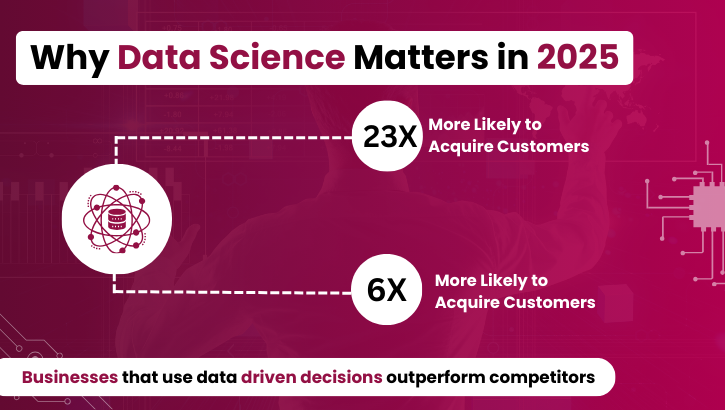
Pro Insight: Businesses using data-driven strategies are 23x more likely to acquire customers and 6x more likely to retain them (McKinsey Research).
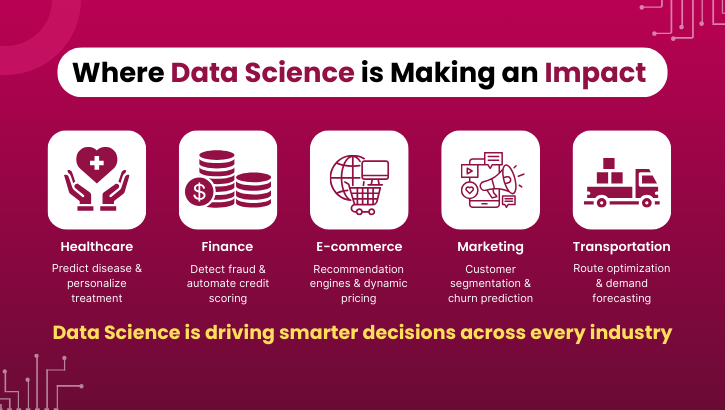
Data Science is not limited to tech giants, it’s being used across every sector. Here’s how industries are using data to gain a competitive edge:
Healthcare:
Finance:
E-commerce:
Marketing:
Transportation:
Action Tip: Start by identifying which department in your business produces the most data (sales, operations, marketing). Launch a pilot project, for example, predicting monthly sales or segmenting customers before scaling company-wide.
People often confuse Data Science with Machine Learning, but they are not identical. Think of Data Science as the entire process, and Machine Learning as one of its most powerful tools.
| Factor | Data Science | Machine Learning |
|---|---|---|
| Definition | The end-to-end process of collecting, cleaning, analyzing, and visualizing data | Focused on creating algorithms that can learn patterns and make predictions |
| Focus | Covers data collection, wrangling, visualization, and communication of insights | Focuses primarily on model building and training |
| Tools | SQL, Python, R, Tableau, Power BI | TensorFlow, Scikit-learn, PyTorch, Keras |
| Output | Reports, dashboards, business recommendations | Predictive models, classifications, clustering outcomes |
Quick Analogy: Data Science is like preparing a meal you plan, shop, cook, and serve. Machine Learning is just the cooking part.
Breaking into Data Science requires a mix of technical, analytical, and business skills. Let’s look at them in detail:
A solid foundation in programming is non-negotiable.
Example: A data scientist might use Python to clean raw sales data, SQL to pull customer records from a database, and R to run statistical tests on churn probability.
Mathematics forms the backbone of all data models.
Example: Before launching a new marketing campaign, a data scientist uses A/B testing to determine which campaign version performs better statistically.
Communicating insights is as important as finding them.
Example: A retail company can visualize sales trends by region, helping managers quickly spot underperforming areas.
ML turns data into predictions and automation.
Example: E-commerce companies use ML models to recommend products based on browsing and purchase history increasing conversion rates by up to 30%.
The most overlooked but critical skill knowing how data impacts ROI, KPIs, and company strategy.
Example: It’s not enough to say “sales will drop 5% next month.” A data scientist should also recommend why it’s happening (low customer retention) and how to fix it (launch targeted campaigns).
Career Tip: Employers prefer candidates with hands-on projects over just certifications. Build a GitHub portfolio with at least:
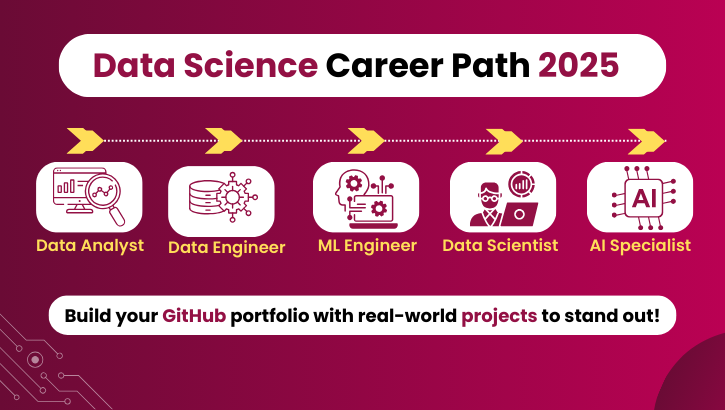
Data Science is one of the fastest-growing career fields, offering multiple job roles for different interests and skill levels.
Pro Tip: Along with technical skills, invest in communication skills. The ability to explain complex insights to non-technical stakeholders makes you stand out.
Netflix is a global leader in using data science for personalization.
Business Insight: Even small businesses can replicate this by using AI-driven recommendation tools for e-commerce or content websites.
Get Started Today! Contact Us to schedule a free consultation and discover how Data Science can increase your revenue and efficiency.
Data Science is not just a buzzword it’s a powerful business enabler and a lucrative career path. Whether you are a business owner, a student, or a professional, 2025 is the perfect time to invest in Data Science skills or solutions.