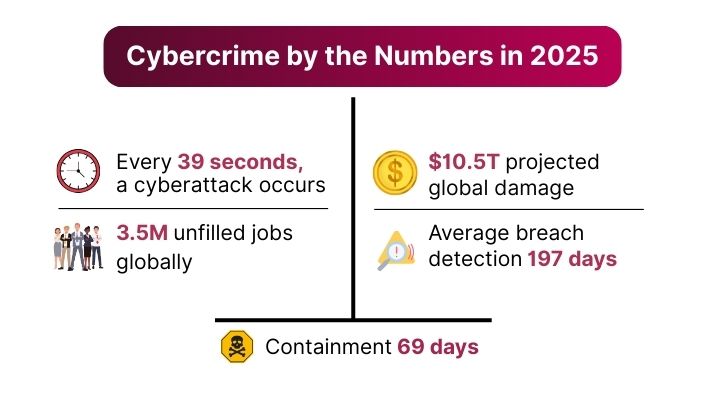
Every 39 seconds, a cyberattack happens somewhere in the world. By 2025, cybercrime damages are projected to reach an astronomical $10.5 trillion annually (CybersecurityAsia, 2025). Moreover, organizations face long detection and containment windows: on average, companies take 197 days to identify a breach and 69 more days to contain it varonis.com
Now here’s the real question: Who will stop it?
My own journey into ethical hacking began in 2008 at Coventry University, where I made two of the best decisions of my career: choosing Ethical Hacking and Internet & Information Security as core papers. My dissertation on Wireless Hacking and Intrusion Detection opened my eyes to just how fragile and fascinating our digital world truly is.
That moment was a turning point for me. And today, it’s the same turning point for thousands of young professionals. Because the same skill can either destroy or defend. And in 2025, those who choose to defend will unlock some of the highest-paying, most future-proof careers in technology.
Cybersecurity is fundamentally about safeguarding systems, networks, and data from attacks. Even more critical, it's about preserving trust, the confidence that your bank, your personal data, and your digital tools are secure and dependable.
By 2025, cybercrime is projected to cost the global economy USD 10.5 trillion annually, making it a far-reaching threat to global prosperity.
And the damage does not stop at cost: companies take an average of 197 days to detect a breach and 69 days to contain it. These gaps give attackers months of unchecked access.
These are not just cold numbers. They are urgent reminders that cybersecurity goes beyond technical defense, it is a mission to protect the digital lives and trust of millions.
Yet, even as attacks grow in scale and sophistication, the world faces a staggering shortage of talent. Today, there are more than 3.5 million unfilled cybersecurity jobs worldwide, a gap that has remained stubbornly high for years. World Economic Forum
This is why cybersecurity matters in 2025 not just as a shield against digital threats, but as one of the most urgent and rewarding career paths. Every breach creates not just a problem, but an opportunity for skilled professionals who can stop it.
Cybersecurity professionals are among the most sought-after talent in today’s tech landscape. The demand isn't just high, it’s surging. Learn what’s at stake for your career.
· India
Ethical hacking isn’t niche, it’s increasingly mainstream. According to Glassdoor, the average annual base salary for ethical hackers in India is around ₹5.5 lakh, with seasoned professionals in the 90th percentile earning up to ₹25 lakh per year (eSentire).
· United States
In the US, mid-level cybersecurity roles like penetration tester or security engineer command averages between $100,000 and $175,000. Top specialists—such as product security engineers, threat hunters, and red team experts—regularly earn over $200,000, while CISOs and other senior leaders can see compensation reach $750,000.
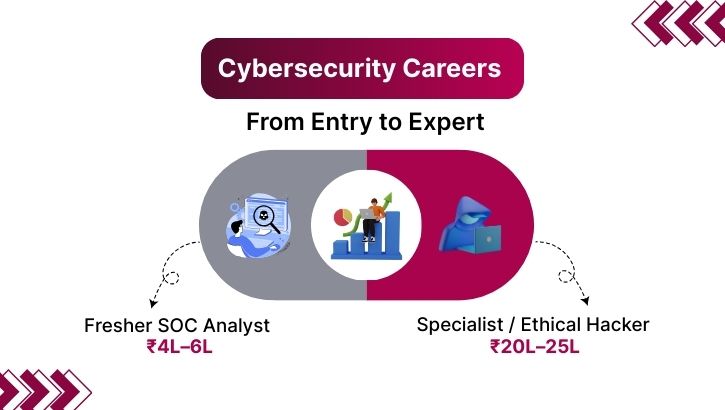
A fresher in India may begin as a SOC analyst earning ₹4–6 lakh annually, monitoring alerts and escalating incidents. With three to five years of experience, the same professional can move into roles like penetration tester or cloud security engineer, easily doubling their salary and gaining access to global opportunities.
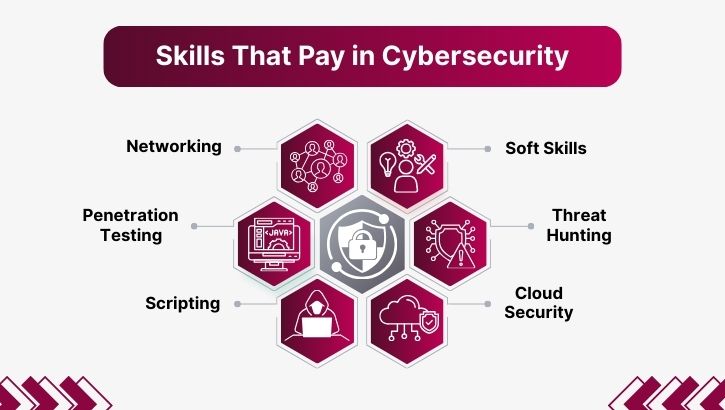
1. Networking and Operating Systems
Every cybersecurity career starts with a solid grasp of how data flows through networks and how operating systems function. Without this foundation, it’s impossible to understand where vulnerabilities exist or how attackers exploit them.
According to (ISC), 40% of recruiters say networking fundamentals are the #1 priority when hiring entry-level talent. That means being confident in concepts like TCP/IP, DNS, DHCP, routing, and switching is not optional, it is the minimum requirement.
2. Scripting and Automation
Cybersecurity is a race against time, attackers automate their exploits, so defenders must automate their defenses. That’s where scripting comes in.
According to LinkedIn’s 2024 workforce report, cybersecurity job postings requiring Python grew 29% year-over-year, making it one of the hottest skill upgrades for freshers and mid-level professionals.
3. Penetration Testing and Vulnerability Management
If networking and scripting are the foundations, penetration testing is the battlefield. Cybersecurity professionals in this role think like attackers probing for weaknesses but with the mission to fix them before criminals exploit them.
According to HackerOne, ethical hackers earned over USD 300 million in bug bounty rewards in 2023, proving the demand for skilled penetration testers is not just corporate but global.
4. Cloud Security
As more than 90 percent of enterprises move workloads to the cloud, the need for professionals who can secure cloud environments has become critical. Cloud security is no longer a niche, it is now one of the highest-paying areas in cybersecurity.
According to Gartner, through 2025, 99 percent of cloud security failures will be caused by customer misconfiguration, not by cloud service providers. Gartner
The (ISC) Cybersecurity Workforce Study also found that cloud security is one of the top three most in-demand skills for cybersecurity employers worldwide.
5. Application Security
Every modern business runs on applications such as web apps, mobile apps, and APIs. That makes application security one of the most critical areas in cybersecurity. Weaknesses in code are often the easiest way for attackers to break in.
The OWASP Top 10 continues to highlight the most dangerous and common flaws in web applications, with injection and broken access control consistently ranking at the top OWASP.
According to a report by Veracode, 83 percent of applications have at least one security flaw during their initial scan, showing how widespread these issues are and how essential application security professionals have become. Veracode.
6. Threat Hunting and Incident Response
Prevention is never enough in cybersecurity. Breaches happen, and when they do, organizations need experts who can detect, contain, and eliminate threats quickly. This is where threat hunting and incident response come in.
According to IBM’s 2023 Cost of a Data Breach Report, organizations with a strong incident response team and regularly tested IR plans saved an average of USD 2.66 million per breach compared to those without. IBM
The SANS Institute highlights that effective threat hunting reduces dwell time the period attackers remain undetected which averages over 200 days in many breaches. SANS
7. Soft Skills: Communication and Problem-Solving
Technical expertise may get you the interview, but soft skills often decide who gets the job. In cybersecurity, professionals must explain complex risks in plain language, coordinate with cross-functional teams, and stay calm under pressure when incidents strike.
According to the (ISC) Cybersecurity Workforce Study, employers consistently report that communication and analytical thinking are among the top non-technical skills missing in candidates. Strong problem-solving ability and teamwork are what transform a good technician into a trusted cybersecurity professional.
For freshers, this means practicing not only the technical labs but also presenting your findings, writing clear documentation, and collaborating in group projects. These skills prove you can operate in the real world, not just in a classroom or a test environment.
Certifications That Employers Value
Certifications remain one of the fastest ways to prove your credibility in cybersecurity. Employers often use them as benchmarks to shortlist candidates, especially for entry-level roles. The right certification can accelerate your career by validating both your knowledge and commitment.
Entry-Level Certifications (Perfect for Freshers)
· CompTIA Security+
· Cisco CyberOps Associate
· Certified SOC Analyst (CSA)
Intermediate Certifications (For 2–5 years experience)
· CEH (Certified Ethical Hacker)
· GIAC Security Essentials (GSEC)
· Microsoft Security, Compliance, and Identity Fundamentals
Advanced Certifications (For senior professionals and specialists)
· OSCP (Offensive Security Certified Professional)
· CISSP (Certified Information Systems Security Professional)
· CISM (Certified Information Security Manager)
According to Pearson VUE’s Value of IT Certification report, 91 percent of employers say certifications play a critical role in hiring decisions, and professionals with certifications are more likely to receive promotions and salary increases.
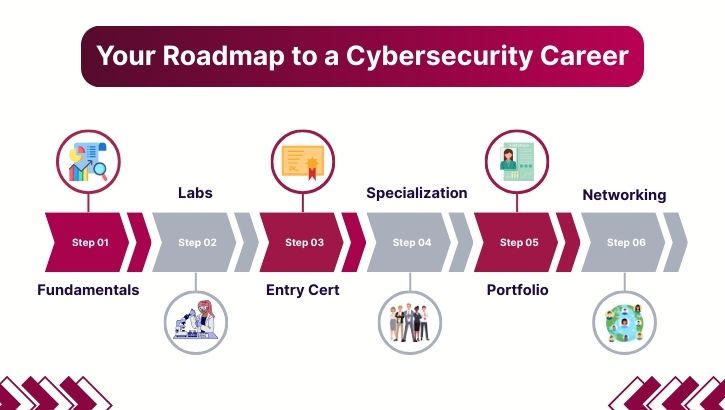
Breaking into cybersecurity may feel overwhelming, but the path becomes clearer when you take it step by step. Employers want proof that you can combine knowledge with hands-on practice. Here is a practical roadmap to get started in 2025:
Step 1: Build Strong Fundamentals
Learn networking basics (TCP/IP, DNS, routing) and operating systems (Linux, Windows). These are the building blocks every cybersecurity professional relies on.
Step 2: Practice with Labs and Challenges
Set up a virtual lab at home using tools like VirtualBox or VMware. Explore capture-the-flag (CTF) challenges and platforms like Hack The Box or TryHackMe to apply what you learn.
Step 3: Earn Your First Certification
Start with an entry-level credential such as CompTIA Security+ or Certified SOC Analyst. This demonstrates seriousness to employers and gets you noticed for internships and junior roles.
Step 4: Specialize in a Path
Choose a focus area — cloud security, penetration testing, SOC analyst, or application security. Begin working on intermediate certifications (CEH, GSEC, or cloud-specific credentials).
Step 5: Showcase Your Work
Build a portfolio. Document lab exercises, bug bounty findings, or open-source contributions. Recruiters value demonstrable skills as much as degrees.
Step 6: Keep Learning and Networking
Join cybersecurity communities, attend webinars, and connect with professionals on LinkedIn. Networking often opens doors to roles that are never advertised publicly.
According to the World Economic Forum, more than 3.5 million cybersecurity jobs are unfilled globally. This gap is not due to a lack of demand, but a shortage of skilled professionals.
When I began my own journey in Ethical Hacking and Cybersecurity more than a decade ago, I was fascinated by the duality, the same knowledge that could break the systems could also protect them. That choice, to defend rather than exploit, shaped my career and continues to shape the careers of thousands of professionals today.
Cybersecurity in 2025 is more than a technical skill. It is a responsibility. Every breach headline we read is a reminder that businesses, governments, and individuals depend on professionals who can stand guard in the digital world.
For freshers and job seekers, this is more than an opportunity, it is an invitation. The demand is massive, the salaries are rewarding, but the real value lies in the trust you help build.
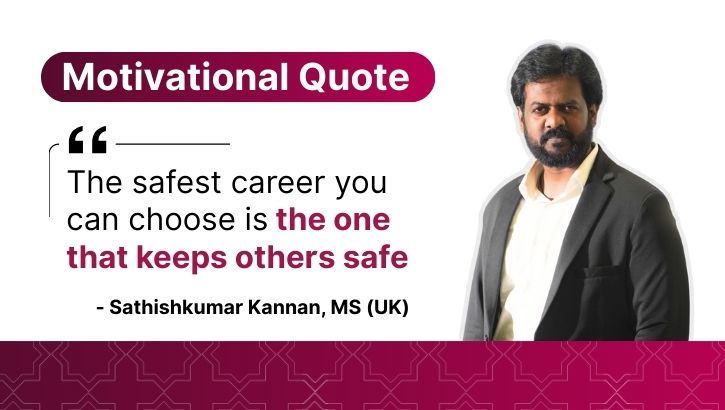
The truth is simple: the safest career you can choose is the one that keeps others safe. Cybersecurity is that career.