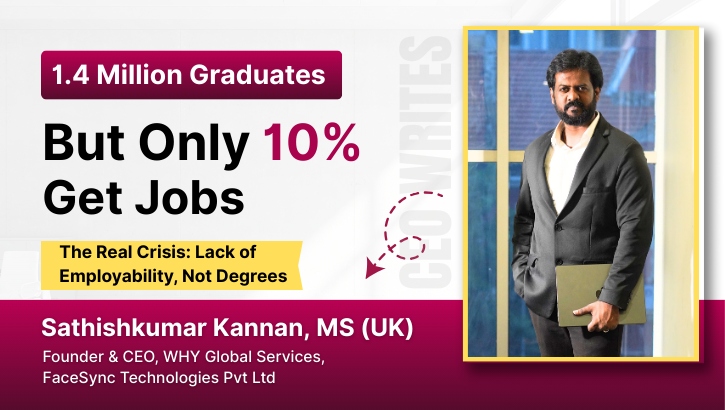
India produces over 1.4 million graduates annually, across engineering and various other streams, yet the numbers belie a deeper crisis. As MR Jayaram, president of the Education Promotion Society for India (EPSI), starkly puts it, “Every year, around 14 lakh students graduate, but only 1.4 lakh secure placements. That means 90% of our youth remain unemployed.”
What’s more, the Unstop Talent Report 2025 reveals that a staggering 83% of engineering graduates are still jobless or without internship offers, and even among business school grads, 46% remain unemployed.
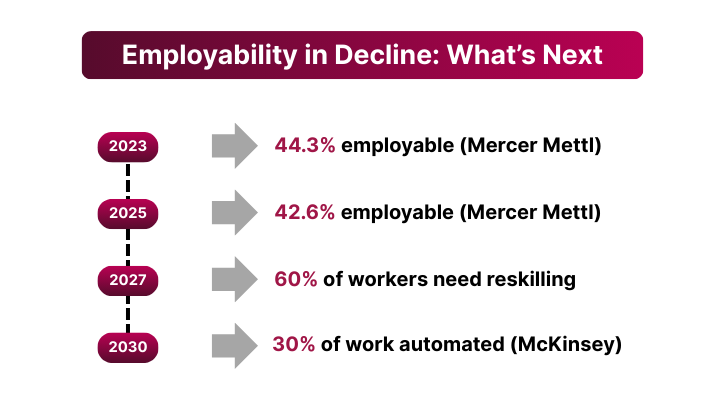
The Graduate Skill Index 2025 by Mercer Mettl places overall graduate employability at just 42.6%, marking a decline from 44.3% in 2023. The bright spot? Only 46% of graduates meet the bar for AI & ML roles but non-technical employability, such as in sales or HR, trails at 43.5%.
This gap isn’t about degrees, it’s about relevance. Employers consistently report that freshers lack critical soft skills: communication, problem-solving, and adaptability rank among the top deficits.
For decades, degrees were seen as the golden ticket. Score good marks, collect your certificate, and a job would follow. But in 2025, that equation has broken down.
The world of work has transformed:
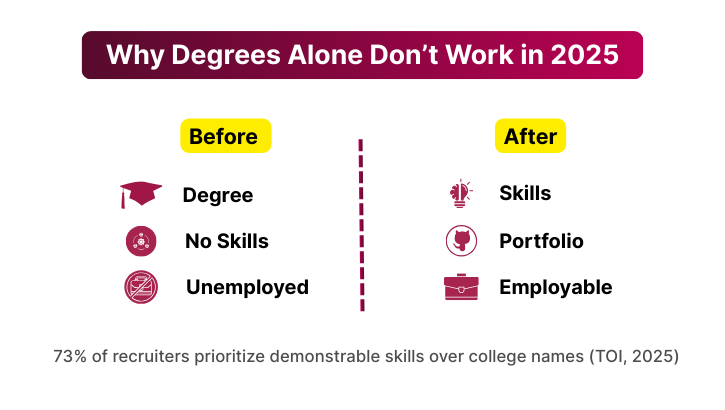
Employability isn’t about degrees, it’s about readiness. Companies aren’t asking whether you’ve passed exams; they’re asking whether you can perform from Day One.
Employability today means being able to:
And this is where most freshers stumble. They graduate with theory but without application, with certificates but no demonstrable proof of skills.
That employability gap is the #1 reason freshers are struggling to get hired in 2025.
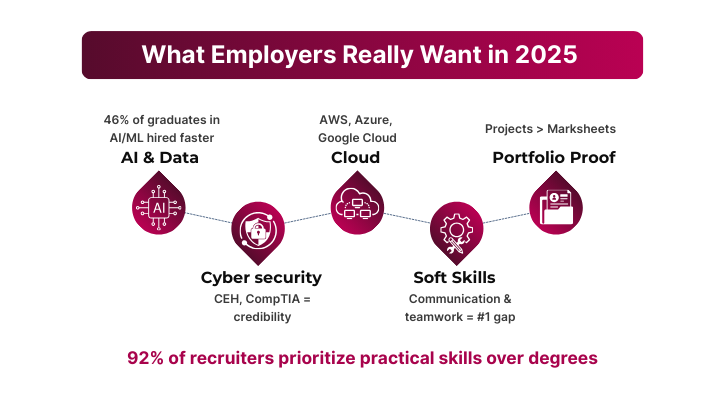
When I speak with CEOs, CTOs, and hiring managers, they all echo the same checklist. The hiring bar has shifted. Employers in 2025 are looking for:
Notice what’s missing? “Marks” and “Degrees” didn’t even make the list.
The good news? This struggle is not permanent. Employability is a skillset, and any fresher can crack the code by following a few powerful steps:
Here’s the hard truth: in 2025, degrees don’t guarantee jobs—skills do. The job market doesn’t reward generalists anymore; it rewards those who can solve today’s problems with tomorrow’s tools.
Think about it:
As a fresher, this can feel overwhelming—but here lies your biggest opportunity. You don’t need to master everything. What employers want is depth, not breadth. Pick one or two high-demand skills, go deep, and prove you can apply them in the real world.
Here’s the difference:
Who do you think gets the call?
Imagine hiring a chef who shows you their degree but has never cooked a meal. Would you trust them? That’s exactly how employers feel about freshers who only bring marksheets.
In 2025, your portfolio is your career passport. It’s not enough to say you know coding, design, or marketing you must show it. A strong portfolio proves two things: skill and initiative.
What can you showcase?
The secret? Your projects don’t have to be massive. Even a small chatbot, a simple e-commerce website, or a local business marketing campaign shows more initiative than a blank portfolio. Employers don’t just want to see that you learned something, they want proof that you can apply it.
The takeaway: Portfolios speak louder than resumes. Start small, build often, and let your work answer the employer’s question: “Can this fresher actually deliver?”
In a noisy job market, certifications are your credibility boosters. They signal to employers: “This candidate didn’t just read about it—they went through structured training and passed industry standards.”
For instance:
But here’s the truth: certifications alone won’t land you a job. They’re multipliers, not magic. Combine them with projects in your portfolio, and you create a powerful one-two punch: “I know the theory, and here’s proof I applied it.”
The best part? Many top certifications are now affordable or even free. Platforms like Coursera, AWS Free Tier, and HubSpot Academy make it accessible for anyone willing to learn.
The takeaway: Certifications don’t replace skills, they validate them. If your resume says, “Cloud Computing,” and your profile shows “AWS Certified,” employers instantly know you’re serious.
If technical skills are the engine, soft skills are the steering wheel. Without them, you might move, but you’ll crash quickly.
Employers across India and globally agree: communication, teamwork, and adaptability are the top skills freshers lack. Why? Because most education systems train students to pass exams, not to present ideas, collaborate, or think on their feet.
Think about the workplace:
The good news? Soft skills are trainable.
The takeaway: technical skills open the door, but soft skills decide how far you go. Master them early, and you’ll stand out, not just as an employee, but as a future leader.
You can’t learn swimming by reading about water. The same applies to careers, you can’t learn jobs by only reading textbooks. That’s why internships and OJT are game changers.
Employers love candidates with real exposure—even short internships count. Why? Because it proves you’ve worked with deadlines, tools, teams, and real-world problems. A fresher with six months of OJT looks 3x more employable than one with only classroom learning.
Don’t wait for the “perfect” internship. Start anywhere, startups, NGOs, part-time gigs, even freelancing. What matters is that you build practical experience and document it. Add it to your portfolio, collect testimonials, and highlight the skills you learned.
Internships build both hard skills (coding, marketing, analytics) and soft skills (teamwork, communication, problem-solving). That combination is exactly what employers crave.
The takeaway: Learning by doing beats learning by reading. Stack as many internships or OJT experiences as you can, and you’ll not only get shortlisted, you’ll get hired faster.
Companies don’t hate hiring freshers, they hate hiring unprepared talent.
The #1 reason freshers struggle is not a lack of opportunities, but a lack of readiness.
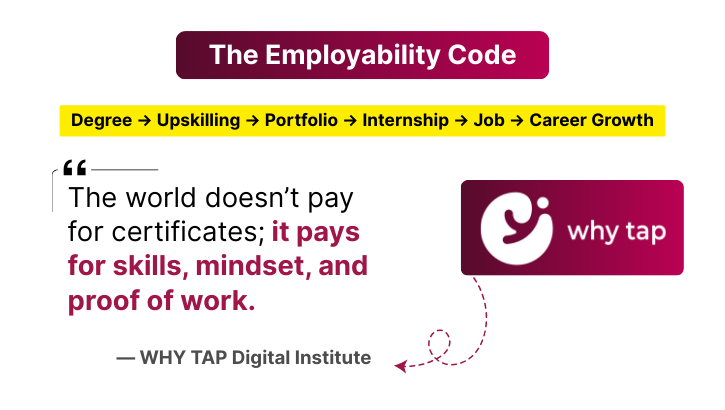
The world doesn’t pay for certificates; it pays for skills, mindset, and proof of work.
My advice is simple: Don’t just chase degrees, chase employability. Don’t wait for opportunities, create them. And remember, in 2025 and beyond, your portfolio, your adaptability, and your ability to learn fast are your strongest weapons.
Explore WHY TAP’s Programs to build your skills and land your dream job! Learn More