




Table of Contents
- 1.
- 2.
- 3.
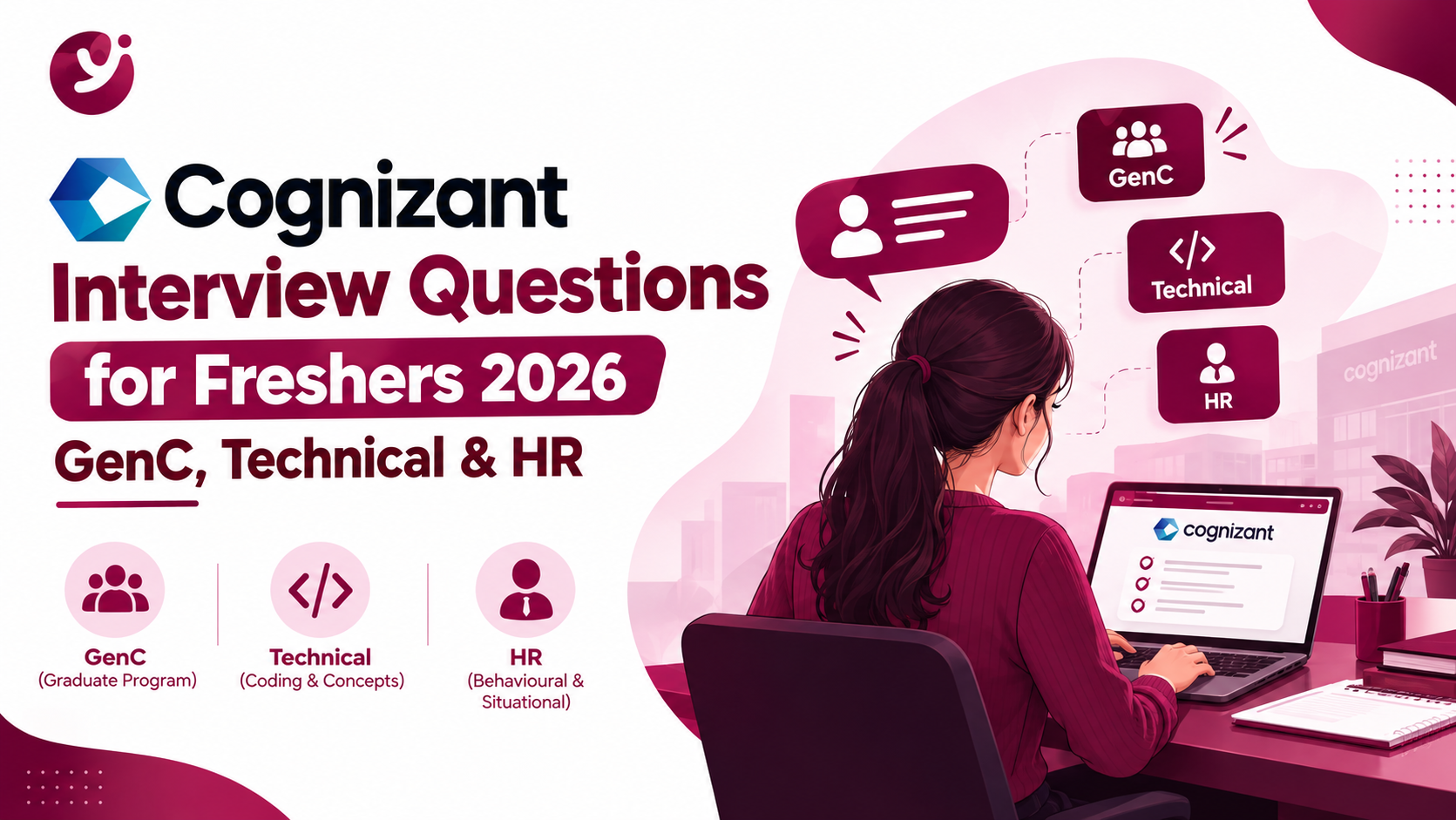
Searching for Cognizant interview questions? This preparation guide focuses on the concepts you can actually explain in an interview. Instead of memorising a random question bank, practise answers, write working code where relevant and understand your project decisions. The most useful topics depend on the role, technology stack and hiring programme you have applied for.
If you are a fresher applying for GenC and entry-level technology roles, begin with the exact job description. The questions below are sample preparation prompts, not a promise of what an interviewer will ask.
This guide brings together role-specific practice questions, clear answers and interview preparation steps. The examples help you practise; your invitation and job description remain the authority on current assessments.
Technical Interview Questions for Cognizant Freshers
When comparing Cognizant interview questions, always check which advertised role the advice is about; a genuine candidate experience may not match your own selection pathway.
For Cognizant interview questions, begin by matching the job description to your resume. A software role may need programming, database and debugging skills, whereas an operational role may test communication and practical decision-making. List the three most relevant competencies and prepare a concise definition, one example and one limitation for each. Use the same method for your final-year project. Describe the problem, architecture, your contribution, testing and one choice you would improve. An interviewer can follow up on any claim made in your answer, so explain work you actually performed. Avoid confusing online candidate anecdotes with formal hiring rules. Good Cognizant interview questions preparation is a repeatable study process, not a collection of memorised sentences.
Preparation example: Cognizant's GenC pathway can test communication, aptitude or technical skills according to the role. For an SQL-focused assessment, explain why LEFT JOIN preserves rows without a match and test your query with an empty related table. For Java-oriented assessment, show inheritance and method overriding with working classes. Always connect your explanation to a project you genuinely built, and identify one failure case you have tested.
Cognizant's GenC careers page describes application, initial screening, role-dependent assessments, interviews and result. Assessments may evaluate communication, aptitude and technical skills; not every applicant completes every stage.
What is the difference between an interface and an abstract class?
In Java, an interface defines a contract and may contain default and static methods. An abstract class can hold instance state, constructors and shared implementations. Select an interface to specify capabilities across classes and an abstract class when related subclasses share implementation. In preparing for Cognizant interview questions, this distinction is useful.
How do SQL INNER JOIN and LEFT JOIN differ?
INNER JOIN returns only records that match the join condition in both tables. LEFT JOIN retains all left-side rows and fills right-side columns with NULL where This example strengthens Cognizant interview questions preparation. no match exists. Explain the output with a Students and Enrolments example.
What is polymorphism in Java?
Polymorphism lets code work through a common type while behaviour vari Check this principle against Cognizant interview questions examples.es by implementation. For example, a Shape reference can call draw() on Circle and Rectangle objects, with each object executing its own method.
Important Technical Concepts and Sample Answers
[INFOGRAPHIC IMAGE 1: Three-card visual showing top technical topics for Cognizant roles, each with a brief definition and example. Alt text: 'Cognizant technical interview preparation topics'. Upload a designed infographic in Sanity.]
To deepen Cognizant interview questions, select one technical concept from the questions above and build a small example. Explain the normal case, then challenge it with an unusual input or changed requirement. For instance, "What is the difference between an interface and an abstract class?" should prompt a clear definition and practical demonstration. For "How do SQL INNER JOIN and LEFT JOIN differ?", compare two alternatives and explain why one fits a particular situation. Finally, use "What is polymorphism in Java?" to practise explaining your thinking aloud in simple language. Record misconceptions in a study notebook and revisit them after solving another task. When a technical fact depends on the programming language or product, say so. This helps the reader separate broadly applicable ideas from language-specific behaviour.
These concepts help you respond to follow-up questions, rather than reciting isolated textbook definitions. Explain each answer in your strongest relevant programming language or technical discipline.
Explain your final-year project architecture.
Begin w Apply the same reasoning to Cognizant interview questions.ith the user problem, then describe the frontend, backend, database, data flow and deployment. State which components you built and one design trade-off. Interviewers can probe any techno Use this scenario when practising Cognizant interview questions.logy named on your resume.
How would you find duplicate values in an array?
Use a hash set to track previously observed values. If an element is already in the set, record it as dup A clear explanation improves Cognizant interview questions preparation.licate. Expected time is O(n) with O(n) extra space, assuming average-case hash operations.
What is exception handling?
Exception handling handles runtime failures through constructs such as try, catch and finally. For example, a program can catch an invalid-number exception and show a useful message rather than terminate unexpectedly.
Cognizant Coding, Practical Questions and Preparation Strategy
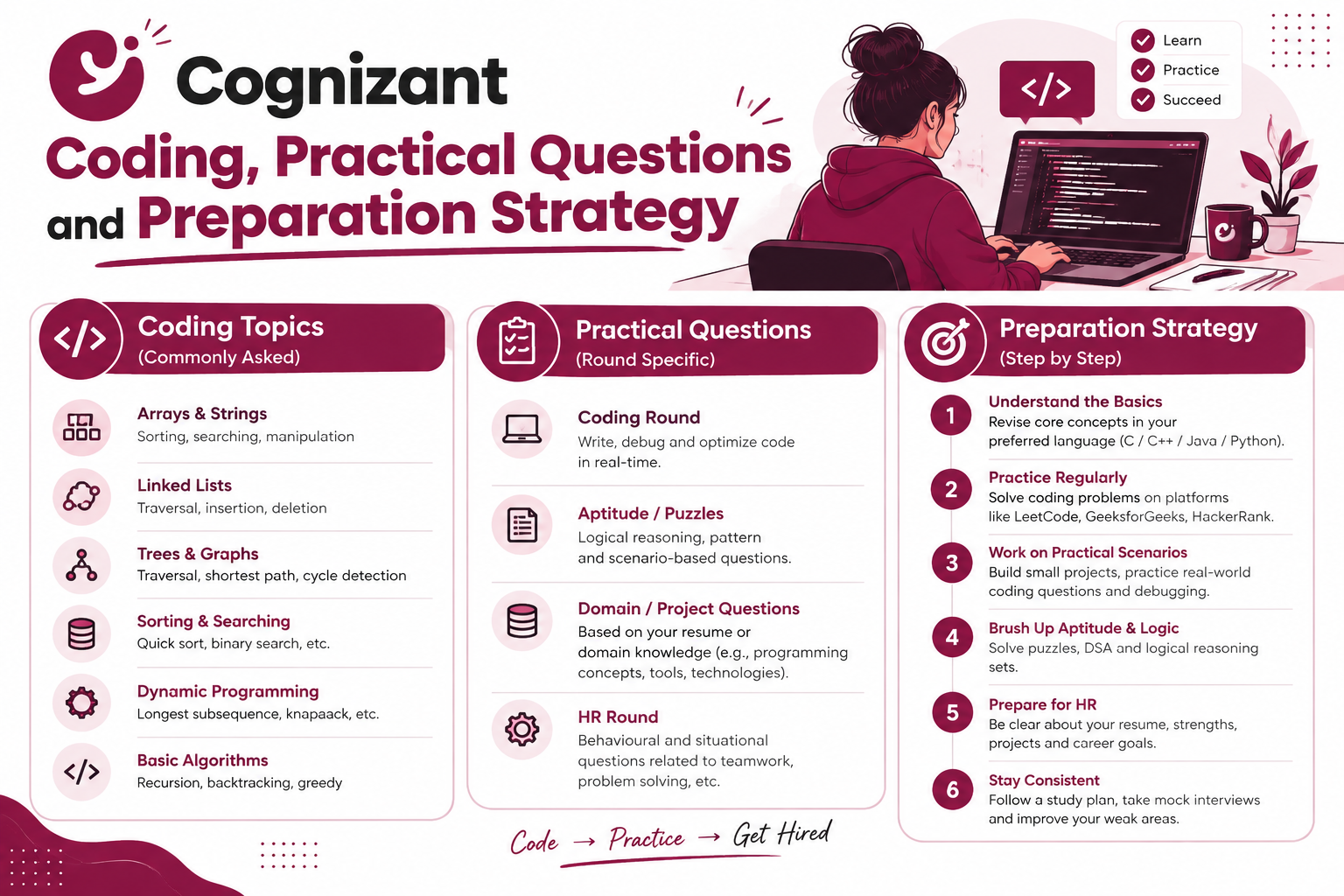
Prepare the tasks relevant to your job family: algorithms and SQL for software roles, or troubleshooting, equipment, safety and domain examples for engineering roles. Explain assumptions before attempting a solution. Prepare a concise self-introduction and a two-minute project walkthrough. For Chennai-specific searches, verify the interview location from the invitation; never assume a special Chennai question paper.
For a GenC-oriented technical example, compare an SQL query using INNER JOIN with one using LEFT JOIN. Draw two small tables and manually work out the returned rows before writing the statement. Ask what should happen when a department has no employees. This helps connect database theory to an observable result.
Another useful exercise is explaining one final-year project to a nontechnical interviewer first and a developer second. Keep the problem and outcome consistent, but change the level of detail: begin with user need, then add data flow, validation, database schema and test cases. State the components you personally built.
For Cognizant interview questions, practise problem solving with an explicit test strategy. Restate the requested result, identify assumptions and choose a simple approach before optimizing. Coding candidates should test empty input, duplicates, boundary values and unexpected characters. For SQL queries, consider missing relationships, groups with no matching rows and the difference between null values and zero counts. If the role requires engineering calculations or infrastructure support, use appropriate limits, units and diagnostic evidence instead. Compare at least two possible approaches, explaining readability, efficiency, reliability or safety. A corre Test this idea while studying Cognizant interview questions.ct output is only the first step; interviewers can also ask why the result is correct and how you know it would remain correct for unseen cases.
Two More Questions Worth Practising
What is normalization in databases? — Normalization organizes tables to reduce unnecessary repeated data and update anomalies. Splitting students and course registrations into related table Revisit this concept alongside Cognizant interview questions.s illustrates why foreign keys matter.
Why does the skill cluster matter? — A Python/SQL-oriented assessment can emphasize different questions from a Java-oriented one. Follow the exact role, assessment invitation and genuine skills listed on your resume instead of treating candidate anecdotes as universal rules.