Introduction
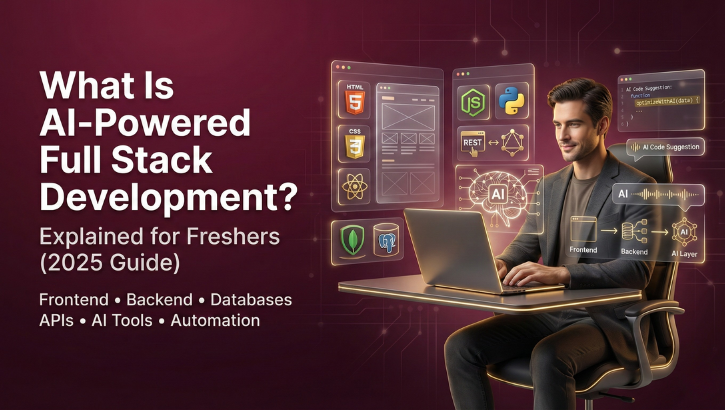
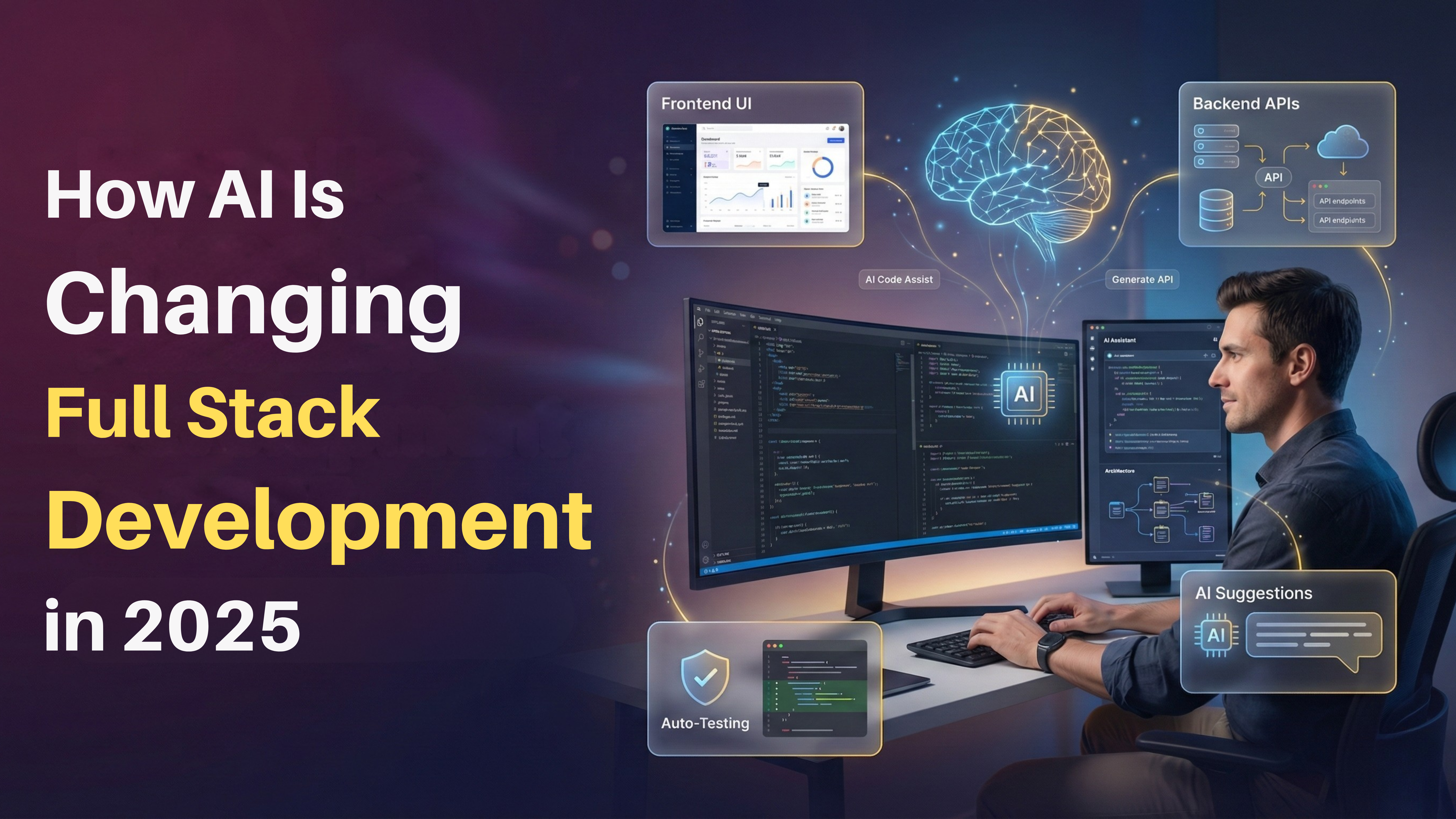
The tech industry is changing faster than ever. Traditional Full Stack Development is still in huge demand, but a new, more powerful version has entered the market AI-Powered Full Stack Development.
In 2025, companies want developers who can code, build products faster, ship projects quickly, and use AI tools to boost productivity.
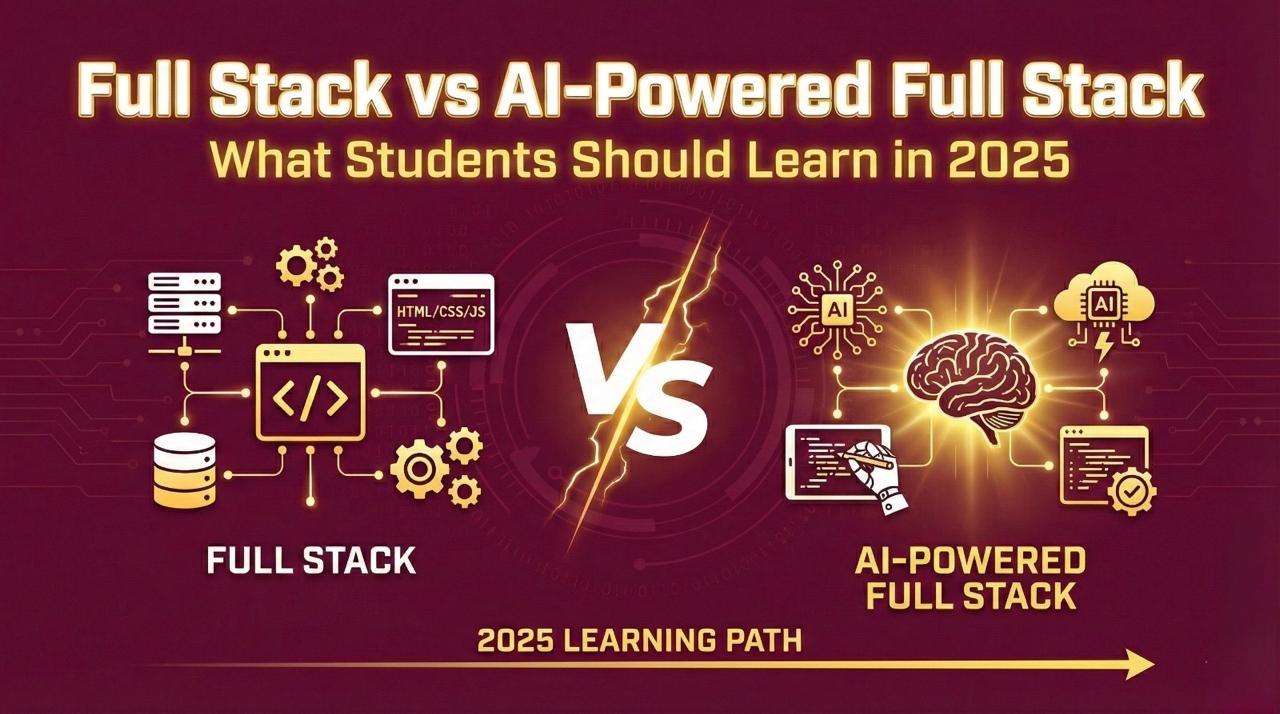
Below is a simple comparison to help students understand which path suits them better Full Stack vs AI-Powered Full Stack.
| Category | Traditional Full Stack Developer | AI-Powered Full Stack Developer | ||||||||
|---|---|---|---|---|---|---|---|---|---|---|
| Primary Skills | Coding Speed | Debugging | Learning Difficulty | Development Time | Documentation | Project Complexity | Industry Demand 2025 | Salary Range (India) | Who Should Learn? | Future Scope (2025–2030) |
| HTML, CSS, JS, React, Node, MongoDB | Normal | Manual debugging | Moderate to high | Longer | Written manually | Limited to developer’s experience | High | ₹3.5–6 LPA (fresher) | Students who prefer manual coding | Strong |
| MERN + AI tools (ChatGPT, Copilot, Cursor, Claude, Replit) | 3–5x faster with AI assistance | AI auto-debug & suggestions | Easier (AI explains code & fixes errors) | Much shorter (AI generates large code blocks) | Auto-generated by AI | Can build advanced apps with AI help | Very high (+40% growth) | ₹5–8 LPA (fresher) | Students who want faster results & smarter development | Dominant & highest-growth path |
Both fields offer strong opportunities, but AI-powered full stack developers have a clear advantage.
Traditional Full Stack Developer Job Roles
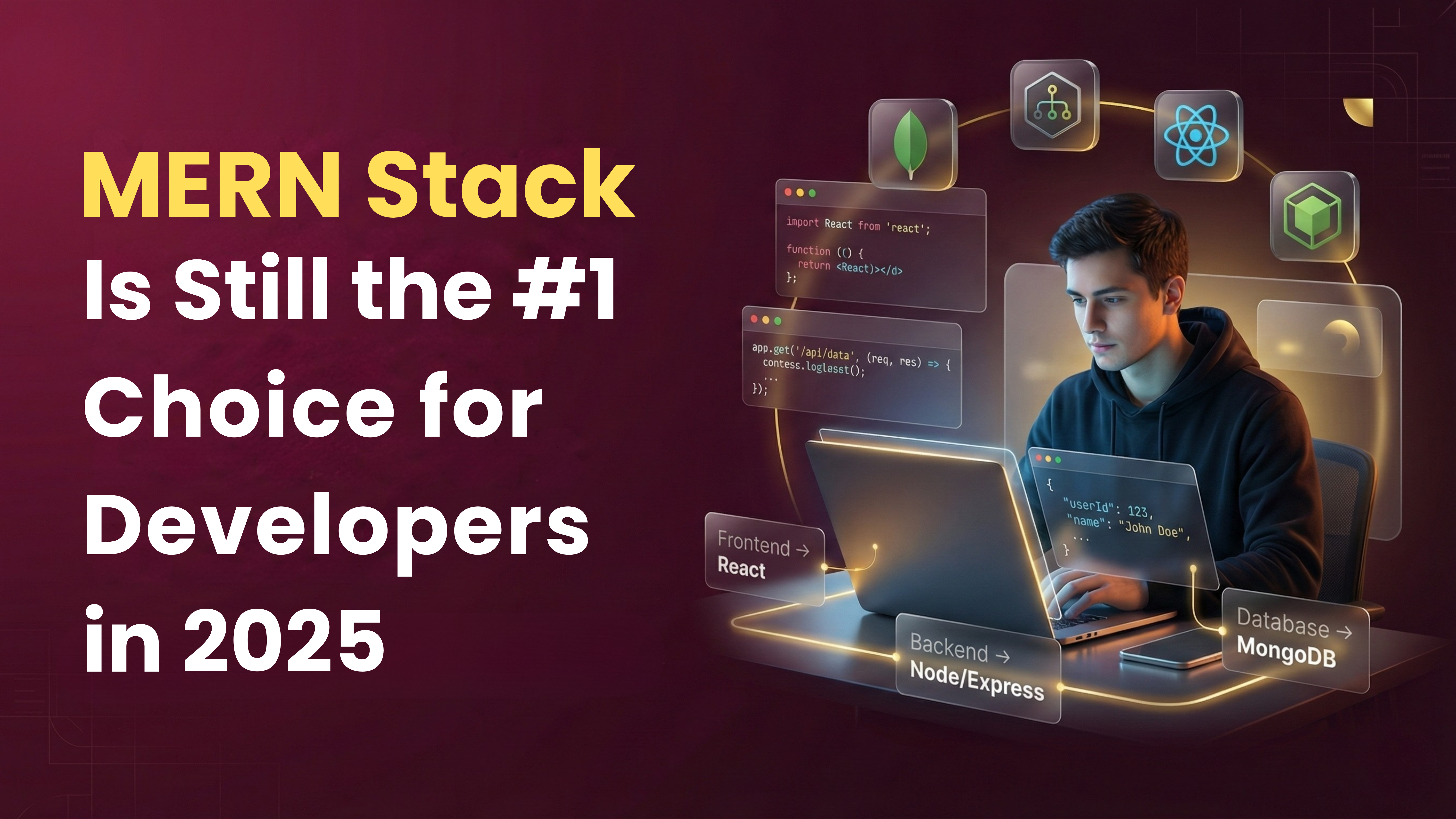
A MERN Developer works with the MERN Stack: MongoDB, Express.js, React, and Node.js.
They build complete web applications using JavaScript for both front-end (React) and back-end (Node/Express).
They handle everything from designing the UI to creating APIs and managing the database.
In short:
MERN Developer = Full stack developer who specializes in the MERN technology stack.
A JavaScript Developer uses JavaScript to build websites or web applications.
They may work on:
Since JavaScript runs everywhere, this role focuses on creating fast, responsive, interactive applications.
In short:
They build apps using JavaScript across different platforms.
A Back-End Developer works on the server side of applications.
They manage:
They make sure everything behind the scenes functions smoothly and securely.
In short:
They build the brain of the application.
A Front-End Developer works on the visual part of websites and apps.
They build user interfaces using:
They focus on design, layout, and making the experience smooth and user-friendly.
In short:
They create what users see and interact with.
A Web Application Developer builds web-based software rather than simple websites.
Examples:
They work on both front-end and back-end but are focused mainly on building complete functional web apps.
In short:
They develop software that runs in the browser.
A Software Engineer designs, builds, tests, and maintains software systems.
They may work on:
They have a broader role compared to developers, often solving complex problems, and designing scalable systems.
In short:
They are all-round problem solvers who build complex software solutions.
Industries Hiring:
IT companies, product startups, SaaS companies, digital agencies, e-commerce brands.
These are new-age roles emerging rapidly:
An AI-Integrated Full Stack Developer builds full stack applications with AI features built directly into them.
They combine MERN stack skills with AI models, APIs, and integrations.
They work on:
In short:
They build full stack apps + integrate AI intelligence into them.
An AI-Assisted MERN Developer uses AI tools (Copilot, Cursor, ChatGPT) to speed up MERN stack development.
They write code with AI assistance, debug faster, and build projects more efficiently.
They use AI for:
In short:
MERN developer who codes 3–5x faster using AI tools.
An AI Automation Engineer builds systems that automate tasks using AI workflows.
They automate:
They often create AI-driven dashboards and automation pipelines.
In short:
They automate business processes using AI, APIs, and full stack code.
A Prompt Engineer for coding specializes in writing high-quality prompts that make AI generate accurate, clean, optimized code.
They:
In short:
They tell AI exactly how to write the code, like a technical director.
An AI Tooling Developer builds tools, scripts, and utilities that improve developer productivity.
Examples:
In short:
They build tools that help developers code faster using AI.
This role blends traditional software engineering with AI-powered enhancements.
They use AI to:
In short:
They are traditional software engineers but supercharged with AI.
This developer builds APIs that interact with AI models.
They work on:
They need strong backend + LLM integration knowledge.
In short:
They build APIs that connect applications to AI intelligence.
A Junior AI Engineer supports AI teams by building:
They are not full ML engineers, but they understand how to integrate AI models into applications.
In short:
A beginner-friendly role for developers who can integrate AI but don’t build the models.
Industries Hiring:
Everything above + emerging sectors:
FinTech, HealthTech, EdTech, MediaTech, Automation Startups, AI Startups.
Why is demand rising?
What Companies Expect from a Traditional Full Stack Developer
Still valuable. Still in demand.
But companies say this is now the minimum requirement.
What Companies Expect from an AI-Powered Full Stack Developer
Ability to use AI tools daily
* Build features 3–5x faster
* Debug with AI assistance
* Write documentation using AI
* Build larger, more complex projects
* Understand AI integrations (basic)
* Follow modern AI workflows in engineering teams
In short:
Companies want developers who code fast, deliver fast, and understand AI-driven workflows.
To be practical:
If a student learns only Traditional Full Stack → They will still get jobs
But may face:
If a student learns AI-Powered Full Stack → They become future-ready
Benefits include:
The best option for 2025?
Learn MERN + AI-Powered Full Stack together.
This is exactly what top training institutes and modern tech teams follow.
1. Faster Learning Curve
AI explains code in simple terms.
2. Reduced Frustration
Stuck on a bug? AI fixes it.
3. Better Portfolio Projects
Complex apps (AI chatbots, dashboards, e-commerce) can be built with ease.
4. Higher Chances of Placement
Companies LOVE developers who know AI tools.
5. Future-Proof Career
AI will be mandatory in development by 2026–2027.
6. Final Recommendation from WHY TAP
Students should learn:
MERN Stack (Full Stack Foundations)
AI Coding Tools (Copilot, Cursor, ChatGPT)
This is the winning combination for job readiness in 2025.
WHY TAP’s AI-Powered Full Stack Development Program (2025)
Become a 2025-Ready Developer
Master MERN + AI coding tools with WHY TAP and become an industry-ready full stack developer in just 6 months.
Learn with Real Projects
Build job portals, e-commerce apps, dashboards, and AI-integrated applications with guidance from expert mentors.
Learn Faster, Get Placed Faster
With AI-assisted development, WHY TAP helps you code smarter, learn faster, and become placement-ready with a powerful portfolio.