





Table of Contents
- 1.
- 2.
- 3.
- 3.1
- 3.2
- 4.
- 5.
- 5.1
- 5.2
- 5.3
- 5.4
- 5.5
- 6.
- 7.
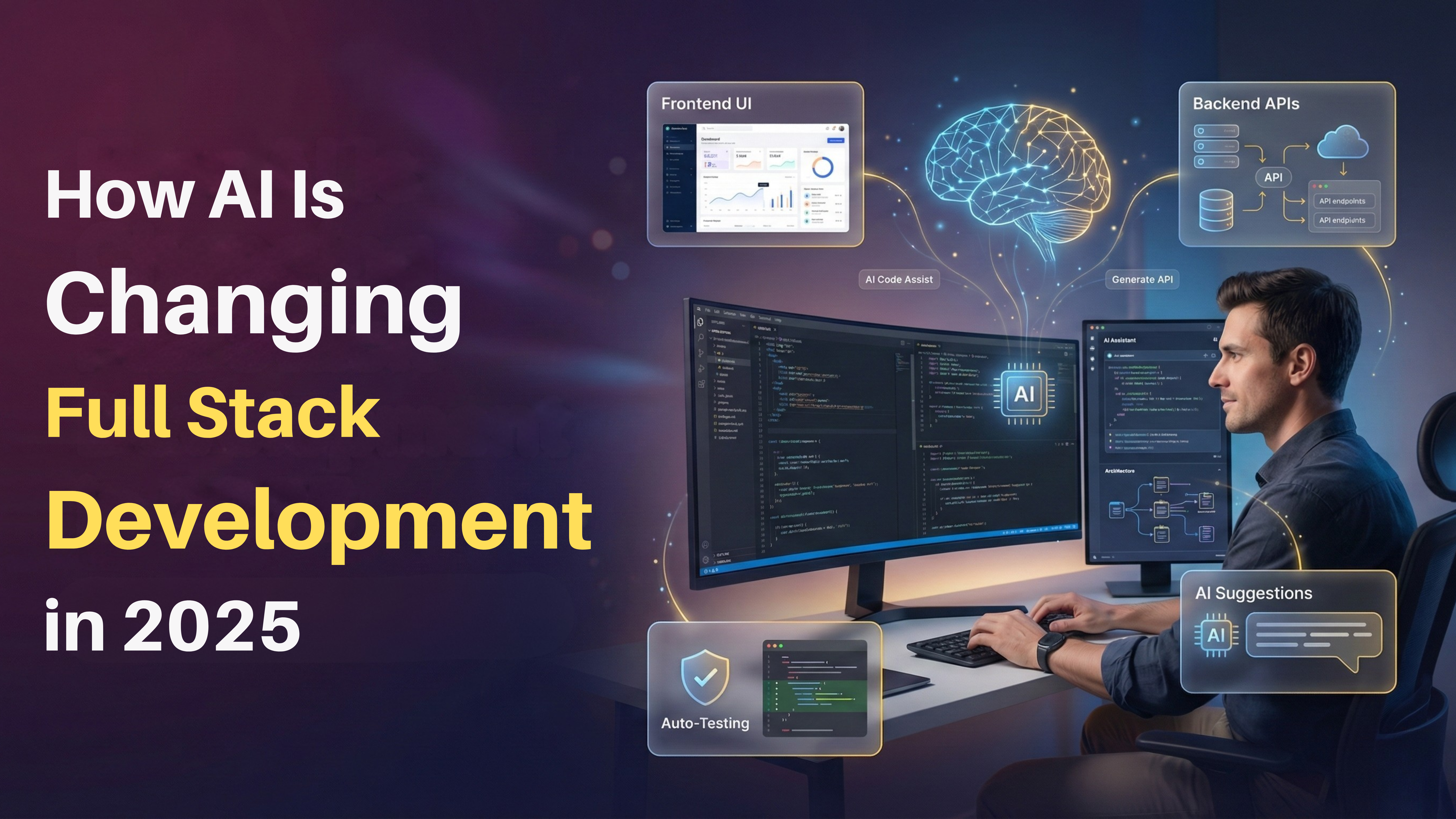
AI is changing full stack development in 2025, and it has completely reshaped how developers build, test, deploy, and maintain applications. Full Stack Developers are no longer writing every line of code manually AI tools now speed up development, reduce bugs, automate repetitive tasks, and make engineers far more productive.
Below is the major ways AI is transforming Full Stack Development.
1. AI Code Generation: Faster & Smarter Development for Full Stack Development
AI tools like GitHub, Copilot, Cursor AI, Replit AI, and ChatGPT have become core parts of the developer workflow.
How AI Code Generation Helps Developers
- Suggests code as you type
- Writes entire functions or modules
- Generates boilerplate code instantly
- Converts logic into working code
- Helps debug errors with explanations
- Improves code quality and structure
Impact on Full Stack Developers
- Faster development
- Fewer syntax errors
- Higher productivity
- Ability to build complex features quickly
- Beginners can learn faster
Developers who know how to prompt effectively gain a huge advantage.
2. AI Auto-Testing: Eliminating Bugs Before Deployment
Testing, which once took hours or days, is now automated with AI tools.
How AI Improves Testing
- Auto-generates unit tests
- Detects bugs and vulnerabilities
- Suggests optimized test cases
- Performs regression testing
- Identifies edge cases developers miss
Why This Matters
Full Stack Developers can now:
- Ship features faster
- Reduce QA workload
- Maintain cleaner, more stable code
- Ensure higher reliability
AI-powered testing improves the overall development quality, especially for startups and SaaS products.
3. AI Deployment: Zero-Click CI/CD & Smart Monitoring
Deployment has traditionally been one of the most challenging and time-consuming parts of full stack development. Developers had to manually configure servers, set up environments, write deployment scripts, handle dependency issues, test builds, monitor logs, and troubleshoot failures. A single mistake could break the entire application or expose it to vulnerabilities.
However, in 2025, AI-powered deployment has transformed the entire DevOps ecosystem. Modern AI tools now automate nearly every stage of deployment from pipeline creation to real-time monitoring making the process faster, safer, and significantly more efficient for developers. What used to take hours, or sometimes days, can now be done in minutes with a single command or prompt.
This shift has created a new era of Zero-Click Deployment, where AI takes over tasks that previously required deep DevOps expertise.
How AI Is Automating CI/CD Pipelines
1. Auto-Creation of CI/CD Pipelines
Previously, creating a CI/CD pipeline required knowledge of YAML files, shell scripting, environment variables, and multiple stages such as build, test, integration, and deployment.In 2025, AI tools now:
- Analyze your repository
- Understand your tech stack
- Automatically generate a pipeline
- Configure build and test steps
- Set up environment-specific deployment rules
With tools like GitHub Actions AI, developers simply prompt:
“Create a CI/CD pipeline for my MERN app with staging and production environments.”
The AI instantly generates the entire pipeline, optimizes steps, and even validates the configuration. This eliminates the struggle developers once had with complex DevOps scripts.
2. Predicting Deployment Failures Before They Happen
One of the biggest breakthroughs in AI deployment is predictive failure detection.AI models’ scan:
- Commit history
- Build behavior
- Dependency changes
- Server load patterns
- Previous deployment logs
Based on this, AI can identify the risk of failure even before the deployment starts. For example:
- If a new npm package has known vulnerabilities
- If a specific commit caused issues earlier
- If server capacity is insufficient
- If an environment variable is missing
The AI alerts the developer and suggests fixes proactively. This drastically reduces downtime and production errors.
3. Automated Rollbacks When Errors Occur
Manual rollbacks used to take time and often required senior DevOps intervention. Sometimes developers struggled to identify which version to roll back to.
AI deployment platforms now:
- Detect when an application behaves abnormally
- Compare logs with previously successful versions
- Automatically trigger rollback within seconds
- Notify developers with an explanation of the issue
This ensures the application stays stable and users never experience major service interruptions.
4. Server Optimization With AI
AI now plays a major role in optimizing server configurations.Traditional deployments required guessing:
- How much CPU the app needs
- Which memory limit is safe
- How many instances to run
- When to increase or decrease capacity
Now AI models continuously study patterns such as:
- Peak traffic hours
- API request loads
- Memory leaks
- CPU spikes
Based on this, AI adjusts server usage automatically by:
- Allocating more resources during heavy loads
- Reducing usage during low activity
- Optimizing container or server configurations
- Suggesting better deployment architecture
This reduces cloud wastage and ensures the application remains fast and responsive.
5. Auto-Scaling Cloud Resources
Auto-scaling is no longer based only on simple CPU or memory thresholds.AI-powered scaling considers:
- User behavior
- Traffic forecasts
- Seasonal trends
- App update schedules
- Historical performance data
This means the system automatically scales before traffic increases, ensuring no slowdowns or outages.
For example, an e-commerce app can scale up two hours before a planned sale based on past traffic data and AI predictions.
6. Smart Log Monitoring and Anomaly Detection
AI now monitors logs in real time and learns what “normal behavior” looks like for your application.It detects anomalies such as:
- Sudden spikes in error rates
- Unauthorized access attempts
- Slow database queries
- API response delays
- Dependency failures
When something unusual happens, AI immediately notifies developers with:
- What went wrong
- When it started
- Why it likely happened
- Suggested fixes
This level of monitoring was impossible manually and required multiple tools. Now it is centralized and automated, improving reliability significantly.
Benefits for Full Stack Developers
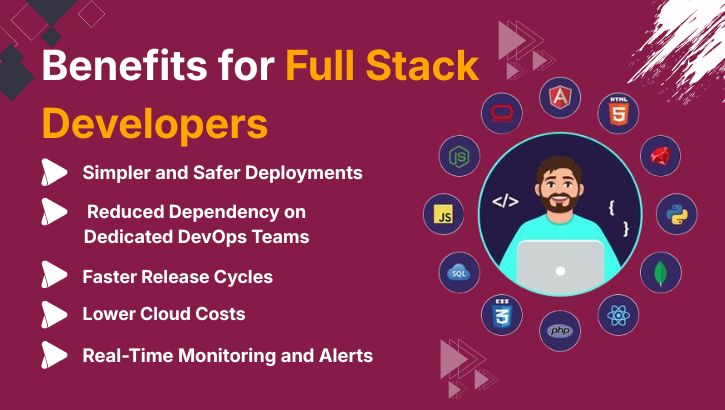
1. Simpler and Safer Deployments
With AI handling most backend DevOps complexity, developers can deploy confidently without fear of breaking production.
AI ensures that:
- The build is stable
- Environment variables are correct
- Dependencies are compatible
- Security vulnerabilities are flagged
- Server resources are adequate
This reduces deployment anxiety and speeds up release cycles.
2. Reduced Dependency on Dedicated DevOps Teams
Full stack developers no longer need to rely entirely on DevOps teams for:
- Environment setup
- Pipeline configuration
- Server monitoring
- Scaling decisions
AI tools allow developers to take control of the entire process using simple prompts or prebuilt templates.
3. Faster Release Cycles
AI removes repetitive deployment tasks.This means teams can:
- Push updates more frequently
- Roll out bug fixes instantly
- Deploy new features several times a day
Organizations now adopt Continuous Deployment effortlessly.
4. Lower Cloud Costs
AI optimizes resource usage automatically.It prevents unnecessary spending by:
- Stopping idle servers
- Scaling efficiently
- Removing unused resources
- Predicting ideal configurations
This can reduce cloud bills significantly for startups and enterprises.
5. Real-Time Monitoring and Alerts
Developers receive alerts for:
- API errors
- Downtime
- Security threats
- Performance issues
- Database failures
AI gives actionable recommendations instead of just sending warnings.
AI Deployment Platforms Leading the Market in 2025
Vercel AI Deployment
Perfect for front-end frameworks and serverless environments. Known for instant zero-click deployment using AI recommendations.
GitHub Actions AI
Deep integration with repositories. Auto-creates optimized pipelines, tests, and deployment workflows.
AWS AI Ops
Enterprise-grade system that handles predictive scaling, auto-healing, and intelligent monitoring.
GCP Autopilot
Automates Kubernetes resources, scaling, and error detection without manual configuration.
4. Next-Gen AI-Powered Developer Workflow
AI has changed the entire workflow of full stack development in 2025. Developers are now using AI at almost every stage:
1. Planning & Architecture
AI suggests:
- Best tech stacks
- Database schema
- API structures
- System design diagrams
- Scalability recommendations
2. Front-End Development
AI tools generate:
- React components
- UI design suggestions
- Error-free JSX
- Responsive layouts
- Style combinations
Design-to-code is now possible with a single prompt.
3. Back-End Development
AI helps create:
- REST APIs and GraphQL endpoints
- Authentication systems
- Database models
- Complex business logic
Developers spend more time on architectural decisions, not repetitive coding.
4 . Documentation & Reporting
AI auto-generates:
- API documentation
- Code comments
- User guides
- Release notes
This saves hours of manual effort.
5 . Continuous Improvement
AI tools analyze:
- Code quality
- Performance bottlenecks
- Security risks
- Optimization opportunities
Developers get real-time suggestions to improve their applications.
5. The Future: AI-Augmented Full Stack Developer
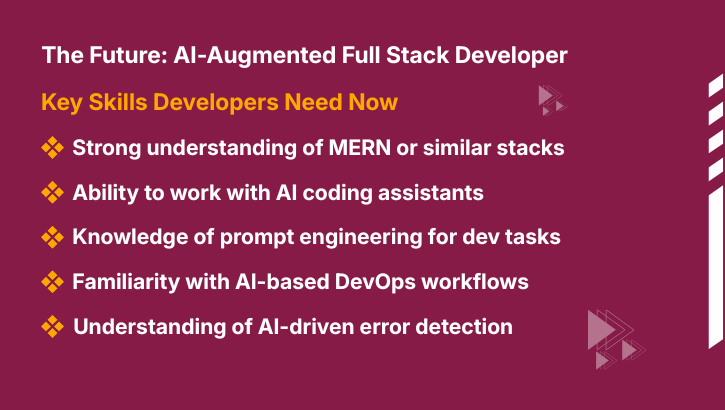
In 2025, companies don’t just want developers they want AI-assisted developers who can build faster, think smarter, and use AI to improve productivity.
Key Skills Developers Need Now
- Strong understanding of MERN or similar stacks
- Ability to work with AI coding assistants
- Knowledge of prompt engineering for dev tasks
- Familiarity with AI-based DevOps workflows
- Understanding of AI-driven error detection
Developers who combine full stack skills with AI usage become 2–3x more productive and highly valuable in the industry.
Conclusion
AI is not replacing Full Stack Developers, it’s upgrading them.
In 2025, the best developers are those who leverage AI for:
- Writing code
- Testing
- Deployment
- Optimization
- Documentation
AI has transformed the development workflow into a faster, smarter, and more efficient process. Full Stack Developers who adapt will enjoy higher salaries, better job roles, and strong career stability in the coming years.