
Every full stack developer dreams of creating apps that are both lightning-fast and highly secure. No matter your skill level, focusing on speed and security optimization helps you build reliable, scalable web applications that users trust.
In this guide, you’ll learn how to optimize your full stack application for both performance and security, using the best developer tools and following the latest 2025 full stack roadmap practices.
Full stack development involves managing both the frontend (client-side) and backend (server-side) of a web application.
A full stack developer understands how data flows between the frontend, backend, and database, ensuring apps run efficiently and securely.
Pro Tip :
If you’re new to this field, start with the MERN Stack (MongoDB, Express.js, React, Node.js), it’s beginner-friendly and ideal for end-to-end development.
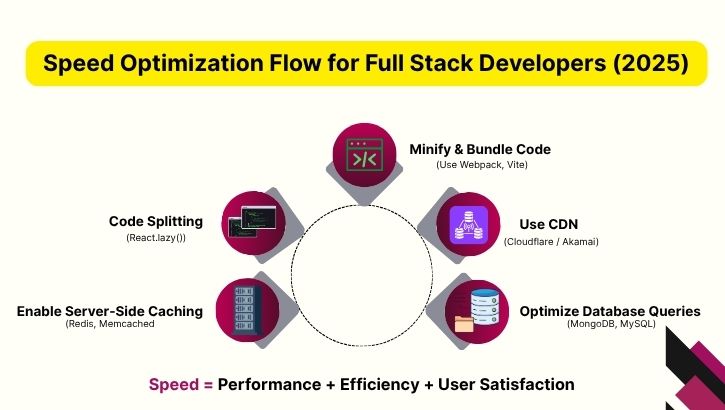
Users today expect apps to load in under 3 seconds and they also expect their data to be safe.
A slow or insecure app can lead to:
That’s why every full stack developer must prioritize speed optimization and security hardening as part of their app development process.
1. Minify and Bundle Frontend Assets
Reduce the size of your JavaScript, CSS, and HTML files. Tools like Webpack, Vite, and Parcel help bundle and compress resources for faster delivery.
Pro Tip :
Use lazy loading for images and components in React.js and it prevents unnecessary resource loading.
2. Use a Content Delivery Network (CDN)
CDNs like Cloudflare or Akamai cache your assets globally. This allows users to load your website from the server closest to their location and improving performance.
3. Optimize Database Queries
Whether you’re using MongoDB or MySQL, avoid redundant or nested queries.
Use indexing to speed up data retrieval and caching for frequently accessed data.
Example:
In MongoDB, use .explain() to analyze query performance.
Pro Tip :
Use Mongoose (for MERN developers) to manage schemas and validations efficiently.
4. Enable Server-Side Caching
Implement caching with tools like Redis or Memcached to reduce the load on your backend server.
5. Use Lightweight Frameworks and Libraries
Avoid adding unnecessary libraries to your frontend. Every extra dependency increases your bundle size.
For example, instead of using large UI kits, use Tailwind CSS for faster performance.
6. Implement Code Splitting
Split large JavaScript files into smaller chunks using React.lazy() or dynamic imports. This improves page load time significantly.
Speed alone isn’t enough, you must also make your full stack app secure from vulnerabilities like XSS, SQL injection, and data leaks.
1. Use HTTPS Everywhere
Implement SSL certificates to encrypt communication between client and server.
This protects sensitive data such as login credentials and payment details.
Pro Tip :
Use Let’s Encrypt and it provides free SSL certificates for developers.
2. Sanitize and Validate User Input
Always validate data at both frontend and backend to prevent attacks such as SQL injection or XSS (Cross-Site Scripting).
Example:
Use input validation libraries like validator.js in Node.js.
3. Use Environment Variables
Never hardcode API keys, database credentials, or tokens.
Store them securely in .env files and use packages like dotenv to access them.
4. Implement Authentication and Authorization
Use JWT (JSON Web Tokens) or OAuth for secure authentication.
Always manage user sessions safely and invalidate tokens on logout.
Pro Tip :
Use bcrypt to hash passwords before saving them in the database.
5. Keep Dependencies Updated
Old libraries can contain security vulnerabilities. Regularly update your packages using:
npm audit fix
or
yarn upgrade
6. Set Up Proper Error Handling
Avoid displaying raw error messages to users and they can reveal sensitive system details.
Instead, log errors safely using Winston
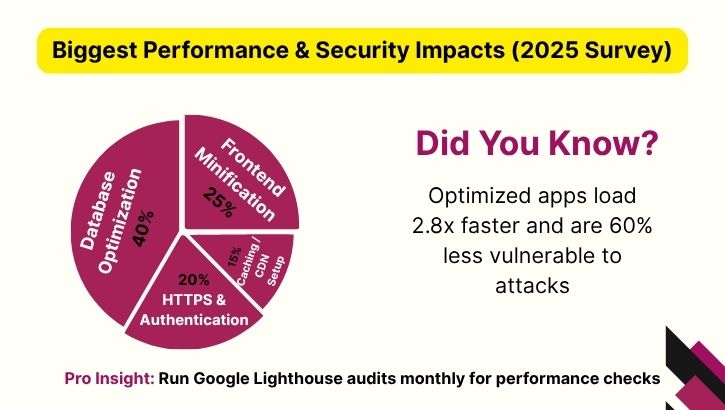
| Tool | Purpose | Category |
|---|---|---|
| Webpack | Bundle and minify frontend files | Frontend Optimization |
| Redis | Cache backend data | Backend Performance |
| Cloudflare | CDN for faster asset delivery | Network Optimization |
| Lighthouse | Audit app performance | Performance Testing |
| MongoDB Indexing | Optimize data queries | Database Optimization |
Pro Tip :
Run Google Lighthouse audits regularly to measure performance and accessibility metrics.
| Tool | Purpose | Purpose |
|---|---|---|
| Helmet.js | Secure HTTP headers | Node.js (Backend) |
| bcrypt.js | Hash passwords | Authentication |
| JSON Web Token (JWT) | Token-based authentication | Backend APIs |
| OWASP Dependency Check | Detect vulnerable libraries | Security Audit |
| dotenv | Manage environment variables | Configuration |
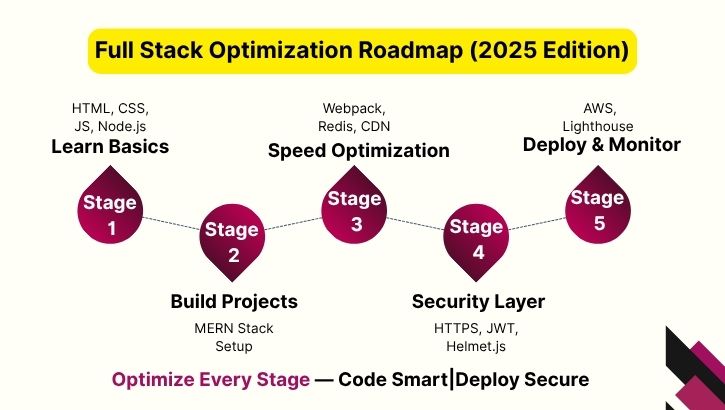
Optimizing apps for speed and security should be part of your full stack developer roadmap.
Here’s how to integrate these practices step-by-step:
| Stage | Focus Area | Key Tools & Actions |
|---|---|---|
| Stage 1 | Learn basics of frontend & backend | HTML, CSS, JS, Node.js |
| Stage 2 | Build MERN stack projects | MongoDB, Express.js, React.js, Node.js |
| Stage 3 | Optimize for speed | Webpack, CDN, Caching |
| Stage 4 | Implement security layers | HTTPS, JWT, Helmet.js |
| Stage 5 | Deploy and monitor | Docker, AWS, Lighthouse |
Let’s say you built a blog application using the MERN stack.
Here’s how you can improve its speed and security:
By integrating these steps, you can improve app performance by up to 60% while maintaining top-tier security .
In 2025, being a great full stack developer means more than just writing code, it’s about building apps that perform fast and stay secure.
By using the right full stack developer tools, following a solid roadmap, and leveraging modern MERN stack development practices, you can ensure your applications deliver top-notch performance while keeping users safe.
Pro Tip :
Speed attracts users and security retains them. Combine both, and your full stack apps will truly shine!
SEO Meta Info
Meta Title:
How to Optimize Your Full Stack App for Speed and Security (2025 Guide)
Meta Description:
Learn how to optimize your full stack app for performance and protection. Discover top tools, best practices, and roadmap strategies for faster, safer web applications.
Target Keywords:
full stack development, full stack developer, full stack developer tools, full stack developer roadmap, MERN stack development