Are you aiming to crack your next Full Stack Developer interview? Whether you're a fresher starting your software career or an experienced developer upgrading to full-stack roles, interview preparation can feel overwhelming.
The good news?
Most full-stack interview questions follow predictable patterns, covering concepts, tools, databases, APIs, deployment, and best practices.
In this guide, you’ll find the Top 25 Full Stack Developer Interview Questions & Expert Answers, along with actionable tips, examples, and interview-ready explanations to help you stand out with confidence.
Save this page for revision before your interview!
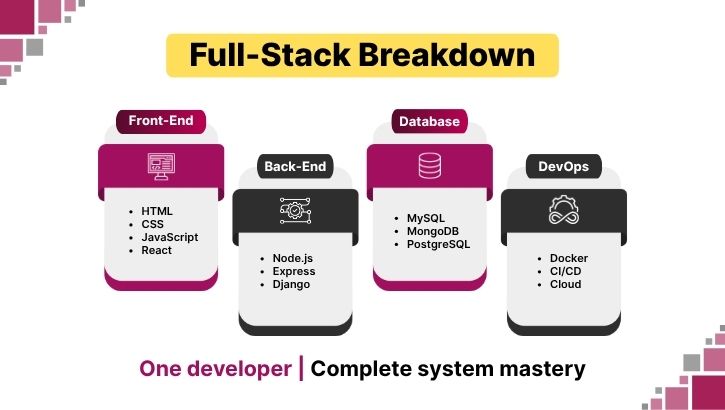
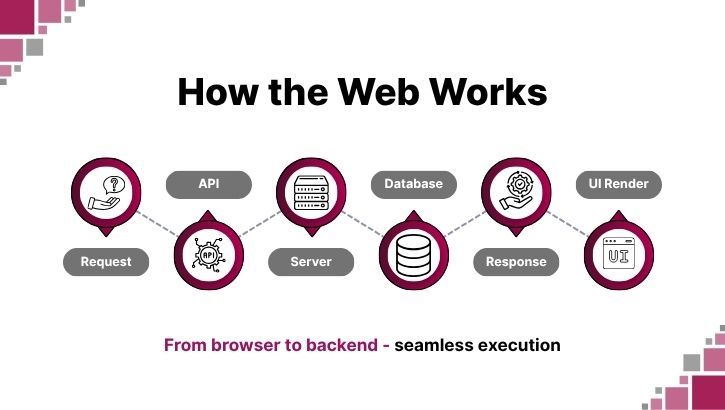
Full stack development involves building both the front-end (client side) and back-end (server side) of applications. Instead of focusing on only one layer, full-stack developers can:
⦁ Design user interfaces
⦁ Create APIs
⦁ Manage databases
⦁ Deploy applications
⦁ Ensure performance & security
In modern tech teams, full stack developers are highly valuable because they ensure smooth communication between front-end, back-end, and DevOps layers and leading to efficient development cycles.
⦁ Giving vague or textbook-style answers
⦁ Ignoring performance/security questions
⦁ Not explaining real-world examples
⦁ Weak communication about system thinking
⦁ Memorizing answers instead of understanding concepts
To succeed, showcase clarity + practical thinking + project experience.
⦁ Practice coding challenges (LeetCode, HackerRank)
⦁ Work on real projects (portfolio/GitHub)
⦁ Be ready to explain architecture diagrams
⦁ Use examples from past projects
⦁ Explain trade-offs, not just definitions
⦁ Maintain eye contact
⦁ Discuss problems logically
⦁ Demonstrate confidence in explaining code
⦁ Listen before answering
⦁ Be honest if you don’t know something
Mock Interview Checklist
| Understand fundamentals | ✅ |
| Practice coding questions | ✅ |
| Revise API & DB concepts | ✅ |
| Build a portfolio | ✅ |
| Prepare STAR-format examples | ✅ |
“I designed a MERN application where the front-end handled user authentication, the backend used JWT, MongoDB stored user data, and Docker ensured deployment consistency. I optimized queries, added caching, and implemented role-based access for security.”
Use similar real-world examples in your interview.

Subject: Thank You — [Your Name]
Hi [Interviewer Name],
Thank you for the opportunity to interview for the Full Stack Developer role. I enjoyed our discussion and I’m excited about the chance to contribute to your engineering team.
Looking forward to next steps!
Regards,
[Your Name]
Preparing for a Full Stack interview becomes easier when you understand core concepts, practice coding, and explain real-world scenarios clearly.
Remember, employers look for problem-solvers, team players, and continuous learners, not just coders.