In a world where attention is the new currency, the battle isn’t for minutes it’s for milliseconds. Whether you’re scrolling through Instagram, glancing at YouTube thumbnails, or browsing a website, the content that earns your focus is the content that wins. Research shows that the average person decides whether to stay or scroll within just a few seconds. According to one recent overview, the average adult internet user’s attention span is estimated at around 8.25 seconds.
This tiny window makes or breaks creators, brands, and businesses. And mastering it isn’t luck, it's science.
In this deep-dive guide, we’ll explore the psychology, neuroscience, and strategy behind powerful hooks, how they work, and how you can craft them with precision.
Attention spans haven’t just shrunk, they've changed in composition. With hundreds of thousands of new posts, videos, and ads competing for eyeballs every minute, your content needs to win the moment it begins. Every minute:
Hooks don’t just attract attention. They:
And to understand hooks, we first need to understand the brain.
Our brains are wired for snap decisions. Even though we’re not running from predators any more, this fast-filtering mechanism is still very active.
1. The Brain Loves Novelty
When the brain detects something new or unusual, it releases dopamine, thereby pushing us to pay attention.
2. The “Threat or Reward” Scan (Limbic System)
Within milliseconds, our brain asks: is this a threat? Is this rewarding? Or can I ignore it? Hooks that implicitly promise reward (“I’ll show you how to double your reach in 30 seconds…”) activate the reward circuitry.
3. Cognitive Ease
The brain prefers simple, easily digestible information. A complicated, slow hook loses attention.
4. Curiosity Gaps
Rooted in the “information gap theory”, humans instinctively dislike not knowing something. That gap opens and they want to close it.
For example, a scientific study measured sustained attention across age groups and found that young adults could stay “in the zone” for a mean of ~76 seconds in a controlled task. While this is a focused‐attention task (rather than general browsing), it underlines that our attention systems are finite and sensitive to stimulus.
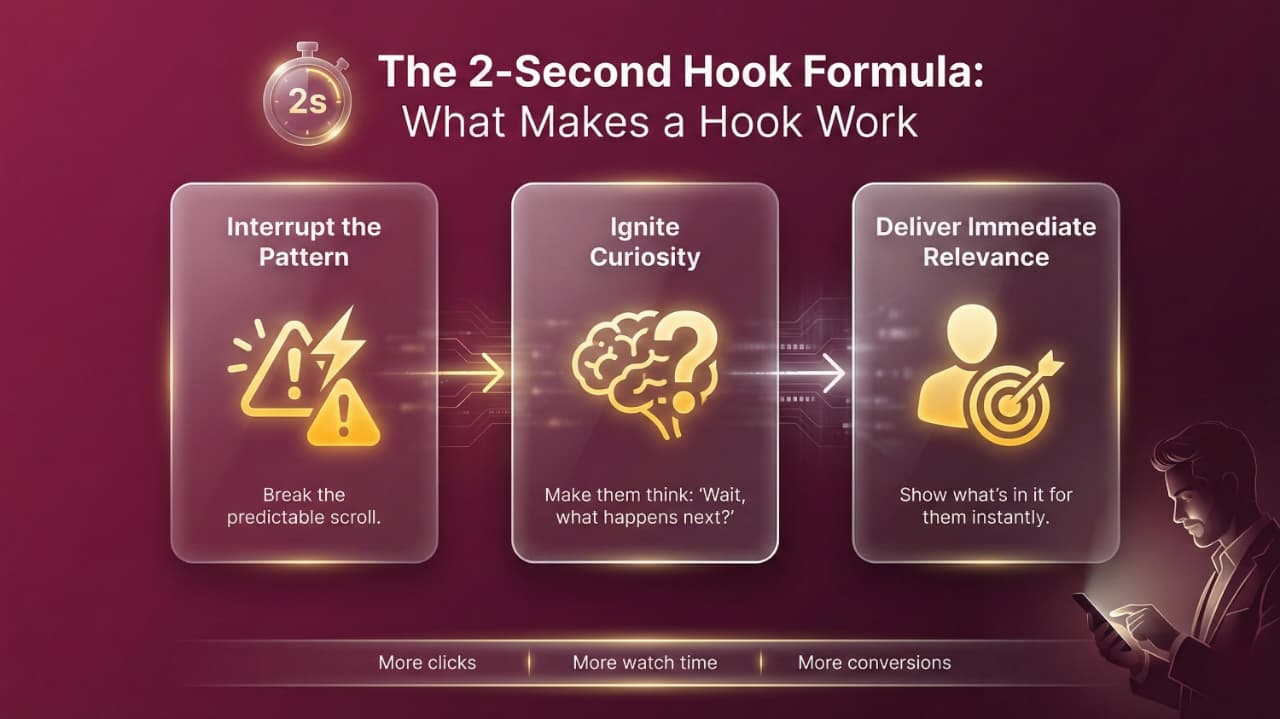
After analysing many high-performing posts, ads and videos, professionals consistently find that great hooks do three things:
They interrupt the pattern
They break the predictable flow of what the viewer expects.
They ignite curiosity
They create a feeling of “I need to know what happens next”.
They deliver immediate relevance
They show instantly what’s in it for the viewer.
Without all three, your content struggles to perform.
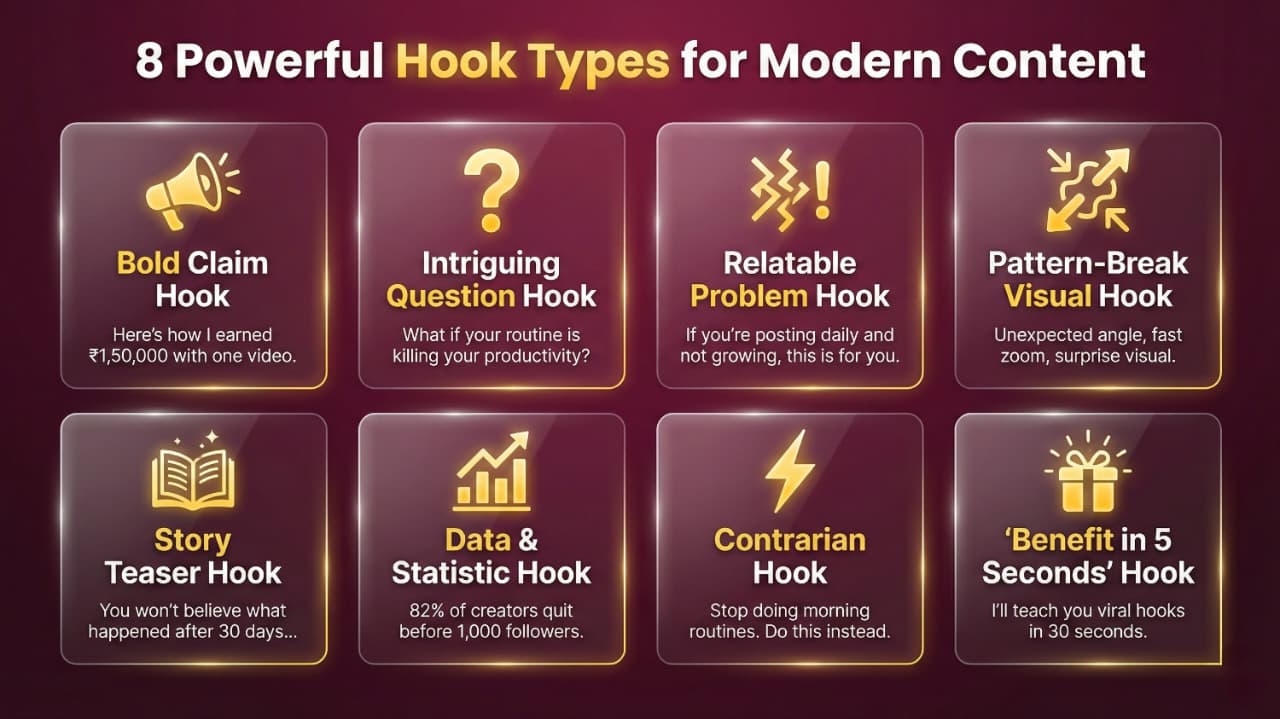
Here are the most powerful hooks used by creators, brands and marketers and how you can use them.
1. The Bold Claim Hook
E.g.: “Here’s how I earned ₹1,50,000 with one video.” “Most people are budgeting wrong.” Why it works: Big claims trigger novelty + reward anticipation.
Use when: you have strong data, results, or transformation to share.
2. The Intriguing Question Hook
E.g.: “What if I told you your morning routine is killing your productivity?” “Ever wondered why some posts go viral and some flop?” Why it works: The brain instinctively tries to answer questions and engagement begins instantly.
3. The Relatable Problem Hook
E.g.: “If you’re posting daily and still not growing, this is for you.” “Does your content get impressions but no engagement?” Why it works: People stop when they feel seen and it forges an instant emotional connection.
4. The Pattern-Break Visual Hook (Video/Reels)
Examples: sudden close-up, surprising movement, flash-cut visual. Why it works: The brain notices unusual changes in motion faster than text.
5. The Story Teaser Hook
E.g.: “You won’t believe what happened when I tried this for 30 days…” “One decision changed everything for me.” Why it works: Humans are storytelling animals. A cliffhanger activates curiosity gaps.
6. The Data & Statistic Hook
E.g.: “82% of creators quit before they reach 1,000 followers here’s why.” “This one tweak boosted conversions by 47%.” Why it works: Numbers add legitimacy and make the brain trust you more.
7. The Contrarian Hook
E.g.: “Stop doing morning routines. Do this instead.” “Everything you know about multitasking is wrong.” Why it works: Unexpected viewpoints create cognitive dissonance our brain wants to resolve.
8. The “Benefit in 5 Seconds” Hook
E.g.: “I’ll teach you how to write viral hooks in the next 30 seconds.” “If you want a job in tech, remember these 3 rules…” Why it works: People love fast, practical value.
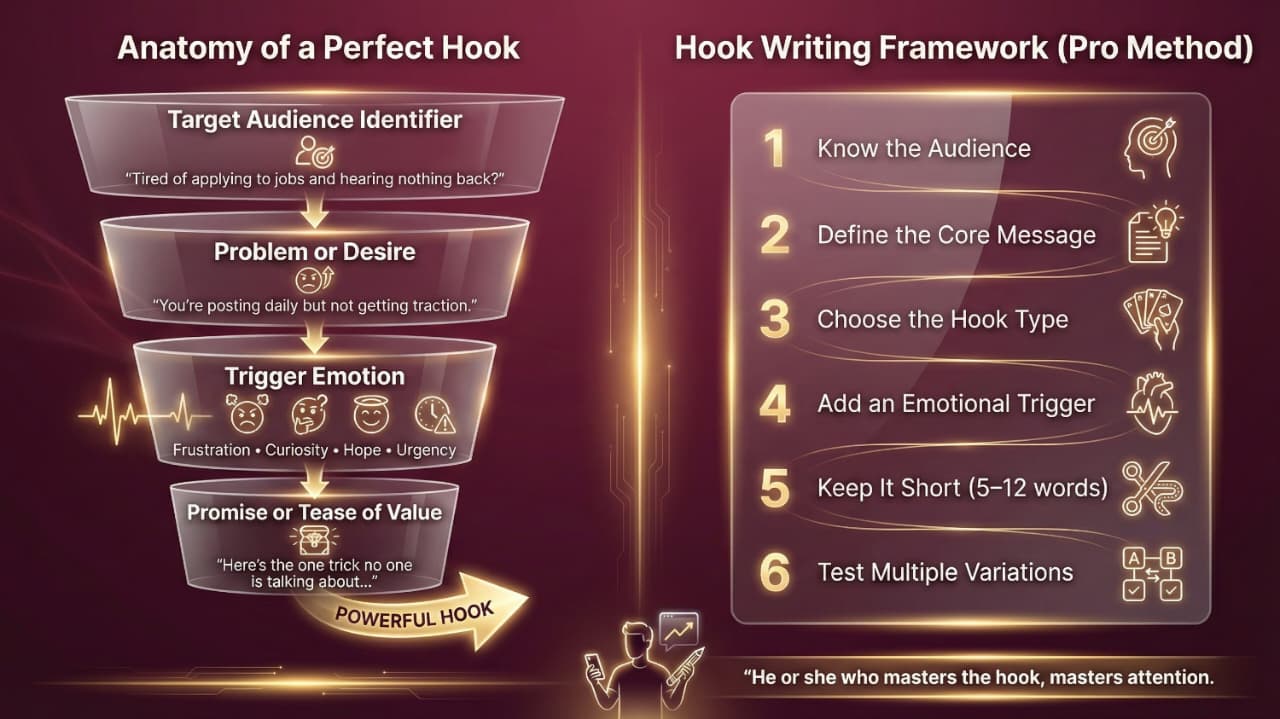
A powerful hook often contains these four components:
1. A Target Audience Identifier
“Tired of applying to jobs and hearing nothing back?”
2. A Problem or Desire
“You’re posting daily but not getting traction.”
3. A Trigger Emotion
Frustration, curiosity, hope, excitement, urgency.
4. A Promise or Tease of Value
“Here’s the one trick no one is talking about…”
Examples of Elite-Level Hooks
For Digital Creators:
For Business Owners:
For Students / Professionals:
Modern training platforms like WHY TAP understand the importance of hooks not just in marketing but in communication, pitching, resume writing and presentation skills.
Their digital-marketing and full-stack programmes incorporate AI-driven content techniques, teaching students how to:
Students also work on real projects, gaining practice with hooks across platforms like Instagram Reels, YouTube Shorts, websites and paid ad campaigns. This practical exposure is why WHY TAP graduates often feel confident creating content that stands out.
In the digital age, hooks are no longer just a marketing tactic, they are a core career skill.
Use this expert strategy whenever you create content:
Step 1: Know the Audience
Your hook fails if it doesn’t speak to someone specific. Identify:
What’s the key takeaway of your content? Your hook should be the doorway to that value.
Bold claim? Data? Question? Contrarian? Pick one based on the message.
Curiosity, fear of missing out, excitement, everything becomes stronger with emotion.
The best hooks are: 5–12 words or 1 short sentence.
Pro creators write 10 hooks for every piece of content. The first idea is rarely the best.
Even great creators slip up. Watch out for:
Too much buildup
If your hook takes too long, you lose the viewer.
Being too generic
“Learn digital marketing” is boring. “Learn the skill that helps you earn more in 90 days” is better.
Over-promising
Never bait people with false claims. Authenticity creates long-term trust.
No visual support (for video)
Even the best hook fails if your visual opening is dull.
No clear takeaway
If your audience feels tricked, they won’t return.
Real-World Examples of High-Performing Hooks (Before vs After)
Before:
“How to get better at interviews.”
After:
“Here are 3 interview mistakes even experts still make.”
Before:
“Tips to grow on Instagram.”
After:
“Stop doing this if your Instagram isn’t growing.”
Before:
“How to learn full stack development.”
After:
“You can become a full stack developer in 90 days if you avoid these beginner mistakes.”
Why Hooks Are the Future of Communication
Hooks aren’t just for content creators, they're for everyone. Students use them in resumes. Marketers use them in ads. Developers use them in portfolios. Entrepreneurs use them in pitches.
As information becomes infinite, attention becomes scarce. He or she who masters the hook masters influence.
This is why institutions like WHY TAP integrate digital psychology and communication training into their curriculum. Because a great skill is useless if you don’t know how to present it.
In the attention economy, the hook is your first impression, your handshake, your headline, your spark. It’s the difference between being scrolled past and being remembered.
To master hooks is to understand people. To understand people is to master communication. And to master communication is to unlock opportunity.
Start experimenting. Test variations. Keep your openings sharp, emotional, curiosity-driven.
Because in a world where thousands of pieces of content battle for a viewer’s time, you don’t just need to be good, you need to be unignorable.
And that starts with the hook.