






Table of Contents
- 1.
- 2.
- 3.
Are you preparing for a Data Analyst interview and looking for the most frequently asked questions, sample answers, and a clear preparation roadmap?
Whether you’re a fresher, a career-changer, or an experienced professional, succeeding in a data analyst interview requires structured preparation, clarity in communication, and practical understanding of analytical tools. This guide on Data Analyst Interview Questions 2025 helps you follow the right steps and stay interview-ready.
The good news? Most Data Analyst interviews follow predictable patterns. Hiring managers generally focus on your technical skills, analytical thinking, problem-solving capability, and ability to translate data into business decisions.
To help you stand out, this guide covers:
• The Top 25 most asked Data Analyst interview questions
• Professional sample answers (short + real project example)
• Body language tips
• A mock-interview checklist
• A corporate-style follow-up email
• FAQs to clarify common doubts
A Data Analyst interview is designed to evaluate your ability to:
• Understand business problems
• Work with data tools and analytical techniques
• Interpret and communicate insights clearly
• Think critically and solve data-driven problems
• Maintain accuracy, ethics, and data governance.
Top 25 Data Analyst Interview Questions (with Answers & Examples)
1. What is Data Analytics?
Answer:
Data Analytics is the process of examining raw data to uncover patterns, insights, and trends that help businesses make informed decisions.
Example:
“In my recent project, I analyzed customer purchase patterns to identify slow-moving products, which helped the sales team redesign their discount strategy.”
2. What are the key steps in the Data Analysis process?
Answer:
Data Collection → Cleaning → Exploration → Analysis → Interpretation → Reporting.
Example:
“In a churn prediction project, I cleaned missing values, explored correlations, analyzed customer behavior using Python, and shared insights with the marketing team.”
3. What tools and technologies do you use for data analysis?
Answer:
SQL, Excel, Python (Pandas, NumPy), Power BI/Tableau, and Google Analytics.
Example:
“I used SQL for data extraction, Python for analysis, and Power BI to build a dashboard for weekly sales reporting.”
4. How do you ensure data quality?
Answer:
By validating accuracy, consistency, completeness, timeliness, and removing duplicates or errors.
Example:
“In a finance dataset, I used Excel and Python to identify outliers and validate missing values before analysis.”
5. What is structured vs unstructured data?
Answer:
Structured data is organized in rows/columns; unstructured data includes text, images, videos.
Example:
“I analyzed structured sales data from SQL and unstructured customer reviews using sentiment analysis.”
6. What is the role of a Data Analyst?
Answer:
To convert data into actionable insights that support business decisions.
Example:
“I helped a retail client reduce delivery delays by analyzing logistics data and identifying bottlenecks.”
7. Data Analytics vs Data Science vs Data Engineering
Answer:
Analysts interpret data, Data Scientists build predictive models, Data Engineers build data pipelines.
Example:
“I worked with a Data Engineer to source cleaned datasets and collaborated with a Data Scientist to validate model accuracy.”
8. How do you handle missing or inconsistent data?
Answer:
Techniques include deletion, imputation, interpolation, or flagging.
Example:
“For customer age gaps, I used median imputation in Python to improve model consistency.”
9. What is data normalization?
Answer:
Organizing data to reduce redundancy and improve integrity.
Example:
“I normalized customer tables using 3NF to prevent update anomalies in SQL.”
10. How proficient are you in SQL?
Answer:
Comfortable with joins, subqueries, aggregations, CTEs, window functions.
Example:
“I wrote SQL queries to automate weekly KPI reports, reducing manual effort by 70%.”
11. What KPIs have you worked with?
Answer:
Revenue, churn rate, retention, AOV, conversion rate, NPS, operational efficiency.
Example:
“I tracked weekly conversion rates and optimized marketing campaigns based on funnel drop-offs.”
12. How do you visualize data effectively?
Answer:
Choose the right chart, maintain clarity, use consistent colors, avoid clutter.
Example:
“I built a Power BI dashboard showing month-on-month revenue growth with slicers for region filters.”
13. Correlation vs Causation?
Answer:
Correlation = relationship; Causation = direct cause-effect.
Example:
“In a sales analysis, ad spend correlated with revenue, but seasonality caused actual spikes.”
14. Which statistical methods do you use?
Answer:
Mean, median, mode, regression, hypothesis testing, confidence intervals.
Example:
“I used regression analysis to identify key drivers of customer churn.”
15. How do you handle outliers?
Answer:
Detect using Z-scores, IQR, visualization; treat by capping, removing, or investigating.
Example:
“I capped extreme order values using the 95th percentile to stabilize the model.”
16. Importance of data storytelling?
Answer:
It connects insights to decisions through narrative, visuals, and recommendations.
Example:
“I used a story-driven dashboard to explain why customer churn was rising in Tier-2 cities.”
17. What are dashboards? How do you design them?
Answer:
Dashboards are visual summaries of key metrics; designed for clarity, relevance, and quick interpretation.
Example:
“I built a CEO dashboard showing sales, profit, churn, and regional breakdowns.”
18. How do you clean data in Python or Excel?
Answer:
Use Pandas functions (dropna, fillna, replace), Excel functions (TRIM, CLEAN, filters).
Example:
“I cleaned 100,000+ rows using Pandas: removed duplicates, fixed typos, standardized formats.”
19. Types of Analytics?
Answer:
Descriptive = what happened
Diagnostic = why it happened
Predictive = what might happen
Prescriptive = what to do
Example:
“I used predictive analytics to forecast demand for the next quarter.”
20. How do you handle large datasets?
Answer:
Use chunking, indexing, optimized queries, cloud tools, and sampling.
Example:
“I processed 3M+ rows using Pandas chunks and SQL indexing to improve performance.”
21. What is A/B testing?
Answer:
A method to compare two versions (A vs B) to determine which performs better.
Example:
“I ran an A/B test on landing pages; version B increased conversions by 18%.”
22. How do you handle confidential data?
Answer:
Follow GDPR policies, encryption, access controls, anonymization.
Example:
“I anonymized customer IDs before sharing data with business stakeholders.”
23. Describe a recent analytics project.
Answer:
Explain goal → tools → process → results.
Example:
“I analyzed delivery delays using SQL + Python and helped reduce turnaround time by 12%.”
24. How do you stay updated in analytics?
Answer:
Through courses, blogs, LinkedIn, GitHub, Kaggle, and continuous projects.
Example:
“I follow Analytics Vidhya and practice weekly challenges on Kaggle.”
25. Why should we hire you?
Answer:
Because you have the skills, mindset, and problem-solving approach.
Example:
“I combine technical skills with strong business understanding and can deliver insights from day one.”
Click here to Register for FREE Consultation with our Career Counsellor
Body Language & Communication Tips - Data Analyst Interview
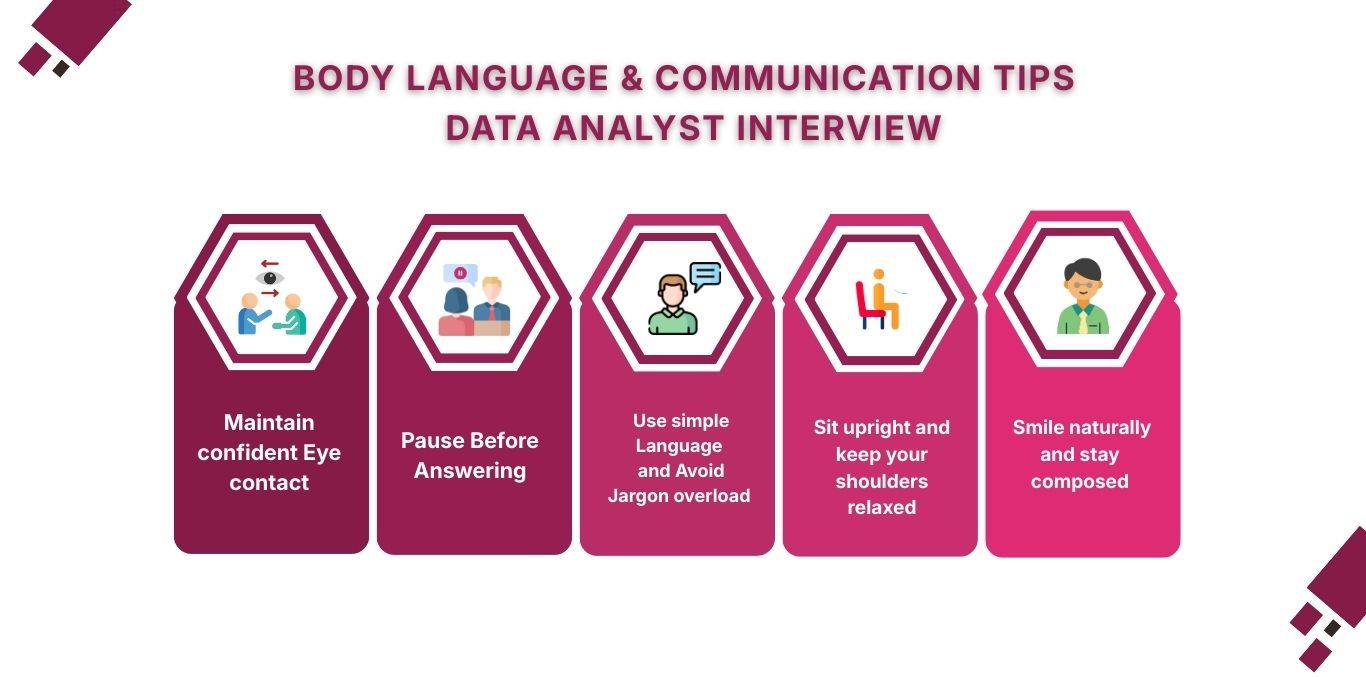
1. Maintain confident eye contact
Eye contact signals confidence, honesty, and attentiveness. You don’t need to stare; simply maintain natural eye contact while speaking and listening. It shows the interviewer that you are fully present and engaged in the conversation, which builds trust.
2. Pause before answering
A brief pause of 1–2 seconds before answering demonstrates thoughtfulness and clarity. Instead of rushing into a response, use the pause to structure your answer. Interviewers appreciate candidates who think logically rather than speak impulsively.
3. Use simple language and avoid jargon overload
Complex terminology does not impress interviewers clarity does. Use straightforward language to explain tools, concepts, or projects. If you mention a technical term, follow it with a simple explanation. This shows strong communication skills and adaptability.
4. Sit upright and keep your shoulders relaxed
Your posture reflects your confidence and energy. Sitting upright with relaxed shoulders communicates professionalism, alertness, and self-assurance. Avoid slouching or leaning back too casually; both can signal disinterest or nervousness.
5. Smile naturally and stay composed
A warm, natural smile helps create a positive connection. It reduces interview tension and signals that you are approachable. Staying composed especially under difficult questions, shows emotional maturity, a quality employers value highly in analysts who present insights to stakeholders.
Take FREE Data Analytics Skill Test and get certifications
Mock-Interview Checklist for Data Analyst Interview cracking
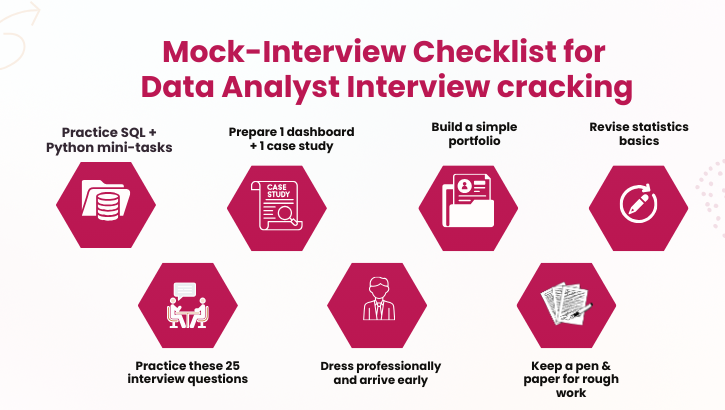
- Practice SQL + Python mini-tasks
- Prepare 1 dashboard + 1 case study
- Build a simple portfolio
- Revise statistics basics
- Practice these 25 interview questions
- Dress professionally and arrive early
- Keep a pen & paper for rough work
Practice SQL + Python mini-tasks
Interviewers often test your ability to write quick SQL queries or perform data manipulation using Python. Practise common tasks like joins, aggregations, filtering, and using Pandas functions. Short, focused exercises every day will sharpen your problem-solving speed and accuracy.
Prepare 1 dashboard + 1 case study
Having a dashboard (Power BI/Tableau) and a business case study demonstrates practical ability. A dashboard highlights your visualization skills, while a case study shows how you approach a real business problem from start to finish. Together, they immediately prove your job-readiness.
Build a simple portfolio
A well-organized portfolio even a basic one sets you apart from other candidates. Include 2–3 projects with clear descriptions, screenshots, datasets used, code snippets, and insights generated. Keep it structured and easy for recruiters to review in under 2 minutes.
Revise statistics basics
Most interviews test your understanding of mean, median, variance, probability, correlation, regression, and hypothesis testing. Clear conceptual knowledge helps you answer confidently and gives context to your analytical decisions.
Practice these 25 interview questions
Rehearse your answers out loud and check for clarity, confidence, and structure. Use the STAR method (Situation, Task, Action, Result) for experience-based questions. Good preparation ensures you speak naturally instead of memorizing answers.
Dress professionally and arrive early
Your first impression matters. Dress neatly in formal or business-casual attire and reach the venue (or virtual meeting) at least 10–15 minutes early. It shows professionalism, respect for time, and readiness.
Keep a pen & paper for rough work
During analytics interviews, you may need to sketch logic, write SQL structures, or calculate values. Keeping a notepad handy helps you organize your thought process and present your ideas clearly.
Ready to Get Hired in 2025?
Get personalized support, real projects, and placement guidance.