The world of work is changing faster than ever. Artificial Intelligence (AI) is no longer just a buzzword, it is reshaping how companies attract, hire, and retain talent. At the same time, a new generation, Gen Z, is entering the workforce with radically different expectations. Together, AI and Gen Z are creating new workforce models that HR leaders cannot ignore.
But here’s the paradox: while technology offers speed and scale, it also raises questions of fairness and trust. Meanwhile, younger employees are demanding more than salaries they want purpose, flexibility, inclusivity, and growth.
The question every HR leader and CEO must ask is this: Are we building future-ready recruitment models, or are we repeating old mistakes with new tools?
Recruiters today face an impossible balancing act. On one hand, there is immense pressure to fill roles quickly in a competitive market. On the other, the workforce they are hiring is more fluid and less loyal than ever.
A recent Deloitte survey in India shows that 47% of Gen Z professionals plan to leave their jobs within two years, prioritizing growth, and alignment with their values over mere stability. Many cite lack of learning, mentorship, and purpose as triggers for turnover.
Traditional retention strategies like pay raises and job security no longer guaranteed loyalty. The same Deloitte data reveals that beyond salary, on-the-job learning, mentorship, and meaningful work are among the top decision drivers for Gen Zs when choosing or staying in a role
This dilemma raises a pressing question: if recruiters can no longer rely on “yesterday’s playbook,” how should they adapt?
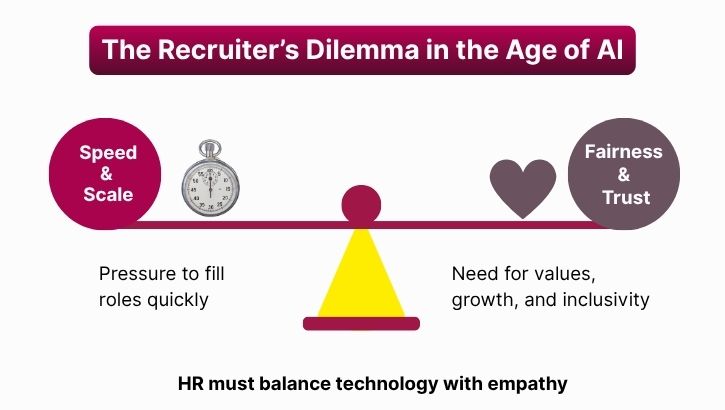
For decades, companies assumed that if they offered salary hikes, bonuses, perks, and job security, employees would stay loyal. This model worked in a world where stability mattered most.
But today’s Gen Z workforce sees things differently. They value purpose over paychecks, flexibility over formality, and growth over guarantees. A recent survey by Deloitte shows that 89% of Gen Zs and millennials consider having a sense of purpose important to job satisfaction and well-being. Many have turned down roles or switched jobs when the roles didn’t match their values.
The lesson? What worked yesterday won’t work tomorrow. HR leaders must rethink retention through the lens of values, inclusivity, and development opportunities.
Here lies one of the greatest contradictions in HR today:
Millions of resumes flood HR inboxes every year.
Yet, leaders still say they “can’t find the right talent.”
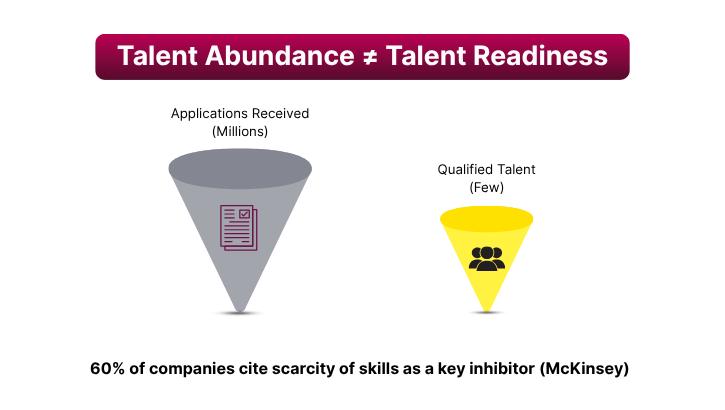
This is the Talent Abundance–Scarcity Paradox. The problem is not a lack of candidates, it’s a skills mismatch.
According to a McKinsey analysis, 60% of companies cite scarcity of tech talent and skills as a key inhibitor for their digital transformations.
So while HR teams drown in applications, the truth is clear: abundance of applications ≠ abundance of skills.
This paradox calls for a smarter, skills-first approach where HRs don’t just screen resumes but actively identify, train, and develop talent pipelines for the future.
Today’s candidates behave like consumers. They expect fast responses, transparent communication, and personalized experiences. Yet, many recruitment processes remain lengthy, impersonal, and opaque.
More than half of candidates abandon job applications when the form is too long or the process is overly complex, a LiveCareer report finds 57% of applicants quit mid-application due to frustration with the length or complexity.
For Gen Z, who are digital natives, waiting weeks for a response feels outdated. They expect real-time communication, sometimes through chatbots, instant notifications, or personalized recommendations.
This experience gap not only frustrates candidates but also damages employer branding. In a world where social media amplifies every review, a poor hiring experience can quickly turn away top talent.
AI is being hailed as the great disruptor in recruitment. But is it a friend or foe?
Why AI is a Friend
Unilever’s case is a great example. By adopting gamified neuroscience-based assessments and AI video interviews, they reduced time-to-hire by 75%, reduced recruiter hours significantly, and improved diversity outcomes.
The lesson? AI is powerful, but not perfect. It can empower HR when used responsibly or damage trust when misused.
To adapt to this new era, HR leaders must embrace modern frameworks that align with both AI and Gen Z expectations. One of the most powerful among these is the T-Shaped Skills Model.
What It Means
Why It Matters
Surveys and studies indicate a major skills mismatch — many organizations report readiness gaps in areas like digital, collaboration, AI literacy, problem solving. T-Shaped professionals help bridge these gaps because they bring both deep expertise and enough exposure to other domains to work across silos. Enabling Innovation & Agility
Teams composed of T-shaped members tend to be more creative, more capable of solving complex problems which span multiple disciplines, and better at adapting when change hits. Harvard Business Review and thought leadership pieces often point to T-shaped talent as key for cross-functional innovation.
How HR Leaders Can Build T-Shaped Talent
The classic model says:
In today’s world, this model needs to be digitally reimagined:
A key driver for this shift is how fast skills are becoming obsolete. According to Harvard Business Review, the half-life of many skills is now less than five years, and in some tech fields it has fallen to about 2.5 years. What we learn today might be outdated within a few years unless it is refreshed. Harvard Business Review
Organizations must therefore treat learning as ongoing—not just a one-time event. This means embedding learning in the flow of work, making it adaptive, making feedback continuous, and enabling employees to build both deep skills and broad, cross-functional capabilities.
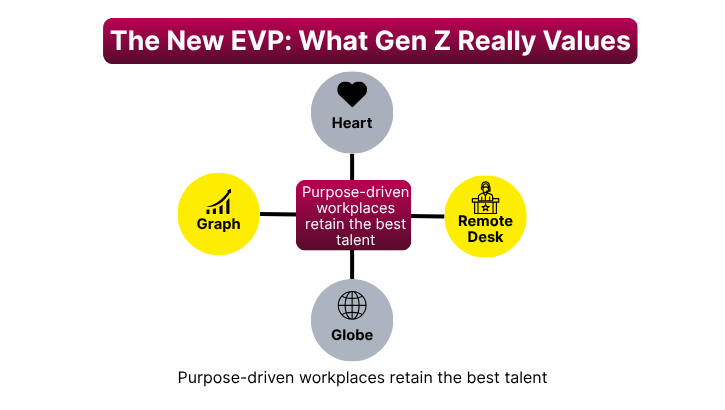
Recent surveys show that for Gen Z (and millennials), alignment with values isn’t optional, it’s essential. According to Deloitte’s 2025 Gen Z & Millennial Survey, 47% of Gen Zs and 49% of millennials have left a job because it lacked purpose or did not align with their values.
Another finding: nearly 90% of Gen Zs and millennials consider a sense of purpose very or somewhat important to job satisfaction and well-being.
This is a wake-up call for HR leaders. Building a compelling EVP isn’t just about competitive salaries anymore, it’s about embedding organizational values in everything: how you lead, how you communicate, how you reward, and how you evolve. When values and purpose are clear and lived, people stay. When they aren’t, even the best salary can’t hold onto talent.
What Indian HR Leaders Can Do
India presents both unique opportunities and complex challenges. With over 65% of its population under the age of 35, the country has one of the youngest workforces in the world, and rapid digital adoption is transforming industries at record speed (weforum.org). This demographic dividend puts India in a position to lead in HR innovation but only if leaders act decisively.
Here’s what Indian HR leaders should focus on:
Use AI where it adds real value: resume screening, candidate engagement, attrition prediction but ensure the final hiring and promotion decisions remain human-led. This balance preserves empathy and accountability.
Bias doesn’t disappear just because a process is digital. Regularly audit AI recruitment and performance tools to uncover gender, caste, or regional biases before they become systemic. As Amazon’s failed experiment showed, unchecked algorithms can amplify discrimination.
McKinsey research shows that skills now have a half-life of about 2.5 to 5 years, especially in technology roles. Indian companies must embed continuous learning cultures blending classroom training with micro-learning, AI-driven nudges, and project rotations.
A Deloitte survey finds that nearly 90% of Gen Z and millennials consider a sense of purpose essential to job satisfaction. Indian HR leaders must craft EVPs that highlight not just salaries, but purpose, flexibility, inclusivity, and growth.
India’s diversity across languages, regions, and socioeconomic backgrounds demands HR strategies that ensure opportunity is equitable. AI systems must be trained on diverse datasets to avoid replicating old cultural and social biases.
So, will AI replace HR? The answer is no. But HR professionals who ignore AI may well be replaced by those who embrace it.
The real future lies in AI + HR collaboration. AI can bring speed, scale, and insights. HR can bring empathy, ethics, and purpose. Together, they can design workforce models that are not only efficient but also fair and human.