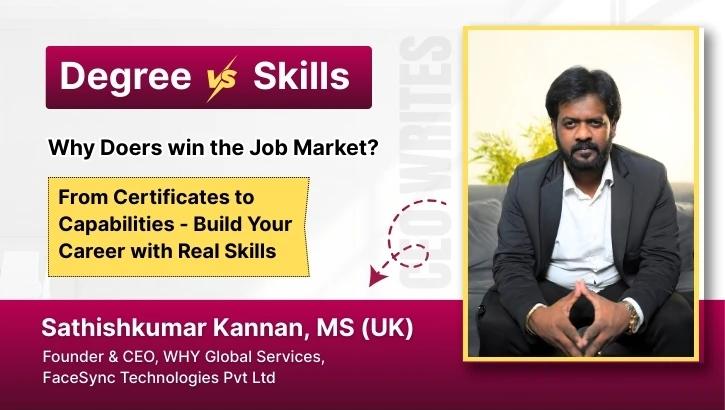
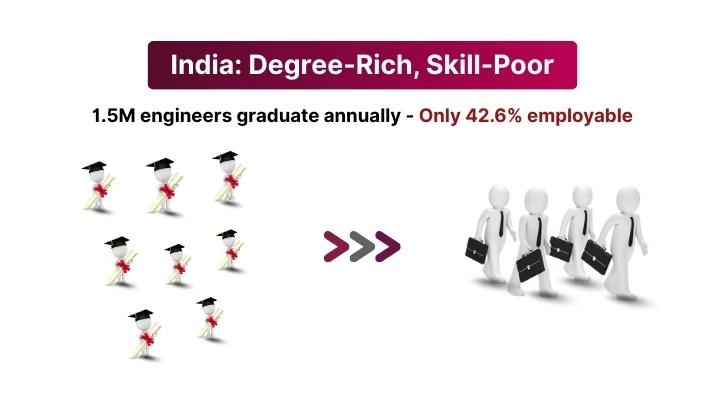
Every year, India awards 1.5 million engineering degrees and millions more across arts, commerce, science, and professional disciplines. Yet, a sobering truth shadows this achievement: only 42.6% of Indian graduates are actually employable, according to the Mercer-Mettl Graduate Skill Index 2025, a decline from 44.3% in 2023.
This gap between credentials and competence presents a stark reality: India is degree-rich but skill-poor. Despite producing vast numbers of graduates, the job market isn’t absorbing them because academic certificates alone no longer hold value.
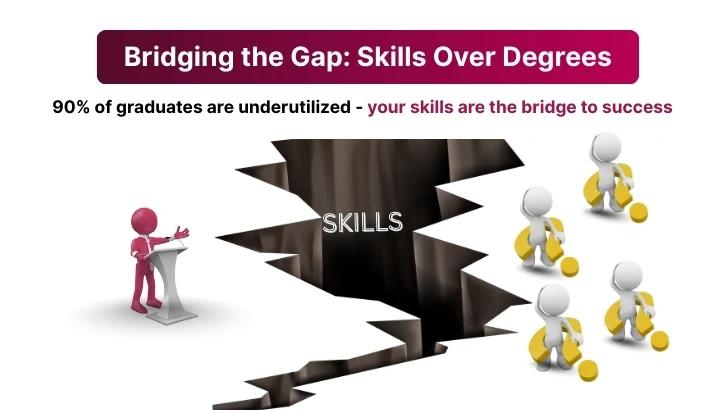
In the words of experts: out of 1.4 million graduates, only 140,000 secure placements, leaving 90% unemployed or underutilized.
Even as some bright spots emerge like nearly 46% employability in AI and machine learning this only highlights the disparity in employability across disciplines: technical specialities see traction, while non-technical roles like HR and digital marketing languish between 39% and 41%.
Meanwhile, with India aiming to build a $1 trillion digital economy by 2030, this skills disconnect risks turning our demographic dividend into a burden unless we urgently bridge theory and application.
Welcome to the Graduate Paradox: where degrees are abundant, but employability is scarce.
For decades, a degree certificate was the golden ticket. In India especially, it symbolized not just education, but status, security, and respect.
But the world changed. Automation, globalization, and AI have rewritten the rules. Today, a degree may still get you into the interview room, but it won't keep you employed. In fact, McKinsey reports that by 2030, 375 million workers globally may need to switch occupations due to automation and AI.
In India, the disconnect is starker: despite record graduation numbers, over 80% of engineers are not employable in the knowledge economy, according to an employability report by Aspiring Minds (business-standard.com).
In other words, degrees are no longer currency. They are the entry ticket but the real exchange rate in the job market is now skills, adaptability, and proof of work.
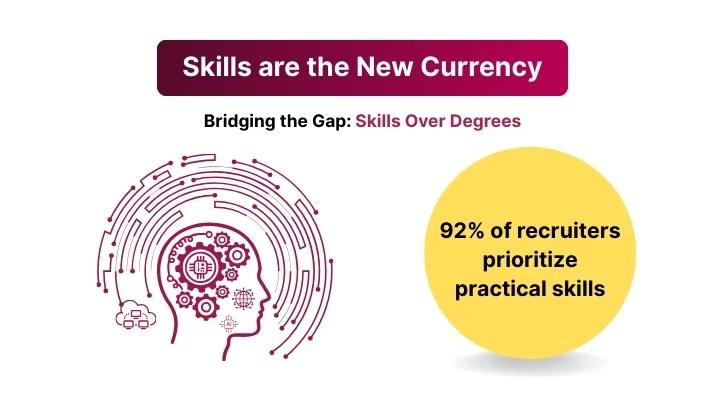
In today's digital economy, worth is no longer measured by degrees, it's measured in capability. From AI to Cybersecurity, employers demand workflow fluency, not just credentials.
India’s booming AI sector exposes the gap: for every 10 generative AI roles, only 1 engineer has the right skills, leaving 90% of critical roles unfilled and slowing growth.
Recruiters have flipped priorities. A LinkedIn survey shows 76% of Indian professionals believe companies now value skills over degrees, and 82% of employers are willing to hire without formal experience if candidates can prove ability.
Indeed’s data confirms the shift: 51% of hiring managers value on-the-job experience over degrees, while BCG notes that skills-first hires stay 9% longer and grow faster.
As Microsoft India’s President Puneet Chandok said: “Just like you train your body, AI requires hands-on practice.” The message is clear: passive learning is obsolete. Skills are the new career currency.
Let’s be clear: degrees are not useless. They remain valuable in several ways:
The job market is undergoing a seismic shift. According to a World Economic Forum report, by 2027, 44% of workers’ skills will be disrupted by emerging technologies (weforum.org). Degrees can’t keep pace with this speed of change unless they’re paired with continuous upskilling.
Employers are echoing the same sentiment. A survey by LinkedIn found that 76% of Indian professionals believe companies now prioritize skills over degrees. Even Google, IBM, and Apple have eliminated degree requirements for many roles, signaling a skills-first future (forbes.com).
India stands at a historic inflection point. Our digital economy is projected to touch $1 trillion by 2030 (nasscom.in), making technology the backbone of national growth. Sectors like AI, Data Science, Cybersecurity, Cloud, and Full Stack Development are expected to contribute the lion’s share of this expansion.
But here’s the paradox: while the economy races ahead, the workforce is struggling to keep up.
Employers aren’t just hiring degrees anymore. They’re hiring problem-solvers, communicators, and learners who can deliver from Day 1.
Employers also emphasize skills that degrees rarely teach:
Recruiters are increasingly asking: “Show me what you’ve built.”
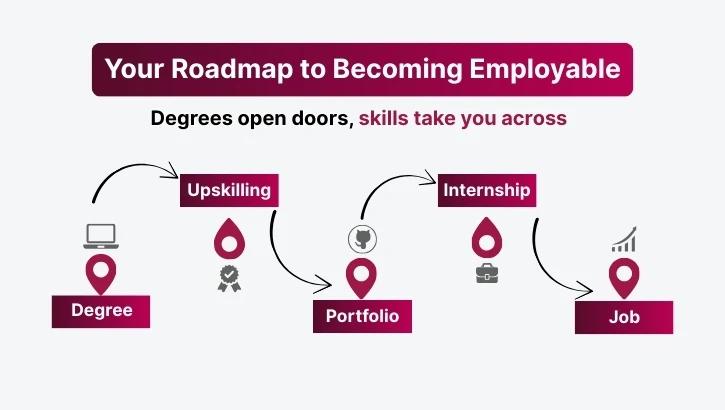
The employability crisis is real but it’s not a dead end. The good news? Students today have more access to skills, tools, and platforms than any previous generation. The difference between being unemployed and being in-demand often comes down to the steps you take now.
Here’s a practical 6-step roadmap:
Focus on areas that are shaping the future of work:
Action:
Start with free/affordable platforms like Coursera, edX, Kaggle, or LinkedIn Learning. Then move to structured programs with live projects (like WHY TAP).
Employers don’t just want a CV they want proof of work.
Action:
Set a goal of creating 3–4 portfolio projects in your field before graduation.
Industry certifications prove you can apply knowledge.
Action:
Pick 1–2 certifications aligned with your career path. They act as golden keys in interviews.
Every survey shows employers value soft skills as much as technical ones.
Action:
Join clubs, public speaking forums, or even record yourself explaining your projects on LinkedIn.
Nothing beats hands-on learning. A live project teaches what textbooks never can.
Action:
Target at least 6–12 months of project-based internship experience before applying for full-time roles.
Skills expire fast. WEF predicts that half of all skills will be outdated in just 4 years (weforum.org).
Action:
Create a Personal Development Plan (PDP) with clear milestones and review it quarterly.
At WHY TAP, we recognized early that traditional education alone cannot create employable graduates. The gap between degrees and industry is wide and unless we reimagine learning, students will keep graduating with certificates but no careers.
That’s why we built WHY TAP around four core pillars:
Most institutes teach theory first and delay practice. We flipped the model.
Example: A Full Stack student doesn’t just learn React or Node.js in class; they build client-facing apps, dashboards, and e-commerce projects that go live.
The future of learning is human + machine mentorship.
Result: Students graduate future-ready, not past-focused.
Education should empower, not burden.
Outcome: Students graduate debt-free and workplace-ready, with confidence that their time and skills have real market value.
We don’t stop at training. We walk the full journey with our students.
Evidence: WHY TAP alumni are now thriving as Full Stack Developers, Digital Marketers, Data Analysts, and Cybersecurity professionals across leading firms.
What makes us different?
In short, WHY TAP doesn’t just train. We transform. We take raw potential and shape it into job-ready, industry-ready professionals who can thrive in any market, in any era.
If you’re a student, remember this:
Because in today’s world, a degree may open the door — but only skills will get you a seat at the table.
And at WHY TAP, our mission is simple: to make sure every student who walks in with a degree, walks out with a career.