Top 10 Skills You Must Know to Become a Cybersecurity Expert
Sathishkumar Kannan, MS (UK)
15/07/2025
Share:
Table of Contents
1.
2.
3.
4.
5.
6.
7.
8.
9.
10.
11.
12.
13.
14.
15.
16.
17.
18.
19.
20.
21.
22.
23.
24.
25.
26.
27.
28.
29.
30.
31.
32.
33.
34.
35.
36.
37.
38.
39.
40.
41.
42.
Introduction
Imagine this: you’re sipping your morning coffee and checking emails. Suddenly, your company’s network goes dark. A ransomware popup flashes across every screen: “Pay in Bitcoin or lose everything.”
This isn’t fiction. It’s today’s reality:
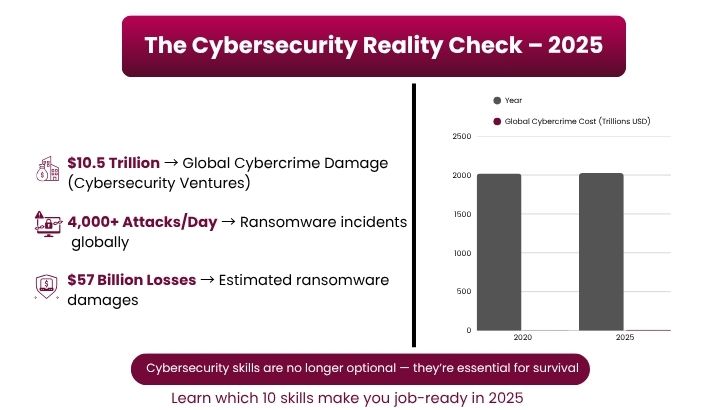
Global cybercrime
are projected to hit $10.5 trillion annually in 2025 (Cybersecurity Ventures).
Ransomware alone accounts for $57 billion in damages in 2025, with nearly 4,000 attacks happening worldwide every single day.
Cybersecurity is no longer just an IT concern, it’s a boardroom priority. Organizations across finance, healthcare, government, and e-commerce are desperate for skilled professionals who can safeguard their digital ecosystems.
For professionals and students, the message is clear: mastering cybersecurity skills is not optional, it’s essential.
In this article, I’ll outline the Top 10 cybersecurity skills you need in 2025, with insights into tools, certifications, and career relevance.
1. Networking Fundamentals
Before you can protect a network, you must understand how it works. Networking forms the foundation of every cybersecurity role, and without it, detecting or stopping attacks becomes nearly impossible.
Core Skills
Strong knowledge of TCP/IP, DNS, DHCP, HTTP/HTTPS
Configuring and managing Firewalls, VPNs, IDS/IPS
OSI model and network segmentation
Routing, switching, VLANs
Packet sniffing and analysis with tools like Wireshark
Responsibilities
Designing and securing network infrastructure
Monitoring traffic and identifying suspicious activity
Troubleshooting and resolving connectivity issues
Documenting and enforcing network access policies
Supporting SOC teams with network visibility
Why It Matters
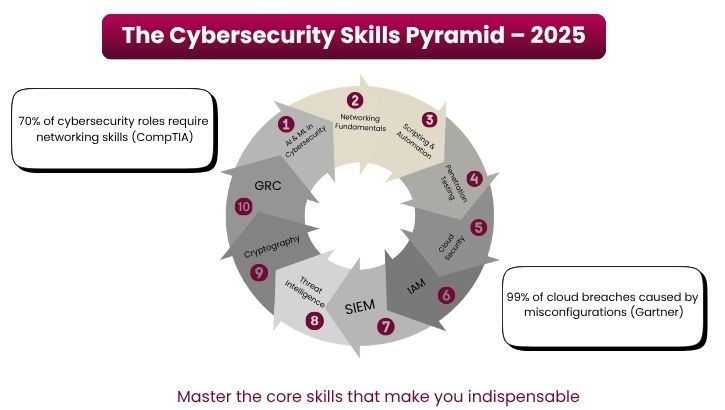
Over 70% of entry-level cybersecurity jobs require networking knowledge (CompTIA). Employers expect candidates to be comfortable with basic network security and troubleshooting. Certifications like Cisco CCNA are a strong plus.
Job Skill: Configure, monitor, and secure networks while quickly detecting unusual activity.
2. Scripting & Automation
Cybersecurity is a race against time. Attackers use automation to strike fast — defenders must do the same. Scripting allows professionals to react instantly and at scale.
Familiarity with exploit frameworks and reporting methods
Writing detailed vulnerability assessment reports
Responsibilities
Running vulnerability scans and penetration tests
Simulating real-world cyberattacks ethically
Reporting and prioritizing risks for remediation
Collaborating with development and IT teams to patch issues
Educating teams on common security gaps
Why It Matters
Bug bounty programs paid over $300 million to ethical hackers in 2023 HackerOne proving the high demand for these skills. Employers want testers who can proactively strengthen defenses.
Job Skill: Identify, simulate, and document vulnerabilities, providing actionable fixes before attackers exploit them.
4. Cloud Security
With most businesses moving to the cloud, cloud security is one of the most sought-after skills. Misconfigurations are the #1 cause of cloud breaches.
Core Skills
AWS, Azure, GCP security
Identity & Access Management (IAM)
Encryption, monitoring, cloud firewalls
Compliance frameworks (ISO, GDPR, DPDP)
Responsibilities
Securing workloads in cloud environments
Implementing IAM and zero-trust policies
Preventing misconfigurations and data leaks
Ensuring compliance with regulations
Why It Matters
Through 2025, 99% of cloud security failures will be due to misconfigurations (Gartner). Employers want professionals who can secure cloud apps and infrastructure.
Job Skill: Design, monitor, and secure cloud systems while preventing misconfigurations.
5. Identity & Access Management (IAM)
Every breach begins with stolen access. IAM ensures that only the right people, at the right time, with the right permissions can access systems.
Incident responders are highly paid because quick response can save millions in losses. Employers look for experts who ensure business continuity during crises.
Job Skill: Detect, contain, and recover from cyberattacks with minimal damage.
8. Cryptography
Encryption is the lock and key of cybersecurity. It protects sensitive data from interception and theft.
Core Skills
SSL/TLS, AES, RSA, PKI
Hashing algorithms (SHA, MD5)
Digital certificates and signatures
Responsibilities
Securing communications with encryption
Managing digital certificates and keys
Protecting sensitive data at rest and in transit
Adapting to post-quantum cryptography
Why It Matters
Cryptography underpins banking, defense, healthcare, and e-commerce security. Without it, no data is truly safe.
Job Skill: Apply encryption methods to secure data and communications.
9. Governance, Risk, and Compliance (GRC)
Cybersecurity isn’t only technical — it’s also about compliance. GRC ensures organizations align with global standards and avoid penalties.