About This IoT Workshop
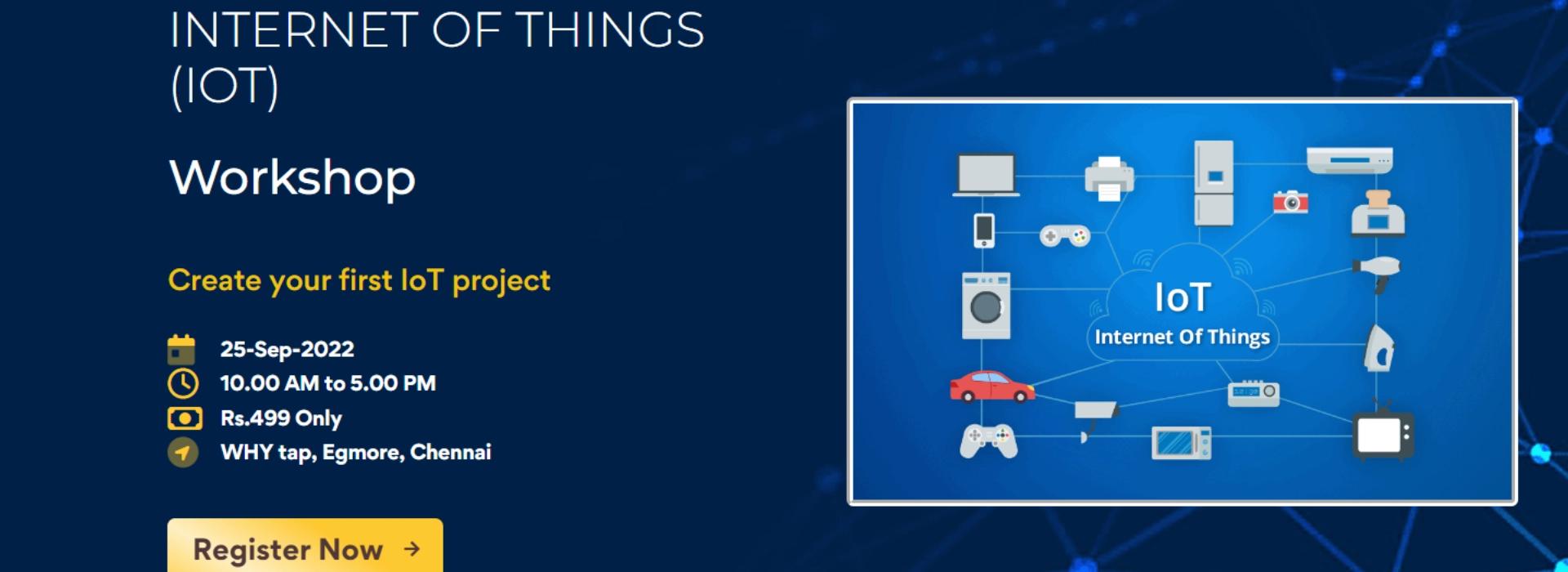
Come and attend our 1-Day IoT Workshop, where we provide hands-on learning to help you understand and develop IoT-based projects. This workshop mentions IoT concepts, architecture along with the languages that are used to create smart devices.
The Internet of Things (IoT) is a fascinating connection of electronic devices in such a way that vehicles, buildings, and everyday objects exchange information. As a result, with electronics connected to sensors and other forms of network occupation, they can collect and share data. The global IoT market was valued at 418 billion dollars back in 2021 and is anticipated to expand to approximately 1.6 trillion by 2025, confirming the growth prospect in a field that is quite alluring and with a fast-growing pace.
With this workshop, by the end, you will have developed your first IoT project and seen over 3 different IoT demo projects.
Topics to be Covered
1. What is IoT?
In this section, we will start the presentation with an introduction to the Internet of Things (IoT) and what it stands for. The discussion will involve how IoT integrates physical devices with the internet to become smart devices. Real-world applications like smart homes, healthcare monitoring, and industrial automation aim to provide an insight into how IoT shapes our world.
2. IoT Architecture
We will dig deeper into the hub and spoke architecture of IoT systems by discussing the various levels involved-from sensors acquiring the data to the cloud servers that retain it. You will learn how data moves through the IoT network and the role that each layer plays-and that is essential-in performing a working IoT system.
3. Introduction to NodeMCU
NodeMCU is a widely used microcontroller in almost every IoT project. Learn how to set up NodeMCU and hook it up to Wi-Fi networks, and use it as a base on which to build your IoT devices. By the end of this section, you will be able to create an IoT solution based on NodeMCU.
4. Types of Microcontrollers
- ESP8266
- ESP32
The features and capability of this microcontroller for IoT projects
5. Understanding MQTT Protocol
Get to know the MQTT (Message Queuing Telemetry Transport), a lightweight communication protocol generally used for IoT devices. This section will show you how the MQTT protocol allows for an efficient exchange of data, even on low-bandwidth networks, through a publish/subscribe model.
6. Arduino IDE for IoT Projects
- Installing Arduino IDE
- Coding in Embedded C
Learn coding and uploading programs for your IoT devices.
7. Cloud Server and Firebase Configuration
- Setting up Firebase
- Uploading data into the Server
Learn how to set up Firebase for your IoT projects so that it can store and manage data.
8. Visual Studio Setup
- Installation of Visual Studio
- Add extensions for IoT projects
- Connect VS Code to Firebase
- HTML coding and publishing a website with Firebase.
9. Demo Projects
You will apply everything you have learned themselves in the practical demo projects:
- Temperature and Humidity Monitoring
- LED Control
- Home Automation Using Firebase
By the end of the day, one must have a solid grasp of basic IoT concepts and practical knowledge of developing simple IoT projects using the internet. Don't take a chance on this exciting prospect of starting one of the most promising realms in technology!