




Table of Contents
- 1.
- 2.
- 2.1
- 3.
- 3.1
- 4.
- 5.
- 6.
- 7.
Recruiters don’t get impressed by certificates anymore. They get impressed by proof. And the strongest proof you can show is real-world data analytics projects that demonstrate how you solve actual business problems.
In today’s competitive hiring landscape, simply completing a course is not enough. Companies want to see how you think, how you structure analysis, and how you translate raw data into measurable impact. Your portfolio is no longer a side document; it is your primary selling point.
Strong real-world data analytics projects help you:
- Demonstrate technical depth
- Showcase business reasoning
- Prove problem-solving ability
- Build interview confidence
The difference between getting shortlisted and getting ignored often comes down to the quality of your projects.
In this blog, we’ll break down seven powerful project types that recruiters value, explain what makes them hiring-ready, and show you how to present them strategically so they actually help you get hired.
Why Real-World Data Analytics Projects Matter More Than Certificates
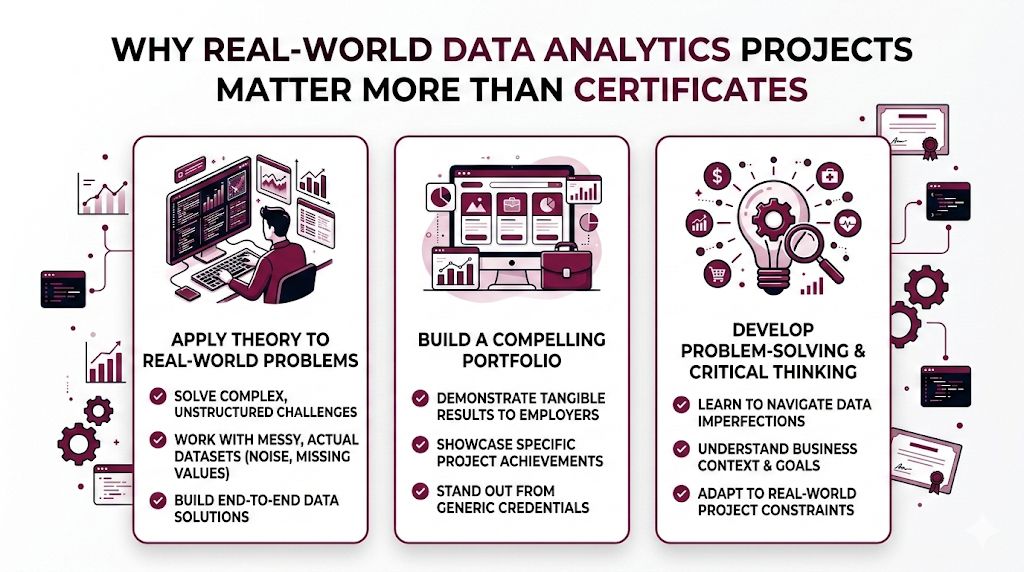
Certificates prove that you completed a course. Projects prove that you can deliver results.
In hiring conversations, recruiters rarely spend time discussing your certification syllabus. Instead, they dive deep into your portfolio.
They want to understand:
- What problem did you solve?
- Why did you choose that approach?
- What business impact did your analysis create?
- What would you improve if given more time?
This is where real-world data analytics projects make the difference.
A well-structured project shows applied thinking, not just theoretical knowledge. It demonstrates how you handle messy datasets, define KPIs, and extract meaningful insights.
Many hiring managers actively look at curated lists, like best data analyst projects to understand what meaningful portfolio work looks like. But simply copying ideas is not enough. Execution depth is what matters.
Here’s why projects outweigh certificates:
- They simulate real business scenarios
- They reveal your analytical reasoning
- They test your communication clarity
- They build interview talking points
Recruiters hire candidates who can solve problems, not just pass exams. Next, let’s understand what truly makes a project “hiring-ready.”
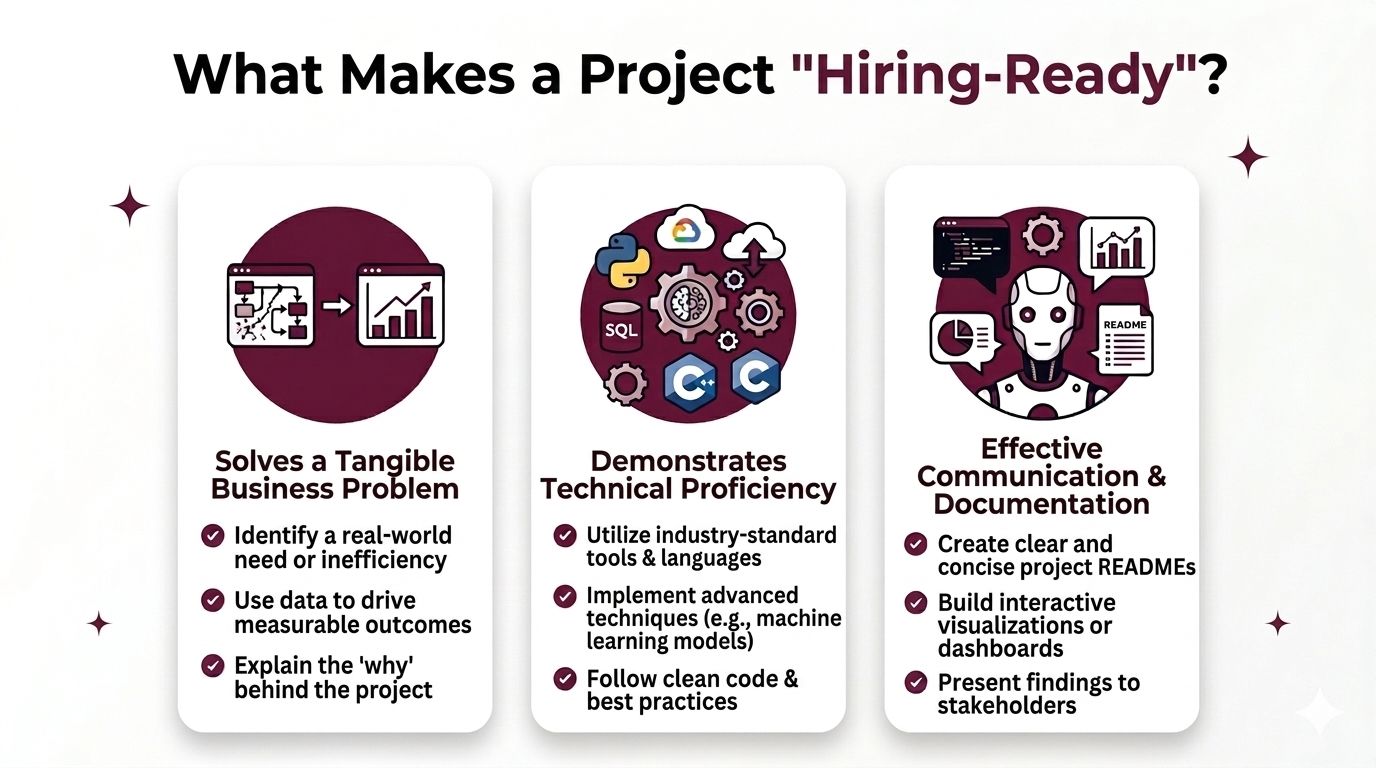
What Makes a Project “Hiring-Ready ”?
Not every project belongs in your portfolio.
Some projects help you learn. Others help you get hired.
A hiring-ready project goes beyond technical execution. It mirrors a real business scenario and demonstrates structured thinking from problem definition to final recommendation.
Strong real-world data analytics projects typically include:
- A clearly defined business objective
- Real or realistically messy datasets
- Well-defined KPIs
- Clear methodology explanation
- Measurable outcomes or recommendations
Recruiters are not impressed by dashboards alone. They want to see how you think through ambiguity, justify decisions, and connect insights to impact.
Tutorial Projects vs Portfolio Projects
Many candidates confuse tutorial completion with data analytics portfolio projects. There is a big difference. Tutorial projects often follow step-by-step instructions using clean datasets. They focus on tool usage.
Data analytics portfolio projects, on the other hand, require independent thinking. They demand that you define the problem, choose the right approach, and explain trade-offs.
Tutorial vs Hiring-Ready Project Comparison
| Aspect | Tutorial Project | Hiring-Ready Project |
|---|---|---|
| Dataset | Clean & predefined | Real-world & messy |
| Objective | Follow instructions | Solve business problems |
| KPIs | Generic | Business-driven |
| Interview depth | Limited discussion | Deep technical & strategic discussion |
If your project cannot survive 10 minutes of interview questioning, it is not hiring-ready.
Next, let’s explore the first three high-impact project types recruiters love.
Project #1–#3: Business-Centric Analytics Projects
If you want projects that instantly grab recruiter attention, start with business-driven analytics work. These projects simulate real decision-making scenarios and show that you understand impact, not just tools.
Here are three high-impact real-world data analytics projects that significantly strengthen your portfolio:
Sales Performance Dashboard
Business Problem: Why are sales declining in certain regions or product categories?
What You Analyze:
- Monthly revenue trends
- Regional performance
- Product-wise contribution
- KPI tracking (conversion rate, average order value)
Hiring Value: Demonstrates KPI alignment, dashboard clarity, and business storytelling.
2. Customer Churn Analysis
Business Problem: Why are customers leaving, and how can we reduce churn?
What You Analyze:
- Customer behavior patterns
- Retention metrics
- Risk segmentation
- Predictive churn probability
Hiring Value: Shows predictive thinking and data analytics projects for resume-impact awareness.
Strong portfolio inspiration can be found in curated data analytics portfolio projects but your depth of analysis must go beyond templates.
3. Marketing Campaign ROI Analysis
Business Problem: Did a campaign generate profitable returns?
What You Analyze:
- Campaign spend vs revenue
- Customer acquisition cost
- ROI and conversion efficiency
- Channel effectiveness
Hiring Value: Demonstrates financial reasoning and decision-support capability.
These three projects signal one thing to recruiters: You understand business impact.
Build Projects That Employers Respect
Building impactful projects requires more than downloading datasets. It requires structured guidance, business framing, and interview-level depth.
If you want to move beyond tutorial-based learning and work on industry-relevant case studies, explore structured industry-aligned analytics training that focuses on practical, hiring-ready projects.
The right guidance helps you:
- Choose meaningful business problems
- Structure analysis professionally
- Present insights with clarity
- Prepare confidently for technical interviews
Strong projects build strong interviews.
Project #4–#5: Technical Depth Projects
Business-facing dashboards are powerful, but technical depth separates average candidates from strong ones.
Recruiters want to see that you can handle raw data, optimize queries, and work with complex datasets independently. Technical depth projects prove execution strength.
Here are two high-impact technical projects:
4️. Data Cleaning & Preprocessing Automation
Business Problem: Raw datasets often contain missing values, duplicates, inconsistent formats, and noise. Poor data quality leads to poor decisions.
What You Demonstrate:
- Handling missing values strategically
- Detecting outliers
- Data transformation logic
- Automated preprocessing pipelines
Hiring Signal: Shows reliability and data integrity awareness a critical skill in real-world environments.
5️. SQL-Based Business Intelligence Analysis
Business Problem: Organizations rely heavily on SQL to extract insights from structured databases.
What You Demonstrate:
- Complex joins and subqueries
- Aggregation and KPI computation
- Query optimization
- Business-oriented data interpretation
Hiring Signal: Proves strong execution skills and logical thinking.
Skill Demonstration Mapping
| Project | Core skill highlight | Hiring signal |
|---|---|---|
| Cleaning automation | Data preprocessing | Technical reliability |
| SQL Bi Analysis | Query optimization | Execution depth |
| Sales dashboard | KPI tracking | Business clarity |
| Churn model | Predictive reasoning | Strategic thinking |
Technical projects add credibility to your portfolio. They show that you can move beyond visuals and understand what happens behind the scenes.
Project #6–#7: Advanced & AI-Integrated Projects
If you want your portfolio to stand out in 2026, AI-integrated projects are powerful differentiators. These projects signal that you are not just comfortable with analytics; you are future-ready.
Recruiters increasingly value candidates who understand how to combine analytics with predictive and AI-driven techniques.
Here are two high-impact advanced projects:
6. Predictive Demand Forecasting
Business Problem: How can a company predict product demand to reduce stockouts or overstock?
What You Demonstrate:
- Time-series analysis
- Trend and seasonality modeling
- Forecast validation
- Business scenario evaluation
Hiring Signal: Shows forward-thinking capability and cost-optimization awareness.
7️. AI-Assisted Customer Segmentation
Business Problem: How can businesses identify high-value customers and personalize strategies?
What You Demonstrate:
- Clustering techniques
- Feature engineering
- Behavioral segmentation
- Business strategy alignment
Projects like these align with curated lists such as
data analytics projects to get hired, but true hiring advantage comes from explaining your decision logic, not just building the model.
Advanced projects signal:
- Strategic thinking
- AI collaboration skills
- Competitive market awareness
- Scalability mindset
If your portfolio includes at least one AI-integrated project, you position yourself as future-ready, not just technically competent.
Next, let’s discuss how to present these projects in a way that actually converts interviews into job offers.
How to Present These Projects to Actually Get Hired
Building strong real-world data analytics projects for a resume is only half the job. Presenting them correctly is what converts interviews into offers.
Many candidates lose opportunities not because their projects are weak but because their explanations lack structure.
Here’s how to present your projects strategically:
Start With the Business Problem
Do not begin with tools. Start with:
- What problem were you solving?
- Why did it matter?
- What KPI was affected?
Recruiters care about impact first, tools second.
Explain Your Decision-Making
Walk interviewers through:
- Why you chose that dataset
- Why you selected specific features
- Why you picked that model or method
- What trade-offs you considered
Depth creates confidence.
Quantify Results
Whenever possible, show measurable outcomes:
- Increased revenue by X%
- Reduced churn by Y%
- Improved forecast accuracy by Z%
Quantification builds credibility.
You can observe how structured portfolios translate into real results by reviewing verified placement outcomes from candidates who presented projects effectively.
Portfolio Depth vs Interview Impact
| Portfolio level | Recruiter reaction | Interview outcome |
|---|---|---|
| Basic tutorials | Entry-level skills | Shortlisting only |
| Business-driven projects | Job-ready candidate | Strong selection probability |
| AI-integrated analytics | Future-ready professional | Higher salary potential |
If you're unsure about your readiness, taking a structured career skill assessment can help identify gaps before interviews.
Strong presentation turns good projects into strong offers.
Conclusion
In today’s data analytics projects to get hired speak louder than certificates. Real-world data analytics projects demonstrate your ability to solve business problems, think critically, and communicate insights clearly.
Throughout this blog, we explored seven high-impact project types, from business-centric dashboards to AI-integrated forecasting models. The common thread is simple: depth, clarity, and measurable impact.
Recruiters are not looking for candidates who can follow tutorials. They are looking for professionals who can define problems, justify decisions, and deliver value. If your portfolio reflects real business thinking and structured execution, you don’t just apply for jobs you compete confidently for them.
The difference between getting noticed and getting hired often comes down to the strength of your projects.
Turn Your Projects Into Job Offers
Strong real-world data analytics portfolio projects can open doors, but structured guidance turns them into consistent job outcomes.
If you want to build business-driven projects, master technical depth, integrate AI concepts, and prepare for real hiring scenarios, the Certification in AI Powered Data Analytics is designed to help you do exactly that.
With industry-aligned case studies, project-based learning, and placement-focused preparation, you can move from learning analytics to getting hired in analytics.
Build smarter projects.Present them strategically.Compete with confidence.