






Table of Contents
- 1.
- 2.
- 3.
- 4.
- 5.
- 5.1
- 6.
- 7.
- 8.
- 8.1
- 9.
AI tools for SEO are transforming the way businesses approach AI content marketing tools and SEO automation tools in 2026. From keyword research and content planning to AI-powered content optimization and analytics, marketers now use AI SEO tools 2026 to improve productivity, streamline workflows, and create more search-focused content strategies. As search engines become smarter and competition for online visibility increases, AI-assisted tools are becoming essential for modern digital marketing.
Businesses and content creators use AI tools to support:
- Keyword research
- Search intent analysis
- Content optimization
- Blog drafting
- SEO performance tracking
These systems help marketers save time while improving efficiency and content scalability across multiple platforms.
Another major advantage of AI tools for SEO is faster decision-making. SEO professionals can now analyze audience behavior, monitor ranking trends, identify optimization opportunities, and improve content strategies with the help of SEO automation tools and AI-driven insights. However, human creativity, audience understanding, and strategic thinking still remain important because search engines continue prioritizing valuable and user-focused content. In the upcoming sections, we will discuss the best AI SEO tools 2026, how AI-powered content optimization improves productivity and search optimization, and which AI content marketing tools help marketers create better content, improve rankings, and streamline digital marketing strategies.
Why AI Tools Are Becoming Essential for SEO and Content Marketing
AI tools for SEO are becoming an important part of AI content marketing tools and SEO automation tools because digital marketing workflows are growing more complex and data-driven. In 2026, businesses need faster ways to analyze search trends, optimize content through AI-powered content optimization, and manage large-scale marketing strategies using AI SEO tools 2026 without sacrificing efficiency.
Traditional SEO processes often required significant manual work for:
- Keyword research
- Competitor analysis
- Content planning
- SEO audits
- Performance tracking
AI-powered tools now simplify many of these tasks through automation and predictive analysis.
One major reason marketers rely on AI systems is productivity. AI-assisted workflows help teams:
- Generate content ideas
- Identify ranking opportunities
- Analyze search intent
- Improve content structure
- Optimize existing pages
This reduces repetitive work and allows marketers to focus more on strategy and creativity.
AI tools are also improving search intent optimization. Modern search engines evaluate:
- User behavior
- Contextual relevance
- Semantic relationships
- Conversational queries
- Content usefulness
AI-powered platforms help marketers understand these patterns and create content that aligns more closely with audience expectations.
Another advantage is scalability. Businesses managing multiple websites or large content libraries use AI tools to:
- Automate SEO audits
- Track rankings
- Monitor content performance
- Organize workflows
- Improve publishing efficiency
These capabilities make AI-assisted marketing especially valuable for growing digital brands.
For marketers exploring modern AI marketing tools, understanding AI-powered SEO workflows can significantly improve productivity, optimization efficiency, and content marketing performance in 2026.
AI SEO Tools Help Improve Keyword Research and Search Optimization
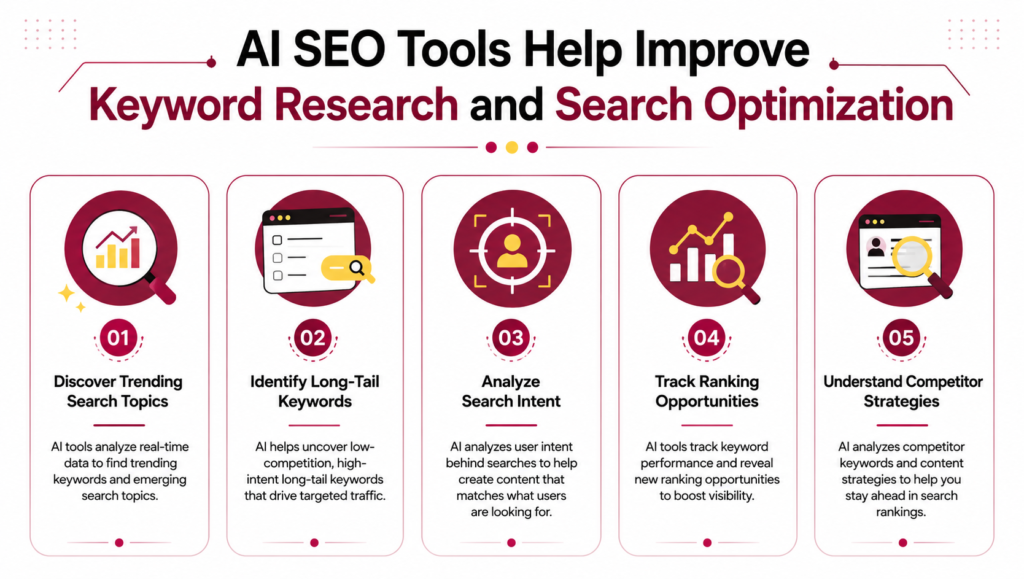
Keyword research and search optimization have become faster and more accurate with the help of AI tools for SEO and SEO automation tools. In 2026, marketers use AI SEO tools 2026 to discover search trends, analyze competition, understand user intent, and identify content opportunities through AI-powered content optimization and AI content marketing tools that would take much longer through manual research methods.
AI-powered keyword research tools help marketers:
- Discover trending search topics
- Identify long-tail keywords
- Analyze search intent
- Track ranking opportunities
- Understand competitor strategies
These insights help businesses create content that aligns more closely with what users are actively searching for.
Another major advantage is semantic SEO optimization. Instead of focusing only on exact-match keywords, AI tools now analyze:
- Related search terms
- Topic relationships
- Contextual relevance
- Conversational queries
- Audience search behavior
This helps marketers create more natural and comprehensive content strategies.
AI SEO Tool vs Marketing Benefit
| AI SEO Tool | Marketing Benefit |
|---|---|
| AI Keyword Research Tools | Faster search analysis |
| AI Content Optimization Tools | Better SEO performance |
| SEO Analytics Platforms | Improved ranking insights |
| AI Workflow Automation | Higher productivity |
AI SEO tools also support:
- Content gap analysis
- Technical SEO audits
- Internal linking suggestions
- Search trend monitoring
- Ranking performance tracking
These features help marketers improve optimization workflows while reducing manual effort.
However, successful SEO still depends on content quality and audience understanding. AI tools can provide recommendations, but marketers still need to create:
- Valuable insights
- Clear explanations
- User-focused structure
- Helpful content experiences
- Strategic content planning
For businesses and marketers exploring modern AI SEO tools, understanding semantic optimization and AI-assisted keyword research is becoming essential for improving search visibility in 2026.
AI Writing and Content Optimization Tools Improve Productivity
Creating high-quality content consistently can be time-consuming, especially for businesses managing blogs, websites, social media, and SEO campaigns simultaneously. In 2026, AI writing and content optimization tools are helping marketers speed up content workflows while maintaining better organization and efficiency.
AI writing assistants support tasks such as:
- Blog outline generation
- Headline suggestions
- Content drafting
- Grammar improvement
- Meta description creation
These tools help reduce repetitive writing tasks and improve content production speed.
Another major advantage is content optimization. AI-powered platforms analyze factors like:
- Readability
- Keyword placement
- Search intent alignment
- Semantic relevance
- Content structure
This helps marketers improve SEO performance and audience experience before publishing content.
AI-assisted workflows are also useful for:
- Repurposing blog content
- Generating social media captions
- Creating email content
- Improving formatting
- Streamlining editing processes
As a result, content teams can manage larger publishing schedules more efficiently.
Despite these advantages, human input remains critical. AI tools may help generate ideas and structure, but marketers still need to improve:
- Brand voice
- Creativity
- Storytelling
- Audience understanding
- Strategic messaging
Content that lacks originality or emotional connection may struggle to engage readers effectively.
For marketers and students exploring modern AI tools, understanding how AI writing systems support content optimization can improve productivity and digital marketing workflows.
Best AI Tools for SEO and Content Marketing in 2026
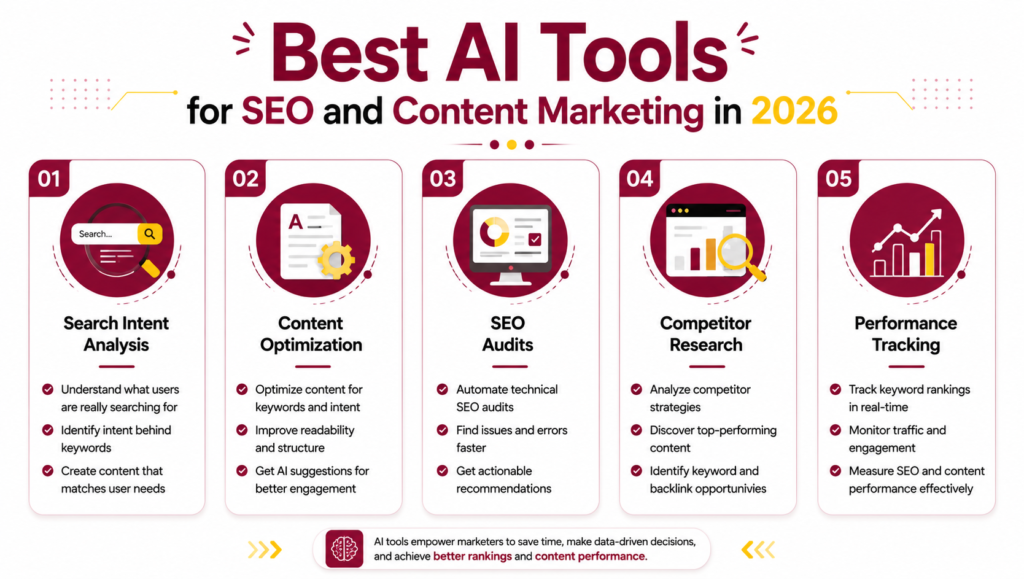
AI tools are reshaping SEO and content marketing by helping businesses create, optimize, and manage digital content more efficiently. In 2026, marketers rely on AI-powered platforms to streamline workflows, improve search visibility, analyze audience behavior, and scale content production across websites, blogs, and social media channels.
Modern SEO strategies now involve much more than traditional keyword research. Businesses use AI tools to support:
- Search intent analysis
- Content optimization
- SEO audits
- Competitor research
- Performance tracking
These systems help marketers identify opportunities faster and improve decision-making through automation and data-driven insights.
AI writing assistants and content optimization platforms are also helping teams produce content at a larger scale without spending excessive time on repetitive tasks. At the same time, search engines continue prioritizing useful, audience-focused, and original content, which means human creativity and strategic thinking still remain highly important. In the upcoming sections, we will discuss the best AI tools for SEO and content marketing in 2026, how AI-powered workflows improve productivity and search optimization, and which tools help marketers create better content, improve rankings, and streamline digital marketing strategies.
AI-Powered Analytics and Automation Are Changing Content Marketing
Content marketing is becoming more data-driven, and AI-powered analytics tools are helping marketers understand how audiences interact with content across different platforms. In 2026, businesses use AI-assisted systems to track performance, identify engagement patterns, and improve content strategies more efficiently.
AI-powered analytics help marketers measure:
- Audience engagement
- Search performance
- Content reach
- User behavior
- Conversion trends
These insights allow businesses to understand which types of content perform best and where improvements are needed.
Automation is another major advantage. AI tools can now support:
- Automated reporting
- Content scheduling
- Audience segmentation
- Performance monitoring
- Workflow management
This reduces manual work and helps marketing teams manage larger content operations more effectively.
AI-assisted content analysis also helps businesses optimize:
- Blog readability
- Search intent alignment
- Content structure
- Keyword relevance
- User experience
As a result, marketers can improve both SEO performance and audience satisfaction.
Which AI SEO Skills Will Be Important in 2026?
Students and marketers preparing for future SEO and content marketing roles should focus on practical skills that combine analytics, optimization, and AI-assisted workflows.
Important AI SEO skills include:
- Search intent optimization
- Semantic SEO
- AI-assisted workflows
- Content strategy
- Audience analysis
- Data-driven SEO decision-making
Professionals who combine AI-powered efficiency with creativity and audience understanding are often better prepared for future digital marketing opportunities.
SEO Automation Tools Help Marketers Scale Content Faster
Managing SEO for multiple pages, blogs, and campaigns can become difficult without automation. In 2026, SEO automation tools help marketers handle repetitive optimization tasks more efficiently, allowing teams to scale content production and improve workflow management.
SEO automation tools are commonly used for:
- Site audits
- Rank tracking
- Content scheduling
- Internal linking suggestions
- Technical SEO monitoring
These systems help marketers identify issues quickly and maintain better optimization consistency across websites.
Another major benefit is faster content scaling. Businesses producing large amounts of content can use AI-powered systems to:
- Organize publishing workflows
- Generate optimization recommendations
- Monitor keyword performance
- Repurpose existing content
- Improve content management efficiency
This helps teams manage high-volume content strategies without slowing down production.
Content Marketing Workflow vs AI Support
| Content Marketing Workflow | AI Support |
|---|---|
| Keyword Research | Faster search analysis |
| Blog Drafting | AI-assisted writing support |
| Content Optimization | Better readability and SEO |
| Analytics Reporting | Automated performance tracking |
Automation tools also improve collaboration because marketers, writers, and SEO teams can track:
- Workflow progress
- Content performance
- Publishing schedules
- SEO recommendations
- Optimization updates
However, automation should support strategy rather than replace it. Successful SEO still depends on:
- Audience-focused content
- Strong content quality
- Clear messaging
- Search intent understanding
- Human creativity
For marketers exploring modern SEO automation strategies, combining automation with strategic content planning can improve productivity and long-term SEO performance.
Common Mistakes Marketers Make While Using AI SEO Tools
AI SEO tools can improve productivity and optimization workflows, but relying on them without proper strategy can create serious content quality issues. In 2026, many marketers make the mistake of depending too heavily on automation instead of balancing AI efficiency with human creativity and audience understanding.
One common issue is publishing AI-generated content without proper editing. This often leads to:
- Repetitive wording
- Generic explanations
- Weak originality
- Poor readability
- Low audience engagement
Search engines increasingly prioritize helpful and high-quality content, so poorly edited AI content may struggle to perform well.
Another mistake is focusing only on keywords while ignoring search intent. Some marketers use AI tools to generate keyword-heavy content without understanding:
- User expectations
- Audience behavior
- Contextual relevance
- Content usefulness
- Search journey stages
Modern SEO works better when content solves real user problems instead of simply targeting search phrases.
Overautomation is another growing concern. Some businesses automate:
- Content publishing
- Link building
- Content generation
- SEO recommendations
- Reporting workflows
without reviewing quality or strategic alignment. Excessive automation can reduce authenticity and audience trust.
Marketers should also avoid:
- Copying AI-generated outputs directly
- Ignoring brand voice
- Publishing thin content
- Overlooking factual accuracy
- Neglecting human storytelling
AI tools work best when they support research, optimization, and workflow efficiency rather than completely replacing creative thinking.
For students and marketers who want to evaluate their SEO, analytics, and content strategy strengths, this skill assessment can help identify improvement areas related to AI-powered digital marketing workflows.
How Students and Marketers Can Learn AI-Powered SEO Strategies
Learning AI-powered SEO strategies in 2026 requires a combination of technical SEO knowledge, content strategy understanding, and practical experience with modern AI tools. Since search engines and content platforms continue evolving rapidly, students and marketers must stay updated with both automation workflows and audience-focused optimization practices.
One effective way to start learning is by exploring AI-assisted SEO tools used for:
- Keyword research
- Search intent analysis
- Content optimization
- SEO audits
- Analytics reporting
Practical experimentation helps learners understand how these systems support real-world digital marketing workflows.
Students should also focus on building strong content strategy skills because AI tools work best when combined with:
- Audience understanding
- Clear messaging
- Semantic SEO
- Content structure
- User-focused writing
Successful SEO still depends heavily on valuable and relevant content experiences.
Another important area is understanding search intent and semantic optimization. Modern search engines evaluate:
- Contextual relevance
- Topic depth
- User engagement
- Conversational search patterns
- Content usefulness
Marketers who understand these factors are often better prepared to create high-performing SEO content.
Continuous learning is also important because AI-powered marketing tools continue changing through:
- Search engine updates
- Automation improvements
- AI-generated content systems
- Analytics advancements
- SEO workflow innovations
Students and professionals who combine AI-assisted workflows with creativity, critical thinking, and strategic content planning are generally more prepared for future opportunities in SEO and content marketing.
Final Thoughts
AI tools are transforming SEO and content marketing by improving productivity, automation, analytics, and optimization workflows. Businesses now use AI-powered systems to manage keyword research, search intent analysis, content creation, and performance tracking more efficiently across digital platforms.
In 2026, semantic SEO, conversational search, AI-assisted analytics, and automation-driven workflows will continue influencing how marketers plan and optimize content strategies. At the same time, search engines still prioritize originality, audience value, and helpful content experiences, making human creativity and strategic thinking highly important.
As digital marketing continues evolving, students and marketers must learn how to combine AI-powered efficiency with audience-focused content strategy. Professionals who understand both automation tools and user behavior will be better prepared for future opportunities in SEO, content marketing, and AI-driven digital growth.
Build Future-Ready AI SEO and Content Marketing Skills
AI-powered tools are changing how businesses approach SEO, content creation, analytics, and digital marketing workflows. Companies now look for professionals who can use AI systems effectively while still creating valuable, audience-focused, and search-optimized content that improves visibility and engagement.
To improve AI-powered SEO and content marketing skills, learners should focus on:
- Search intent optimization
- Semantic SEO
- AI-assisted content workflows
- Keyword research strategies
- Content optimization
- Analytics and performance tracking
If you want to build industry-ready expertise with practical learning exposure and future-focused marketing preparation, this AI marketing certification can help support your journey toward long-term success in SEO and content marketing.