

Table of Contents
- 1.
- 2.
- 2.1
- 2.2
- 2.3
- 2.4
- 3.
- 3.1
- 3.2
- 3.3
- 3.4
- 4.
- 4.1
- 4.2
- 4.3
- 5.
- 5.1
- 5.2
- 5.3
- 5.4
- 5.5
- 6.
- 6.1
- 6.2
- 6.3
- 6.4
- 7.
- 7.1
- 7.2
- 7.3
- 7.4
- 8.
- 8.1
- 8.2
- 8.3
- 8.4
- 8.5
- 9.
- 9.1
- 9.2
- 9.3
- 9.4
- 9.5
- 10.
- 10.1
- 10.2
- 10.3
- 10.4
- 10.5
- 11.
Introduction
In India, the fear that AI will replace human jobs is no longer theoretical it’s already reshaping hiring. According to the World Economic Forum, AI and automation will displace 85 million jobs globally but create 97 million new roles, many of them skill-intensive and human-led. Closer home, McKinsey estimates that up to 30% of work activities in India could be automated by 2030, especially in repetitive and low-skill roles future jobs in india.
This has created a real problem for students and professionals: What should you learn today to stay employable tomorrow? The answer isn’t avoiding AIit’s understanding where AI stops and human value begins. This blog breaks down the reality of AI vs human jobs in India, explains which roles are genuinely at risk, and shows the skills and creative abilities that will actually get you hired in 2026, even in an AI-first job market.
Understanding the AI Job Disruption future jobs in India
AI is no longer an experiment in India; it’s already reshaping how companies hire and operate. From IT services to banking and e-commerce, organizations now use AI to automate repetitive work, speed up decisions, and reduce dependency on large manual teams. According to the World Economic Forum, automation and AI will transform over 40% of core job skills globally by 2027. India, with its scale-driven workforce, feels this impact faster than many countries.
Why AI Adoption Is Growing Rapidly in India
Indian businesses adopt AI for practical, not futuristic, reasons.
- High volume of repetitive tasks
- Cost pressure in IT and services
- Growing AI talent ecosystem
- Digital-first government and startups
The NASSCOM reports that India’s AI market is expected to reach $25 billion by 2027, driven largely by enterprise automation and analytics.
Jobs Most Affected by AI in India
AI targets roles built around repetition and predictability.
- Data entry & document processing
- Basic customer support (chatbots, voice bots)
- Manual reporting and MIS roles
- Template-based content creation
Example:
Banks now use AI to process loan applications in minutes a task that earlier required multiple clerks and days of manual checks.
Jobs AI Is Creating in India
While some tasks disappear, new roles emerge.
- AI operations & monitoring roles
- Business analysts interpreting AI insights
- Automation testers & model reviewers
- AI product and process managers
Job Impact Snapshot
Job Impact Snapshot
| Work Type | Human Dependence | AI Role | |
|---|---|---|---|
| Repetitive tasks | Analysis & reporting | Strategy & creativity | Client interaction |
| Low | Medium | High | Very high |
| Fully automated | AI-assisted | Human-led | Human essential |
Reality check:
AI doesn’t replace people it replaces routine work. Indian professionals who move into thinking, decision-making, and creative roles stay relevant.
The Real Comparison
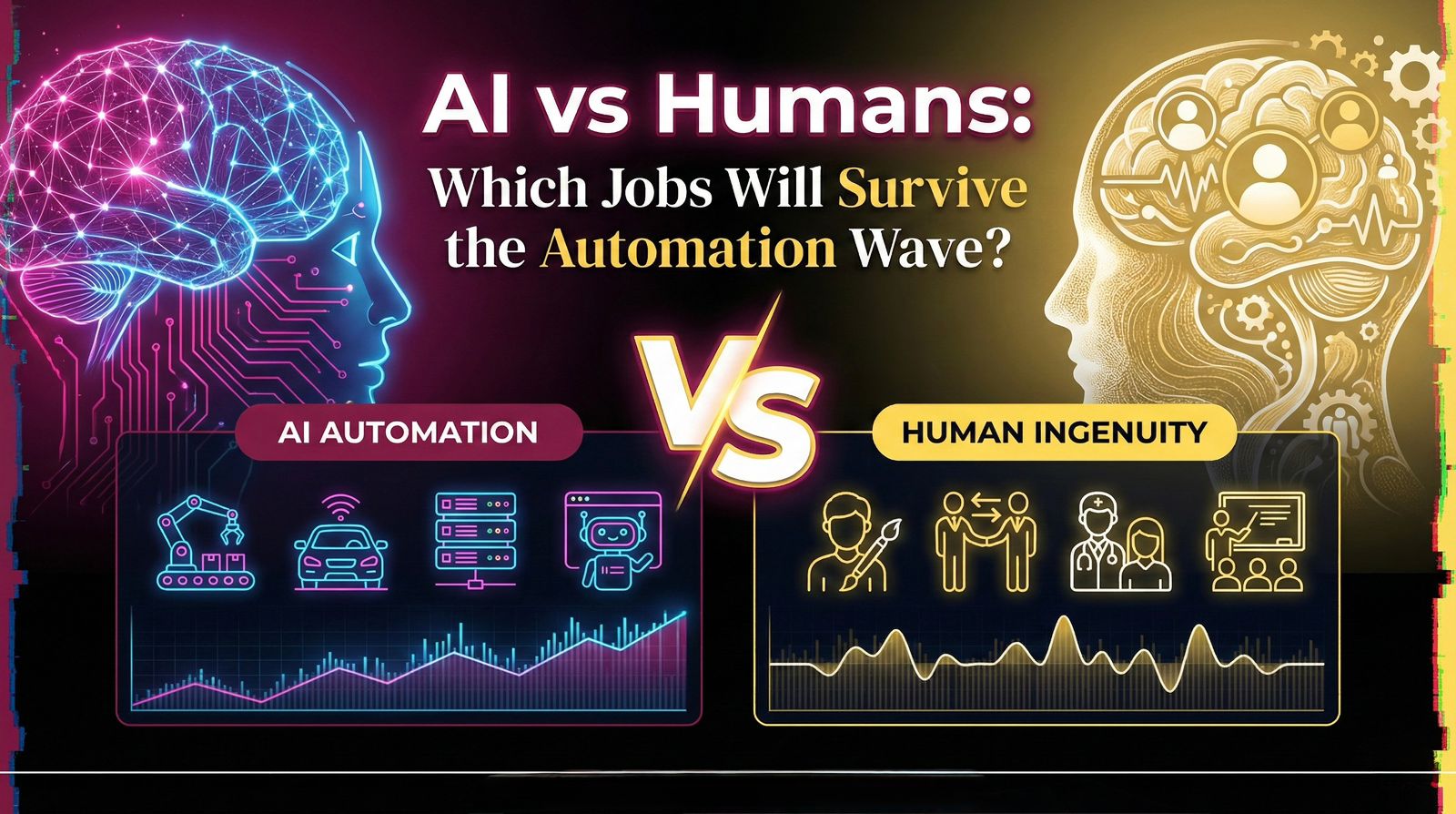
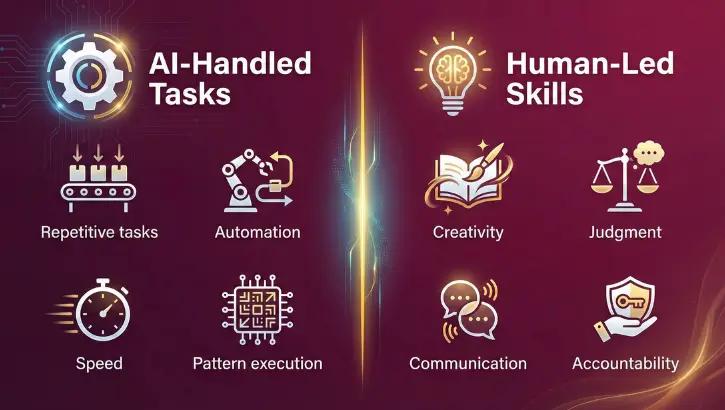
The AI debate in India often sounds extreme either AI will take all jobs or AI can’t replace humans. The truth sits in between. AI performs brilliantly at speed, scale, and repetition, while humans dominate judgment, creativity, and accountability.
According to the IBM Institute for Business Value, nearly 40% of the global workforce will need reskilling due to AI adoption, not because jobs disappear, but because job expectations change. India reflects this shift clearly.
What AI Does Better Than Humans
AI excels when rules stay fixed and data stays large.
- Processes huge data volumes in seconds
- Works 24/7 without fatigue
- Reduces errors in repetitive tasks
- Cuts operational costs
Example:
E-commerce platforms use AI to auto-generate invoices, track inventory, and predict demand tasks that earlier needed entire operations teams.
What Humans Do Better Than AI
Humans win where context, emotion, and responsibility matter.
- Make decisions with incomplete data
- Understand cultural and local nuances
- Build trust with customers and teams
- Take ethical responsibility for outcomes
Example:
AI can shortlist resumes, but a hiring manager decides who fits the team, who can grow, and who handles pressure.
The Real Comparison (India-Focused)
- AI replaces tasks, not roles
- Humans guide AI outputs and decisions
- Jobs evolve instead of disappearing
AI vs Human Strengths Snapshot
- AI dominates: data entry, basic support, reporting
- Humans dominate: strategy, creativity, leadership, sales
In India’s job market, companies don’t choose AI or humans. They hire humans who know how to use AI and still think independently.
The Hiring Reality in 2026
By 2026, hiring in India will no longer revolve around degrees alone. According to the 2024 Microsoft and LinkedIn Work Trend Index, 71% of leaders would rather hire a less experienced candidate with AI skills than a veteran without them. Furthermore, LinkedIn’s 2026 ‘Jobs on the Rise’ report confirms that in India, the demand for AI fluency is reshaping recruitment, with roles like Prompt Engineer leading the market.
What Recruiters Actually Look For in 2026
Companies don’t ask, “Can you do this task?”
They ask, “Can you think when AI gives you 10 options?”
Recruiters prioritize candidates who can:
- Interpret AI-generated insights
- Make decisions under uncertainty
- Communicate ideas clearly
- Take ownership of outcomes
- Adapt quickly to new tools
Example:
Two candidates use the same AI tool to analyze sales data. One copies insights. The other explains why sales dropped, what to fix, and what to test next. The second gets hired.
Degrees vs Skills — The New Hiring Equation
Degrees vs Skills — The New Hiring Equation
| Factor | 2020 Hiring | 2026 Hiring | ||
|---|---|---|---|---|
| Degree | Certifications | Problem-solving | AI tool usage | Real projects |
| Mandatory | Nice to have | Secondary | Rare | Optional |
| Optional | Supporting proof | Critical | Expected | Mandatory |
Skills That Trigger Hiring Decisions
- Critical and analytical thinking
- Creativity and idea execution
- Business understanding
- Communication and storytelling
- Ethical judgment and accountability
The Reality Check
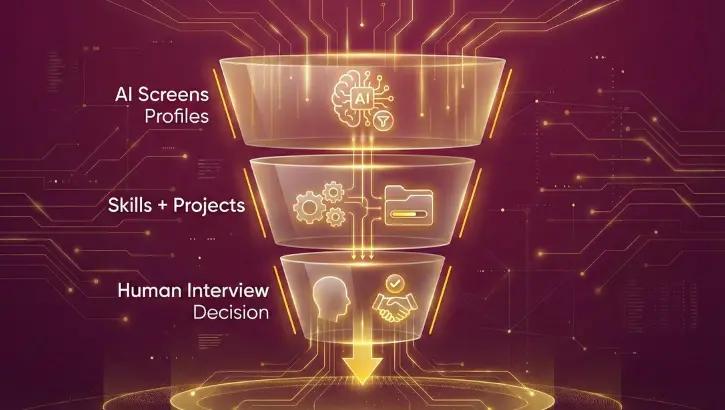
AI filters resumes, screens candidates, and suggests answers but humans make the final call. Employers in 2026 hire people who add judgment, creativity, and clarity where AI stops.Skills That Will Actually Get You Hired in 2026
By 2026, Indian employers won’t hire people for what they know they’ll hire them for how they think and apply knowledge. AI already handles execution. Humans must handle judgment, creativity, and direction. According to LinkedIn Learning Report, skills-based hiring has grown by over 60% in the last few years, and the trend continues upward.
1. Critical Thinking & Problem Solving
AI gives answers. Employers want people who ask the right questions.
- Break complex problems into clear steps
- Challenge AI outputs instead of accepting them blindly
- Decide under uncertainty
Example:
AI suggests increasing ad spend. A skilled marketer questions the data, checks margins, and tests alternatives before acting.
2. Human Creativity with Business Sense
Creativity without purpose doesn’t get hired.
- Storytelling tied to outcomes
- Design thinking and user empathy
- Idea execution, not just ideation
Example:
AI writes 10 captions. A human chooses one, adapts it to local culture, and aligns it with brand goals.
3. Communication & Influence
Clear thinking means nothing without clear communication.
- Explain ideas simply
- Persuade teams and clients
- Present AI-backed insights confidently
4. AI Fluency (Not AI Dependence)
Employers expect you to work with AI.
- Use AI tools to speed up tasks
- Validate outputs with logic
- Combine domain knowledge with AI insights
5. Proof of Skills, Not Certificates
- Live projects
- Internships
- Case studies
- Portfolios
Hiring truth:
People who combine thinking + creativity + AI fluency won’t just survive 2026 they’ll lead it.
Jobs That Are Safest from AI in India
AI handles speed and repetition well, but it struggles with human connection, judgment, and creativity. That gap makes certain jobs in India far safer than others. According to IBM Institute for Business Value, roles that require decision-making, collaboration, and people skills continue to see strong demand even as automation grows.
1. Creative & Strategy Roles
These jobs depend on original thinking and context areas where AI falls short.
- Brand strategists
- UX/UI designers
- Content strategists
- Creative directors
Example:
AI can generate logo options, but a brand strategist decides which design fits Indian cultural values and long-term positioning.
2. Human-Centric Professions
Jobs that rely on empathy, trust, and real-time interaction stay resilient.
- Teachers & corporate trainers
- Counselors & psychologists
- Sales leaders & relationship managers
- HR and people operations professionals
Example:
An AI chatbot answers HR questions, but a human HR manager resolves conflicts and builds team morale.
3. Leadership & Decision-Making Roles
AI supports leaders, but it can’t take responsibility.
- Product managers
- Business heads
- Project leaders
- Operations managers
4. Tech Roles That AI Supports, Not Replaces
AI assists these professionals rather than replacing them.
- Data analysts
- Cybersecurity experts
- AI engineers
- Product designers
Example:
AI flags a security threat. A cybersecurity expert decides how to respond and prevent future risks.
Jobs remain safest when they involve creativity, empathy, accountability, and strategic thinking skills AI cannot replicate.
How Indian Students & Professionals Should Prepare Now
AI won’t suddenly change the job market in 2026 it already has. The mistake most Indian students and professionals make is preparing for old hiring rules. According to LinkedIn Workplace Learning data, nearly 65% of hiring managers now prioritise skills and real-world experience over degrees alone.
1. Stop Chasing Certificates. Start Building Thinking
Courses help but only when they translate into action.
- Learn why a problem exists, not just how to solve it
- Question AI outputs instead of copying them
- Practice decision-making with imperfect data
Example:
Instead of learning Excel formulas only, analyse real sales data and explain business insights.
2. Build Proof That You Can Do the Job
Employers trust evidence, not promises.
- Live projects
- Internships or freelancing
- Case studies
- Portfolios or GitHub profiles
Example:
A fresher with 3 real dashboards beats someone with 10 certificates and no projects.
3. Learn to Work With AI (Not Depend on It)
AI is a tool, not a replacement for thinking.
- Use AI to speed up research
- Validate results using logic and domain knowledge
- Apply human judgment before decisions
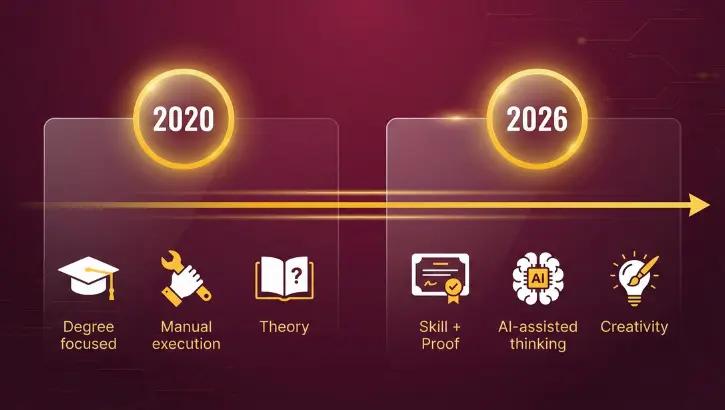
Preparation Shift: Old vs New
| Old Approach | 2026-Ready Approach | ||
|---|---|---|---|
| Degree-focused | Tool memorisation | Theory learning | Manual execution |
| Skill + proof focused | Problem-solving mindset | Project-based learning | AI-assisted thinking |
4. Strengthen Human Skills That AI Can’t Copy
- Communication
- Creativity
- Adaptability
- Accountability
Final advice:
Indian professionals who combine skills, thinking, and AI fluency won’t chase jobs in 2026 jobs will chase them.
What Recruiters in India Will Look for in 2026
Recruiters in India are no longer impressed by long resumes or stacked certificates. By 2026, they will focus on impact, adaptability, and decision-making ability. AI already screens resumes and shortlists profiles, so human recruiters spend time only on candidates who stand out beyond keywords.
1. Proof of Impact, Not Just Job Titles
Recruiters want to see what you changed, not just where you worked.
- Measurable results (growth, savings, efficiency)
- Clear problem–action–outcome stories
- Ownership of projects
Example:
“Managed social media” won’t impress.
“Increased engagement by 38% using data-backed content experiments” will.
2. Thinking Over Execution
AI handles execution. Recruiters test how you think.
- Ability to explain why you chose an approach
- Comfort with ambiguity
- Logical reasoning under pressure
Example:
During interviews, recruiters now ask candidates to critique AI-generated answers instead of writing from scratch.
3. Communication & Business Understanding
Technical skills alone don’t close offers.
- Explain complex ideas simply
- Understand business goals
- Influence teams and clients
Example:
A data analyst who explains insights in business language beats one who only talks in numbers.
4. AI Fluency Without Dependency
Recruiters expect AI familiarity, not blind usage.
- Smart use of AI tools
- Awareness of AI limitations
- Ethical judgment
5. Cultural & Team Fit
- Collaboration skills
- Growth mindset
- Accountability
Recruiter truth:
In 2026, Indian companies will hire people who think clearly, communicate confidently, and add human judgment where AI stops.
Common Myths About AI and Jobs in India
AI discussions in India often swing between panic and denial. Both mindsets hurt careers. Let’s break the most common myths and look at what actually happens in the job market.
Myth 1: “AI Will Replace All Jobs in India”
AI doesn’t wipe out jobs it removes repetitive tasks.
- Automation targets routine work
- Decision-making and creativity stay human
- New roles appear alongside AI
Example:
Banks use AI to verify documents, but relationship managers still handle customer trust and approvals.
Myth 2: “Only Tech Professionals Will Survive”
This myth scares non-tech professionals the most.
- Sales needs persuasion, not code
- HR needs empathy, not algorithms
- Marketing needs creativity, not automation alone
Example:
AI generates ad copies, but a marketer decides messaging based on Indian culture and audience emotion.
Myth 3: “Degrees and Certificates Are Enough”
Recruiters no longer hire based on marks alone.
- Skills matter more than credentials
- Proof beats promises
- Real projects beat theory
Example:
A fresher with hands-on dashboards and case studies often gets hired over a gold-medalist with no practical exposure.
Myth 4: “AI Thinks Better Than Humans”
AI predicts patterns it doesn’t understand consequences.
- No moral judgment
- No accountability
- No real-world intuition
Example:
AI may suggest layoffs to cut costs. Humans evaluate morale, brand impact, and long-term growth.
Myth 5: “Using AI Means Cheating”
Smart professionals already use AI responsibly.
- AI speeds up work
- Humans make final decisions
Reality check:
In India, careers suffer not because of AI but because people refuse to adapt.
Future Outlook
The future of work in India won’t be a battle between humans and machines. It will be a collaboration. By 2026 and beyond, AI will sit inside almost every role just like smartphones and the internet do today. People who understand this shift will move faster than those who fear it.
How Jobs in India Will Evolve
AI will continue to automate routine work, but it will increase the value of human judgment.
- Routine execution will shrink
- Decision-making roles will grow
- Creative and strategic work will expand
- Human accountability will matter more
Example:
In digital marketing, AI will run ad experiments automatically. Humans will decide budgets, brand tone, and long-term strategy.
The Rise of Hybrid Professionals
The most in-demand professionals will blend domain knowledge + AI skills + human thinking.
- Data analysts who understand business
- Designers who use AI but think user-first
- Managers who lead AI-driven teams
Example:
A product manager won’t write code daily but will guide AI-powered features using customer insight.
India’s Advantage in the AI Era
India stands out for one reason adaptability.
- Large, young workforce
- Fast learning culture
- Strong service and tech ecosystem
What Will Not Change
- Companies still need leaders
- Customers still want trust
- Teams still need humans
The Long-Term Reality
- AI becomes a co-worker, not a competitor
- Jobs won’t vanish overnight they’ll evolve
- Human creativity and ethics gain value
Conclusion: The Real Winner in AI vs Human Jobs in India
The future of work in India isn’t about choosing between humans and AI it’s about how well humans adapt. AI will continue to automate repetitive tasks, speed up execution, and reduce costs. But it cannot replace judgment, creativity, accountability, or human connection. That’s where real career security lies.
By 2026, Indian employers won’t hire people who compete with AI. They’ll hire professionals who think critically, communicate clearly, and use AI as a tool not a crutch. Degrees and certificates alone won’t protect careers anymore. Skills, real-world experience, and the ability to turn AI outputs into smart decisions will.
If you want to stay relevant, the path is clear: stop fearing AI and start learning how to work with it intelligently. Programs like the PG Certification in AI-Powered Digital Marketing by WHY TAP focus exactly on this combining human creativity, strategic thinking, and AI-driven execution.
The AI era won’t wait.
The professionals who prepare now will lead the job market tomorrow.