




Table of Contents
- 1.
- 2.
- 3.
- 4.
- 5.
- 6.
- 7.
- 8.
- 9.
- 10.
- 11.
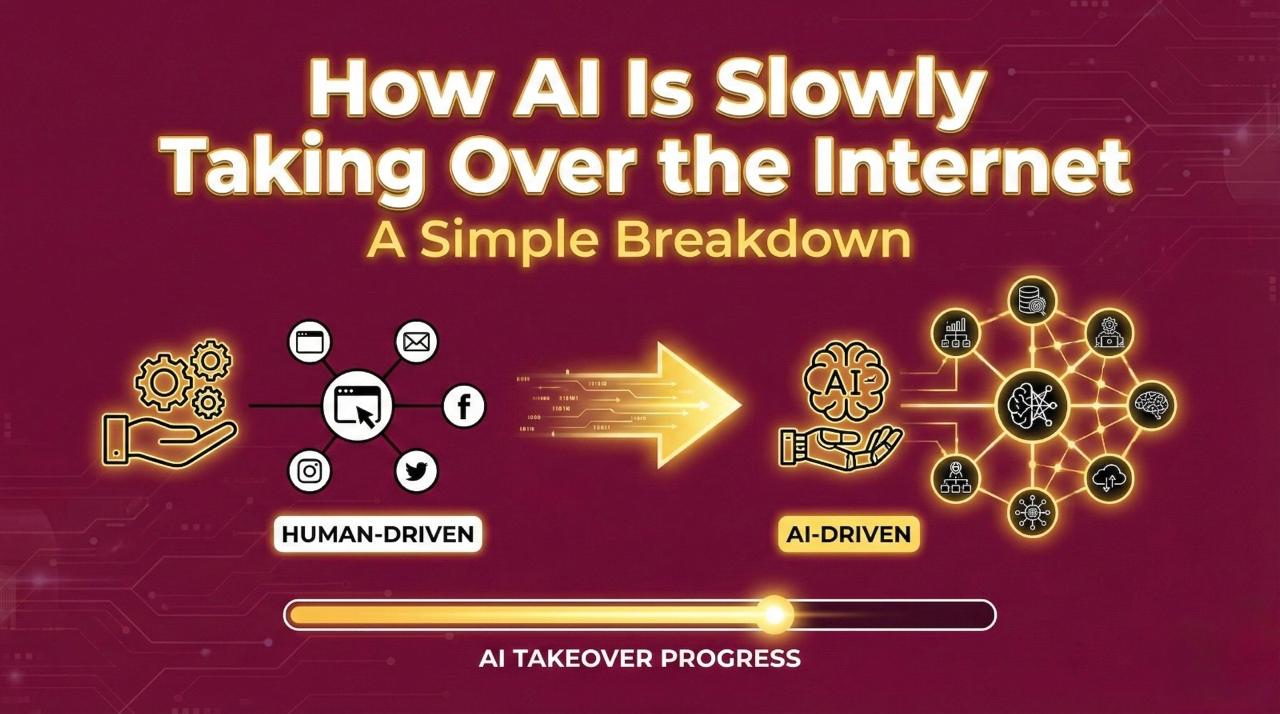
Artificial Intelligence is no longer a futuristic concept. It has quietly become the backbone of the modern internet. Whether you are browsing social media, searching on Google, shopping online, or interacting with digital content, AI is behind the scenes controlling, optimizing, and personalizing nearly everything you see.
According to McKinsey & Company, AI adoption has more than doubled since 2017, affecting almost every major digital sector. What most people don’t realise is this:
AI isn’t taking over the internet suddenly, it’s happening slowly, consistently, and everywhere.
This article breaks down, in the simplest terms, how AI is taking over the internet, why it matters, and what students and professionals must know to stay relevant.
1. AI Controls What You See Online
Today, AI decides your online experience more than you do.
Examples of AI control:
- YouTube: 70%+ of watch-time comes from AI recommendations
- TikTok: The For You Page is entirely AI-driven
- Instagram: AI predicts what keeps you scrolling longer
How it works
AI reads your:
- Likes
- Comments
- Watch duration
- Pause time
- Rewatch patterns
- Scrolling speed
Your feed becomes a personalized world designed by AI.
This is the first major way AI is taking over the internet by controlling visibility.
2. Search Engines Are Becoming AI Answer Engines
Search is undergoing the biggest transformation in its history, and it’s happening faster than most people realise. For nearly two decades, search engines worked the same way, you type a query, and they show a list of websites. But in 2025, this model is being replaced by AI-generated answers, reshaping how information is delivered, consumed, and trusted online.
Google’s introduction of AI Overviews has made this shift very clear. Instead of displaying only blue links, Google now provides instant, AI-generated summaries, pulling insights from multiple sources and presenting them in a conversational format. Users no longer need to click ten different links the answer appears immediately at the top of the page. This is one of the strongest signs of how AI is taking over the internet at a fundamental level.
Similarly, Bing’s integration of OpenAI models has turned search into a chat-like experience. Instead of browsing through pages, users get direct, natural responses. The search engine behaves more like an intelligent assistant than a traditional index of websites.
Tools like ChatGPT, Claude, and Perplexity have accelerated this shift even further. Millions of people now prefer asking AI tools for explanations, summaries, comparisons, and recommendations because the responses are faster, clearer, and customised to their query.
Why This Matters
The internet is clearly transitioning from Search → AI-Powered Answers
This shift impacts everyone:
- Users get faster, more personalised information
- Businesses must adapt their SEO strategies
- Students rely more on conversational AI for learning
- Content creators need AI-friendly content formats
This is not just a feature update; it’s a structural transformation of the web. As AI becomes the gateway to information, traditional search is fading. Understanding this shift is crucial because it shows exactly how AI is taking over the internet not by force, but by offering smarter, faster, more intuitive ways to access knowledge.
3. AI Shapes Online Shopping Like a Digital Salesperson
Among all industries transformed by technology, e-commerce is where AI dominates the most. From the moment you open an online store to the second you check out, artificial intelligence influences almost every part of your shopping journey. This isn’t happening loudly, it’s happening silently in the background, shaping what you see, what you click, and what you eventually buy.
How AI Controls the E-Commerce Experience
Modern online shopping is powered by AI systems that personalise the entire journey:
- Product Recommendations
AI studies your browsing, past purchases, wishlists, and even real-time behaviour to show products you’re most likely to buy. - Predictive Pricing
E-commerce platforms adjust prices dynamically based on demand, user interest, competitor pricing, and inventory. - Virtual Try-Ons
Fashion and beauty brands use AI-powered AR to let users “try before they buy,” boosting confidence and reducing returns. - Conversational Shopping Assistants
Chatbots answer queries, suggest products, and guide users—making shopping feel like chatting with a salesperson. - Auto-Generated Product Descriptions
AI tools instantly write SEO-driven descriptions, saving brands huge amounts of time.
Amazon reports that 35% of its total sales come directly from its AI-driven recommendation engine. That means over one-third of what people buy is influenced by machine learning—not human choice.
This is one of the clearest examples of how AI is taking over the internet, subtly shaping purchasing decisions and redefining the future of online commerce.
4. AI Content Creation Is Exploding
AI content creation is no longer a niche trend—it has become the engine powering a massive portion of the modern internet. What began as a tool for simple text generation has evolved into a multi-format revolution that includes writing, design, video, sound, and even interactive media. Today, AI tools are producing content at a scale the world has never seen.
Leading AI content creation tools such as ChatGPT, Claude, Midjourney, DALL·E, Runway ML, and Synthesia are helping creators, marketers, students, and businesses generate high-quality content in minutes. Whether it’s blogs, Instagram posts, YouTube scripts, ads, landing pages, or videos, AI now plays a major role in shaping what users consume online.
According to the World Economic Forum, generative AI has experienced one of the fastest adoption curves in digital history. Millions of users across the globe have integrated AI into their daily workflows, leading to an exponential rise in AI-generated content across platforms.
Why AI Content Creation Is Growing So Fast
- Speed + Scale
AI creates content in seconds, enabling brands and creators to publish faster than ever. - Cost Efficiency
Businesses reduce editing, design, and production costs by relying on AI-based automation. - Multi-Format Output
AI can generate text, images, videos, voiceovers, and even full automated scripts. - Personalization
AI analyzes audience preferences and tailors content for maximum engagement. - Human-AI Collaboration
Instead of replacing creators, AI is amplifying creativity.
Humans provide ideas → AI executes them → humans refine the output.
The Future of Content Is AI-Assisted
The next decade will not be dominated by humans OR machines—it will be dominated by humans who know how to use AI. Most online content will be either fully AI-generated or heavily AI-assisted.
AI content creation is not the future.
It’s happening right now and it’s taking over the digital world.
5. AI Is Becoming the Brain Behind Cybersecurity

Cybersecurity has officially entered an era where AI systems not humans serve as the primary line of defense. With cyberattacks becoming faster, more sophisticated, and more automated, traditional security methods simply cannot keep up. This is why AI in cybersecurity has become the backbone of modern digital protection.
AI now detects and prevents major threats in real time, including:
- Financial fraud attempts
- Phishing and social engineering attacks
- Malware and ransomware behavior
- Suspicious login patterns
- Automated bot traffic and API abuse
According to IBM Security’s annual report, AI-driven cybersecurity tools reduce breach detection time by nearly 27%, saving companies millions in potential damage. Instead of waiting for manual intervention, AI systems analyze massive amounts of data, identify patterns, and neutralize threats in milliseconds.
Why AI in Cybersecurity Is Taking Over
Pattern Recognition at Scale
AI can analyze billions of data points per second—far beyond human capacity. It detects anomalies instantly and flags behavior that looks unusual or dangerous.
Predictive Threat Intelligence
AI doesn’t just respond to attacks; it predicts them. This proactive approach protects networks before hackers even strike.
Automated Incident Response
Modern cybersecurity uses AI to isolate compromised systems, block IPs, or shut down malicious processes automatically.
Defense Against AI-Driven Attacks
Hackers are now using AI to generate phishing emails, deepfakes, malware, and automated exploits. Only AI-powered defense can match the speed and complexity of these attacks.
6. AI Is Changing Social Media Behaviour
AI doesn’t just show content — it shapes human behaviour.
Meta uses AI to predict:
- What you engage with
- Which ads you react to
- Which videos go viral
- What triggers your emotions
- What makes you stay longer
This leads to:
- Reduced attention spans
- Emotion-targeted feeds
- Behavioural shifts
- Algorithm-driven habits
The internet is no longer neutral —
AI algorithms decide what trends and what dies.
7. AI Is Transforming Education & Careers
AI is now the world’s largest digital tutor.
Students use AI for:
- Assignments
- Coding help
- Concept summaries
- Project explanations
- Research
- Job interview prep
Institutes like WHY TAP (Chennai) integrate AI into Full Stack, Data Science, Digital Marketing, and Prompt Engineering programs to help students stay industry-ready.
8. AI Automation Runs the Backend of the Internet
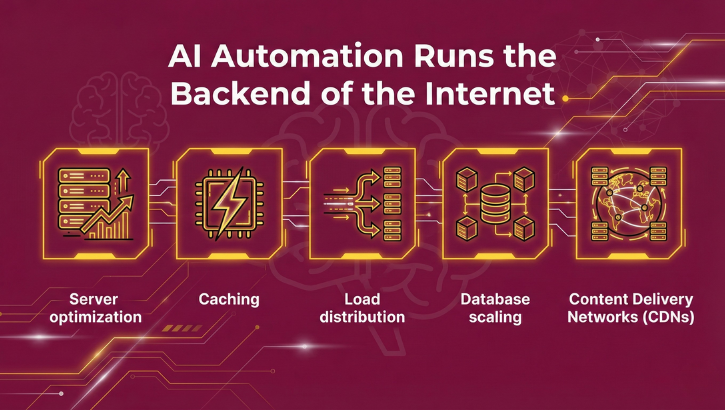
AI silently powers almost every backend digital system.
AI controls:
- Server optimization
- CDN routing
- Database scaling
- Caching decisions
- Website load balancing
Major cloud platforms (AWS, Google Cloud, Azure) rely heavily on AI automation.
This is why the modern internet feels faster, smarter, smoother.
9. AI Runs Digital Ads & Marketing (Almost 100%)
Digital advertising today is fully AI-driven.
AI manages:
- Targeting
- Bidding
- Budget optimization
- Creative testing
- Engagement prediction
- Conversion modeling
Google Smart Campaigns and Meta Advantage+ are AI-run ad systems.
AI now dominates performance marketing.
10. AI Predicts Trends Before They Happen
Platforms use AI to predict:
- Upcoming viral content
- Trending products
- Market demand
- User behaviour
- Viewing patterns
Examples:
- Netflix: 80% of watched content is AI-recommended
- Spotify: personalized playlists
- Amazon: predictive shopping
AI doesn’t follow trends, it creates them.
Will AI Take Over the Entire Internet?
Not in a science-fiction way.
But in a structural, functional way, AI has already taken over the internet.
AI today acts as:
- The recommendation engine
- The search assistant
- The content creator
- The security guard
- The predictor
- The digital advisor
- The data analyst
AI is now the core infrastructure layer of the digital world.
Why Students & Freshers Must Pay Attention
The future belongs to:
- AI-literate professionals
- AI-assisted developers
- AI-trained marketers
- AI-powered analysts
- AI-first designers
Institutes like WHY TAP train students in:
- AI Tools
- Prompt Engineering
- Full Stack + AI
- Data Science + AI
- Digital Marketing + Automation
Those who learn AI early will lead the next decade.
Conclusion
AI is not just influencing the internet, AI is becoming the internet.
From the content you consume to the ads you see, the searches you perform, and the products you buy — everything is increasingly AI-driven, personalized, and predictive.
The real question is not:
“Will AI take over the internet?”
It’s:
“Are you ready for an AI-driven internet era?”
Start learning AI now because the world has already moved ahead.