






Table of Contents
- 1.
- 2.
- 2.1
- 3.
- 3.1
- 4.
- 5.
- 6.
- 6.1
Choosing between Data Analyst vs Business Analyst careers can feel confusing, especially when both roles promise strong growth and high demand. Many students and professionals often compare Data Analyst vs Business Analyst roles but struggle to understand which path offers better scope, salary, and long-term stability. With companies increasingly relying on data-driven decisions, both careers have gained popularity yet they require different skill sets and career approaches.
Data analysts focus more on working with data, tools, and visualization to generate insights, while business analysts concentrate on understanding business problems and translating them into actionable strategies. Although both roles work with data and support decision-making, the core responsibilities in Data Analyst vs Business Analyst highlight important distinctions.
As we move toward 2026, demand for analytics professionals continues to grow across industries. The real question is not which role is better overall, but which one aligns better with your skills, career goals, and learning preferences. In the sections below, we will break down the key differences, salary comparisons, and future scope to help you make a clear and confident career decision.
Data Analyst vs Business Analyst - Understanding the Core Difference
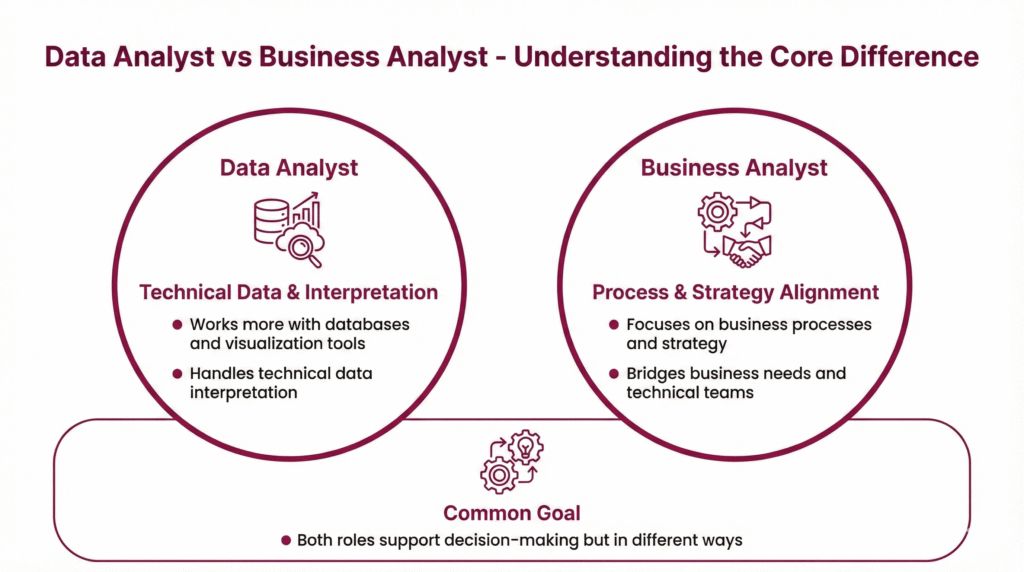
Although both roles work with data and support decision-making, the core responsibilities of difference between data analyst and business analyst A data analyst primarily focuses on collecting, cleaning, and analyzing data to generate insights, while a business analyst focuses on understanding business problems and recommending solutions that improve processes and performance.
According to this detailed role comparison, data analysts work more with technical tools and datasets, whereas business analysts interact closely with stakeholders to identify requirements and drive business improvements. Understanding this distinction in Data Analyst vs Business Analyst helps professionals choose a career aligned with their strengths and long-term goals, especially when considering data analyst career scope 2026.
Key differences between the two roles include:
- Data analysts work more with databases and visualization tools
- Business analysts focus on business processes and strategy
- Data analysts handle technical data interpretation
- Business analysts bridge business needs and technical teams
- Both roles support decision-making but in different ways
Data Analyst vs Business Analyst - Role Comparison
| Aspect | Data Analyst | Business Analyst |
|---|---|---|
| Primary focus | Data analysis & insights | Business problems & solutions |
| Tools used | SQL, Python, Power BI, Excel Excel, | PowerPoint, BI tools |
| Work style | Technical & data-focused | Business & strategy-focused |
| Stakeholder Work | Moderate | High |
| Output | Dashboards & reports | Business recommendations |
Understanding the difference between data analyst and business analyst helps you choose a role that matches your strengths and career goals.
Skills Required for Data Analyst vs Business Analyst
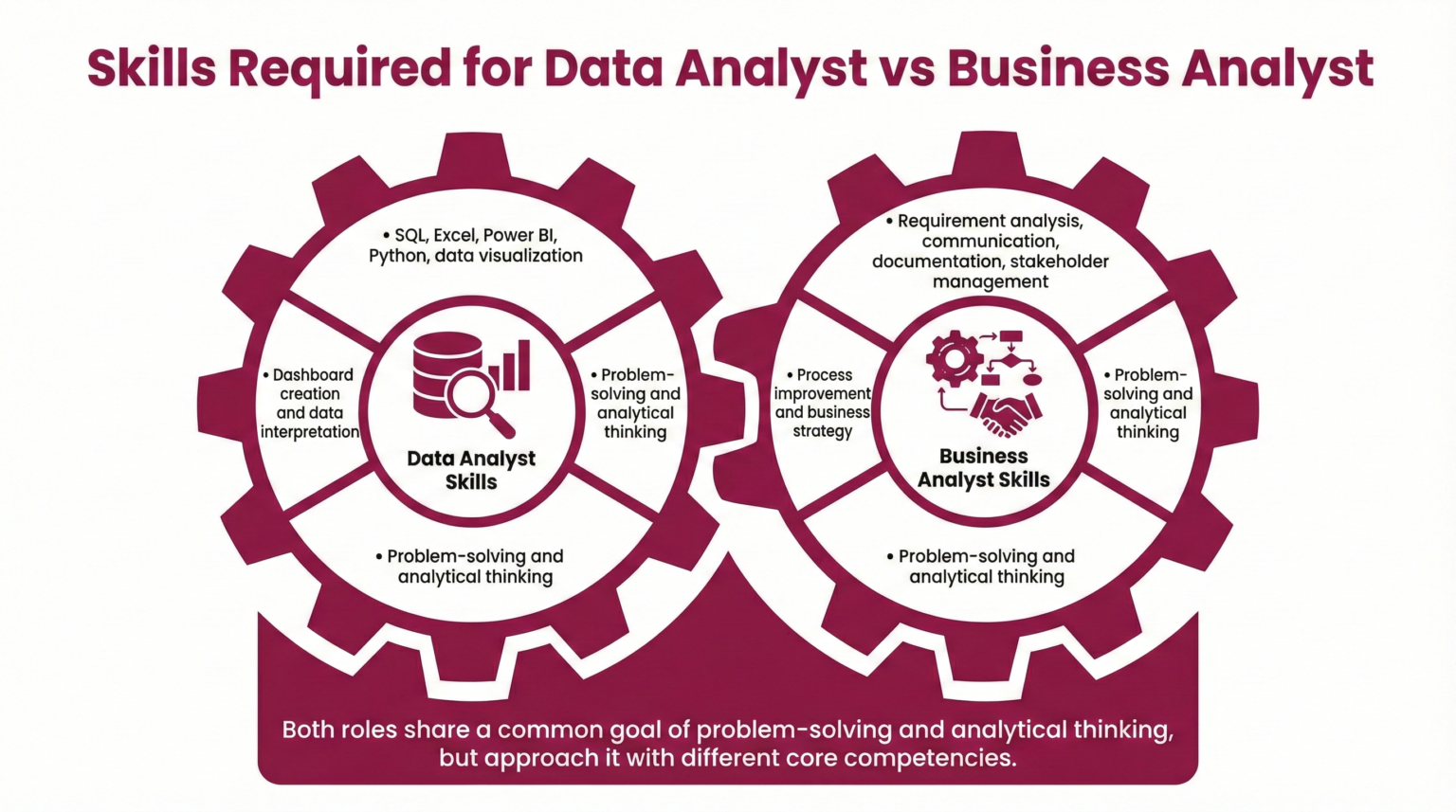
Both data analysts and business analysts work with data, but the skills required for each role differ based on responsibilities. Data analysts rely more on technical tools and data handling, while business analysts focus on communication, requirement gathering, and strategic thinking. Understanding these skill differences helps you decide which career aligns better with your strengths.
Data analysts are expected to work with databases, visualization tools, and sometimes programming languages to generate insights. Business analysts, on the other hand, must understand business processes, communicate with stakeholders, and translate requirements into actionable plans. While both roles require analytical thinking, the technical depth varies.
Key skill differences include the following:
- Data Analyst: SQL, Excel, Power BI, Python, data visualization
- Business Analyst: Requirement analysis, communication, documentation, stakeholder management
- Data Analyst: Dashboard creation and data interpretation
- Business Analyst: Process improvement and business strategy
- Both roles: Problem-solving and analytical thinking
Which Role Is Easier to Enter in 2026?
Insights from this career insights resource suggest that entry into either role depends on background and skill development. Non-IT professionals often find business analyst roles easier initially due to lower technical requirements, while those comfortable with tools and data handling may prefer data analyst roles.
In 2026, structured learning and project experience can make entry into both roles achievable within months.
Salary Comparison in India (2026)
Salary is one of the biggest deciding factors when choosing between data analyst and business analyst roles. In 2026, both careers offer strong earning potential, but compensation varies based on experience, skill depth, and company type. Product-based companies and multinational firms generally offer higher salaries compared to service-based organizations.
According to recent salary comparison insights, entry-level salaries for both roles in India are competitive. However, data analysts with strong technical skills and automation expertise often see faster salary growth in tech-driven industries, while business analysts with domain expertise and stakeholder management skills grow steadily into strategic roles.
Data Analyst vs Business Analyst Salary (India 2026)
| Experience Level | Data Analyst Salary | Business Analyst Salary | Growth Potential |
|---|---|---|---|
| 0–2 Years | ₹3–6 LPA | ₹4–7 LPA | Moderate |
| 3–5 Years | ₹7–12 LPA | ₹8–14 LPA | Strong |
| 6+ Years | ₹12–20+ LPA | ₹15–22+ LPA | High |
Both careers offer attractive growth, but salary acceleration often depends on specialization, certifications, and ability to handle complex projects. Professionals who continuously upgrade their skills tend to secure higher compensation in both paths.
Career Growth & Future Scope
The difference between data analyst and business analyst becomes clear in how each role supports decision-making. Data analyst career scope 2026 have strong career prospects, but the future scope of each role is shaped by technology trends and business needs. As organizations rely more on data-driven strategies, the demand for professionals who can interpret and apply data insights continues to rise. This creates long-term growth opportunities for both career paths.
Data analysts are benefiting from the rapid growth of AI, automation, and big data technologies. Professionals who upgrade their technical skills and learn advanced analytics tools can move into roles such as senior analyst, data scientist, or analytics consultant. Business analysts, on the other hand, often grow into product management, project management, or strategic consulting roles due to their strong business and stakeholder expertise.
Key future scope highlights include:
- Growing demand for data-driven decision-making
- Expansion of analytics roles across industries
- Increasing integration of AI and automation
- Global and remote job opportunities
- Higher demand for hybrid skill professionals
Exploring common career concerns in student FAQs can help professionals understand the expectations and growth paths in analytics careers. Both roles offer strong long-term opportunities, but success depends on continuous skill development and adaptability.
Which Career Is Better for You?
Choosing between Data Analyst vs Business Analyst career paths depends on your strengths, interests, and long-term goals. Both roles offer strong growth and salary potential, but the right choice varies based on whether you prefer working with data tools or focusing more on business strategy and communication.
If you enjoy working with numbers, dashboards, and analytical tools, a data analyst role may suit you better. This path involves working closely with datasets, building visualizations, and identifying patterns that support decision-making. On the other hand, if you prefer interacting with stakeholders, understanding business requirements, and improving processes, a business analyst role can be more suitable.
Here’s a simple way to decide:
- Choose data analyst career scope 2026 if you enjoy technical tools and data interpretation
- Choose business analyst if you prefer business strategy and communication
- Data analyst suits those interested in AI and automation trends
- Business analyst suits those interested in management and consulting roles
- Both roles require analytical thinking and problem-solving
Reviewing real placement records can also help you understand how professionals choose paths based on their strengths and achieve successful career outcomes. The best choice is the one aligned with your skills and future career vision.
Data Analyst vs Business Analyst: How to Choose the Right Path Without Regret
Choosing between Data Analyst vs Business Analyst should not be based on trends or salary alone. The right decision comes from understanding your strengths, interests, and long-term career vision. Many professionals regret their choice when they follow market hype instead of evaluating what suits their skills and learning preferences.
Start by assessing whether you enjoy working with technical tools and datasets or prefer business communication and strategic thinking. If you find satisfaction in building dashboards, analyzing numbers, and working with databases, a data analyst path may be more fulfilling. If you enjoy problem-solving through discussions, planning, and business process improvement, a business analyst role may be a better fit.
To make a confident decision:
- Identify whether you prefer technical or business-oriented work
- Evaluate your willingness to learn tools like SQL or visualization platforms
- Consider long-term career goals such as management or technical specialization
- Explore real job descriptions and required skills
- Start learning basics of both roles before finalizing
Making an informed decision early helps avoid confusion and saves time. Choosing a path aligned with your natural strengths ensures steady growth, better job satisfaction, and stronger long-term career success in the evolving analytics industry.
Final Thoughts
When comparing Data Analyst vs Business Analyst, the real difference lies in focus and skill orientation rather than superiority. Both careers offer strong growth, competitive salaries, and long-term stability in 2026. The right choice depends on whether you are inclined toward technical data handling or business-driven problem solving.
Data analysts thrive in environments where tools, automation, and data insights drive decisions. Business analysts excel where stakeholder communication, process improvement, and strategic planning are key. With AI and analytics continuing to expand across industries, demand for both roles is expected to remain strong.
Instead of asking which career has “more scope,” the better question is: which role matches your strengths and learning preferences? Professionals who align their career path with their natural abilities and continuously upgrade their skills tend to achieve faster growth and higher job satisfaction.
In 2026 and beyond, success in either path will depend on adaptability, structured learning, and the ability to deliver measurable business impact through data and strategy.
Build Skills for the Right Analytics Career Path
Choosing between a data analyst and business analyst career becomes easier when you focus on building strong, practical skills. Both roles require analytical thinking and the ability to work with data, but mastering modern analytics tools gives you a clear advantage in today’s competitive job market. Professionals who develop technical expertise alongside business understanding often have more flexibility and faster career growth.
If you are aiming for high-demand analytics roles with strong salary potential and future scope, focusing on data analytics skills can open multiple career paths. Learning tools like SQL, visualization platforms, and automation techniques not only prepares you for data analyst roles but also strengthens your profile for many business-focused positions.
To build job-ready analytics skills and create long-term career flexibility, explore the Certification in AI Powered Data Analytics and start developing the expertise required for high-growth opportunities in the evolving analytics industry.