









Table of Contents
- 1.
- 1.1
- 1.2
- 1.3
- 1.4
- 2.
- 2.1
- 2.2
- 2.3
- 2.4
- 3.
- 4.
- 4.1
- 4.2
- 4.3
- 4.4
- 5.
- 5.1
- 5.2
- 5.3
- 5.4
- 6.
- 6.1
- 6.2
- 7.
Digital marketing interview questions and answers should help candidates demonstrate the connection between customer intent, channel selection, measurement and business results. An employer may hire for social media, performance marketing, SEO or an all-round digital marketing role; the depth of the questions changes accordingly. This guide combines foundational concepts, practical calculations and troubleshooting scenarios.
Start with a real or hypothetical campaign and practise explaining the goal, target audience, offer, measurement event and next action. A strong answer shows evidence rather than inventing impressive results. If the interview is for an entry-level role, use transparent practice calculations without pretending you managed a large advertising budget.
Digital Marketing Fundamentals and Strategy
These concepts establish the purpose of campaigns. Explain why a channel reaches the intended buyer and how its goal differs from another stage of the customer journey. The correct choice depends on product, geography, market demand and available resources.
What is digital marketing?
Digital marketing promotes products or services using digital channels such as websites, search, social media, email and apps. The important starting point is the customer's need and the business outcome, not the popularity of a channel. Awareness, consideration, conversion and retention campaigns serve different goals and should use different success metrics. This topic also appears in digital marketing interview questions and answers because it tests practical judgment.
What is a marketing funnel?
A funnel describes how people move from discovering an offer to evaluating and potentially buying it. A person watching an educational reel may be in an early stage, while someone requesting a quotation signals a different intent. Journeys are not always linear, so the funnel is a planning framework rather than a literal sequence every buyer follows. This topic also appears in digital marketing interview questions and answers because it tests practical judgment.
Example: In a course marketing case, explain the input data you would collect and what would count as success. Identify at least one exception, such as invalid leads, incomplete attribution or a mismatch between platforms. Then describe a basic verification step. This ability to test a claim makes the answer much stronger than a memorized definition.
What is SEO versus PPC?
SEO earns unpaid search visibility through useful pages, relevance and technical accessibility. PPC places paid advertisements through platform auctions, often charging per click. Organic clicks still require investment in content and development, whereas paid clicks have a direct media cost. Choose based on customer intent, available budget, speed and measurable business outcomes. This topic also appears in digital marketing interview questions and answers because it tests practical judgment.
How is a target audience selected?
Begin with who can actually use and purchase the offer, geographic constraints, the customer problem and first-party evidence. Platform interest segments are imperfect proxies for demand. Build audience hypotheses and compare qualified leads or revenue rather than only reach. Where appropriate, broad audiences can perform well when conversion feedback is accurate. This topic also appears in digital marketing interview questions and answers because it tests practical judgment.
Example: In a course marketing case, explain the input data you would collect and what would count as success. Identify at least one exception, such as invalid leads, incomplete attribution or a mismatch between platforms. Then describe a basic verification step. This ability to test a claim makes the answer much stronger than a memorized definition.
Paid Advertising and Campaign Metrics
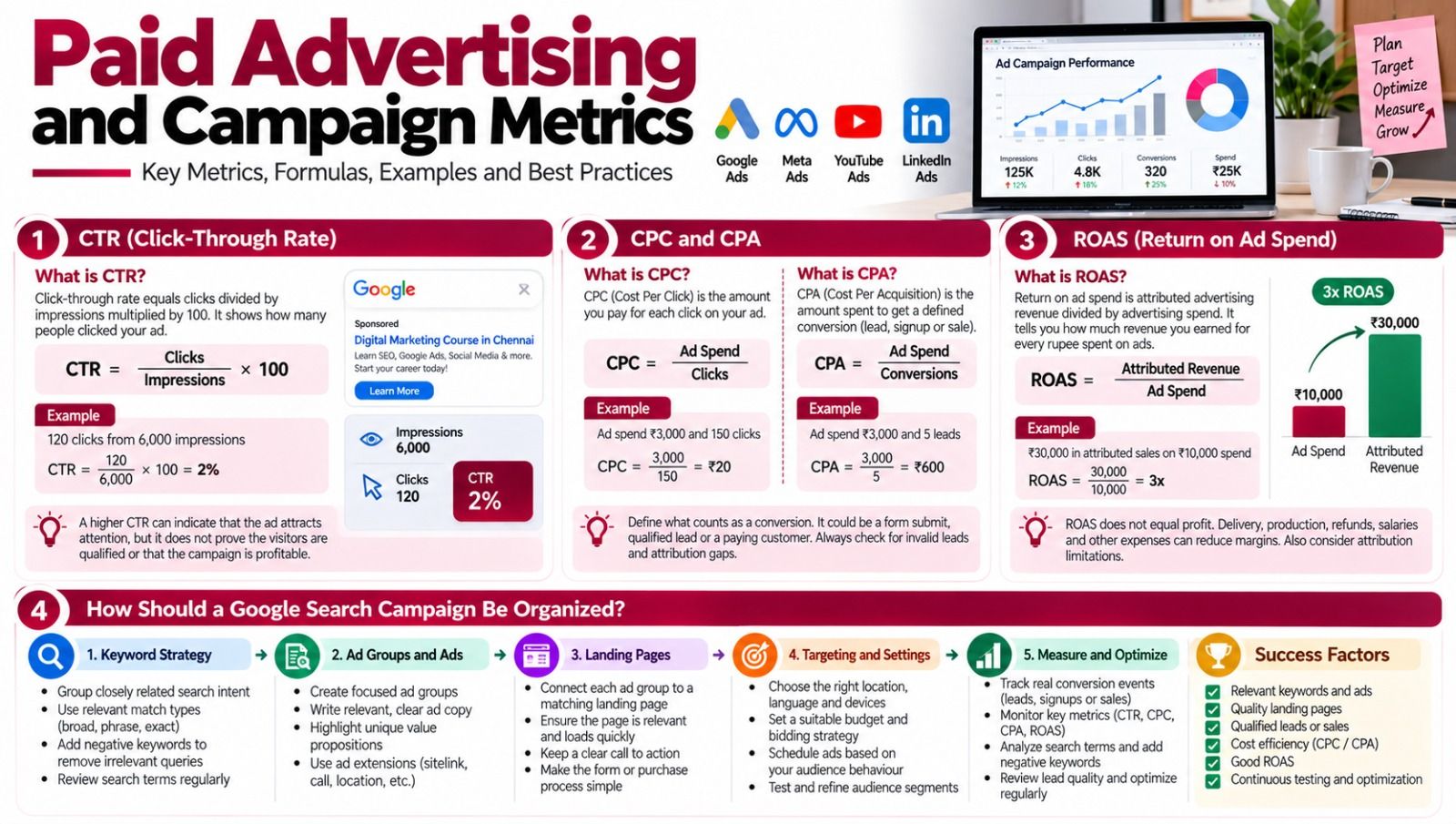
Financial metrics only become useful when you define what was counted. A click is not a qualified lead, and an attributed sale is not automatically profitable. Check the denominator, attribution assumptions and whether a reporting period includes enough outcomes to support the conclusion.
What is CTR?
Click-through rate equals clicks divided by impressions multiplied by 100. If an ad receives 120 clicks from 6,000 impressions, CTR is 2%. The number can indicate that an ad attracts attention, but does not prove the visitors are eligible or that the campaign is profitable. Compare similar placements and intents. This topic also appears in digital marketing interview questions and answers because it tests practical judgment.
What are CPC and CPA?
CPC is ad spend divided by clicks; CPA is spend divided by defined acquisitions. A campaign spending ₹3,000 on 150 clicks and five verified leads has ₹20 CPC and ₹600 measured CPA. Define whether an acquisition is a form submit, qualified lead or paying customer before using the result in a decision. This topic also appears in digital marketing interview questions and answers because it tests practical judgment.
Example: In a paid advertising case, explain the input data you would collect and what would count as success. Identify at least one exception, such as invalid leads, incomplete attribution or a mismatch between platforms. Then describe a basic verification step. This ability to test a claim makes the answer much stronger than a memorized definition.
What is ROAS?
Return on ad spend is attributed advertising revenue divided by advertising spend. ₹30,000 in attributed sales on ₹10,000 spend is 3x ROAS. It does not equal profit because delivery, production, refunds, salaries and other expenses can reduce margins. The attribution system also has measurement limitations. This topic also appears in digital marketing interview questions and answers because it tests practical judgment.
How should a Google Search campaign be organized?
Group closely related search intent, connect ads to matching landing pages, choose relevant geography and language, and measure real conversion events. Review search terms for irrelevant queries, add justified negative keywords and evaluate lead quality. Avoid creating many nearly identical ad groups without a clear reporting or control benefit. This topic also appears in digital marketing interview questions and answers because it tests practical judgment.
Example: In a paid advertising case, explain the input data you would collect and what would count as success. Identify at least one exception, such as invalid leads, incomplete attribution or a mismatch between platforms. Then describe a basic verification step. This ability to test a claim makes the answer much stronger than a memorized definition.
Strengthen your Digital Marketing Interview Questions and Answers skills through practical training at WHY TAP. Explore courses: Explore WHY TAP Courses
Tracking, Attribution and Optimization
Tracking and optimization require accurate event implementation and careful diagnosis. When a report shows poor results, verify that the underlying data represents real actions before changing creative, targeting or bidding. An experiment is strongest when it tests one supported hypothesis.
What is conversion tracking?
Conversion tracking records meaningful actions such as a verified lead or purchase. Define the event precisely, implement tags or approved server-side methods, test whether it fires under expected conditions and check deduplication. A PageView event should not be mislabelled as a completed lead. Reconcile reports with CRM records. This topic also appears in digital marketing interview questions and answers because it tests practical judgment.
What is remarketing?
Remarketing targets eligible people who have previously interacted with a business, subject to consent and platform restrictions. A prior buyer, cart abandoner and casual blog reader differ in intent, so they should not automatically receive identical messages. Remarketing complements prospecting but cannot fix an unclear offer or poor website experience. This topic also appears in digital marketing interview questions and answers because it tests practical judgment.
Example: In a analytics and tracking case, explain the input data you would collect and what would count as success. Identify at least one exception, such as invalid leads, incomplete attribution or a mismatch between platforms. Then describe a basic verification step. This ability to test a claim makes the answer much stronger than a memorized definition.
What is attribution?
Attribution assigns conversion credit to marketing touchpoints. Last-click and data-driven approaches can tell different stories because they allocate credit differently. Cross-device activity and offline purchases can create gaps. State the window and model used, and compare ad platform records with CRM and completed sales rather than assuming all attributed outcomes were caused by one ad. This topic also appears in digital marketing interview questions and answers because it tests practical judgment.
How do you run an A/B test?
State a testable hypothesis, define the primary metric before launch, keep groups comparable and change one major factor. If both creative and landing page change simultaneously, it is difficult to identify the cause of a difference. Consider sample size, uncertainty, seasonality and whether the observed improvement is practically valuable. This topic also appears in digital marketing interview questions and answers because it tests practical judgment.
Example: In a analytics and tracking case, explain the input data you would collect and what would count as success. Identify at least one exception, such as invalid leads, incomplete attribution or a mismatch between platforms. Then describe a basic verification step. This ability to test a claim makes the answer much stronger than a memorized definition.
Practical Campaign Problems and Career Preparation
In a practical interview, explain the problem, the available evidence, the likely causes and a small test. Interviewers may change a budget or introduce missing data to see whether you adapt logically. Describe what you can verify and what remains an assumption.
How would you improve a landing page?
Check whether the ad promise matches the page, mobile load speed, clarity of benefits, evidence, form friction and call-to-action visibility. Analyze drop-offs and identify whether visitors are qualified before redesigning. When irrelevant search terms cause low conversions, targeting changes might have higher value than replacing the entire landing page. This topic also appears in digital marketing interview questions and answers because it tests practical judgment.
What if a campaign gets clicks but no leads?
First validate analytics and confirm whether leads exist in the CRM. Then examine search terms, placements, device behavior, page load errors, form submission failures and offer relevance. Segment the evidence, prioritize the largest likely bottleneck and test a targeted change. Avoid promising that more budget alone will solve the problem. This topic also appears in digital marketing interview questions and answers because it tests practical judgment.
Example: In a campaign management case, explain the input data you would collect and what would count as success. Identify at least one exception, such as invalid leads, incomplete attribution or a mismatch between platforms. Then describe a basic verification step. This ability to test a claim makes the answer much stronger than a memorized definition.
How do you assess lead quality?
Agree with sales on which criteria make a lead useful: geography, eligibility, genuine interest, contactability and progression to a later stage. Compare campaigns by qualified leads and eventual business outcomes when accessible. A very low reported form-lead cost is not a success if most records are duplicates or irrelevant. This topic also appears in digital marketing interview questions and answers because it tests practical judgment.
How do you present a campaign report?
Begin with business objective and time range, then show spend, reach, relevant clicks, meaningful conversions, lead quality and sales progression where available. Explain what changed, what the data does and does not prove, and your proposed next experiment. Do not hide underperforming segments or present attributed revenue as audited profit. This topic also appears in digital marketing interview questions and answers because it tests practical judgment.
Example: In a campaign management case, explain the input data you would collect and what would count as success. Identify at least one exception, such as invalid leads, incomplete attribution or a mismatch between platforms. Then describe a basic verification step. This ability to test a claim makes the answer much stronger than a memorized definition.
Worked Digital Marketing Case Study
Suppose an admissions campaign spends ₹6,000, receives 300 clicks and generates twelve valid inquiries. CPC is ₹20, lead conversion rate is 4% and measured CPA is ₹500. These figures do not tell you whether the leads enrolled or whether the campaign was profitable. Ask sales to distinguish contacted, eligible and converted prospects. If ten of the twelve were from the wrong district, the problem may be targeting or lead qualification rather than the form design. If the CRM contains only seven records, investigate event definitions, duplicate submissions, webhook errors and attribution. A disciplined marketer validates the measurement before suggesting more spend.
How to Explain a Digital Marketing Project
Use Objective → Audience → Channel → Offer → Campaign Structure → Tracking → Result → Learning. Describe which parts you personally performed and what evidence supports the outcome. If the campaign had zero conversions, identify what checks you made before concluding that creative was ineffective. Project stories are stronger when they demonstrate a sound decision process than when they exaggerate short-term results.
Seven-Day Digital Marketing Preparation Plan
Day 1: revise funnels and search intent. Day 2: compare SEO, social media and paid search. Day 3: practise CTR, CPC, CPA and ROAS calculations. Day 4: study lead and purchase tracking. Day 5: analyze a landing page and search term report. Day 6: prepare two realistic campaign scenarios and a project walkthrough. Day 7: complete a mock interview, review inaccuracies and read the requirements of the exact role.
Conclusion
Practising digital marketing interview questions and answers should leave you able to explain why a campaign was launched, how its outcome was measured, what could be wrong with the data and which experiment should come next. Do not confuse more platform activity with better business outcomes. For current advertising platform concepts and policies, use official documentation: Google Official Documentation .
Frequently Asked Questions
Take the next step towards your IT career with WHY TAP. Visit: