


Table of Contents
- 1.
- 2.
- 3.
- 3.1
- 4.
- 4.1
- 5.
- 5.1
- 6.
- 7.
- 8.
- 9.
- 10.
- 11.
- 11.1
Full Stack Developer Roadmap 2026
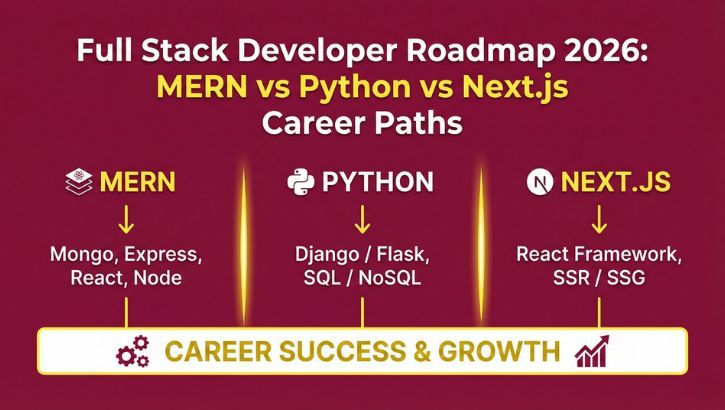
Choosing a full-stack development path in 2026 is more confusing than ever. MERN, Python, and Next.js are all trending, but each stack leads to very different career outcomes. Many learners start without clarity, only to realize later that the stack they chose doesn’t match their goals or job market expectations.
Today, companies don’t just hire developers who can write code; they look for professionals who can build complete applications, understand backend logic, manage databases, and deploy products end to end. This shift has made full-stack developers one of the most in-demand roles, but only when the right roadmap is followed. The good news is there’s no single “best” stack, only the best-fit stack for your career goals. In the sections below, we’ll break down what full-stack development means in 2026, compare MERN vs Python vs Next.js career paths, and help you choose the right roadmap with clarity and confidence.
What Does a Full Stack Developer Mean in 2026?
In 2026, the role of a full-stack developer has evolved far beyond just knowing frontend and backend basics. Companies now expect developers to own the complete application lifecycle, from building interfaces to deploying scalable systems.
Here’s what “full stack” really means today:
● Frontend development
○ Building responsive, user-friendly interfaces
○ Working with modern frameworks and performance-focused designs
● Backend development
○ Creating APIs and handling server-side logic
○ Managing authentication, security, and integrations
● Database management
○ Working with SQL and NoSQL databases
○ Designing efficient data structures and queries
● Deployment and basic DevOps
○ Using Git, cloud platforms, and CI/CD basics
○ Understanding how applications run in production
● Problem-solving and ownership
○ Debugging across the stack, not just one layer
○ Taking responsibility for features end-to-end
Modern companies prefer developers who can build, ship, and maintain products independently, especially in fast-moving teams and startups. This broader expectation is why full-stack roles continue to grow in demand.
For a clear breakdown of the core skills expected today, refer to Full Stack Developer Roadmap – Core Skills Overview, which outlines how full stack responsibilities have expanded in recent years.
Understanding this modern definition is the first step before choosing between MERN, Python, or Next.js career paths.
Core Skills Every Full-Stack Developer Must Learn
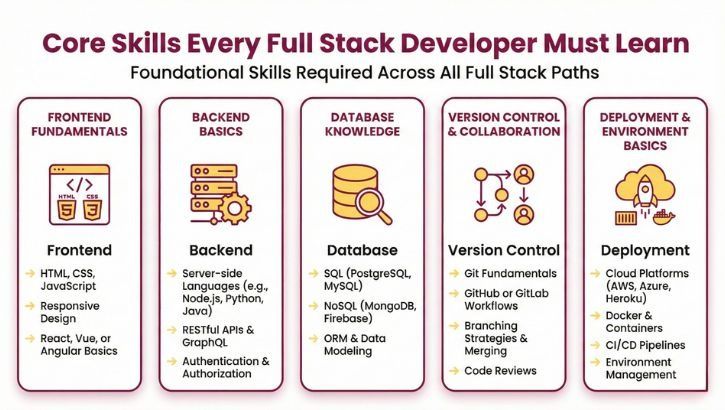
Before choosing between MERN, Python, or Next.js, every aspiring full stack developer must build a strong common foundation. These core skills remain the same across all stacks and are what employers expect as minimum job readiness in 2026.
Foundational Skills Required Across All Full-Stack Paths
● Frontend fundamentals
○ HTML, CSS, and JavaScript are non-negotiable
○ Understanding responsive design and browser behavior
○ Ability to convert UI designs into functional interfaces
● Backend basics
○ Building REST APIs and handling server-side logic
○ Authentication, authorization, and session handling
○ Understanding how frontend and backend communicate
● Database knowledge
○ Working with SQL (MySQL/PostgreSQL) and NoSQL (MongoDB)
○ Designing schemas and writing efficient queries
○ Understanding data relationships and performance
● Version control & collaboration
○ Using Git and GitHub for code management
○ Working with branches, pull requests, and code reviews
● Deployment & environment basics
○ Hosting applications on cloud platforms
○ Environment variables, basic CI/CD awareness
○ Debugging issues in production
According to The Complete Full Stack Developer Roadmap for 2026, developers who master these fundamentals find it much easier to switch stacks, learn new frameworks, and grow faster in their careers.
Once these core skills are in place, choosing the right stack becomes a strategic decision, not a risky guess.
MERN Stack Career Path in 2026
The MERN stack remains one of the most popular full-stack paths in 2026, especially among developers who enjoy working with JavaScript across the entire application. It is widely adopted by startups, product-based companies, and fast-scaling tech teams.
Who Should Choose the MERN Stack?
The MERN stack is best suited for learners with specific interests and career goals.
● JavaScript-first learners
○ If you prefer working with a single language for frontend and backend
○ Easier mental model when everything is built using JavaScript
● Startup and product-driven environments
○ MERN is commonly used in startups and SaaS products
○ Faster development cycles and rapid feature releases
● Frontend-heavy full-stack roles
○ Strong focus on React for building dynamic user interfaces
○ Ideal for developers who enjoy UI logic and user experience
● Freshers who want faster visible results
○ Frontend progress is quick and motivating
○ Easier to build demo projects and portfolios early
Career outcomes with MERN in 2026:
● Full Stack JavaScript Developer
● Frontend-heavy Full Stack Engineer
● Product-focused Software Developer
MERN offers high flexibility and strong job demand, but it also requires good JavaScript fundamentals. Developers who master React and backend concepts together often see faster entry into startup ecosystems and modern tech teams.
Python Full Stack Career Path in 2026
Python full-stack development continues to be a stable and beginner-friendly career path in 2026. It is widely used in enterprise applications, service-based companies, and backend-heavy systems where scalability, reliability, and data processing matter more than flashy interfaces.
Who Should Choose Python Full Stack?
This path is ideal for learners who prefer logic, structure, and backend strength.
● Beginners and non-CS learners
○ Python’s simple syntax makes it easier to learn
○ Faster understanding of backend logic and workflows
○ Lower entry barrier compared to complex JavaScript ecosystems
● Backend-focused developers
○ Strong emphasis on server-side logic using Django or Flask
○ Ideal for APIs, dashboards, admin panels, and internal tools
● Enterprise and service-company roles
○ Python full stack is commonly used in large organizations
○ High demand in fintech, edtech, healthcare, and enterprise software
● Developers interested in data or AI later
○ Python integrates well with data analytics and AI tools
○ Easier transition into data-heavy or AI-assisted roles
Career outcomes with Python full stack in 2026:
● Python Full Stack Developer
● Backend Developer
● Application Developer
Python full stack offers career stability, strong backend exposure, and long-term growth. While the frontend may be simpler compared to MERN, this path is ideal for developers who want solid fundamentals and enterprise-ready experience.
MERN vs Python vs Next.js – Career Path Comparison
Choosing the right full stack path in 2026 is less about which stack is “best” and more about which stack aligns with your background, interests, and career goals. MERN, Python, and Next.js each serve different types of roles and companies, and understanding these differences helps avoid wrong career moves.
Below is a clear comparison to help you decide:
Full Stack Career Path Comparison (2026)
| Factor | MERN Stack | Python | Next.js Full Stack |
|---|---|---|---|
| Primary Language | JavaScript | Python | JavaScript |
| Core Focus | Frontend + API development | Backend-heavy applications | Performance-focused full stack apps |
| Best Fit For | Startups, product teams | Enterprises, service companies | SaaS & modern web products |
| Learning Curve | Medium | Beginner-friendly | Medium – High |
| Frontend Strength | Strong (React) | Moderate | Very Strong (Next.js + React) |
| Backend Strength | Moderate | Strong | Moderate |
| Fresher-Friendly | Yes | Yes | Depends on fundamentals |
| Career Scope (2026) | High & flexible | Stable & long-term | Rapidly growing |
This comparison aligns closely with widely accepted full-stack learning paths outlined in the official Full Stack Developer Roadmap by roadmap.sh, which clearly distinguishes how different stacks evolve based on performance needs, backend depth, and deployment models:
How to use this comparison:
● Choose MERN if you enjoy JavaScript and frontend-heavy work
● Choose Python full stack if you prefer backend logic and enterprise roles
● Choose Next.js if you want to work on high-performance, SEO-focused modern applications
There is no single “winning” stack in 2026. The right choice depends on how you want to work, where you want to work, and how fast you want to grow.
Salary Trends for Full-Stack Developers in India
Salary expectations are a major factor when choosing a full-stack career path, and in 2026, full-stack developers continue to command strong pay due to their versatility. However, salaries vary based on the stack, skill depth, and type of company.
Here’s what freshers and early professionals should know:
● Entry-level salary range
○ Freshers typically start between ₹4–6 LPA
○ Strong projects and internships can push offers higher
○ Stack choice and interview performance play a big role
● Stack-based salary differences
○ MERN developers often see quicker growth in startups and product companies
○ Python full stack roles offer stable pay in enterprise and service firms
○ Next.js developers are seeing rising salaries due to demand for performance-focused apps
● Growth with experience
○ With 2–3 years of experience, salaries can reach ₹8–12 LPA or more
○ Developers who handle both development and deployment earn faster hikes
○ Full-stack roles often grow into tech lead or architect positions
● What actually increases pay
○ Real-world projects over certificates
○ Ability to explain architecture and decisions
○ Knowledge of cloud, deployment, and performance optimization
For a deeper breakdown of stack-wise pay trends and what freshers can realistically expect, refer to Full Stack Developer Salary Trends: What to Expect in 2025 Understanding salary trends helps you choose a stack not just based on popularity but on long-term career value and growth potential.
Step-by-Step Full Stack Developer Roadmap for 2026
Once you’ve understood the differences between MERN, Python, and Next.js, the next step is following a clear, practical roadmap. In 2026, companies don’t expect freshers to know everything – but they do expect structured learning, consistency, and real-world exposure.
Here’s a step-by-step roadmap you can follow:
● Step 1: Master the fundamentals
○ HTML, CSS, and JavaScript basics
○ Programming fundamentals (logic, loops, functions)
○ Understanding how the web works (client–server model)
● Step 2: Learn one full stack path deeply
○ Choose MERN, Python, or Next.js based on your career goals
○ Focus on one backend framework and one frontend framework
○ Avoid stack-hopping in the early stage
● Step 3: Work on real-world projects
○ Build CRUD apps, dashboards, authentication systems
○ Create end-to-end projects (frontend + backend + database)
○ Deploy applications to cloud platforms
● Step 4: Learn deployment & version control
○ Use Git and GitHub for code management
○ Understand hosting, environment variables, and basic CI/CD
○ Learn how production issues are handled
● Step 5: Prepare for interviews
○ Practice explaining architecture and project decisions
○ Revise core concepts and problem-solving questions
○ Focus on clarity, not memorization
For a detailed industry-aligned learning path that also includes DevOps and cloud exposure, refer to this Full Stack + DevOps Roadmap: Following a roadmap like this helps freshers move from confusion to confidence and from learning to real job readiness in 2026.
Why Structured Full Stack Training Improves Career Outcomes
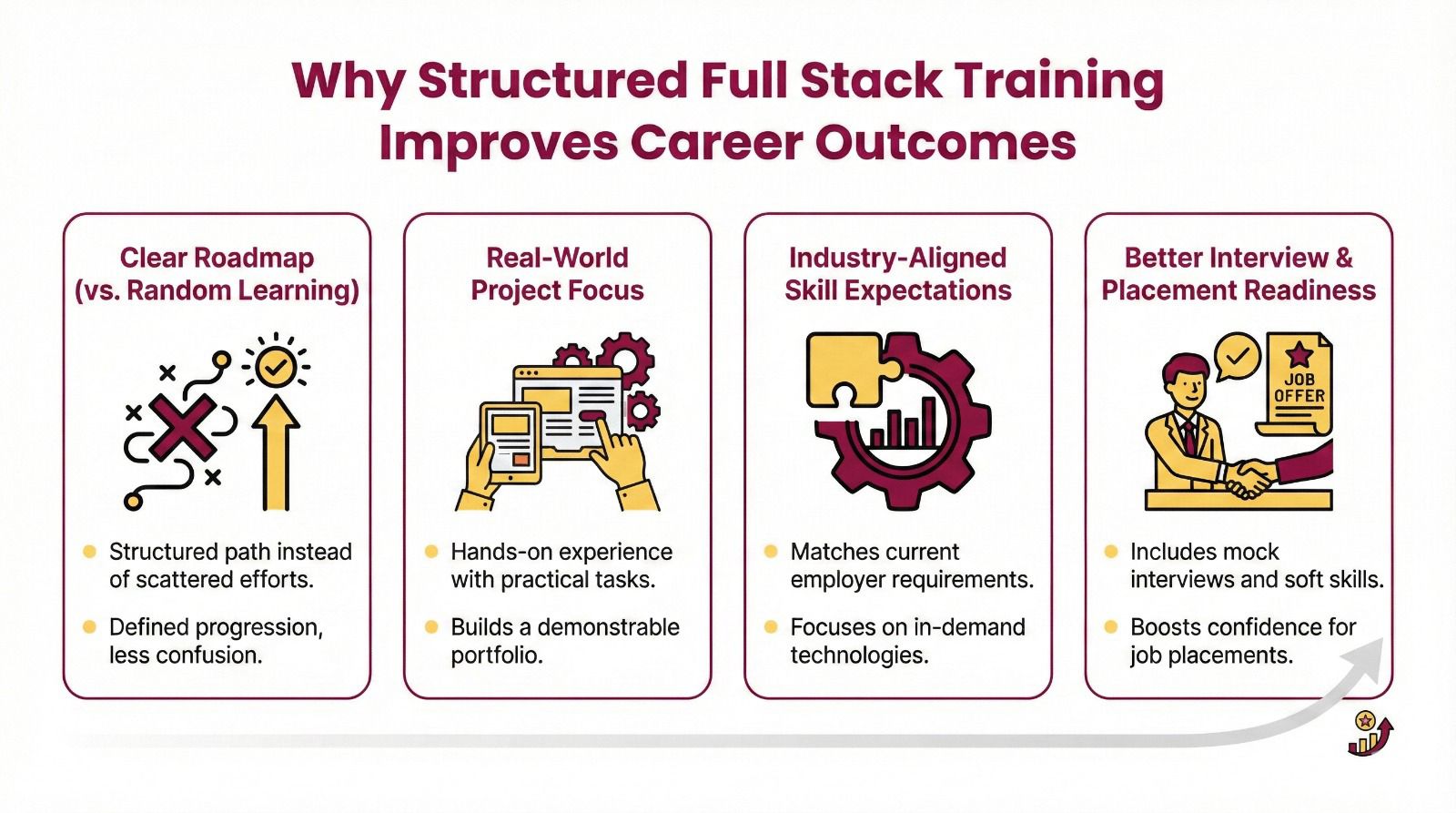
Learning full stack development on your own is possible but in 2026, structured training significantly improves career outcomes, especially for freshers and career switchers. The reason is simple: companies hire developers who are job-ready, not just course-complete.
Here’s why structured full stack training makes a real difference:
● Clear roadmap instead of random learning
○ Prevents confusion caused by jumping between tutorials
○ Ensures fundamentals, stack skills, and projects are learned in the right order
○ Saves time by focusing only on industry-relevant skills
● Strong focus on real-world projects
○ Projects demonstrate end-to-end application building
○ Recruiters value deployed, working applications over certificates
○ Projects help candidates explain architecture confidently in interviews
● Industry-aligned skill expectations
○ Training aligns with what companies actually test in interviews
○ Covers deployment, version control, and basic DevOps awareness
○ Reduces the gap between learning and real job roles
● Better interview and placement readiness
○ Structured programs prepare candidates for technical discussions
○ Resume guidance and mock interviews improve confidence
○ Candidates know how to present their skills clearly
In 2026, the right structure doesn’t just teach you to code it accelerates your career growth.
Why Projects, Resume, and Interview Readiness Matter
Learning a full-stack technology is only half the journey. In 2026, companies hire developers based on proof of skills, not just certificates or course completion badges. This is where projects, a strong resume, and interview readiness play a decisive role.
Here’s why this trio matters so much for placements:
● Why projects matter more than certificates
○ Recruiters want to see what you have built, not just what you’ve learned
○ End-to-end projects prove your ability to work with frontend, backend, databases, and deployment
○ Projects help interviewers assess problem solving, architecture decisions, and practical thinking
○ A strong project can outweigh multiple certificates
● Resume structuring for full stack roles
○ Full stack resumes must highlight projects first, not just skills
○ Clear mention of tech stack, features built, and deployment links improves shortlisting
○ Well-structured resumes make it easier for recruiters to understand your role and impact
● Interview readiness bridges the final gap
○ Interviews test how well you explain your projects and decisions
○ Candidates who can confidently discuss challenges and solutions stand out
○ Preparation reduces nervousness and improves clarity
To build a recruiter-friendly resume that showcases your projects and skills effectively, use the
WHY TAP Resume Builder In short, projects show capability, resumes create first impressions, and interviews close the deal all three are essential for full stack placements in 2026.
Final Thoughts
In 2026, becoming a full-stack developer is not about chasing the most popular stack it’s about choosing the right career path based on your strengths, interests, and long-term goals. MERN, Python, and Next.js each offer strong opportunities, but they lead to different types of roles, companies, and growth trajectories. What truly makes the difference is following a clear roadmap, mastering fundamentals, building real-world projects, and preparing well for interviews.
Full stack developers who combine technical depth with practical exposure and deployment skills are the ones who stand out in hiring processes. With the right direction and consistent effort, full stack development can open doors to high growth, future proof tech careers.
Build a Future-Ready Full Stack Career with WHY TAP
At WHY TAP, we help learners move beyond confusion and build industry ready full stack skills with a clear roadmap. Through structured learning, hands-on projects, expert mentorship, and strong interview preparation, you gain the confidence to work across frontend, backend, and deployment just like companies expect in 2026.
Explore the PG Certification in AI-Powered Full Stack Development and start building a full stack career that aligns with real industry needs, not guesswork.