




Table of Contents
- 1.
- 2.
- 3.
- 3.1
- 3.2
- 4.
- 5.
- 6.
- 6.1
- 7.
- 8.
- 9.
Businesses today operate in a world where data is generated every second. From online transactions to user activity and IoT devices, organizations are producing massive volumes of information that must be processed instantly. This shift has made Real Time and Streaming Data Analytics one of the most critical capabilities for modern companies that want faster insights and smarter decision-making.
Traditional analytics focused on historical reports and delayed insights. However, in competitive markets, waiting hours or days to analyze data is no longer effective. Companies now rely on streaming data analytics to monitor customer behavior, detect issues instantly, and make real-time business decisions. This transformation is driving demand for professionals who understand how to work with live data and modern analytics systems.
As industries move toward automation and AI-driven decision-making, real-time data analytics skills are emerging as high-value capabilities for data professionals. Analysts who can work with streaming data and real-time dashboards are becoming essential to organizations that depend on speed and accuracy. In the sections below, we explore why real-time analytics is the next big skill and how professionals can prepare for this fast-growing field.
What Is Real-Time Analytics and Streaming Data Analytics?
Real-time and streaming data analytics refer to the process of analyzing data immediately as it is generated, allowing organizations to act without delay. Unlike traditional batch processing, where data is collected and analyzed later, real-time systems process streaming data continuously. This enables instant insights, faster decision-making, and proactive business responses.
According to this detailed explanation of real-time analytics, modern systems use streaming pipelines to handle data from applications, sensors, transactions, and digital platforms as things happen. Instead of waiting for daily or weekly reports, companies can monitor performance live.
Streaming data typically comes from:
- Website and app interactions
- Financial transactions
- IoT devices and sensors
- Social media activity
- Online customer behavior
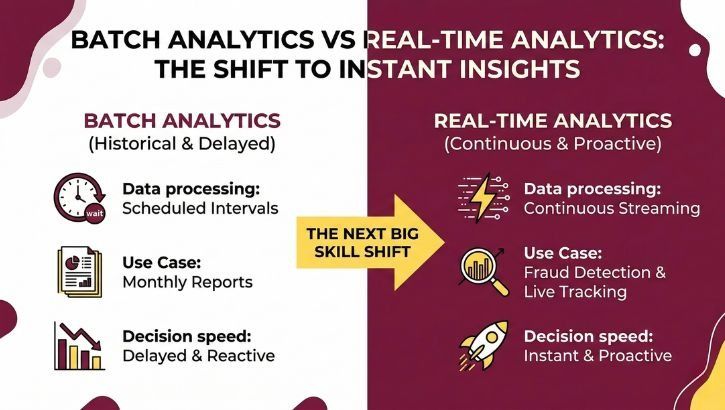
Batch Analytics vs Real-Time Analytics
| Aspect | Batch Analytics | Real-Time Analytics |
|---|---|---|
| Data processing | Scheduled intervals | Continuous streaming |
| Decision speed | Delayed | Instant |
| Use cases | Monthly reports | Fraud detection, live tracking |
| Customer experience | Reactive | Proactive |
| Business impact | Historical insight | Immediate action |
Real-time enables organizations to move from reactive reporting to instant, data-driven action.
Why Companies Are Moving Toward Real-Time Decision-Making
Modern businesses operate in fast-changing environments where delayed insights can lead to missed opportunities. Companies can no longer rely only on historical reports when customer behavior, market trends, and operational data change every second. This is why organizations are shifting toward real-time decision-making powered by streaming analytics.
Real-time data allows businesses to monitor operations continuously and respond immediately to changes. For example, e-commerce platforms track customer activity live to personalize recommendations, while financial institutions monitor transactions instantly to detect fraud. The ability to act on data as it happens creates a strong competitive advantage.
Key reasons companies are adopting real-time:
- Faster response to customer behavior
- Improved operational efficiency
- Better risk detection and prevention
- Real-time performance monitoring
- Enhanced customer experience
Insights on modern real-time processing highlight how organizations use streaming data to automate decisions and improve efficiency.
Real-time decision-making helps companies move from reactive strategies to proactive actions. Organizations that can analyze and respond to live data gain speed, accuracy, and a significant competitive edge in today’s data-driven economy.
Real-Time Data Analytics Skills Required in 2026
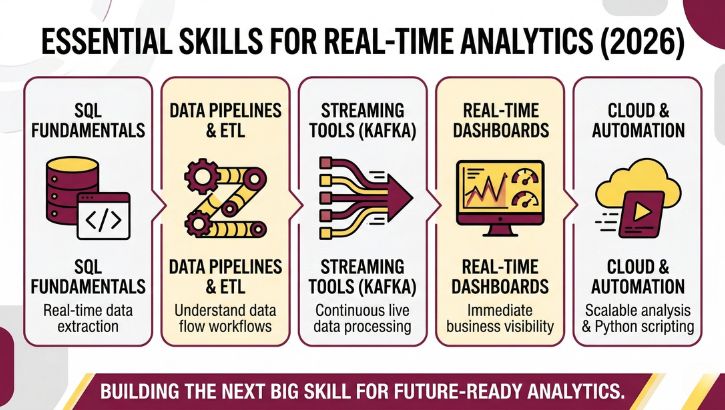
As organizations adopt streaming data systems, the demand for professionals with real-time data skills is rising rapidly. Companies are looking for analysts who can work with live data pipelines, build real-time dashboards, and support instant decision-making. Traditional analytics skills remain important, but they must now be combined with knowledge of streaming technologies and automation.
Professionals entering this field should understand how real-time data flows from multiple sources and how it can be processed quickly for business insights. Analysts who develop these skills can move into high-demand roles across technology, finance, e-commerce, and operations.
Key skills required for real-time roles include:
- Strong SQL and data querying fundamentals
- Understanding of data pipelines and ETL workflows
- Knowledge of real-time dashboard tools
- Basic Python or scripting for automation
- Understanding of cloud and streaming concepts
- Analytical thinking and problem-solving
Real-Time Analytics Tools Used in Streaming Data Analytics
Industry insights on streaming skills show that analytics tools like Kafka, Spark Streaming, and cloud-based analytics platforms are becoming essential for handling live data workflows.
Skill → Use Case → Career Impact
| Skill/Tool | Use Case | Career Impact |
|---|---|---|
| SQL & data querying | Real-time data extraction | Core analytics requirement |
| Streaming tools (Kafka) | Live data processing | High-demand skill |
| Dashboard tools | Real-time monitoring | Better business visibility |
| Python/automation | Data pipeline support | Faster analysis |
| Cloud platforms | Scalable data processing | Strong career growth |
Developing these skills positions professionals for future-ready analytics roles.
Career Opportunities in Real-Time Analytics
The demand for real-time and streaming data analytics professionals is growing rapidly as organizations move toward live data processing and instant decision-making. Companies across industries are investing in streaming technologies to improve customer experience, detect risks, and optimize operations. This shift is creating new career opportunities for analysts who understand real-time data workflows.
Roles related to real-time include data analysts, streaming data engineers, business intelligence specialists, and decision intelligence professionals. These roles focus on building live dashboards, monitoring business performance, and supporting immediate decision-making. As more organizations adopt AI and automation, the need for professionals who can manage real-time insights continues to increase.
Key career benefits in this field:
- High demand across industries
- Faster salary growth for specialized skills
- Opportunities in tech, finance, and e-commerce
- Roles involving AI and automation integration
- Long-term career stability
Understanding evolving digital skills helps professionals align with future job requirements.
Real-time analytics is not just a technical trend - it is a growing career path. Professionals who learn streaming data and real-time tools can position themselves for high-impact roles in modern data-driven organizations.
How Students & Analysts Can Learn Real-Time Analytics
Learning real-time and developing real-time data skills requires a structured approach that combines strong fundamentals with exposure to streaming concepts. Students and working professionals should begin by mastering core skills such as SQL, data modeling, and dashboard creation. These fundamentals form the base for understanding how live data systems operate.
Once the basics are clear, the next step is to explore how streaming pipelines work. Learning concepts like event-driven architecture, data ingestion, and real-time processing tools helps build practical understanding. Hands-on projects, such as creating live dashboards using simulated streaming data, strengthen confidence and problem-solving ability.
A practical learning roadmap includes:
- Strengthening SQL and data visualization skills
- Understanding ETL and data pipeline concepts
- Exploring streaming tools like Kafka or cloud platforms
- Building small real time analytics projects
- Practicing performance monitoring use cases
For additional clarity on common career doubts and pathways, reviewing student faqs can help learners plan effectively.
Consistent practice, project-building, and understanding how businesses use streaming data will prepare students and analysts to succeed in real-time roles.
Why Real-Time Analytics Will Define the Next 5 Years
The next phase of analytics will be defined by speed, automation, and intelligence. Organizations are moving toward systems that can process data instantly and support decisions in real time. As AI and automation continue to expand, real-time and streaming data analytics will become a core requirement rather than an optional capability.
Businesses already depend on live data to track customer behavior, monitor performance, and detect risks. Over the next five years, this dependency will grow as industries adopt AI-driven decision systems and automated workflows. Companies that can respond instantly to data will outperform competitors that rely on delayed reporting.
Key trends shaping the future:
- Integration of AI with real-time
- Increased demand for instant business insights
- Growth of streaming data technologies
- Automation of decision-making processes
- Expansion of data-driven business models
Professionals who understand streaming data and real-time dashboards will play a crucial role in this transformation. As organizations continue to prioritize speed and accuracy, real-time will become one of the most valuable skills in the modern data ecosystem.
Final Thoughts
Analytics is entering a new era where speed matters as much as accuracy. Organizations no longer want to wait for weekly or monthly reports - they want insights the moment data is generated. This shift is making real-time and streaming data analytics critical capabilities for modern businesses and a valuable skill for data professionals.
Analysts who understand streaming data and real-time dashboards can deliver faster insights, support immediate decisions, and create greater business impact. As companies continue adopting AI and automation, professionals who combine traditional analytics skills with real-time data expertise will stand out in the job market.
The future of analytics will belong to those who can analyze and act quickly. In the coming years, the fastest and most adaptable analysts will lead the way in data-driven decision-making.
Build Real-Time Analytics Skills for the Future
Real-time and modern real-time analytics tools are no longer limited to large tech companies - it is becoming a standard requirement across industries. Organizations need professionals who can work with streaming data, build live dashboards, and support instant decision-making. Analysts who understand real-time workflows will have a strong advantage in hiring and long-term career growth.
If you want to stay competitive in 2026 and beyond, upgrading your skills is essential. Learning how to combine SQL, visualization tools, and AI-powered workflows with streaming data concepts can position you for high-demand roles in analytics and decision intelligence.
To develop future-ready skills in analytics, automation, and AI-driven decision-making, explore the Certification in AI Powered Data Analytics and start building the expertise companies are actively looking for in modern data professionals.