









Table of Contents
- 1.
- 1.1
- 1.2
- 1.3
- 1.4
- 2.
- 2.1
- 2.2
- 2.3
- 2.4
- 3.
- 4.
- 4.1
- 4.2
- 4.3
- 4.4
- 5.
- 5.1
- 5.2
- 5.3
- 5.4
- 6.
- 6.1
- 6.2
- 7.
SEO interview questions and answers should test how well you understand search visibility, site accessibility and the needs behind search queries. An entry-level SEO executive may work on content updates and reporting, while a technical specialist may diagnose canonical, JavaScript rendering and indexation problems. The right preparation combines fundamentals, practical diagnosis and a clear explanation of what the available evidence can prove.
Search engine optimization does not guarantee rankings. You cannot determine the quality of a website from a plugin score alone. Use the questions in this guide to practise reasoning with actual URLs, search queries, performance reports and technical checks. If you have no client experience, explain a carefully labelled practice audit rather than making up results.
SEO Basics and Search Intent
Good SEO decisions begin with the searcher's need. Learn why content may deserve visibility, what a crawler can access and how a website organizes information for people and search engines.
What is SEO?
Search engine optimization improves a website's ability to be discovered and understood by search engines while serving people searching for relevant information. It involves technical accessibility, useful content, page organization and a good experience. No legitimate process guarantees one exact position because search results depend on query intent and many changing signals. A useful application of seo interview questions and answers is to diagnose this with evidence.
What is crawling versus indexing?
Crawling means fetching a URL and its resources. Indexing means processing its content and potentially including it in a search engine's index. A crawled page may remain unindexed, and an indexed page may receive very few impressions. Inspect response codes, rendered content, canonicalization and index coverage before recommending a fix. This matters for seo interview questions and answers because assumptions need verification.
A good interview explanation includes a real diagnostic step. Describe the URL, report or piece of evidence you would inspect, the result you expect and what would falsify your initial assumption. When the site uses a JavaScript framework, distinguish raw source HTML from rendered output. Use a small example to show how your recommendation would help a person searching, not simply raise a scoring-tool percentage.
What is search intent?
Search intent is the purpose behind a query, such as finding information, comparing options or completing a transaction. An interview-questions query needs actual questions with usable answers; a course-fees query needs clear pricing context and decision factors. Matching intent is more important than adding the same phrase repeatedly. Practise seo interview questions and answers by testing a real page before making changes.
How are title tags and H1 headings different?
The title element describes a page in HTML and may be used in a search result's title link. An H1 describes the primary visible heading in the document. They can communicate the same topic without being identical. Clear heading hierarchy is useful; adding H4, H5 and H6 where there is no nested structure is not a ranking requirement. Include this concept when revising seo interview questions and answers and check technical details.
A good interview explanation includes a real diagnostic step. Describe the URL, report or piece of evidence you would inspect, the result you expect and what would falsify your initial assumption. When the site uses a JavaScript framework, distinguish raw source HTML from rendered output. Use a small example to show how your recommendation would help a person searching, not simply raise a scoring-tool percentage.
On-Page SEO and Content Optimization
On-page work includes actual information quality, not just visible keywords. Check that a reader receives an answer, can reach relevant pages and understands the page through logical headings and links.
What is on-page SEO?
On-page SEO includes improving relevant content, headings, internal links, descriptive alt text and metadata so a page is understandable and useful. Work from the user's question and the actual page purpose. Avoid keyword stuffing, invisible text and unrelated links. A checklist score may identify omissions but does not guarantee organic traffic. A useful application of seo interview questions and answers is to diagnose this with evidence.
What is technical SEO?
Technical SEO addresses discoverability and functionality: crawlable navigation, indexability, canonical URLs, redirects, mobile rendering, response status, JavaScript output and structured data where suitable. Prioritize issues by their demonstrated effect rather than assuming that every warning is equally severe. A complete audit requires inspecting actual rendered pages. This matters for seo interview questions and answers because assumptions need verification.
A good interview explanation includes a real diagnostic step. Describe the URL, report or piece of evidence you would inspect, the result you expect and what would falsify your initial assumption. When the site uses a JavaScript framework, distinguish raw source HTML from rendered output. Use a small example to show how your recommendation would help a person searching, not simply raise a scoring-tool percentage.
What is robots.txt?
Robots.txt contains crawl instructions for compliant bots. Blocking crawling does not guarantee removal from search, and a blocked crawler may not see a noindex tag. Avoid using Disallow as a substitute for index controls. Test critical rules carefully because accidentally blocking sections can reduce access to valuable pages. Practise seo interview questions and answers by testing a real page before making changes.
What is a noindex tag?
A noindex directive asks an indexing crawler to exclude a page when the crawler can read it. It can appear in a meta robots element or supported HTTP response header. Verify the directive in the served or rendered page, and ensure crawling is not blocked before the search engine has a chance to process it. Include this concept when revising seo interview questions and answers and check technical details.
A good interview explanation includes a real diagnostic step. Describe the URL, report or piece of evidence you would inspect, the result you expect and what would falsify your initial assumption. When the site uses a JavaScript framework, distinguish raw source HTML from rendered output. Use a small example to show how your recommendation would help a person searching, not simply raise a scoring-tool percentage.
Strengthen your SEO Interview Questions and Answers skills through practical training at WHY TAP. Explore courses: Explore WHY TAP Courses
Technical SEO and Indexing Diagnostics
Technical SEO questions ask whether a page can be retrieved and interpreted. Distinguish crawl blocks, index-removal instructions and canonical choices rather than treating all three as the same problem.
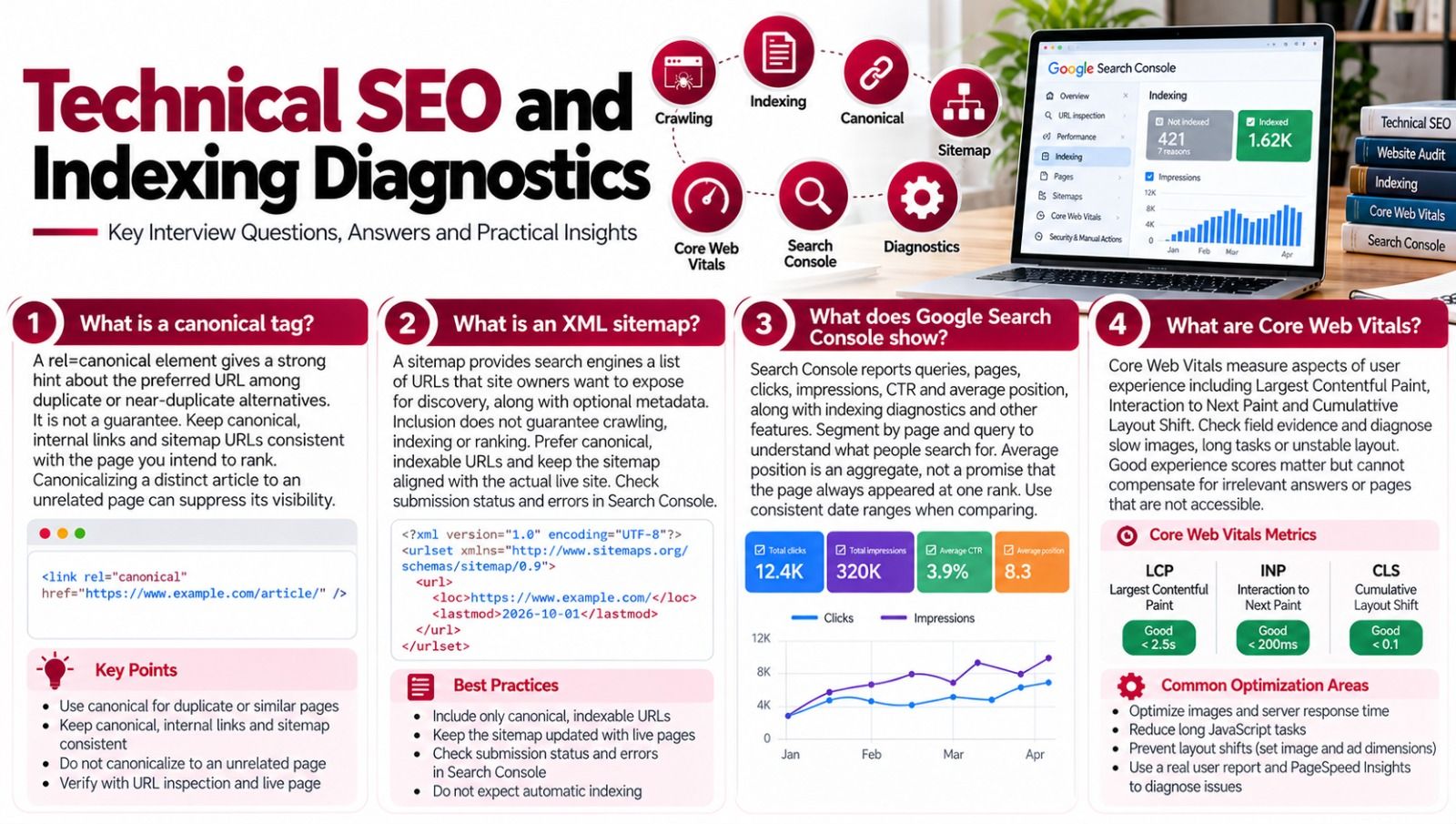
What is a canonical tag?
A rel=canonical element gives a strong hint about the preferred URL among duplicate or near-duplicate alternatives. It is not a guarantee. Keep canonical, internal links and sitemap URLs consistent with the page you intend to rank. Canonicalizing a distinct article to an unrelated page can suppress its visibility. A useful application of seo interview questions and answers is to diagnose this with evidence.
What is an XML sitemap?
A sitemap provides search engines a list of URLs that site owners want to expose for discovery, along with optional metadata. Inclusion does not guarantee crawling, indexing or ranking. Prefer canonical, indexable URLs and keep the sitemap aligned with the actual live site. Check submission status and errors in Search Console. This matters for seo interview questions and answers because assumptions need verification.
A good interview explanation includes a real diagnostic step. Describe the URL, report or piece of evidence you would inspect, the result you expect and what would falsify your initial assumption. When the site uses a JavaScript framework, distinguish raw source HTML from rendered output. Use a small example to show how your recommendation would help a person searching, not simply raise a scoring-tool percentage.
What does Google Search Console show?
Search Console reports queries, pages, clicks, impressions, CTR and average position, along with indexing diagnostics and other features. Segment by page and query to understand what people search for. Average position is an aggregate, not a promise that the page always appeared at one rank. Use consistent date ranges when comparing. Practise seo interview questions and answers by testing a real page before making changes.
What are Core Web Vitals?
Core Web Vitals measure aspects of user experience including Largest Contentful Paint, Interaction to Next Paint and Cumulative Layout Shift. Check field evidence and diagnose slow images, long tasks or unstable layout. Good experience scores matter but cannot compensate for irrelevant answers or pages that are not accessible. Include this concept when revising seo interview questions and answers and check technical details.
A good interview explanation includes a real diagnostic step. Describe the URL, report or piece of evidence you would inspect, the result you expect and what would falsify your initial assumption. When the site uses a JavaScript framework, distinguish raw source HTML from rendered output. Use a small example to show how your recommendation would help a person searching, not simply raise a scoring-tool percentage.
SEO Reporting and Growth Scenarios
Reporting should connect changes to measured outcomes. Start with indexed URLs, queries and click opportunities, then assess whether the issue is visibility, relevance or search-result interaction.
What is structured data?
Structured data provides machine-readable descriptions of eligible content and entities, often through JSON-LD. It may support special search appearances when requirements are met but does not guarantee rich results. Markup must accurately describe what users can see and follow current search engine documentation. A useful application of seo interview questions and answers is to diagnose this with evidence.
What are internal links?
Internal links connect pages on the same site, helping visitors navigate related subjects and assisting crawlers in discovering content. Use relevant anchor wording and ensure targets return a valid page. Linking a course guide to an interview-preparation article can be helpful when the visitor is researching career paths; forced repetition of exact anchors is not. This matters for seo interview questions and answers because assumptions need verification.
A good interview explanation includes a real diagnostic step. Describe the URL, report or piece of evidence you would inspect, the result you expect and what would falsify your initial assumption. When the site uses a JavaScript framework, distinguish raw source HTML from rendered output. Use a small example to show how your recommendation would help a person searching, not simply raise a scoring-tool percentage.
How do you diagnose low organic CTR?
Review which queries produced impressions, which pages ranked for them, device mix and whether the content meets the user's intent. Compare the title link and search appearance with the user's question. A page ranking far below the top positions may need relevance improvements, not just a title rewrite. Test changes and evaluate over a sensible period. Practise seo interview questions and answers by testing a real page before making changes.
What is keyword cannibalization?
When multiple pages target nearly identical intent, they may compete or confuse content strategy. Verify overlap in queries, landing pages and their distinct value before acting. Combine genuine duplicates, or clarify separate intents. Redirects, canonicals and internal links should be selected based on the actual situation, not used automatically. Include this concept when revising seo interview questions and answers and check technical details.
A good interview explanation includes a real diagnostic step. Describe the URL, report or piece of evidence you would inspect, the result you expect and what would falsify your initial assumption. When the site uses a JavaScript framework, distinguish raw source HTML from rendered output. Use a small example to show how your recommendation would help a person searching, not simply raise a scoring-tool percentage.
SEO Audit and Search Console Practical Exercises
Consider a blog with 8,000 impressions, 40 clicks and an average position well below the first results. CTR is 0.5%, but changing the meta title is not automatically the correct next step. Inspect the specific queries and positions, identify whether the blog answers the searcher's question and check for stronger competing content. Now consider a different page with strong positions and low CTR; its search appearance, title link and result features deserve more attention. The same metric can require different solutions depending on context.
How Would You Explain an SEO Audit?
Begin with access and indexability: status codes, robots controls, canonical URLs and sitemap consistency. Review rendered headings and content quality, internal-link paths, mobile performance and relevant structured data. Then analyze Search Console queries, pages, clicks and impressions to choose priorities. Every recommendation should name an affected URL, evidence, proposed fix, owner and validation step. Avoid claiming that a tool's health score is equivalent to Google ranking potential.
Seven-Day SEO Interview Preparation
Day 1: crawling, indexing and rankings. Day 2: search intent, titles, headings and internal links. Day 3: robots, canonicals, redirects and status codes. Day 4: Search Console metrics and sitemap diagnostics. Day 5: Core Web Vitals and JavaScript SEO. Day 6: audit one public website and document evidence. Day 7: rehearse technical and reporting scenarios and verify your explanations against official resources.
Conclusion
Strong seo interview questions and answers explain why an SEO action is justified, how it will be tested and what result would demonstrate progress. Focus on the pages and queries you can measure rather than promises of guaranteed rankings. Google Search Central documentation is a reliable starting point: Google Official Documentation .
Frequently Asked Questions
Take the next step towards your IT career with WHY TAP. Visit: