Artificial Intelligence has moved from being a futuristic concept to a mission-critical pillar for almost every modern organisation. From IT and banking to healthcare, retail, and even government sectors, companies are now dependent on AI to reduce costs, increase efficiency, and scale faster.
As a result, AI professionals in 2025 have become the most in-demand talent across India and the world.
The shift is massive. The companies that once “experimented” with AI are now restructuring entire departments to integrate AI systems creating an urgent need for skilled professionals who can build, deploy, and manage these solutions.
Below is a complete breakdown of why organisations are aggressively hiring AI talent.
Between 2020 and 2024, AI transformed from an optional innovation into a core business infrastructure. In 2025, companies use AI across departments:
AI has become as essential as cloud computing, cybersecurity, or full-stack development.
This has created an unprecedented demand for AI professionals in 2025 who can understand both the technical and strategic aspects of AI implementation.
Earlier, AI roles were meant only for PhDs or hardcore researchers. Today, the hiring landscape has become broader and more practical.
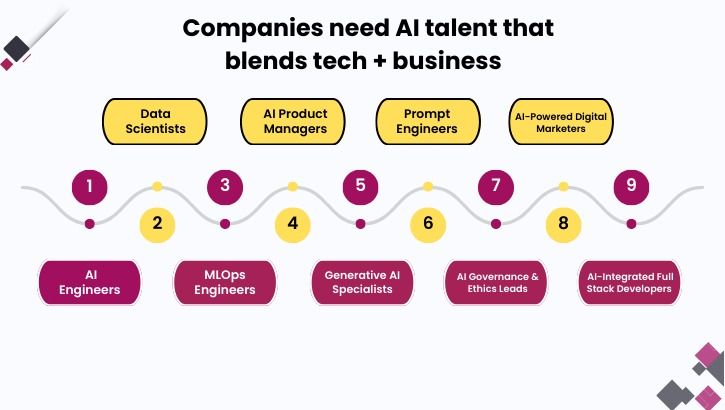
Companies are looking for AI experts across multiple domains:
The ideal AI professional today must combine:
✔ Technical expertise
✔ Domain knowledge
✔ Problem-solving
✔ Business intelligence
✔ Ethical understanding
✔ Strong communication skills
This hybrid skill set is extremely rare which is why salaries have skyrocketed.
Across global markets, the demand for AI professionals is increasing at a pace far greater than the talent pipeline can support.
Industries hiring aggressively include:
Because the supply of skilled AI talent is limited, companies are offering:
The talent gap is expected to remain wide until 2030.
As AI is now used in sensitive areas—credit scoring, hiring, fraud detection, customer recommendations, risk analysis—companies face legal and ethical responsibilities.
This has created demand for new roles such as:
These professionals ensure that AI systems are fair, transparent, secure, and compliant with regulations.
Corporates cannot afford AI-related mistakes, making these roles essential.
Companies that build internal AI teams gain massive advantages:
This has pushed small, mid-size, and large enterprises to hire their own AI professionals in 2025, even if they previously relied on agencies or outsourced developers.
The demand for AI professionals in 2025 is at an all-time high, and companies across every sector—tech, finance, healthcare, retail, manufacturing, logistics, entertainment, and even government—are aggressively hiring specialists who can build, manage, and scale AI systems.
Unlike earlier years where only IT giants hired AI talent, in 2025 every industry now relies on AI-driven automation, prediction, personalization, and optimization, which has created a massive talent gap and an urgent need for skilled AI professionals.
Below are the most in-demand AI roles in 2025, along with why companies want them.
1. AI / ML Engineer
AI/ML Engineers are responsible for building machine learning models, training datasets, improving prediction accuracy, and deploying intelligent systems.
They are among the highest-paid AI professionals in 2025 because companies want engineers who can automate operations, optimize performance, and make their products smarter.
Key Skills: Python, TensorFlow, PyTorch, ML modeling, APIs, data pipelines, cloud platforms.
2. Data Scientist
Data Scientists transform raw data into actionable insights.
In 2025, companies rely on them for forecasting trends, identifying customer behavior, improving decision-making, and reducing business risks.
Key Skills: Statistics, Python, SQL, Power BI, ML models, predictive analytics.
3. MLOps Engineer
As AI deployment becomes mainstream, companies need MLOps Engineers to streamline model deployment, monitoring, scaling, and version control.
They ensure AI systems run reliably in production — an absolutely critical role for organisations adopting AI at scale.
Key Skills: Docker, Kubernetes, CI/CD, AWS/GCP, MLflow, model monitoring.
4. Generative AI Developer
GenAI is the fastest-growing AI specialization in 2025.
Companies want experts who can build tools using LLMs, fine-tune models, develop AI chatbots, automate content generation, and integrate AI into business workflows.
Key Skills: LLM fine-tuning, prompt engineering, API integration, RAG systems, vector databases.
5. Prompt Engineer
Prompt Engineers design high-quality prompts, improve model outputs, and build AI workflows for content, marketing, analytics, customer support, and automation.
This role exploded because businesses want better AI results without complex coding.
Key Skills: LLM behavior, prompt patterns, persona prompts, chain-of-thought design.
6. AI Product Manager
Companies need product managers who understand both business strategy and AI capabilities.
They guide AI-powered products from concept to launch and ensure the AI system solves real customer problems.
Key Skills: Product lifecycle, user research, AI workflow design, business strategy.
7. AI Digital Marketer
As marketing automation becomes AI-first, companies need professionals who understand AI-driven campaigns, predictive analytics, hyper-personalization, and automated funnels.
Key Skills: Meta/Google AI tools, analytics, automation tools, audience modelling, generative content.
8. AI Solutions Architect
These are senior-level AI professionals in 2025 who design complete AI ecosystems for enterprises.
They integrate AI models with existing business infrastructure and ensure the company’s AI roadmap is scalable, secure, and aligned with business goals.
Key Skills: Cloud architecture, enterprise systems, ML pipelines, API-based integrations.
Why These Roles Are in Demand Across All Industries in 2025
Every industry now wants AI professionals in 2025 because AI is no longer a tech feature, it has become a business growth engine. Companies across sectors need AI talent to:
From startups to Fortune 500 companies, AI talent is now viewed as essential, not optional.
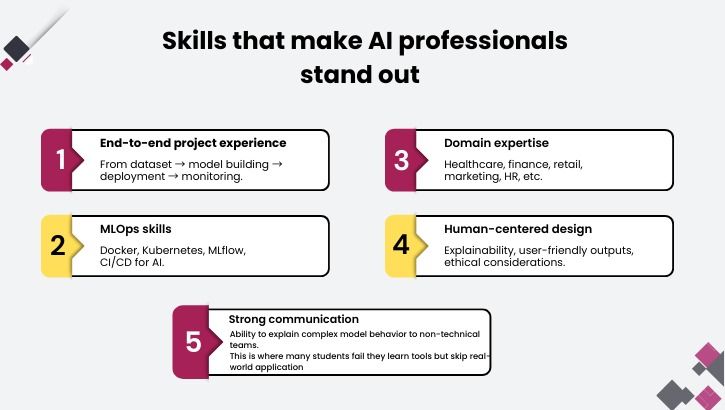
In a market where demand has surpassed supply, the companies hiring the most AI professionals in 2025 aren’t looking for people who merely know tools, they want candidates who can apply AI to real business problems. The professionals who rise to the top all share a combination of technical expertise, practical experience, and strategic thinking that sets them apart from the rest.
Below are the essential skills that make AI professionals highly valuable, future-ready, and irresistible to employers:
The strongest AI professionals in 2025 don’t rely on theoretical knowledge. They build:
End-to-end ML pipelines
Real datasets (not classroom examples)
Predictive models for real problems
AI automation workflows
GenAI applications and chatbots
Employers want proof of execution, portfolios, GitHub repositories, and deployed projects speak louder than certificates.
Companies do not pay for models that work only on Jupyter Notebooks.
They hire AI professionals who can:
Deploy models to production
Build scalable APIs
Monitor drift and performance
Maintain version control
Create reproducible pipelines
Deployment skill alone can double a candidate’s value.
In 2025, MLOps is no longer optional, it is the backbone of AI scalability.
Top professionals master:
These skills allow companies to automate, scale, and maintain AI systems with reliability.
Cloud platforms host almost every modern AI system.
Employers want AI professionals in 2025 who can:
AI is useless without understanding the industry it serves.
The most successful AI candidates specialize in sectors such as:
Domain-aware AI professionals solve problems faster and deliver solutions with real business impact.
Companies don’t just want “model builders.”
They want thinkers.
The best AI professionals:
Soft skills are now a hiring priority.
Why?
Because AI professionals in 2025 must:
With AI adoption increasing, companies want professionals who understand:
Most learners chase tools like Python, TensorFlow, or ChatGPT — but tools alone don’t guarantee success. What companies truly want are AI professionals in 2025 who can solve real problems, deploy real systems, and generate real outcomes.
This is why employers chase the candidates who:
✔ Build real projects
✔ Think strategically
✔ Understand business impact
✔ Master cloud + MLOps
✔ Communicate effectively
✔ Follow ethical AI principles
These are the professionals who get hired, promoted, and fast-tracked into leadership roles.
AI adoption is accelerating across every sector. Companies are not just hiring AI engineers—they want:
This means AI has become a cross-functional requirement, not a niche skill.
Students, freshers, and professionals who start learning AI now will dominate the job market for the next 10 years.
Hands-on, industry-aligned programs like WHY TAP’s AI-Powered Full Stack, Data Science, and Digital Marketing courses prepare learners for real-world AI applications and placements.
Learning AI in 2025 is equivalent to learning computers in the 1990s or learning the internet in the 2000s, it unlocks opportunities across every industry.
AI professionals are getting:
AI isn’t just the future.
AI is the present and professionals who master it will lead the next decade.
Companies want AI professionals in 2025 because AI has become the foundation of business growth, automation, and innovation. Skilled AI talent delivers competitive advantage, reduces risk, and unlocks high ROI across industries.
For students and professionals, this is the best time to build AI expertise especially through hands-on, placement-driven programs like: