





Table of Contents
- 1.
- 2.
- 3.
- 4.
- 5.
Machine learning isn’t just another tech trend it’s a measurable shift happening across every industry. According to McKinsey, companies using machine learning process see an average revenue boost of 20% and cost reduction of up to 40%. A report by IDC estimates that global AI and machine learning spending will exceed $500 billion by 2027, proving it’s not optional technology anymore it’s infrastructure.
Today, ML powers 91% of top-tier digital products including search engines, fraud detection systems, recommendation engines, autonomous driving algorithms, and large-scale business forecasting models. From Netflix deciding what you watch next to Tesla enabling self-driving navigation, machine learning has quietly become the engine behind modern automation and decision-making.
Yet despite its massive adoption, more than 60% of business leaders admit they don’t fully understand how machine learning process actually works they just know they need it. And that’s the real gap: everyone uses ML, very few understand it.
This article fixes that problem.
You’re about to learn exactly machine learning process how works step by step without sugar-coating, oversimplifying, or throwing random buzzwords around. If you’re tired of shallow explanations and want a precise, real-world breakdown of how ML models learn, predict, adapt, and deploy at scale, keep reading.
Why Machine Learning Exists in the First Place
Humans are great at intuition and creative thinking. Machines are unbeatable when it comes to:
- Processing massive amounts of data
- Making repeatable decisions
- Finding patterns humans overlook
If your dataset is small, a traditional program works fine. But when you have millions of data points, multiple variables, and unpredictable patterns, writing rule-based code becomes impossible. That’s where ML steps in the system learns patterns directly from the data.
The Core Concept of Machine Learning
Machine learning process follows one core rule:
Learn patterns from data → Make predictions → Improve over time.
You feed historical data into a model.
The model finds correlations and builds a mathematical representation.
Then it uses that knowledge to make predictions on new, unseen data.
How Machine Learning Works: Step-by-Step Breakdown
This is the real workflow not the one-liner definition everyone throws around.
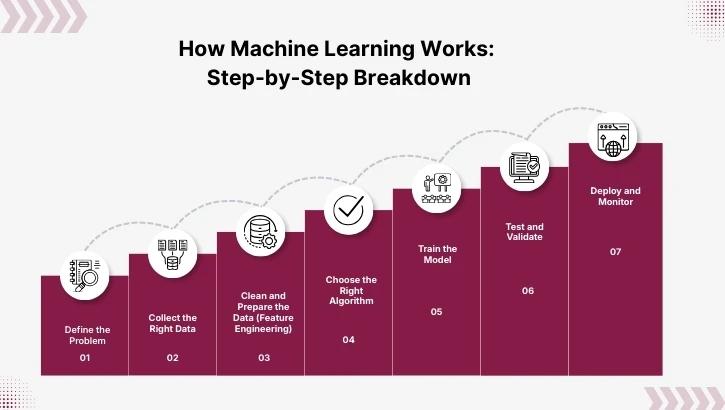
1. Define the Problem
Before touching algorithms, data, or code, you need to define the outcome.
Examples:
- Predict whether a customer will churn → Classification
- Estimate house price → Regression
- Detect fraud → Anomaly detection
- Recommend content → Recommendation system
A poorly defined problem equals a failed project no matter how good the model is.
2. Collect the Right Data
Data is the real fuel.
“The world’s most valuable resource is no longer oil, but data. “The Economist
Machine learning needs large, diverse, and relevant data.
Sources include:
- Customer databases
- IoT devices
- Web scraping
- Public datasets (ex: Kaggle, Google Dataset Search)
- Business CRM/Analytics platforms
Bad data = bad model.
There are no exceptions.
3. Clean and Prepare the Data (Feature Engineering)
This is the part nobody talks about but takes the most time.
You remove:
- Duplicates
- Missing values
- Outliers
- Noise
Then you transform raw data into usable inputs, known as features.
Example:
Instead of:
“User bought this product”
You generate:
- Number of visits before purchase
- Device type
- Time of purchase
- Past shopping behavior
Good features often matter more than the algorithm.
4. Choose the Right Algorithm
Now the machine learning process starts.
Algorithms fall into three major groups:
| Type of ML | Meaning | Example Algorithms |
|---|---|---|
| Supervised Learning | Learns from labeled data | Linear Regression, SVM, Random Forest |
| Unsupervised Learning | Finds patterns in unlabeled data | K-means, PCA |
| Reinforcement Learning | Learns by trial and error | Q-learning, Deep RL |
Example use cases:
- Supervised → Predict house price
- Unsupervised → Segment customers for marketing
- Reinforcement → Train a robot to walk or a game bot to win
5. Train the Model
Training means feeding data to the algorithm repeatedly until it identifies patterns.
The model adjusts internal values (called weights and biases) using mathematical optimization.
If predictions are wrong, the system calculates loss and adjusts until accuracy improves.
Think of it like teaching a kid:
- Show example → They guess
- Correct them → They try again
- Repeat until they understand
6. Test and Validate
A model isn’t useful if it only memorizes data.
It must generalize.
So, you split data:
- Training set → Learn patterns
- Validation set → Tune parameters
- Testing set → Verify performance
Metrics include:
- Accuracy
- Recall
- Precision
- F1 score
- ROC-AUC
7. Deploy and Monitor
Once approved, the model goes into real use:
- Web application
- Mobile app
- Cloud service
- Embedded software (cars, devices, robots)
Monitoring is critical real-world data changes (called data drift), and models degrade over time. Retraining becomes mandatory.
A Real Example: How Netflix Uses Machine Learning
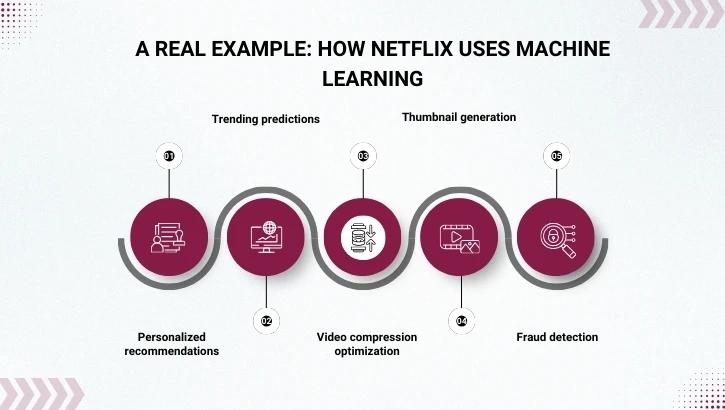
Netflix doesn’t guess what you like it predicts.
ML is used for:
- Personalized recommendations
- Trending predictions
- Video compression optimization
- Thumbnail generation
- Fraud detection
Netflix reported a $1B+ annual revenue increase due to personalized recommendations (source: Netflix Tech Blog).
Types of Machine Learning Models
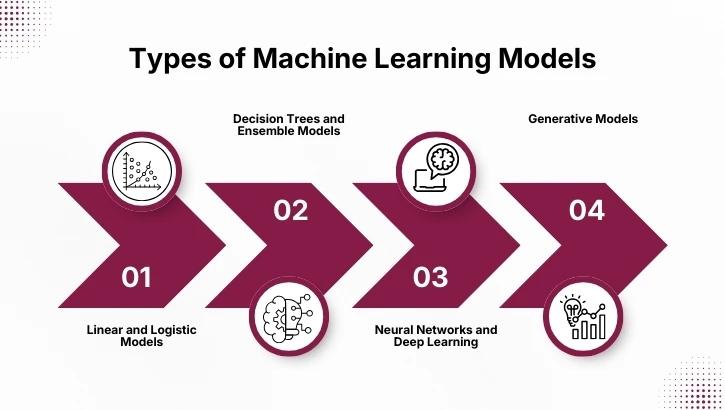
1. Linear and Logistic Models
Simple, fast, strong baseline models.
Used for forecasting, financial models, classification.
2. Decision Trees and Ensemble Models
Algorithms like Random Forest and XGBoost are industry favorites powerful, accurate, and easy to interpret.
3. Neural Networks and Deep Learning
Inspired by the human brain.
Used in:
- Speech recognition
- Facial recognition
- Autonomous driving
- Large Language Models (ChatGPT, Bard)
4. Generative Models
Models like GANs and Transformers create data, not just analyze it.
- AI art
- Synthetic data
- Deepfake video
- Content generation
Where Machine Learning is Used Today
You interact with ML daily you just don’t realize it.
- Google Search ranking
- Amazon product recommendations
- YouTube video suggestions
- Spam filtering
- Navigation (Google Maps)
- Self-driving cars
- Medical diagnosis
- Stock trading
ML isn’t the future it’s already here.
Benefits of Machine Learning
- Automation of repetitive tasks
- Cost reduction
- Accuracy at scale
- Real-time intelligence
- Personalization
- Faster decision-making
Limitations (Yes, ML Isn’t Perfect)
- Needs massive amounts of quality data
- Can be biased
- Expensive to maintain
- Requires retraining
- Results aren’t always explainable
If you blindly trust a model you’re asking for failure.
Future of Machine Learning
Machine learning will evolve toward:
- Fully autonomous learning (self-improving models)
- Hybrid AI (combining rule-based logic + ML)
- Edge AI (smart devices performing ML locally)
- Ethical and explainable AI frameworks
AI won’t replace humans but humans who understand AI will replace those who don’t.
Conclusion
Machine learning process works by learning from data identifying patterns, refining predictions, and improving over time. It’s not hype; it’s a practical, scalable solution powering modern technology.
Whether you’re in tech, business, marketing, finance, or healthcare, ignoring machine learning is like ignoring electricity in the 1900s.
The future isn’t humans vs AI it’s humans using AI.