




Table of Contents
- 1.
- 2.
- 3.
- 3.1
- 4.
- 4.1
- 5.
- 6.
- 7.
- 7.1
- 8.
- 9.
- 10.
- 11.
Choosing the right tech skill has never been more confusing for freshers. With thousands of graduates entering the job market every year, simply having a degree is no longer enough. Employers are actively looking for job-ready skills, and the gap between what students learn and what companies need is growing fast.
Industry hiring trends show that roles in AI, data, cloud, cybersecurity, and full-stack development are expanding rapidly, while traditional entry-level IT roles are shrinking. Freshers who pick the wrong skill often struggle with low salaries, delayed placements, or repeated rejections despite putting in years of effort.
The good news is that 2026 offers massive opportunities for freshers who plan smartly. By learning the right tech skills with a clear roadmap and realistic salary expectations, students can fast-track their careers. In the sections below, we’ll break down the most in-demand tech skills for Indian freshers in 2026, their salary range, and how to start building them step by step.
Why Choosing the Right Tech Skills Matters for Freshers in 2026
For Indian freshers, 2026 is not just about entering the tech industry - it’s about entering it with the right skills. The market is crowded, and companies are no longer hiring based on degrees alone. What you choose to learn now directly impacts your employability, salary, and growth speed.
Here’s why skill selection matters more than ever:
● Too many graduates, too few job-ready candidates
○ Every year, thousands of freshers graduate with similar qualifications
○ Employers struggle to find candidates who can contribute from day one
○ As a result, hiring is shifting toward skills, not certificates
● Not all tech skills offer the same career outcomes
○ Some skills lead to high-demand roles and faster growth
○ Others are becoming saturated or outdated
○ Freshers who choose in-demand skills see better interview calls and offers
● Early decisions influence long-term salary and growth
○ Starting with the right skill often means higher entry-level pay
○ It also opens doors to advanced roles and specializations later
○ Wrong choices can lead to role switches, career delays, or stagnation
● Employers expect a blend of skills
○ Technical ability alone is not enough
○ Companies value problem-solving, adaptability, and industry awareness
○ Freshers who align skills with market demand stand out quickly
As highlighted in Employability skills for high-paying jobs in India, candidates with the right mix of technical and job-ready skills consistently outperform others in hiring and salary outcomes.
In 2026, choosing the right tech skill is not a gamble - it’s a strategic career decision that sets the foundation for long-term success.
How We Identified the Most In-Demand Tech Skills for 2026
With so many tech skills trending online, it’s easy for freshers to feel overwhelmed. To avoid guesswork, this list of most in-demand tech skills for indian 2026 is based on real hiring signals, not hype. The goal is to highlight skills that offer strong demand, fresher-friendly entry points, and long-term growth.
Here’s how these skills were identified:
● Hiring trends across industries
○ Analysis of job postings from IT services, startups, and product companies
○ Focus on roles that consistently appear across multiple sectors
○ Preference for skills that companies actively recruit freshers for
● Demand vs. supply gap
○ Skills where demand is growing faster than the availability of trained talent
○ Areas where companies invest heavily in upskilling new hires
○ Roles that remain open longer due to lack of job-ready candidates
● Career longevity and future relevance
○ Skills that will remain valuable beyond entry-level roles
○ Technologies aligned with AI, cloud, automation, and data-driven systems
○ Reduced risk of becoming obsolete in the next few years
● Salary potential and growth scope
○ Entry-level salary ranges that justify the learning effort
○ Clear growth paths into mid-level and senior roles
As highlighted in Top skills in demand across industries, employers are prioritizing adaptable, future-ready skills over short-term trends. This approach ensures the skills listed ahead are not just popular - but career-defining for freshers in 2026.
Top 10 Most In-Demand Tech Skills for Indian Freshers in 2026
In 2026, companies are not just hiring based on degrees - they are hiring based on skills that directly solve business and technology problems. The tech skills listed below are consistently in demand across startups, IT services, and product-based companies, making them strong career choices for Indian freshers.
The focus here is on:
● Fresher-friendly entry points
● Strong hiring demand
● Competitive salary growth
● Long-term relevance
Top In-Demand Tech Skills, Salary Range & Career Scope (India - 2026)
| Tech Skill | Common Entry-Level Roles | Average Salary Range (₹/Year) | Career Scope |
|---|---|---|---|
| Artificial Intelligence & Machine Learning | AI Engineer, ML Analyst | ₹6–12 LPA | Very High |
| Data Analytics | Data Analyst | ₹5–10 LPA | High |
| Full-Stack Development | Software Developer | ₹4–9 LPA | High |
| Cloud Computing | Cloud Engineer | ₹6–11 LPA | Very High |
| Cybersecurity | Security Analyst | ₹5–10 LPA | High |
| DevOps | DevOps Engineer | ₹6–12 LPA | Very High |
| Digital Marketing & Analytics | Performance Marketer | ₹4–8 LPA | High |
| UI/UX Design | UI/UX Designer | ₹4–7 LPA | Medium - High |
| Business Analytics | Business Analyst | ₹5–9 LPA | High |
| Automation & Testing | QA / Automation Enginee | ₹4–8 LPA | Medium - High |
Why these skills matter for freshers:
● They align with where companies are investing in 2026
● They offer clear growth paths beyond entry-level roles
● Many allow freshers to start with fundamentals and grow through projects.
These skills are not short-term trends - they are core building blocks of the future tech workforce. In the next sections, we’ll explore which of these skills are especially beginner-friendly and how freshers can start learning them step by step.
High-Growth Tech Skills That Are Especially Beginner-Friendly
Not every in-demand tech skill requires years of experience or deep coding knowledge to get started. In 2026, several high-growth tech skills offer beginner-friendly entry points, making them ideal for Indian freshers who are starting from scratch or switching domains.
Tech Skills Freshers Can Start With Zero or Minimal Experience
These skills allow freshers to learn fundamentals quickly, build projects, and enter the job market faster:
● Data Analytics
○ Requires basic math and logical thinking
○ Tools like Excel, SQL, and visualization platforms are beginner-friendly
○ Strong demand across industries for entry-level analysts
● Digital Marketing & Analytics
○ Combines creativity with data-driven decision-making
○ Freshers can start with SEO, ads, analytics, and AI tools
○ High demand for performance-focused roles
● UI/UX Design
○ Focuses on user experience, design thinking, and usability
○ Less coding required at the entry level
○ Portfolio-based hiring favors skilled freshers
● Automation & Testing
○ Entry point into software roles without heavy development work
○ Involves learning testing frameworks and automation tools
○ Widely adopted across IT and product companies
● AI-Assisted Roles for Freshers
○ Many AI roles now focus on implementation, tools, and analysis
○ Freshers can work with AI platforms without deep algorithm knowledge
As highlighted in Top AI jobs for freshers in India for 2026, companies are actively hiring freshers who understand AI tools and data-driven workflows, even at entry level.
For freshers, choosing a beginner-friendly yet high-growth skill reduces entry barriers while keeping long-term career growth strong.
Tech Job Trends Indian Freshers Should Watch in 2026
The tech job market in 2026 is being shaped by rapid innovation, automation, and changing business priorities. For Indian freshers, understanding these trends is just as important as learning the right skills - because trends decide which roles grow, which evolve, and which disappear.
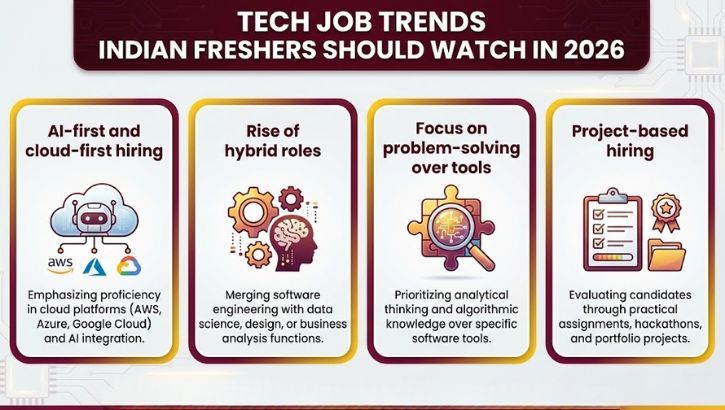
Here are the key tech job trends freshers should keep an eye on:
● AI-first and cloud-first hiring
○ Companies are embedding AI into almost every tech role
○ Cloud platforms are the backbone of modern applications
○ Even non-AI roles now expect basic AI and cloud awareness
● Rise of hybrid roles
○ Employers prefer professionals who combine tech + business or tech + data
○ Roles like growth engineer, analytics-driven marketer, and AI-enabled analyst are increasing
○ Single-skill roles are gradually shrinking
● Focus on problem-solving over tools
○ Tools change quickly, but problem-solving skills remain valuable
○ Companies assess how candidates approach real-world challenges
○ Freshers who show logical thinking stand out in interviews
● Skills Over Certificates: What Recruiters Actually Shortlist Today
○ Degrees alone no longer guarantee interviews
○ Recruiters look for hands-on projects, internships, and practical exposure
○ Demonstrated skills matter more than theoretical knowledge
According to The 10 most in-demand IT jobs in India in 2026, roles aligned with AI, cloud, data, and automation are expected to dominate hiring.
For freshers, tracking these trends helps in choosing skills that stay relevant - and avoiding paths that lead to slow growth or limited opportunities.
What Real Developers and Hiring Communities Are Saying
Beyond reports and job portals, one of the most honest indicators of future tech demand comes from developer and hiring communities. These are professionals who are already working in the industry and actively observing how skills translate into real jobs.
Here’s what real conversations from developer communities reveal:
● Skill relevance matters more than hype
○ Developers consistently warn against chasing every new trend
○ Core skills with real-world application are valued more than buzzwords
○ Skills that solve business problems last longer than flashy tools
● Strong fundamentals are still non-negotiable
○ Communities emphasize basics like problem-solving, logic, and system understanding
○ Tools and frameworks change, but fundamentals carry careers forward
○ Freshers who skip basics struggle in interviews and on the job
● Hybrid skill sets are winning
○ Developers recommend combining coding with cloud, data, or AI exposure
○ Many hiring discussions highlight demand for “jack-of-few-skills” professionals
○ Single-skill profiles face tougher competition
● Projects speak louder than resumes
○ Real-world projects, internships, and hands-on practice matter most
○ Communities often suggest building practical portfolios over collecting certificates
○ Recruiters trust demonstrated work more than listed skills
Insights from discussions like this one on which tech skills or stacks will be in demand show a clear pattern: freshers who listen to real developer advice make smarter career choices.
For students, following these communities helps cut through noise and focus on skills that actually lead to jobs, not just online popularity.
Roadmap for Freshers to Learn In-Demand Tech Skills in 2026
Learning an in-demand tech skill is only effective when freshers follow a clear, structured roadmap. Random tutorials and scattered courses often lead to confusion and slow progress. A step-by-step approach helps freshers build confidence, practical exposure, and job readiness.
Step-by-Step Skill Learning Roadmap for Beginners
Here’s a simple roadmap freshers can follow, regardless of the tech skill they choose:
● Step 1: Choose one core tech skill
○ Pick a skill aligned with your interest and market demand
○ Avoid learning multiple skills at once in the beginning
○ Focus on fundamentals before moving ahead
● Step 2: Build strong basics
○ Learn core concepts, tools, and workflows
○ Understand why things work, not just how
○ Practice small exercises consistently
● Step 3: Work on hands-on projects
○ Apply learning through real-world or simulated projects
○ Projects help you understand practical challenges
○ They also strengthen resumes and portfolios
● Step 4: Add complementary skills
○ Combine your core skill with analytics, AI tools, or automation
○ This improves employability and role flexibility
○ Skill stacking increases long-term growth
● Step 5: Prepare for interviews
○ Practice explaining your projects and decisions clearly
○ Focus on problem-solving and logical thinking
○ Interview readiness is as important as skill learning
Freshers who follow a roadmap like this avoid overwhelm and build job-ready confidence. The key is consistency, practical learning, and aligning every step with real hiring expectations in 2026.
Why AI Skills Are Becoming Non-Negotiable for Tech Careers
In 2026, AI is no longer a niche specialization - it’s becoming a core requirement across tech roles. Even jobs that don’t carry “AI” in the title now expect professionals to understand how AI tools and systems are used in real workflows.
Here’s why AI skills are turning non-negotiable:
● AI is embedded across tech functions
○ Developers use AI-assisted coding and testing tools
○ Data professionals rely on AI for insights and prediction
○ Marketers and analysts use AI for automation, personalization, and optimization
● Companies expect AI awareness, not just AI engineers
○ Employers don’t expect freshers to build complex AI models
○ They do expect familiarity with AI-powered tools and workflows
○ Knowing how to work with AI is becoming a baseline skill
● AI improves productivity and decision-making
○ AI reduces manual effort and speeds up execution
○ Professionals who use AI effectively deliver faster and better results
○ This directly impacts performance reviews and career growth
● AI skills future-proof tech careers
○ Roles without AI exposure are shrinking
○ Professionals with AI awareness adapt faster to role changes
○ AI skills open doors to cross-functional and higher-paying roles
As explained in Why every company wants AI professionals in 2025, AI is influencing hiring decisions across industries - not just in core AI roles.
For freshers, learning AI early isn’t about specialization - it’s about staying relevant, adaptable, and employable in the tech job market of 2026.
How Interview Preparation Matters as Much as Skill Learning
Learning in-demand tech skills is essential but skills alone don’t guarantee job offers. Many freshers struggle in interviews not because they lack knowledge, but because they’re unable to explain their skills, projects, and problem-solving approach clearly.
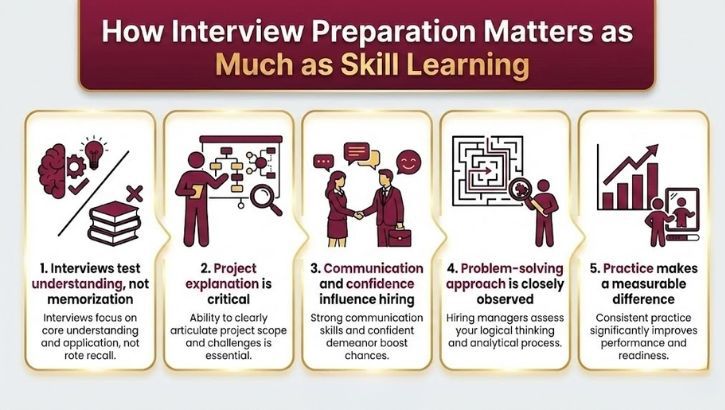
Here’s why interview preparation is just as important as learning the skill itself:
● Interviews test understanding, not memorization
○ Recruiters ask how and why, not just what
○ Freshers must explain logic, decisions, and trade-offs
○ Clear thinking matters more than perfect answers
● Project explanation is critical
○ Interviewers focus heavily on projects
○ They assess your role, challenges faced, and solutions applied
○ Poor explanation can undervalue even strong technical work
● Communication and confidence influence hiring
○ Confident communication shows job readiness
○ Recruiters prefer candidates who can explain ideas simply
○ Nervous or unclear answers often lead to rejection
● Problem-solving approach is closely observed
○ Interviewers care about how you approach unfamiliar problems
○ Logical thinking and structured answers matter more than speed
● Practice makes a measurable difference
○ Mock interviews help identify gaps early
○ They improve clarity, confidence, and response structure
To prepare effectively, freshers should regularly practice with real interview-style questions. Resources like Mock Interview Questions for Tech Students help candidates understand interviewer expectations and refine their answers.
In 2026, tech interviews are designed to assess readiness, reasoning, and communication - not just technical knowledge.
Final Thoughts
For Indian freshers, 2026 is full of opportunities but only for those who make smart skill choices. As the tech industry evolves, degrees alone no longer guarantee jobs. What truly matters is learning in-demand, future-ready tech skills and following a clear roadmap to build them. Skills in AI, data, cloud, cybersecurity, development, and digital marketing are opening doors to better roles, higher salaries, and faster career growth.
Freshers who start early, focus on practical learning, and prepare well for interviews gain a strong edge over the competition. The right combination of skills, hands-on experience, and career-focused preparation can turn confusion into confidence and effort into real job outcomes.
Start Building Job-Ready Tech Skills with WHY TAP
At WHY TAP, we help freshers move beyond confusion and build career-ready tech skills that companies actually hire for. Through structured learning, hands-on projects, AI-powered tools, and strong interview preparation, students gain the confidence to enter the tech job market prepared - not guessing.
If you’re serious about building in-demand skills and starting your tech career with clarity, explore our PG Certification in AI-Powered Digital Marketing and take the first step toward a high-growth career in 2026.