Why People Really Click “Buy now”
More than 95% of purchase decisions happen in the subconscious mind (Harvard Business School). This means customers don’t buy products logically; they buy based on feelings, perception, and instinct. This is where Marketing Psychology becomes the ultimate weapon for brands, advertisers, and digital marketers.
A study by Nielsen found that emotionally connected ads perform 23% better than rational ones. Meanwhile, a report by Invesp reveals that adding psychological triggers can increase conversions by up to 150%.
In an age where consumers see up to 10,000 ads every day, your ability to use Marketing Psychology correctly determines whether they scroll past… or click “Buy Now.”
“People don’t buy what you do; they buy why you do it.” – Simon Sinek
This article reveals 7 powerful psychological triggers based on proven Marketing Psychology principles that instantly influence purchasing decisions.
Marketing Psychology is the scientific study of how human behavior, emotions, perception, and decision making process influence buying actions. It combines neuroscience, consumer behavior, and behavioral economics.
Big companies like Apple, Amazon, Coca-Cola, Netflix, and Nike design their campaigns based on Marketing Psychology.
According to McKinsey, brands that apply Marketing Psychology strategies consistently experience:
This is why understanding and applying Marketing Psychology has become a must have skill for modern marketers.
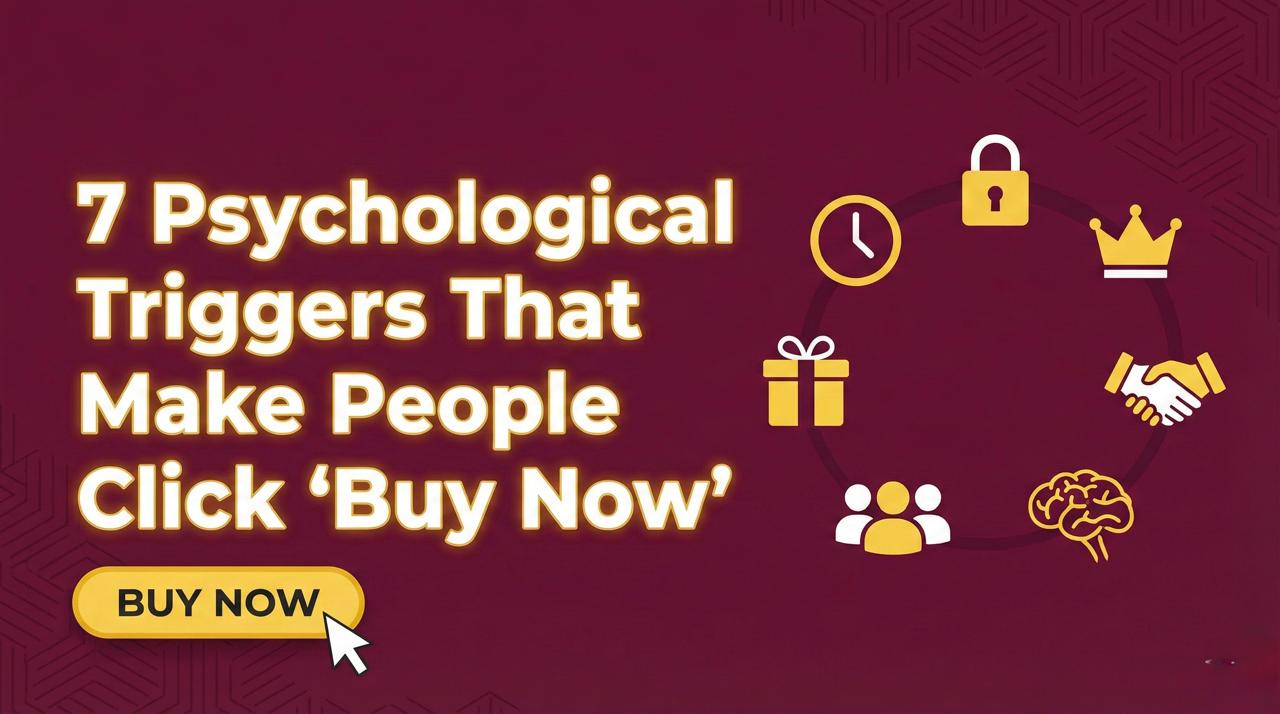
7 Psychological Triggers That Make People Click “Buy Now”
Each of the following triggers is deeply connected to Marketing Psychology and tested in real-world campaigns.
The brain hates losing opportunities.
When something is limited, it becomes more valuable in the human mind.
Examples:
Amazon uses this Marketing Psychology technique on 95% of its product pages.
This activates the amygdala (fear center of the brain) and creates FOMO (Fear of Missing Out), forcing the user toward the Buy Now button.
Humans are social animals. We look to others before we decide.
That’s why:
Examples:
This Marketing Psychology principle is why influencer marketing is a multi-billion dollar industry. “Trust is the new currency.” – Google Marketing Report
People obey authority figures.
If a doctor says it works → We believe.
If an expert recommends it → We trust.
Logos like:
increase conversions by up to 33% (HubSpot).
This Marketing Psychology trigger works because humans evolved to trust leaders for survival.
When someone gives us something, we feel the need to give back.
Examples:
This Marketing Psychology strategy is used by brands like Netflix, Shopify, HubSpot, Canva, and Adobe.
They first “give” → Then they “ask” → You feel obligated to respond.
This simple act can increase conversions by up to 42%.
Urgency tells the brain:
ACT NOW OR LOSE FOREVER.
Used in:
This activates dopamine (reward hormone).
In Marketing Psychology, urgency is one of the most powerful motivators.
Ecommerce brands using urgency experience:
226% increase in click-through rate
135% boost in conversions
Humans fear loss more than they value gain.
“Don’t miss your chance to…”
“Last opportunity to save…”
According to Behavioral Economist Daniel Kahneman, loss hurts 2x more than pleasure feels good. This makes Marketing Psychology deeply effective in crafting high impact lines.
Too many options = No decision.
Apple’s famous design principle:
“Simple is more powerful than complex.”
This reduces decision fatigue and strengthens Marketing Psychology’s influence on customer behavior.
How to Apply Marketing Psychology in Your Campaigns
Use these techniques:
Every successful ad campaign you see today is driven by Marketing Psychology.
Consumers don’t buy a product just because it exists. They buy because of Marketing Psychology the emotions, perceptions and mental triggers that influence their decisions. Every “Buy Now” click is driven by a feeling, not just logic.
When you understand and apply the 7 key psychological triggers: scarcity, urgency, social proof, authority, reciprocity, loss aversion, and simplicity you stop chasing customers. Instead, customers are naturally drawn to you because your message connects with their mind and emotions.
Marketing Psychology doesn’t manipulate people. It helps you understand their fears, their needs, and their desires better. When used responsibly, it builds trust, increases conversions, and turns ordinary marketing into meaningful influence.
In today’s competitive digital world, Marketing Psychology is no longer optional, it is essential. It is not just marketing. It is a modern day influence powered by the human mind.