





Table of Contents
- 1.
- 2.
- 3.
- 3.1
- 4.
- 5.
- 5.1
- 6.
- 7.
- 8.
- 8.1
Introduction
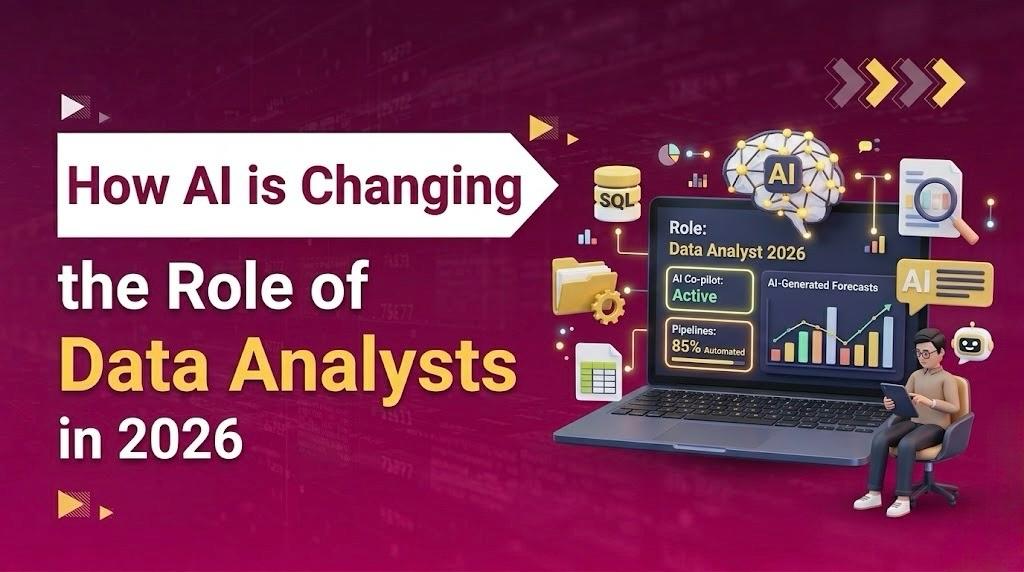
Artificial intelligence is no longer an experimental add-on in analytics; it is becoming the operating layer behind dashboards, reports, and forecasts. As automation tools grow more intelligent, many professionals are asking how AI is changing the role of data analysts in 2026 and whether traditional responsibilities will still remain relevant.
Over the past few years, analysts have already seen automation reduce manual reporting, accelerate data cleaning, and simplify predictive modeling. Tasks that once required hours of effort can now be completed in minutes with AI-assisted tools. This shift is not eliminating analysts, but it is redefining what value they bring to organizations.
In 2026, the competitive edge will not belong to those who merely extract data but to those who interpret AI-generated insights and translate them into business decisions. In the sections below, we will explore how AI is transforming analyst responsibilities, the skills required to stay relevant, and what this evolution means for career growth.
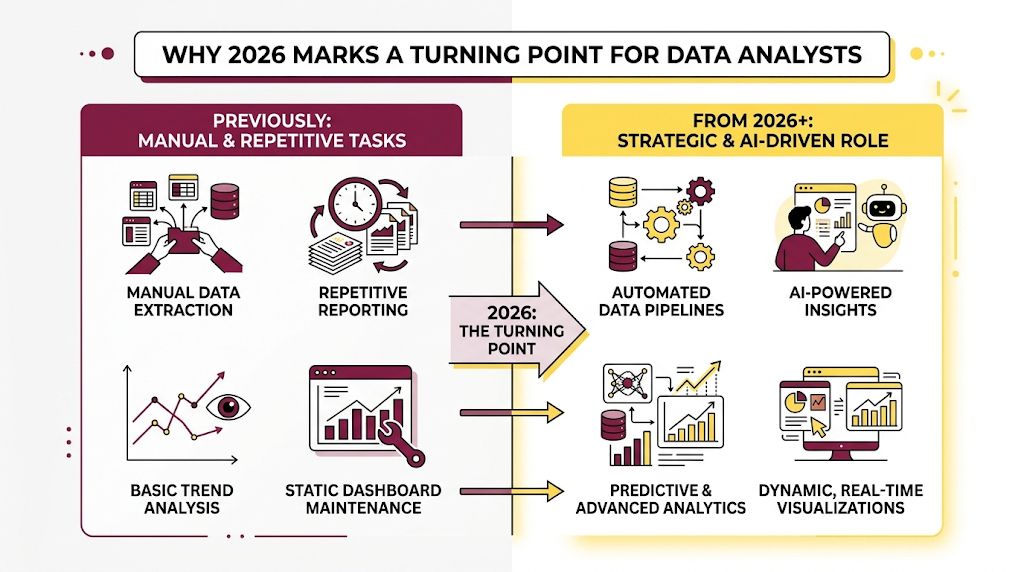
Why 2026 Marks a Turning Point for Data Analysts
The year 2026 represents more than gradual change; it signals structural transformation in analytics roles. Organizations are embedding AI directly into business intelligence platforms, making automation a default feature rather than an optional add-on.
Previously, data analysts spent a large portion of their time on:
- Manual data extraction
- Repetitive reporting
- Basic trend analysis
- Static dashboard maintenance
Today, AI systems can automate much of this workflow. As discussed in AI redefining roles, the traditional reporting-focused analyst role is rapidly evolving into a more strategic position centered around insight validation and decision enablement.
This turning point is driven by three major forces:
- Automation of operational tasks – AI handles repetitive processes.
- Executive demand for faster insights – Decision cycles are shrinking.
- Competitive pressure – Businesses expect predictive and proactive analytics.
In 2026, analysts are no longer valued for generating reports alone. They are expected to question AI outputs, validate patterns, and recommend actions.
This shift does not reduce the importance of analysts; it increases it. But the nature of their contribution is fundamentally changing.
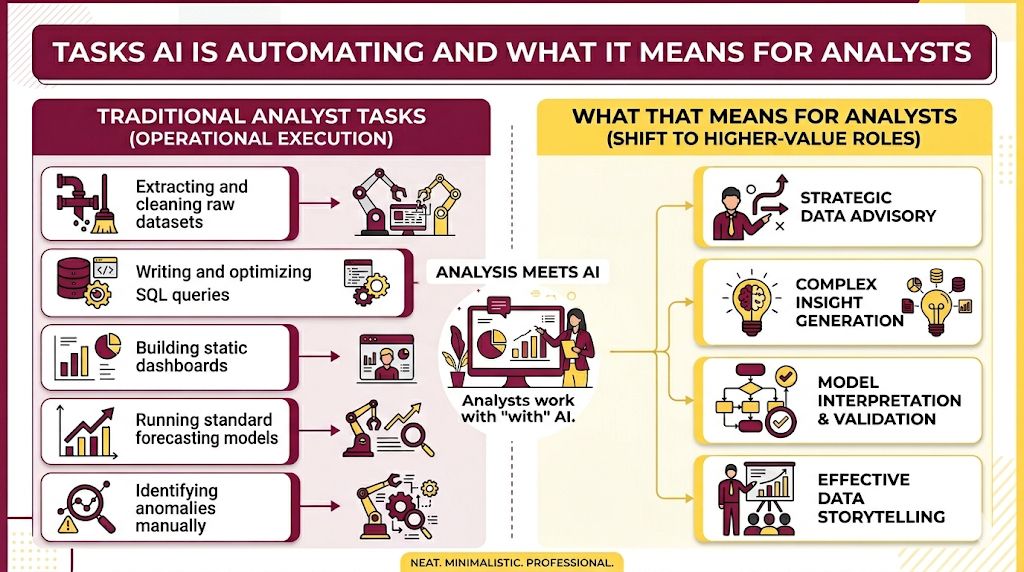
Tasks AI Is Automating and What That Means for Analysts
AI in 2026 is not just assisting analytics it is redesigning workflow architecture. Repetitive, rule-based, and time-intensive processes are increasingly handled by intelligent systems. This shift changes not only what analysts do but also how they deliver value.
Traditionally, analysts invested significant time in operational execution:
- Extracting and cleaning raw datasets
- Writing and optimizing SQL queries
- Building static dashboards
- Running standard forecasting models
- Identifying anomalies manually
Today, AI-powered platforms can automate these layers within minutes. As highlighted in AI analytics trends, automation is accelerating decision cycles and reducing dependency on manual processes.
Workflow Evolution in the AI Era
| Legal Workflow | AI-Enabled Process | Analyst’s Strategic Role |
|---|---|---|
| Manual reporting | Auto-generated dashboards | Insight validation |
| Data preprocessing | Smart data cleaning | Quality assurance oversight |
| Predictive modeling | Automated model suggestions | Scenario testing & refinement |
| SQL scripting | AI-assisted query drafting | Business interpretation |
The Shift from Execution to Strategic Oversight
Automation does not eliminate the analyst; it elevates the role.
With AI handling execution, analysts are now responsible for:
- Interpreting AI-generated insights
- Identifying bias or flawed assumptions
- Evaluating model limitations
- Connecting analytics outputs to business KPIs
- Recommending action plans to leadership
This evolution increases responsibility. Analysts must think critically about AI outputs instead of blindly trusting them.
In 2026, value comes not from generating data but from validating, contextualizing, and transforming AI insights into strategic decisions.
The New Skills Data Analysts Must Develop in 2026
In 2026, knowing SQL is expected. Knowing how to think with AI is what differentiates you.
As automation handles repetitive tasks, data analysts are being pushed toward roles that require judgment, interpretation, and strategic thinking. The technical baseline has shifted. The competitive edge now lies in how you use AI not whether you use it.
The new skill stack looks different.
1. Thinking Before Querying
Instead of jumping into dashboards, analysts must first define:
- What decision needs to be made?
- What business metric is affected?
- What risk is involved?
AI can generate answers. Analysts must ensure the questions are right.
2. AI Supervision Skills
Modern analysts must:
- Validate AI-generated predictions
- Identify bias or flawed assumptions
- Cross-check outputs with domain logic
- Decide when human judgment overrides automation
AI speeds up analysis. Analysts ensure accuracy.
3. Business Communication Over Technical Jargon
Executives don’t want model complexity. They want clarity.
Strong analysts now translate:
- Patterns → Strategic recommendations
- Forecasts → Financial impact
- Insights → Action steps
As highlighted in the future of analytics jobs, companies increasingly value interpretation and business reasoning over manual reporting skills.
4. Continuous Adaptability
AI tools evolve fast. Skills must evolve faster.
The most successful analysts in 2026 will not be those who master one tool but those who adapt to new systems quickly and think strategically across platforms.
The future analyst is not a data extractor. They are a decision partner.
How AI Is Changing Hiring Expectations
If you walked into an analytics interview in 2022, you were tested on SQL queries, dashboard building, and basic forecasting.
In 2026, the questions look different.
Instead of “Can you build this report?”
Employers now ask:
- How would you validate an AI-generated prediction?
- What risks do you see in this automated model?
- How would you explain this insight to a non-technical leader?
The shift is clear. Hiring managers are not just evaluating technical ability; they are assessing analytical judgment.
AI tools are widely accessible. What differentiates candidates is how intelligently they use them.
What Recruiters Now Prioritize
Recruiters increasingly look for:
- Comfort working alongside AI systems
- Ability to challenge automated outputs
- Strong business reasoning
- Clear executive communication
- Accountability in AI-supported decisions
As discussed in AI redefining roles, reporting-heavy roles are shrinking, while decision-support roles are expanding.
To prepare for this shift, candidates should practice structured mock interview scenarios that reflect AI-driven evaluation patterns.
The Real Hiring Shift
Earlier: “Show me your technical skills.”Now: “Show me your decision-making ability.”
Candidates who rely only on tool proficiency may struggle.Those who combine AI familiarity with structured thinking stand out.
In 2026, employers are not hiring data processors.They are hiring analytical strategists.
Risks of Not Adapting to AI-Driven Analytics
AI will not replace every data analyst.But analysts who resist AI may gradually replace themselves.
The biggest risk in 2026 is not automation.It is stagnation.
Professionals who continue operating only as report generators face three major threats:
1. Role Compression
As AI handles repetitive reporting and dashboard creation, organizations need fewer execution-focused analysts. If your value lies only in manual work, your role becomes easier to substitute.
2. Salary Plateau
High-growth roles now demand strategic interpretation and AI fluency. Analysts who avoid upskilling may find salary growth slowing while AI-enabled professionals move ahead.
3. Reduced Strategic Visibility
Analysts who do not adapt often remain in operational support functions. Those who embrace AI move closer to decision-making tables.
Real-world career outcomes reflect this shift. Reviewing verified placement outcomes and learner journeys in learner success stories shows how upskilling impacts career progression and hiring momentum.
The AI shift is not a temporary trend. It is a structural evolution.
Adapting early creates leverage.Adapting late creates pressure.
In 2026, relevance belongs to those who evolve with technology not those who compete against it.
How to Stay Relevant as a Data Analyst in 2026
In 2026, professional relevance will no longer be defined by the number of tools listed on your resume. Tool proficiency is becoming a baseline expectation. What truly differentiates analysts now is their ability to adapt, collaborate, and think strategically within AI-driven workflows.
The market is not eliminating data analysts; it is filtering them.
Organizations are reducing dependence on repetitive execution roles while increasing demand for analysts who can interpret AI-generated insights, validate automated outputs, and translate findings into measurable business decisions.
Reactive vs Proactive Career Path
| Career Approach | Outcome in AI Era |
|---|---|
| Avoid AI tools | Limited growth |
| Use AI casually | Moderate stability |
| Master AI collaboration | High demand & salary leverage |
The contrast is clear:
- Avoiding AI limits exposure to high-impact projects.
- Casual usage keeps you relevant but replaceable.
- Mastery positions you as a strategic asset.
To move into the high-demand category, analysts must commit to:
- Continuous upskilling
- Real-world AI project exposure
- Industry-aligned problem solving
Professionals who actively explore structured ecosystems and a reliable career transition platform like ARC360Jobs align themselves closer to evolving hiring expectations.
In 2026, analysts who evolve with AI will not just survive they will lead.
Conclusion
AI is not replacing data analysts in 2026; it is redefining their value. Automation is handling repetitive tasks, but strategic thinking, interpretation, and business judgment are becoming more critical.
As AI reshapes workflows and hiring expectations, analysts must evolve beyond reporting and focus on validating insights and driving decisions.
In 2026, success will not come from competing with AI but from collaborating with it intelligently.
Become an AI-Ready Data Analyst
The role of a data analyst is evolving fast. To stay competitive in 2026, you need more than tool knowledge you need AI collaboration skills, strategic thinking, and structured interview readiness.
The Certification in AI Powered Data Analytics is designed to help analysts adapt to this shift with real-world projects, AI-integrated workflows, and placement-focused preparation.
If you want to move from reporting to decision enablement, now is the time to upgrade your skill set.
Prepare for the future. Don’t wait to catch up to it.