





Table of Contents
- 1.
- 2.
- 3.
- 3.1
- 4.
- 5.
- 6.
- 7.
- 7.1
Use Case Choosing the right analytics skills has become confusing for many students and beginners. With the rise of automation and AI tools, the debate around No-Code Analytics Tools vs Traditional Analytics is growing rapidly. Should you learn tools that require little or no coding, or should you invest time in mastering SQL, Python, and advanced analytics techniques? This question is shaping career decisions for aspiring data professionals in 2026.
No-code platforms promise faster results and easier learning, allowing users to build dashboards and analyze data without programming knowledge. At the same time, traditional analytics skills still dominate job descriptions and remain essential for deeper analysis and problem-solving. This has created uncertainty about which path offers better career growth and long-term stability.
Understanding the strengths and limitations of both approaches is crucial before making a decision. In the sections below, we will compare no-code tools and traditional analytics skills based on career opportunities, industry demand, and future growth to help you choose the smartest learning path for your analytics career.
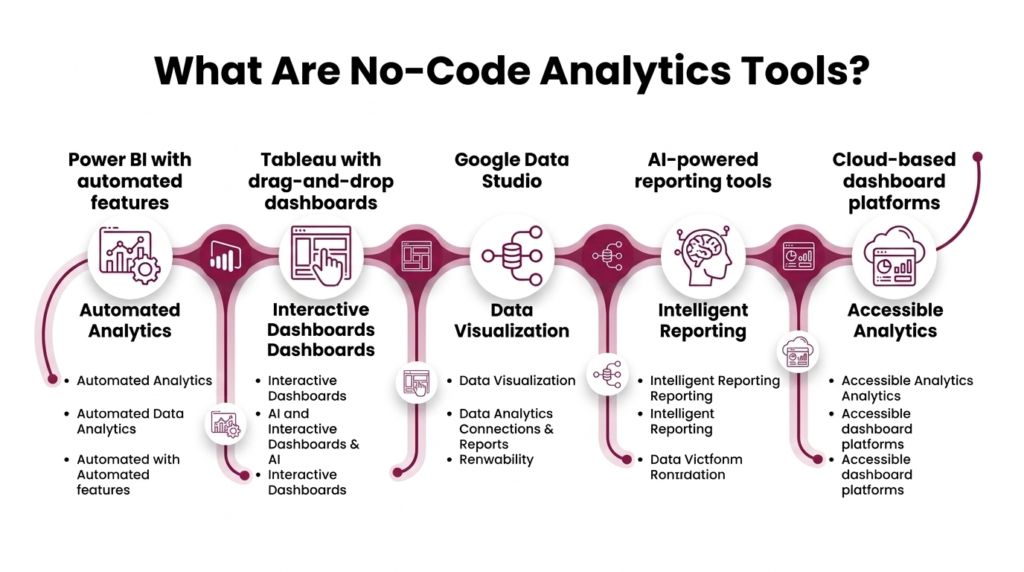
What Are No-Code Analytics Tools?
No-code analytics tools are platforms that allow users to analyze data, build dashboards, and generate insights without writing complex code. These tools use visual interfaces, drag-and-drop features, and automated workflows to simplify data analysis. They are designed for beginners, business users, and professionals who want quick insights without deep programming knowledge.
Modern no-code analytics platforms help users connect datasets, create visual reports, and monitor performance with minimal technical effort. This makes analytics more accessible to non-technical teams such as marketing, operations, and management.
Common examples of no-code analytics tools include:
- Power BI with automated features
- Tableau with drag-and-drop dashboards
- Google Data Studio
- AI-powered reporting tools
- Cloud-based dashboard platforms
These tools are useful for quick reporting, business monitoring, and basic data visualization. They reduce the need for manual coding and allow faster insight generation. However, while no-code tools simplify analytics, they may have limitations when handling complex data modeling, automation, and advanced analytics tasks that require deeper technical expertise.
What Is Traditional Analytics (Coding-Based)?
Traditional analytics refers to data analysis methods that require coding skills such as SQL, Python, R, and scripting. Unlike no-code tools, this approach allows analysts to directly manipulate raw data, build complex queries, automate workflows, and perform advanced statistical or predictive analysis. It provides deeper control and flexibility over datasets.
According to this comparison of traditional analytics approaches, coding-based analytics is better suited for handling large datasets, complex transformations, and custom logic. Companies rely on these skills when they need scalable, automated, and highly customized analytics solutions.
Traditional analytics typically involves:
- Writing SQL queries for data extraction
- Using Python for automation and modeling
- Performing data cleaning and transformation
- Building advanced dashboards and reports
- Integrating analytics with cloud systems
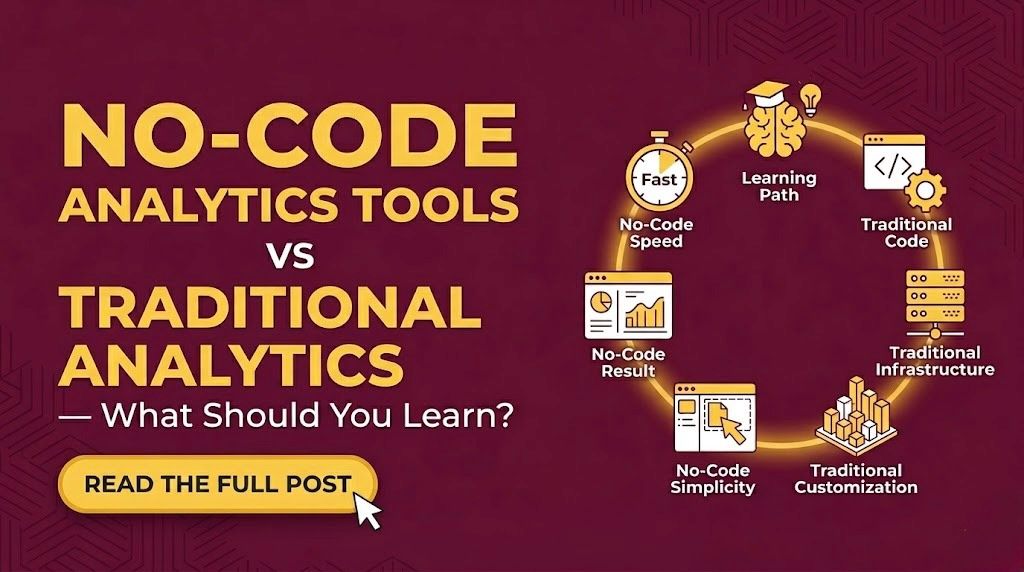
No-Code Analytics tools vs Traditional Analytics
| Aspect | No-Code Tools | Traditional Analytics |
|---|---|---|
| Coding requirement | Minimal or none | Required |
| Flexibility | Limited | High |
| Complexity handling | Basic to moderate | Advanced |
| Automation capability | Pre-built workflows | Custom automation |
| Career depth | Entry to mid-level roles | Advanced & scalable roles |
Traditional analytics offers stronger long-term career growth due to its flexibility and depth.
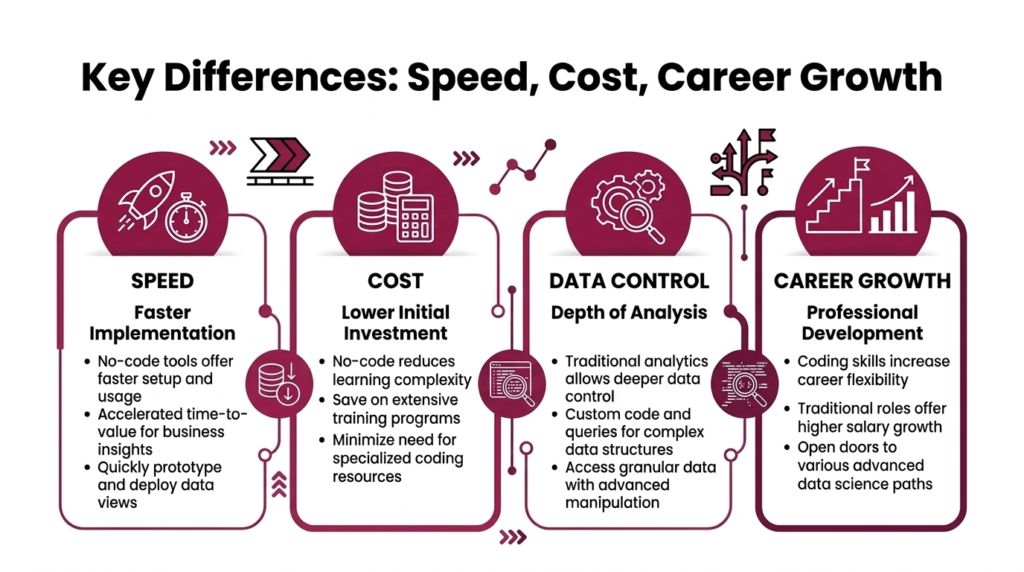
Key Differences: Speed, Cost, Career Growth
Both no-code and traditional analytics have their advantages, but the right choice depends on your career goals. No-code tools are designed for speed and simplicity, allowing users to generate reports quickly without deep technical knowledge. Traditional analytics, however, focuses on flexibility, scalability, and deeper problem-solving. Understanding these differences helps students and professionals choose the right learning path.
No-code platforms are often faster to learn and use, making them ideal for beginners or business users who need quick insights. Traditional analytics requires more time to master but offers stronger long-term career growth and higher earning potential. Companies typically prefer professionals who can go beyond dashboards and handle complex data challenges.
Key differences between the two approaches:
- No-code tools offer faster setup and usage
- Traditional analytics allows deeper data control
- No-code reduces learning complexity
- Coding skills increase career flexibility
- Traditional roles offer higher salary growth
When No-Code Tools Are Enough - And When They Are Not
A detailed analytics comparison explains that no-code tools are effective for basic dashboards and reporting but may fall short for advanced analysis, automation, and large-scale data processing.
Use Case → Best Approach
Choosing the right approach depends on your long-term career goals and required skill depth.
Which Skills Do Companies Actually Prefer in 2026?
In 2026, companies are not choosing between no-code and traditional analytics - they are looking for professionals who can use both effectively. Employers prefer candidates who understand core analytics concepts and can also work with modern tools that improve productivity. The focus has shifted toward hybrid professionals who combine technical depth with practical tool usage.
Hiring trends show that organizations value SQL, data visualization, and problem-solving skills more than tool-specific knowledge alone. While no-code tools help generate quick insights, companies still need professionals who can handle complex datasets, automate workflows, and support strategic decisions. This makes traditional analytics skills highly relevant, especially when combined with AI-assisted tools.
Skills companies prioritize:
- Strong SQL and data fundamentals
- Ability to use dashboards and BI tools
- Understanding of automation and AI tools
- Business problem-solving skills
- Clear communication and storytelling
Exploring this detailed career guide highlights how hybrid analytics skills improve job opportunities and career stability.
The most preferred candidates are those who can use no-code tools for speed while applying traditional analytics skills for deeper insights and long-term value.
What Students & Beginners Should Learn First
For students and beginners, choosing between no-code and traditional analytics can feel overwhelming. The smartest approach is not to pick one over the other, but to follow a structured learning path. Start with core analytics fundamentals and then gradually explore no-code tools and automation platforms. This combination builds both confidence and long-term career value.
Begin with foundational skills such as Excel, basic SQL, and data visualization. These help you understand how data works and how insights are generated. Once comfortable with the basics, you can explore no-code tools to build dashboards faster and improve productivity. This balanced approach prepares you for real-world job requirements.
A practical learning roadmap includes:
- Learn Excel and basic data handling
- Understand SQL fundamentals
- Practice dashboard creation using BI tools
- Explore no-code analytics platforms
- Build small real-world projects
- Gradually learn automation and AI tools
Real student success stories show that learners who combine fundamentals with modern tools become job-ready faster.
Focusing on both core skills and practical tools ensures beginners develop a strong foundation while staying aligned with industry expectations in 2026 and beyond.
Final Verdict: No-Code vs Traditional - The Smart Choice
The debate between no-code analytics and traditional analytics is not about choosing one over the other. The smartest choice in 2026 is to build a hybrid skill set that combines the speed of no-code tools with the depth of traditional analytics. Companies are not looking for tool-specific users - they want professionals who can solve business problems using the right approach.
No-code tools are excellent for quick reporting, dashboards, and business monitoring. They help beginners start quickly and improve productivity. However, traditional analytics skills like SQL, data modeling, and automation remain essential for handling complex datasets, building scalable solutions, and advancing into higher-paying roles.
A balanced approach offers the best career advantage:
- Learn fundamentals first (Excel, SQL, visualization)
- Use no-code tools for speed and productivity
- Develop coding skills for deeper analysis
- Combine AI tools with analytics knowledge
- Focus on business problem-solving
The future of analytics belongs to hybrid professionals who can work with both no-code and traditional tools. Choosing a combined learning path ensures stronger career growth, better job opportunities, and long-term stability in a rapidly evolving data industry.
Final Thoughts
Choosing between no-code tools and traditional analytics should not be about what is easier to learn, but what is smarter for long-term growth. While no-code platforms help beginners start quickly and build confidence, traditional analytics skills provide the depth and flexibility needed for advanced roles and higher salaries. The most successful professionals combine both approaches to stay competitive.
In 2026, companies prefer hybrid analysts who can generate quick insights using modern tools while also handling complex data challenges when required. This balanced skill set ensures faster career growth, better job stability, and stronger opportunities across industries.
The smartest strategy is simple: build strong fundamentals, use no-code tools for speed, and gradually develop deeper analytics skills. Learning smart rather than just easy will help you stay relevant and succeed in the evolving analytics job market.
Build Job-Ready Analytics Skills That Companies Prefer
The analytics industry is evolving quickly, and companies are looking for professionals who can combine practical tools with strong fundamentals. Learning only no-code tools or only coding is no longer enough - the real advantage comes from building a balanced, job-ready skill set that matches industry demand.
If you want to move beyond confusion and build a clear analytics career path, focus on mastering core skills like SQL, visualization, and AI-assisted analytics. Structured learning and real-world projects can help you understand when to use no-code tools and when deeper analytics skills are required.
To build a future-ready skill set and become confident in modern analytics workflows, explore the Certification in AI Powered Data Analytics and start developing the practical expertise companies expect from data professionals in 2026 and beyond.