





Table of Contents
- 1.
- 2.
- 3.
- 3.1
- 3.2
- 3.3
- 3.4
- 4.
- 5.
- 6.
- 7.
- 8.
- 9.
- 10.
- 10.1
In 2025, Data Analytics has moved from being a “good career option” to becoming a must-have skill across every industry. Companies today generate more data than ever before consumer behavior data, marketing data, sales data, financial data, operational data, and even AI-driven insights. To make sense of this data, businesses need skilled Data Analysts who can turn raw numbers into clear decisions.
From IT and healthcare to finance, e-commerce, manufacturing, and government sectors, data-driven decision-making is now central to business growth. This has created a massive demand for job-ready Data Analysts, especially in India, where digital transformation is accelerating at a fast pace.
If you’re a fresher, a career shifter, or someone exploring high-growth career paths, this guide gives you a complete picture of whether Data Analytics is the right choice for you in 2025.
1. Why Data Analytics Is a Great Career Choice in 2025
Here are the strongest reasons for choosing Data Analytics today:
Highest Demand Across Industries
Almost every company today uses data to make smarter decisions. Demand for skilled analysts continues to grow in:
- IT & Software
- Banking & Finance
- E-Commerce
- Healthcare
- Marketing & Digital Advertising
- Telecom
- Retail
- Logistics & Supply Chain
Data Analytics is not limited to one field its applications span across business functions and domains.
High Salary Growth & Strong Job Security
Data Analysts earn higher-than-average salaries compared to many traditional tech roles. Even freshers receive strong packages, especially if they have practical skills in:
Companies also offer faster salary hikes, job stability, and opportunities for global roles.
No Coding Background Required to Start
Unlike software development, Data Analytics allows beginners without coding knowledge to enter the field.
You can start with:
- Excel
- SQL basics
- Power BI/Tableau
- Basic Python
As you grow, you can learn advanced tools gradually.
Work With Real-Time Business Problems
Data Analysts solve real challenges like:
- Why did sales drop?
- Which marketing campaign performed best?
- Which customer segments convert better?
- How to reduce operational costs?
This makes the job intellectually rewarding and practical.
A Clear Career Path with Multiple Specializations
Data Analytics is not a single job it is a family of careers:
- Data Analyst
- Business Analyst
- Marketing Analyst
- Product Analyst
- Financial Data Analyst
- Supply Chain Analyst
- Power BI Developer
- Data Visualization Specialist
- Junior Data Scientist
This allows you to specialize in the domain you enjoy.
2. What Does a Data Analyst Do?
A Data Analyst’s job revolves around finding insights that help businesses make informed decisions.
Daily Responsibilities Include:
- Collecting data from multiple sources
- Cleaning raw data
- Running SQL queries
- Analyzing patterns and trends
- Building dashboards
- Presenting insights to management
- Creating reports for business teams
In simple terms:
A Data Analyst finds the “why” behind business performance.
3. Skills Needed to Become a Data Analyst in 2025
The best part is you don’t need all skills at once. You can learn step by step.
3.1 Beginner Skills
Excel
Excel is the foundation of Data Analytics. It helps you clean data, organize information, perform calculations, create pivot tables, and build simple dashboards. Most companies still rely heavily on Excel for day-to-day analysis.
SQL
Structured Query Language (SQL) is used to extract, filter, and manage data from databases. Every Data Analyst must know how to write SQL queries to pull the correct data before starting analysis.
Power BI
Power BI is a data visualization tool used to convert raw data into interactive dashboards. It helps analysts present insights clearly to business teams and management.
3.2 Intermediate Skills
Python (Pandas, NumPy)
Python is used for deeper analysis and automation.
- Pandas helps in cleaning, filtering, and transforming data.
- NumPy is used for numerical calculations and faster data processing.
Data Cleaning
Data cleaning involves correcting errors, removing duplicates, handling missing values, and preparing data for meaningful analysis. Clean data leads to accurate results.
Exploratory Data Analysis (EDA)
EDA is the process of exploring data to find patterns, trends, and relationships. It helps analysts understand what is happening inside the dataset before creating reports or models.
Data Visualization
Visualization means presenting data through charts, graphs, and dashboards. This helps stakeholders quickly understand insights and make better decisions.
3.3 Advanced Skills
Machine Learning Basics
Machine Learning allows computers to learn from data and make predictions. Analysts use ML basics like regression or classification to solve business problems.
Predictive Analytics
Predictive analytics uses historical data to forecast future trends—like sales, demand, customer behavior, or risks. It helps businesses plan smarter.
Big Data Tools
Big data tools handle extremely large datasets that Excel or Python alone cannot process. Tools like Hadoop, Spark, and cloud platforms help in processing millions of records efficiently.
3.4 Soft Skills
Problem-Solving
A Data Analyst must think logically, ask the right questions, and identify the root cause behind issues. Strong problem-solving leads to accurate insights.
Communication
Analysts need to explain complex data in simple, clear language to teams like marketing, sales, or management. Good communication improves decision-making.
Storytelling With Data
Storytelling means presenting insights in a way that answers:
- What happened?
- Why did it happen?
- What should the business do next?
This skill helps turn data into actionable strategies.
4. Salary Potential of Data Analysts in India (2025)
Salary depends on skills, city, company, and experience.
| Experience Level | Salary Range | ||
|---|---|---|---|
| Fresher (0–1 yrs) | Junior Analyst (1–3 yrs) | Mid-Level Analyst (3–5 yrs) | Senior Analyst (5+ yrs) |
| ₹4.5 – ₹7 LPA | ₹6 – ₹12 LPA | ₹12 – ₹18 LPA | ₹18 – ₹28 LPA |
Specialized roles like Marketing Analyst, Product Analyst, and Power BI Developers often receive higher pay.
5. City-Wise Data Analytics Career Trends in India
| City | Salary Range | ||||
|---|---|---|---|---|---|
| Bangalore | Hyderabad | Chennai | Pune | NCR | Mumbai |
| ₹7 – ₹20 LPA | ₹6 – ₹18 LPA | ₹6 – ₹16 LPA | ₹6 – ₹17 LPA | ₹6.5 – ₹18 LPA | ₹7 – ₹20 LPA |
Metro cities offer better opportunities, but remote jobs are now more common.
6. How AI Is Transforming the Data Analytics Job Market
AI Helps Analysts Work Faster
Tools like ChatGPT, Gemini, and Copilot automate:
- SQL query suggestions
- Python code assistance
- Data cleaning
- Insights explanation
- Report summaries
Analysts who know how to use AI tools become far more efficient.
New Roles Are Emerging
AI-driven roles in 2025 include:
- AI Data Analyst
- Automation Analyst
- AI Visualization Specialist
- AI-Assisted Business Analyst
These roles offer higher salaries and faster promotions.
7. Industries Hiring Data Analysts Aggressively in 2025
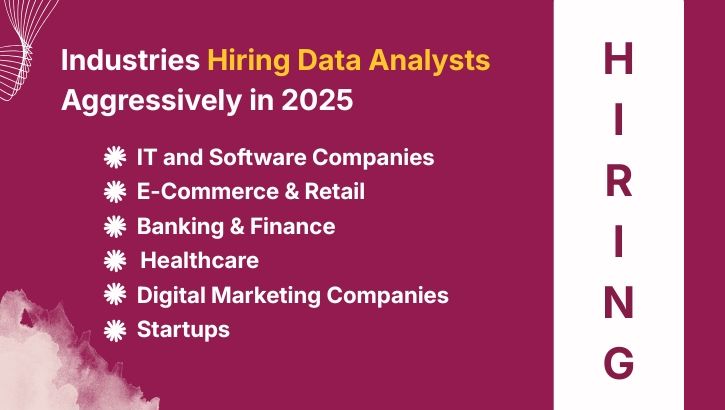
1. IT and Software Companies
Need analysts for product usage data, feature analytics, and client reporting.
2. E-Commerce & Retail
Demand forecasting, customer segmentation, pricing insights.
3. Banking & Finance
Fraud detection, risk analysis, portfolio analytics.
4. Healthcare
Clinical data interpretation, patient insights, hospital analytics.
5. Digital Marketing Companies
Campaign performance insights, customer behavior patterns.
6. Startups
Every decision is made using data—analysts have a huge role in growth.
8. Is Data Analytics Easy for Freshers?
Yes, it is one of the most beginner-friendly tech careers because:
- No coding background required
- Tools are easy to learn
- Jobs are available in multiple industries
- Demand is continuously growing
- Skills are practical and logical
Freshers with strong portfolios get hired faster.
9. How to Start a Career in Data Analytics
Step-by-Step Roadmap
Step 1: Learn Excel + SQL
The foundation of data work.
Step 2: Learn Power BI and build dashboards
This makes your profile interview-ready quickly.
Step 3: Learn Python for deeper analysis
Pandas, NumPy, Matplotlib.
Step 4: Work on real datasets and projects
Use Kaggle, GitHub, open datasets.
Step 5: Build a portfolio
At least 4–6 dashboards and Python projects.
Step 6: Prepare for interviews
Data cleaning questions, SQL challenges, storytelling.
Step 7: Apply to companies
Job portals, companies directly and LinkedIn networking.
10. Who Should Choose Data Analytics?
This career is perfect for:
- Freshers looking for high-paying tech roles
- Career shifters from non-coding backgrounds
- B.Com, BBA, BA, B.Sc students
- Working professionals in finance, HR, marketing
- Anyone interested in analysis and insights
Conclusion
Data Analytics is one of the strongest and most future-proof careers in India in 2025. With high demand, strong salary packages, global opportunities, and an easy entry path for beginners, it offers a clear and rewarding career path.
As companies rely more on data-driven strategies, the demand for skilled Data Analysts will continue to rise.
If you have logical thinking, curiosity, and the willingness to learn practical tools, Data Analytics can be an excellent career for you.
Start your Data Analytics career with WHY TAP's industry-ready program.
Learn SQL, Python, Power BI, dashboards, and real-time projects all designed to make you job-ready.
If you’re serious about becoming a Data Analyst, WHY TAP gives you the perfect foundation with tools, projects, portfolio building, and placement support.
Switching to a high-growth career begins with the right training.
Join WHY TAP’s Data Analytics course and transform your future with hands-on learning and real-world projects.