Search Engine Optimization (SEO) continues to be one of the most powerful digital strategies for businesses, entrepreneurs, digital marketers and students who want to grow online visibility without depending entirely on paid advertising. With competition rising and algorithms evolving, understanding how Google ranks websites is one of the most essential skills to survive in the digital space. A major question every beginner struggles with is understanding On-Page vs Off-Page SEO, what the difference is, how each contributes to ranking performance, and which one is more important when starting out.
This detailed guide breaks down On-Page vs Off-Page SEO in a practical and beginner-friendly manner, covering what they are, how they impact search rankings, and how they work together to improve visibility, credibility, authority and long-term digital success. By the end of this guide, you will clearly understand which SEO activities you need to prioritize and how to apply them in real-world campaigns in 2025.
SEO has shifted dramatically from the early days of keyword stuffing and link spamming to today’s AI-powered evaluation of real user value. Search engines process an enormous amount of data daily; for example, Google handles more than 16.4 billion searches per day, and over 75% of users never scroll past the first results page, according to DemandSage research.
This makes ranking in the first-page results absolutely critical. Even strong brands can fail if customers cannot find them in search. Businesses, freelancers and job seekers who understand On-Page vs Off-Page SEO gain a competitive advantage because strong SEO brings continuous organic traffic, better lead generation and higher trust without increasing marketing cost.
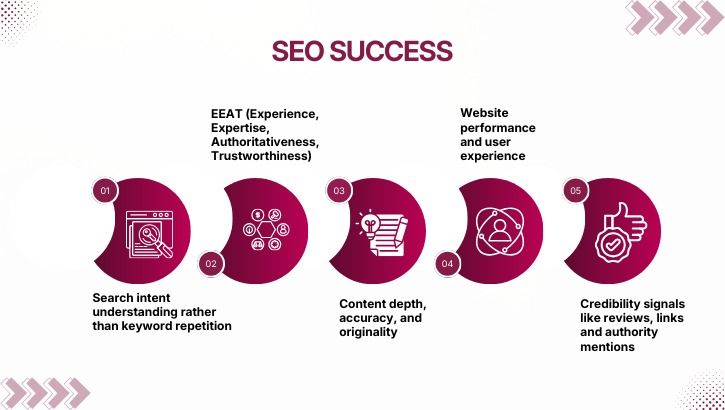
That’s exactly why mastering On-Page vs Off-Page SEO matters for every beginner entering the digital space.
To understand SEO clearly, let’s break down both sides:
On-Page SEO refers to optimization activities done inside your website. These include content quality, keyword placement, formatting, structure, page experience, metadata, responsive design, page speed, internal links, schema markup and image optimization. On-Page SEO helps search engines understand what your website is about and why it should be considered relevant.
Off-Page SEO includes actions done outside your website, such as building backlinks, mentions, digital PR, social media signals, reviews, influencer partnerships, community involvement and overall brand authority building. Off-Page SEO helps Google evaluate trust, credibility and popularity.
Together, mastering On-page vs Off-page SEO means strengthening both relevance and authority, which are the two biggest pillars of ranking success.
| Element | Purpose | Example |
|---|---|---|
| Keyword Optimization | Helps match search intent | Use natural placement of long-tail keywords |
| Meta Title & Description | Improves click-through rate | 50-60 character title + 150-160 character description |
| Header Structure | Improves readability | H1 main title, H2 sections, H3 sub-sections |
| Internal Links | Increases time spent & crawling | Link between related blogs |
| Image Optimization | Higher accessibility & ranking | Alt text describing images |
| Page Loading Speed | Better performance | Target under 3 seconds |
| Mobile Experience | Google mobile-first index | Fully responsive UI/UX |
| Schema Markup | Rich results enhancement | FAQ / Article schema |
Executing these well will create a strong foundation for long-term ranking and will support stronger results when applying On-Page vs Off-Page SEO strategy.
Off-page SEO is all about trust and authority. Even if your content is amazing, Google will not rank it without external validation. Off-page includes:
According to SEMrush, 67.5% of SEO experts agree that backlinks strongly influence ranking performance.
Strong backlink profiles matter because they tell Google that your content is trusted by real sources. That’s why Off-Page strategy is essential when working with On-Page vs Off-Page SEO alignment.
| Factor | On-page SEO | Off-page SEO |
|---|---|---|
| Focus | Quality and relevance | Trust and authority |
| Control | You fully control it | Dependent on others |
| Timing | Faster improvements | Takes longer but lasting |
| Examples | Speed, content, keywords | Backlinks, PR, reviews |
| Ranking Dependency | Foundation building | Power building |
Both sides of On-Page vs Off-Page SEO are essential and complement each other. A website with strong content but no backlinks often struggles to rank, whereas a site with backlinks but poor on-page structure will not sustain rankings.
Many beginners ask which side matters more. The answer is: always start with On-Page SEO because without a strong base, promoting your site externally becomes meaningless. Only after content is optimized should external link-building and reputation-building start.
A successful digital strategy combines On-Page vs Off-Page SEO in balance rather than choosing one over the other.
Recent algorithm changes place more importance on:
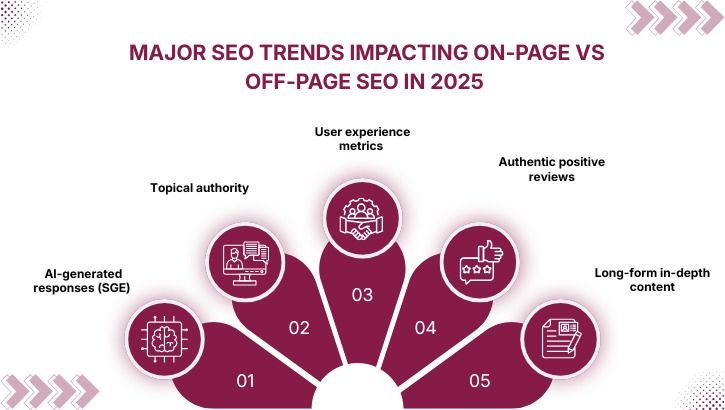
These trends show that successful On-Page vs Off-Page SEO depends on quality, depth, usability, and trust signals blended together.
WHY TAP, a leading AI-powered digital marketing training institute in Chennai, teaches students with real projects, industry tools such as SEMrush, Ahrefs, Surfer, Google Search Console, and hands-on backlink execution frameworks. They guide students through keyword research, site audits, technical SEO, link campaigns, and data-based ranking improvements.
This practical model helps beginners learn how to apply On-Page vs Off-Page SEO principles in real digital scenarios rather than just understanding theory. The institute also provides placement training, portfolio development and real business project exposure.
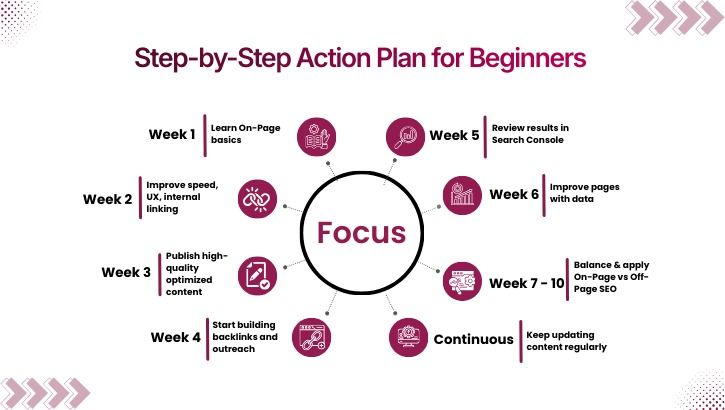
There is no winner in On-Page vs Off-Page SEO both are essential components of a successful SEO strategy in 2025. On-Page SEO builds the structure, clarity and relevance needed for search engines to understand your content, while Off-Page SEO strengthens trust, credibility and authority over time. The fastest and most sustainable growth occurs when both elements work together in harmony, supporting each other rather than being approached separately. SEO is not about shortcuts or tricks anymore; it is a long-term discipline based on real value, actionable expertise, and consistent improvement. The key to success is patience, persistence and a willingness to refine strategies as algorithms evolve. When applied correctly, the combination of On-Page vs Off-Page SEO creates lasting digital visibility, stronger rankings, higher conversions and long-term brand success