In the last decade, engineering has undergone multiple revolutions from cloud computing to IoT, from automation to intelligent systems. But none has reshaped the engineering landscape as profoundly and as quickly as generative AI. Today, tools like ChatGPT, Claude, Gemini, and a growing ecosystem of large-language-model systems are redefining how engineers design, build, test, troubleshoot, and innovate.
And at the heart of this AI revolution lies a skill that didn’t even exist a few years ago:
Once considered a niche competency, it has now become a foundational skill; just as essential as coding, math, and problem-solving. Whether you’re a software engineer, mechanical engineer, electronics engineer, civil engineer, or even a fresher stepping into your first technical role, the ability to communicate effectively with AI systems is what separates high-impact modern engineers from everyone else.
This blog explores why every engineer needs prompt engineering, how it is transforming the industry, and why mastering it today will define engineering success in the decade ahead.
Even if you never intend to become an AI specialist, AI is already part of your daily engineering ecosystem.
Research indicates that engineering disciplines are being transformed by AI: for example, one article notes that “AI has had a particularly strong impact on industrial, systems, mechanical, and aerospace engineering processes … by optimizing manufacturing, streamlining design processes, improving forecasting models, and enabling predictive maintenance.” Moreover, according to the 2025 AI Index Report from Stanford HAI, generative AI saw global private investment of US $33.9 billion, an 18.7% increase from 2023.
But here’s the truth:
AI is only as good as the prompts it receives. Just like a programming language, prompt engineering is the interface through which you “program” the AI. Without good prompts, you get shallow, inaccurate, or incomplete results. With strong prompts, you unlock the full intelligence and capabilities of today’s powerful models.
Every engineer is fundamentally a problem solver. But problem solving has changed.
Traditionally, engineers:
AI speeds up steps 2, 3 and 4 but only if the engineer issues crystal-clear prompts that break down the problem.
It teaches engineers how to:
In essence, prompt engineering sharpens analytical thinking because it forces engineers to think with precision and clarity.
Instead of simply knowing solutions, engineers must learn how to instruct AI to produce them. This shift is monumental.
According to a recent insight article, the market for prompt engineering is expected to grow at a compound annual growth rate (CAGR) of ~32.8 % between 2024 and 2030.
An engineer using AI is not competing with AI, they’re competing with other engineers who use AI better.
Imagine two engineers working on the same task:
When a task that took 8 hours can now be done in 30 minutes, companies notice. Engineering productivity is now tightly linked to prompt fluency.
Modern engineering projects are rarely siloed. They require collaboration across:
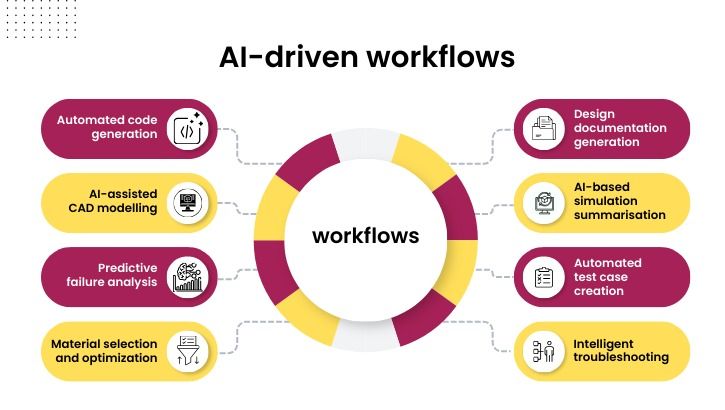
AI sits at the centre of these intersections, helping engineers simulate, calculate, optimize, and automate workflows that would otherwise take days or weeks.
It helps you build AI-driven workflows such as:
As AI gets integrated into engineering tools (AutoCAD, SolidWorks, MATLAB, Ansys, Fusion 360, Altium, VS Code, and more), it will be as essential as knowing how to use the software itself.
The shift towards AI-infused workflows is supported by reports that in manufacturing alone, the global AI in manufacturing market is projected to grow from US $7.6 billion in 2025 to US $62.33 billion by 2032 (CAGR ~35.1%).
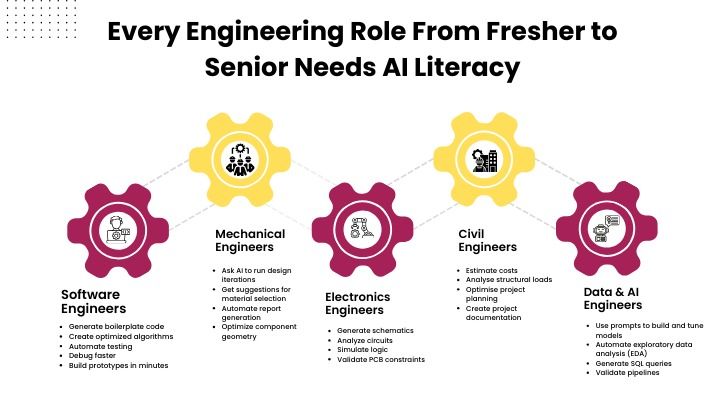
No matter the domain, prompt engineering accelerates career progress.
Using AI creatively is now a form of innovation.
Engineers skilled in prompt engineering can:
The future belongs to engineers who don’t just use AI but collaborate with it.
It allows engineers to use AI as
When creativity is amplified by computation, engineering breakthroughs become inevitable.
Effective engineers are great communicators whether with teammates, clients, or now, AI models.
It teaches engineers:
Skills that once improved team collaboration now also improve AI collaboration.
This results in better:
Prompt engineering isn’t just a technical skill, it’s a communication skill.
Companies are already integrating AI into engineering workflows:
According to PwC, nearly 49 % of technology leaders said AI was “fully integrated” into their companies’ core business strategy (October 2024 survey).
Engineers without AI adaptability risk becoming obsolete not because they lack talent, but because they lack the tools of the modern era.
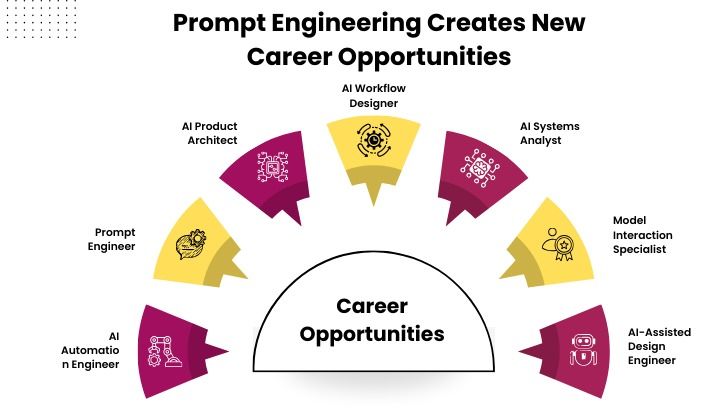
Engineers with strong prompt engineering skills can explore new-age roles like:
These roles offer higher salaries, more innovation-driven work, and future-proof career stability.
According to research, the global prompt engineering market size is estimated at USD $505 billion in 2025 and projected to reach roughly USD $6.5 trillion by 2034.
Prompt engineering is not replacing traditional engineering, it is upgrading it.
Forward-thinking tech institutes, such as WHY TAP (Chennai), have already integrated AI-powered learning and prompt engineering fundamentals into their engineering & IT training programmes.
Here’s why:
WHY TAP’s AI-integrated courses, whether in Full Stack Development, Digital Marketing, Data Science, or other IT tracks teach students how to use prompt engineering to become more effective and employable.
This is a major advantage for engineering graduates stepping into a competitive job market.
Just like English became the language of global commerce and collaboration, prompting is becoming the language of AI-driven engineering.
Engineers who are fluent in prompting will:
Those who resist it will inevitably fall behind.
It is not optional, it is the engineer’s passport to the future.
The Engineer who lead tomorrow are the engineers who prompt well today.
AI isn’t taking engineering jobs. Engineers who understand AI are taking the jobs of engineers who don’t.
It is the skill that bridges the gap between:
Every engineer, computer, mechanical, electrical, civil, electronics, or otherwise needs prompt engineering because it is the core skill that unlocks the full potential of modern AI.
It transforms engineers from being tool users to becoming AI collaborators, capable of achieving 10× performance, creativity, and innovation.
And in a world where technology evolves at lightning speed, It ensures engineers stay relevant, competitive, adaptable, and future-ready.