





Table of Contents
- 1.
- 2.
- 3.
- 4.
- 4.1
- 5.
- 6.
- 7.
- 8.
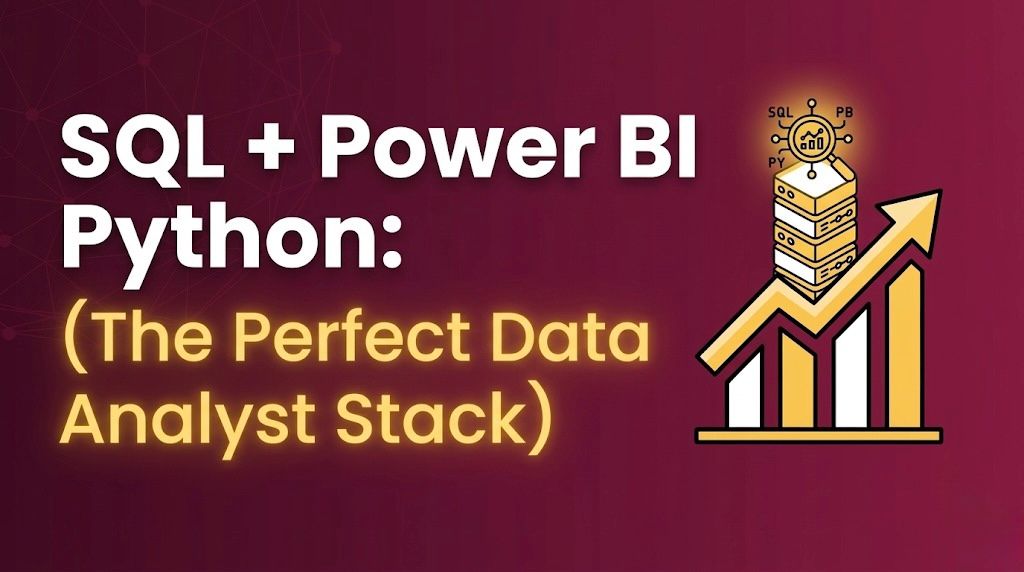
Many aspiring analysts believe mastering one tool is enough to get hired. Some focus only on Excel, others jump into Python, while many try learning visualization tools without understanding how everything connects. In reality, companies are not hiring tool specialists; they are hiring professionals who can work across a complete analytics workflow. This is why building the Perfect Data Analyst Stack has become essential in today’s competitive job market.
Modern organizations expect analysts to extract data from databases, analyze it efficiently, and present insights that influence business decisions. SQL, Power BI, and Python together form a powerful combination that covers data extraction, analysis, automation, and visualization. Analysts who understand how these tools work together can deliver faster insights and handle complex business problems more effectively.
Instead of learning tools in isolation, professionals must focus on building an integrated tech stack that mirrors real-world workflows. In the sections below, we will explore why SQL, Power BI, and Python together create the ideal data analyst stack and how mastering this combination can significantly improve job opportunities, salary growth, and long-term career stability.
Why Modern Data Analysts Need a Complete Tech Stack
The role of a data analyst has evolved from simple reporting to end-to-end data problem solving. Companies no longer expect analysts to work with a single tool. Instead, they want professionals who can extract data, analyze it efficiently, and present insights that support business decisions. This shift has made building a complete analytics stack essential for career growth.
According to industry insights on essential data skills, modern analysts must combine multiple tools to handle real-world datasets and workflows. Using only one platform often limits efficiency and slows down decision-making. Organizations now prioritize candidates who can move seamlessly between databases, analysis tools, and visualization platforms.
A complete data analyst stack helps professionals:
- Work with large and complex datasets
- Automate repetitive analysis tasks
- Build dashboards for stakeholders
- Deliver faster and more accurate insights
- Adapt to evolving analytics technologies
Learning tools in isolation can create knowledge gaps, while mastering a structured stack prepares analysts for real job responsibilities. Professionals who understand how different tools connect within an analytics workflow are better positioned to secure high-growth roles and remain competitive in a rapidly changing data industry.
SQL - The Foundation of Every Data Analyst Stack
SQL remains the backbone of modern analytics workflows. No matter how advanced visualization tools or automation platforms become, data must first be extracted and structured correctly. SQL allows analysts to query databases, filter large datasets, and retrieve precise information needed for analysis. Without SQL, working with real-world enterprise data becomes difficult and inefficient.
Industry discussions around essential top skills consistently highlight SQL as a non-negotiable requirement for data analyst roles. While Excel can handle smaller datasets, it struggles with large-scale data environments where SQL excels. Recruiters often treat SQL proficiency as a baseline qualification.
Key advantages of SQL in a data analyst stack:
- Efficient handling of large structured datasets
- Faster data extraction compared to spreadsheets
- Ability to perform joins, aggregations, and filtering
- Direct access to enterprise databases
- Strong demand across industries
SQL vs Excel for Data Handling
| Capability | Excel Approach | SQL Approach | Business Impact |
|---|---|---|---|
| Data volume handling | Limited | Large-scale | Scalability |
| Query flexibility | Query flexibility | Advanced querying | Accuracy & speed |
| Data integration | Manual merging | Table joins | Better insights |
| Automation | Formula-based | Query-based workflows | Efficiency |
Mastering SQL builds a strong foundation for advanced analytics and enables smooth integration with tools like Python and Power BI.
Power BI - Turning Data into Business Decisions
While SQL helps extract and structure data, Power BI transforms that data into meaningful insights for decision-makers. Companies rely heavily on dashboards and visual reports to monitor performance, track KPIs, and identify trends. Analysts who can present data clearly through visualization tools become valuable contributors to business strategy rather than just support staff.
Insights shared in-demand skills highlight that data visualization and dashboard creation are among the most sought-after skills in analytics hiring. Organizations want professionals who can convert complex datasets into easy-to-understand visuals that guide leadership decisions. Static reports are no longer enough interactive dashboards are now the industry standard.
Power BI plays a critical role in the analytics stack by enabling:
- Real-time dashboard creation and monitoring
- Clear communication of insights to stakeholders
- KPI tracking across departments
- Interactive reporting for faster decisions
- Integration with databases and cloud tools
When analysts combine SQL with Power BI, they can extract data directly and present insights without delays. This ability to turn raw data into business-ready visuals makes Power BI an essential component of the modern data analyst stack and significantly improves job readiness.
Python - Automation & Advanced Analytics Power
Python adds intelligence and automation to the data analyst stack. While SQL extracts data and Power BI visualizes it, Python allows analysts to clean messy datasets, automate repetitive tasks, and perform deeper statistical analysis. This makes workflows faster, more scalable, and less dependent on manual intervention.
Companies increasingly expect analysts to handle complex datasets that require preprocessing, transformation, and automation. Python enables analysts to go beyond basic reporting and support predictive insights, trend analysis, and data modeling. Professionals who understand Python are often seen as more versatile and capable of handling advanced analytics projects.
Key advantages of adding Python to your stack include:
- Automating repetitive data cleaning tasks
- Handling unstructured or semi-structured data
- Performing advanced statistical analysis
- Integrating APIs and external data sources
- Supporting predictive and trend analysis
How Python Connects SQL and Power BI
Python acts as a bridge between data extraction and visualization. Analysts can pull data using SQL, process and transform it in Python, and then push refined datasets into Power BI dashboards.
Manual Analyst vs Stack-Based Analyst
| Capability | Manual Analyst | Stack-Based Analyst | Career Impact |
|---|---|---|---|
| Data cleaning | Manual adjustments | Automated scripts | Faster workflow |
| Analysis depth | Basic calculations | Advanced analytics | Higher value |
| Reporting speed | Delayed updates | Automated refresh | Better efficiency |
| Problem-solving | Scope Limited | End-to-end solutions | Strong growth |
For those exploring structured skill development, reviewing common career queries in student FAQs can help clarify how mastering this stack supports long-term growth.
Why This 3-Tool Stack Gets You Hired Faster
Recruiters rarely look for candidates who know just one tool. They prefer professionals who can manage the entire data workflow - from extracting raw data to presenting business-ready insights. This is why SQL, Power BI, and Python together form one of the most sought-after combinations in analytics hiring. Candidates who demonstrate this integrated skillset are often seen as job-ready and require less training.
Companies want analysts who can independently handle tasks such as querying databases, preparing datasets, building dashboards, and automating repetitive reporting. When you master this three-tool stack, you position yourself as someone who can deliver end-to-end analytics solutions rather than just isolated reports.
Key reasons this stack improves employability:
- Covers the full analytics workflow from data extraction to visualization
- Reduces dependency on multiple team members for analysis
- Demonstrates strong technical and practical capability
- Improves portfolio quality and interview performance
- Increases salary and job-switch opportunities
Real-world placement records show that candidates with strong stack-based skills often secure roles faster than those who rely on a single tool. Employers value professionals who can contribute immediately and scale with evolving data needs.
How to Master This Stack Without Wasting Years
Learning SQL, Power BI, and Python separately without direction can lead to confusion and slow progress. Many aspiring analysts jump between tutorials, collect certificates, and still struggle to apply their skills in real projects. The key to mastering this stack efficiently is following a structured, workflow-based approach that mirrors real industry practices.
Start with SQL to understand data extraction and database structure. Once comfortable, move to Python for cleaning, transforming, and automating datasets. Finally, use Power BI to build dashboards that communicate insights clearly. This sequence reflects how data flows in real business environments and helps you develop end-to-end capability rather than isolated knowledge.
To accelerate mastery:
- Practice with real-world datasets instead of only theory
- Build 3–5 portfolio projects using the full stack
- Focus on automation and workflow integration
- Simulate interview scenarios with case-based questions
- Continuously refine projects based on feedback
Structured learning combined with practical application reduces the time needed to become job-ready. Professionals who follow a focused roadmap can build strong stack proficiency within months instead of years, positioning themselves for faster hiring and stronger salary growth.
Final Thoughts
Mastering individual tools can help you start your analytics journey, but true career growth comes from understanding how those tools work together. SQL, Power BI, and Python form a powerful combination that allows analysts to handle complete data workflows - from extraction and analysis to visualization and decision support. This integrated approach is what modern companies expect from job-ready data professionals.
As the demand for data-driven decision-making continues to rise, organizations are prioritizing candidates who can deliver insights quickly and efficiently. Analysts who rely on a single tool often face limitations in career growth, while those who build a strong technical stack move faster into higher-paying and more strategic roles. The ability to automate tasks, manage large datasets, and communicate insights clearly makes stack-based analysts highly valuable.
In today’s competitive job market, learning tools in isolation is no longer enough. Professionals who invest in mastering a complete analytics stack position themselves for stronger job opportunities, faster salary growth, and long-term career stability in an increasingly data-driven and AI-powered business environment.
Master the Stack Companies Actually Hire For
Knowing that SQL, Power BI, and Python form the Perfect Data Analyst Stack is the first step. The real advantage comes when you can apply these tools together in real-world projects and business scenarios. Companies are hiring analysts who can extract data, automate workflows, and build dashboards that support decision-making - not just professionals who know tools individually.
If your goal is to become job-ready and move into high-growth analytics roles faster, building this stack through structured learning is essential. A focused approach helps you avoid random tutorials, develop practical project experience, and prepare for interviews that test real problem-solving ability. The right training can significantly reduce the time it takes to transition from beginner to employable analyst.
To build a strong foundation and master the complete analytics workflow, explore the Certification in AI Powered Data Analytics and start developing the stack that companies actively look for in modern data.