Landing a digital marketing role is a competitive process, especially for freshers and career switchers. Employers are looking for candidates who not only understand digital marketing theory but can also demonstrate practical skills, strategic thinking, and the ability to execute campaigns that drive measurable results.
This comprehensive digital marketing interview preparation guide walks you through everything you need to know to ace your interview, from understanding role requirements and building a compelling portfolio to mastering common interview questions and demonstrating tool proficiency. Whether you're applying for your first marketing role or transitioning into digital marketing, this guide will give you the edge you need to stand out.
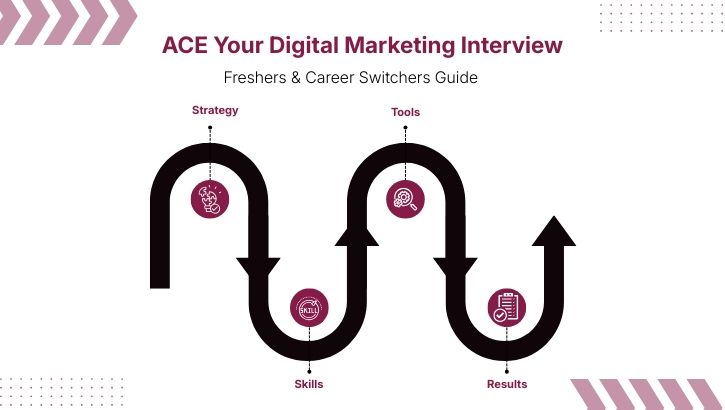
Before you start your digital marketing interview preparation, you need to understand what the specific role entails and what skills you'll be expected to demonstrate. Digital marketing interview preparation starts with identifying the skills, tools, and mindset required for the position. Digital marketing encompasses many specializations, each with its own technical requirements and competencies.
To begin your digital marketing interview preparation, focus on identifying which specialization aligns best with your skills and interests. This clarity forms the foundation of successful preparation.
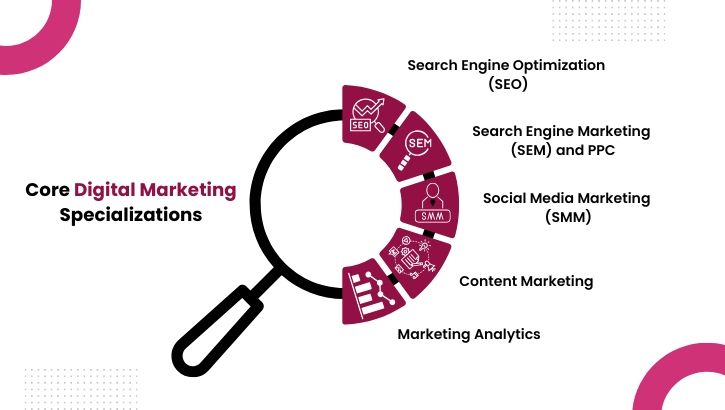
SEO specialists focus on improving organic search visibility. Interviewers will expect you to understand keyword research fundamentals, on-page optimization techniques, technical SEO basics, link building strategies, and analytics measurement. You should be familiar with tools like Google Search Console, Google Analytics 4, Semrush, and Ahrefs. Be prepared to discuss the difference between white hat and black hat SEO techniques, how Google's algorithm works at a high level, and how to analyze competitor strategies during your digital marketing interview preparation.
PPC specialists manage paid search campaigns on platforms like Google Ads and Bing. Prepare to discuss campaign structure, keyword match types (broad, phrase, exact, broad modified), quality score factors, bidding strategies, and conversion tracking implementation. You should understand terms like cost-per-click (CPC), click-through rate (CTR), conversion rate, and return on ad spend (ROAS). Be ready to explain how you'd structure a campaign for a specific business goal and discuss A/B testing approaches during your digital marketing interview preparation process.
Social media managers handle content creation, community engagement, and paid social advertising. Know the strengths and weaknesses of each major platform (Facebook, Instagram, LinkedIn, TikTok), understand audience targeting options, and be familiar with content calendar planning. Interviewers may ask about organic reach decline and paid social strategy, algorithm changes, and how to measure social ROI. These topics are vital for your digital marketing interview preparation journey.
Content marketers create and distribute valuable content to attract and retain audiences. You should understand content strategy development, SEO writing principles, different content formats (blog posts, infographics, videos, whitepapers), content distribution strategies, and how to measure content performance. This knowledge is crucial for anyone undergoing digital marketing interview preparation.
Analytics professionals use data to measure performance and drive strategy. Be prepared to discuss Google Analytics 4 implementation, event tracking, UTM parameter conventions, conversion funnel analysis, and how to create dashboards for executive reporting. This analytical understanding strengthens your digital marketing interview preparation significantly.
Action Step: For the specific role you're interviewing for, extract key requirements from the job description and identify which of these specializations are most important. Prioritize learning deeply about those areas while maintaining foundational knowledge across all disciplines. Doing this will make your digital marketing interview preparation more focused and effective.
Remember, aligning your natural strengths with the job expectations is one of the smartest moves you can make in your digital marketing interview preparation.
One of the biggest mistakes job seekers make is showing up to an interview without tangible examples of their work. A strong portfolio dramatically increases your chances of getting hired because it provides proof of your capabilities.
During your digital marketing interview preparation, make sure your portfolio highlights measurable results, analytics screenshots, and certifications that prove your credibility.
Case Studies (2-3 mini case studies minimum)
Each case study should follow this structure:
Including clear case studies like these helps your digital marketing interview preparation stand out during real interviews.
For example, a case study might look like:
"I managed SEO for a local e-commerce site. The goal was to increase organic traffic by 50% in 6 months. I conducted keyword research focusing on long-tail variations of high-intent terms, optimized 40 existing blog posts for those keywords, built 25 new pieces of pillar content, acquired 15 high-quality backlinks through outreach, and improved site speed from 3.5s to 1.8s. Result: Organic traffic increased 62% in 5 months, organic conversions increased 48%, and we ranked on page one for 150+ keywords. Learning: Starting with keyword difficulty analysis before writing saved significant time and ensured better content-keyword matching."
Live Digital Assets
These live assets show employers that your digital marketing interview preparation is hands-on, not just theoretical.
Proof of Results
Real performance metrics add strong credibility to your digital marketing interview preparation and make your portfolio more powerful.
Certifications
If you're a fresher without paid client work, don't panic. You can still build a compelling portfolio by working on personal projects:
Even if you’re new, personal projects can showcase your initiative and strengthen your digital marketing interview preparation journey.
Your resume is often the first filter. Many companies use Applicant Tracking Systems (ATS) that scan for keywords before a human ever reads your resume. Optimize it strategically while keeping it honest.
Use Keywords from the Job Description
If the job description mentions "Google Analytics 4," "content optimization," "conversion rate optimization," and "social media management," weave those exact phrases naturally into your resume. Create a section listing your skills that directly mirrors the JD.
Quantify Every Achievement
Instead of: "Managed social media campaigns"
Write: "Increased Instagram followers from 2K to 15K (650% growth) in 8 months through strategic content planning and paid social campaigns, resulting in 120 qualified leads."
Interviewers remember numbers. Specific metrics prove impact and make you memorable
Tool and Platform Proficiency Section
List tools explicitly by category:
Include Portfolio and Links
In your header, include links to:
Once your portfolio and resume are polished, your digital marketing interview preparation should focus on mastering questions and strategy.
These questions test your understanding of core concepts. Answer with a simple definition, then explain how it works in practice.
1. What is digital marketing, and why is it important?
"Digital marketing is promoting products and services through online channels like search engines, social media, email, and websites. It's important because it allows businesses to reach global audiences cost-effectively, target specific demographics precisely, measure campaign performance in real-time, and build direct relationships with customers."
2. What are the main differences between SEO and SEM?
"SEO (Search Engine Optimization) focuses on earning organic, non-paid rankings through content optimization, technical improvements, and link building—results take 3-6 months but are long-term. SEM (Search Engine Marketing) involves paid ads like Google Ads PPC—you pay per click and see immediate results, but you pay for every click regardless of conversion."
3. Explain the buyer's journey and how each stage informs marketing strategy.
"The buyer's journey has three stages: Awareness (prospect recognizes a problem), Consideration (they're researching solutions), and Decision (they're ready to buy). For Awareness, I'd create educational blog content and run awareness-focused ads. For Consideration, I'd develop comparison content and nurture sequences. For Decision, I'd emphasize testimonials, pricing clarity, and retargeting campaigns."
These questions assess your hands-on knowledge of specific tools and platforms.
4. Walk me through how you'd set up a Google Ads campaign from scratch.
"First, I'd define the campaign goal (search, display, shopping, etc.) and select an appropriate bidding strategy. Next, I'd conduct keyword research using Google Keyword Planner and Semrush, grouping keywords into themed ad groups. For each ad group, I'd create 3-4 ad variations (testing headlines, descriptions, and landing page combinations) and set up conversion tracking in GA4 to measure performance. I'd establish a daily budget, set geographic and demographic targeting, set negative keywords to reduce wasted spend, and launch with A/B testing in mind."
5. How do you ensure data accuracy in Google Analytics 4?
"First, I implement GA4 correctly with the Google tag placed on all pages. Second, I use Google Tag Manager to manage tags centrally rather than hardcoding. Third, I define conversion events precisely—for example, distinguishing between form submissions and actual leads. Fourth, I audit UTM parameters for consistency across campaigns (using standard naming conventions like source_medium_campaign_content). Fifth, I check for duplicate data and tracking issues. Finally, I create a data validation process where I compare GA4 data to other sources like CRM systems to identify discrepancies.”
6. Describe your process for optimizing a landing page for conversions.
"I use the CRO (Conversion Rate Optimization) framework: First, analyze current performance using GA4 heatmaps and session recordings to understand user behavior. Second, form hypotheses about what's preventing conversions (e.g., unclear value prop, unclear CTA, form friction). Third, implement changes—one variable at a time for proper A/B testing. Fourth, run statistical tests to achieve 95% confidence levels. Fifth, document results and apply learnings to other pages. I'd test elements like headline clarity, CTA button color/copy, form field count, social proof placement, and page load speed."
These questions reveal your strategic thinking and problem-solving approach.
7. Tell me about a campaign that didn't perform as expected. What did you learn?
This is a STAR story (Situation, Task, Action, Result). Example: "I launched a Facebook campaign targeting broad interests with a $5 CPM budget. Situation: The campaign achieved 50K impressions but only 200 clicks (0.4% CTR) and zero conversions. Task: I needed to understand why such poor performance. Action: I analyzed audience demographics and realized I was reaching people far outside our target buyer profile. I paused the campaign, rebuilt the audience with tighter demographic and interest targeting, rewrote ad copy to emphasize specific pain points, created new creative variations, and reduced daily budget to test before scaling. Result: The revised campaign achieved 3.2% CTR and 12 conversions at $45 CPA. Learning: Audience targeting is more important than budget size. I now always run 24-48 hour tests with tight audiences before scaling."
8. How would you increase conversion rates for an e-commerce website?
"I'd take a multi-channel approach: First, analyze existing GA4 data to identify where drop-off occurs in the funnel. Second, improve on-page elements—test headline clarity, product imagery, pricing display, trust signals (reviews, security badges), and CTA button prominence. Third, reduce friction: simplify checkout process, offer guest checkout, and add exit-intent offers. Fourth, implement retargeting campaigns for cart abandoners. Fifth, A/B test continuously—headlines, product recommendations, shipping costs transparency, and urgency elements. Sixth, improve site speed (every 1-second delay reduces conversions by ~7%). Finally, use email remarketing to recapture interested visitors. I'd measure success by tracking conversion rate improvement and CAC."
These questions assess your work style, collaboration ability, and growth mindset.
9. Tell me about a time you disagreed with a manager or team member. How did you handle it?
"I once recommended reallocating budget from a consistently underperforming paid social campaign to search advertising, but my manager wanted to continue the social campaign unchanged. Rather than simply disagreeing, I prepared data: detailed GA4 analysis showing search had 3x better ROAS, lower CAC, and higher customer LTV. I presented this data respectfully and asked to pilot a reallocated approach on 30% of budget for 30 days. We tried it, the data backed up my hypothesis, and we gradually shifted more budget to search. Learning: Present data, not opinions. Suggest experiments instead of ultimatums. Focus on shared goals."
10. Describe a time you learned something new quickly. How did you approach it?
"When my company decided to launch a TikTok campaign but nobody had experience, I volunteered to lead the learning curve. I spent a week consuming expert content: watched YouTube tutorials on TikTok advertising best practices, took a free Meta Blueprint course on short-form video, analyzed top-performing competitor campaigns, and studied trending sounds. By day 10, I'd launched a pilot campaign and documented our learnings in a team playbook. Over two months, we optimized targeting, creative, and posting cadence, achieving 4x improvement in engagement. This taught me that I learn best by combining expert learning with hands-on experimentation."
Practical assignments are a key part of digital marketing interview preparation, helping you prove both knowledge and execution ability.
Scenario: "Create an SEO content brief for a target keyword: 'best project management software for remote teams'"
Approach:
Pro tip: Talk through your reasoning aloud. Interviewers want to see your thought process, not perfection.
Scenario: "Outline a Google Ads campaign strategy for a new SaaS product with a $5,000 monthly budget"
Approach:
Scenario: "Create a 2-week social media content calendar for a fitness brand targeting women aged 25-40"
What to include:
Before your interview, make sure you can confidently use these essential marketing tools. Being fluent with them will boost your digital marketing interview preparation and show interviewers that you’re job-ready.
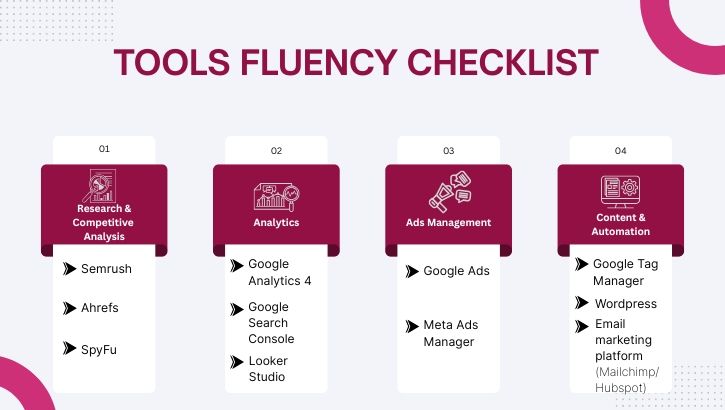
Research & Competitive Analysis
Analytics
Ads Management
Content & Automation
Be honest if you don’t know a particular tool—interviewers appreciate honesty. Explain how you’d learn quickly through tutorials or documentation. A willingness to learn is a key strength during your digital marketing interview preparation.
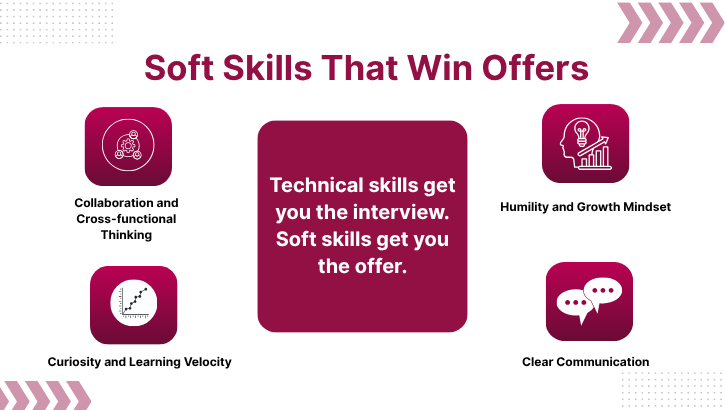
Technical skills get you the interview. Soft skills get you the offer.
Never enter an interview without researching the company. Strong preparation helps you tailor your answers and ask smart questions an essential part of your digital marketing interview preparation.
Minutes 0-10: Website and Blog
Minutes 10-20: Social Media
Minutes 20-30: Paid Ads
Minutes 30-40: Competitive Landscape
Minutes 40-45: Prepare Questions
Develop 3-5 informed questions to ask the interviewer:
Doing this research sharpens your digital marketing interview preparation and makes you sound confident.
The final 24 hours before your interview determine how confident and composed you’ll feel. Use this sprint to review everything.
Time management and calm preparation are key parts of a strong digital marketing interview preparation plan.
Night Before (30 minutes)
Morning Of (30 minutes)
5 Minutes Before (breathing)
The interview doesn’t end when you walk out. The follow-up email can help you stand out and is the final touch in your digital marketing interview preparation.
Within 24 Hours: Send a Thank-You Email
Example: "Hi [Interviewer], Thanks for our conversation about your content marketing strategy. I was impressed by your focus on SEO and noticed an opportunity: your blog covers [Topic A] extensively, but there's an untapped keyword cluster around [Topic B] with 5K monthly searches and low competition. I've sketched a brief at [link] on how you could address this audience. I'm enthusiastic about contributing to your marketing goals. Looking forward to hearing from you. Best, [Your name]"
This demonstrates you were listening, thinking strategically, and ready to contribute immediately.
Landing a digital marketing role takes technical know-how, real execution, strong soft skills, and honest preparation. Follow this digital marketing interview preparation guide step by step, understand the role, build a results-driven portfolio, practice core questions, research the company, and follow up with intent.
Interviewers value curiosity, initiative, fast learning, and outcomes. Show that through your portfolio, your stories, and your questions. These elements will strengthen your digital marketing interview preparation and make you stand out from other candidates.
Treat the interview as a conversation, not an interrogation. You’re evaluating them too. Go in confident, authentic, and prepared your digital marketing interview preparation will speak for itself and reflect your true potential.
You’ve got this go ace it and land the role you deserve with confidence in your digital marketing interview preparation.
Book a Session: Schedule a free mock interview with WHY TAP mentors who have interviewed and hired dozens of successful digital marketers. Receive personalized feedback to improve your digital marketing interview preparation.
Enroll Now: Join WHY TAP’s AI-Powered Digital Marketing Course, which includes dedicated interview preparation modules, portfolio building, real mock interviews, and placement support with top companies.
Start your digital marketing journey with confidence. Your next opportunity is waiting.