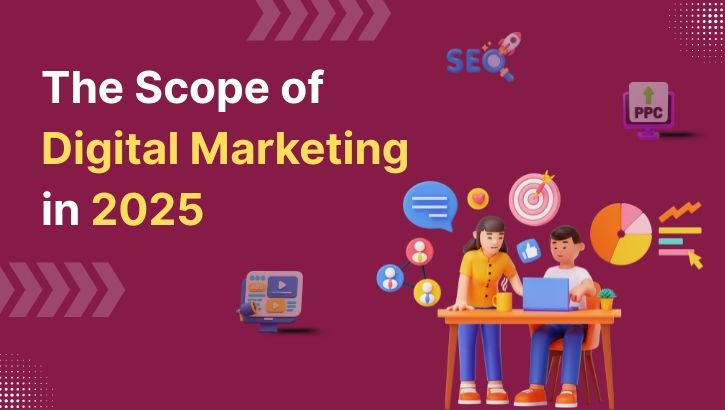
Digital marketing is no longer a nice-to-have, it is central to business success in India and around the world. With soaring internet adoption, smartphone penetration, regional language growth, and AI-driven tools, the scope for digital marketing in 2025 is vast and expanding. As industry forecasts show, brands, agencies, and professionals who master digital marketing are positioned for growth, relevance, and high demand.
For students, this means the opportunity is greater than ever. Whether you aim to become a digital marketing specialist, social media manager, SEO/SEM expert, or content strategist, the digital landscape offers clear pathways for career growth and impact.
In this article, you will learn:
This article gives a clear view of the scope of digital marketing 2025 for students and beginners.
Understanding the scope of digital marketing 2025 helps learners see future growth clearly.
Check us out for your development and growth : PG Certification in AI-Powered Digital Marketing
In India, digital advertising alone is projected to grow at a Compound Annual Growth Rate (CAGR) of 15 % from 2024 to 2029. A recent comprehensive industry report points to digital media already making up nearly 46 % of total ad spend in India. Globally, digital marketing is shifting from traditional channels toward omnichannel, data-driven, AI-enabled strategies.
Market shifts are a major part of the expanding scope of digital marketing 2025.
Consumers are now mobile-first, video-first, voice-search enabled, and expect instant, personalized experiences. Trends such as voice search, visual search, short-form video, and generative AI are reshaping how brands reach and engage audiences. In India, the explosion of regional language internet users also opens large new markets beyond metros.
Consumer change continues to influence the scope of digital marketing in 2025, and it would be ever evolving.
With many businesses moving budgets from offline to digital, there is a growing demand for digital marketers who can deliver measurable results, track performance, manage campaigns across platforms, and drive ROI.
These shifts strongly contribute to the growing scope of digital marketing 2025.
As noted in Deloitte’s Marketing Trends 2025, “Empower with Automation and Generative AI” and “Transform Privacy into Opportunity with First-Party Data” are key pillars.
These changes clearly show how the scope of digital marketing 2025 is expanding across industries.
India is contributing to the fast-growing scope of digital marketing 2025.
In India, digital marketing salaries have increased significantly, reports indicate average salary growth of ~30 % in recent years for skilled professionals. The number of job roles and specialisations is growing, including roles such as SEO specialist, SEM analyst, social media strategist, content marketing manager, and performance marketing manager.
The digital boom is no longer limited to major cities. Tier-2 and Tier-3 cities are witnessing a surge in internet usage, social media adoption, and e-commerce activity. This means local businesses, regional language marketing, and localized digital campaigns are in high demand.
Sectors such as e-commerce, FinTech, EdTech, health & wellness, and regional D2C brands are heavily investing in digital marketing. For students and professionals, building expertise in these verticals can be a differentiator.
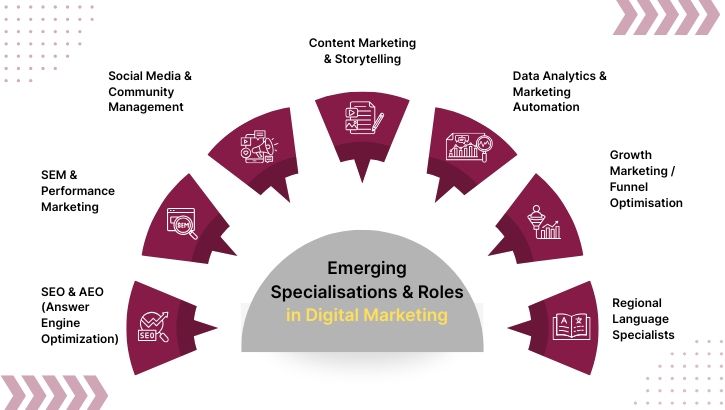
As the scope broadens, so do the roles. Some of the key emerging specialisations:
For students, gaining foundational knowledge in one or more of these areas significantly increases career prospects.
All these new roles highlight the increasing scope of digital marketing 2025 for students and professionals.
Understanding Core Digital Marketing Channels
Digital marketers must have an in-depth understanding of SEO, SEM, social media, email, and content marketing. SEO builds long-term organic visibility, SEM drives instant reach through paid search, while social and email marketing foster engagement and retention. Content marketing ties everything together through storytelling and authority building. Mastery of these channels helps marketers create integrated campaigns that deliver consistent brand experiences and measurable ROI.
Analytics and Data Interpretation
In 2025, data is the new creative brief. Tools like Google Analytics 4, Meta Insights, and campaign dashboards provide deep insights into user behavior, conversion paths, and engagement trends. Marketers must go beyond vanity metrics to interpret what the data means, understanding which touchpoints drive sales, which audience segments convert better, and how customer journeys evolve. Data literacy ensures every marketing rupee is spent intelligently.
Marketing Automation and CRM Tools
With thousands of leads generated daily across multiple touchpoints, automation is no longer optional. Platforms such as HubSpot, Mailchimp, ActiveCampaign, and Salesforce CRM allow marketers to nurture prospects through automated email flows, lead scoring, and personalised campaigns. The ability to integrate CRM with automation tools ensures seamless communication between marketing and sales, improving lead quality and conversion rates.
Paid Advertising Platforms
Performance marketing remains one of the strongest levers for ROI-driven growth. Understanding Google Ads, Meta Ads Manager, LinkedIn Ads, and YouTube Ads enables marketers to craft audience-specific, data-driven ad campaigns. Knowledge of A/B testing, retargeting, keyword bidding, and conversion tracking separates amateurs from professionals. In 2025, performance marketers who can blend creative ad copy with algorithmic precision will dominate.
Generative AI Tools
AI has shifted from buzzword to backbone. Platforms like ChatGPT, Jasper, Copy.ai, and Writesonic assist in creating SEO-optimised blogs, ad copies, and campaign ideas within minutes. Marketers should also learn to fine-tune AI prompts, verify factual accuracy, and maintain brand voice consistency. The best professionals use AI not as a replacement but as a creative collaborator, enabling higher productivity and strategic depth.
Chatbots and Conversational Marketing
Customer interactions are moving toward AI-powered chatbots and voice assistants. Integrating tools such as Drift, ManyChat, or Intercom helps automate lead qualification, FAQs, and 24×7 support. These systems collect valuable first-party data and personalise the customer experience. Understanding chatbot scripting and NLP (Natural Language Processing) principles will be a major advantage.
Voice and Visual Search Optimisation
As smart speakers and visual recognition tools gain popularity, marketers must adapt to voice and visual search. Optimising content for conversational keywords (“near me,” “how to,” “best in Chennai”) and image search improves brand visibility. Tools like Google Lens and Pinterest Lens are shaping the next frontier of SEO. Mastery of this area future-proofs a brand’s discoverability.
WHY TAP provides a 6 Months intensive digital marketing programme with Stipend and assured Placement, click here to explore more about the programme.
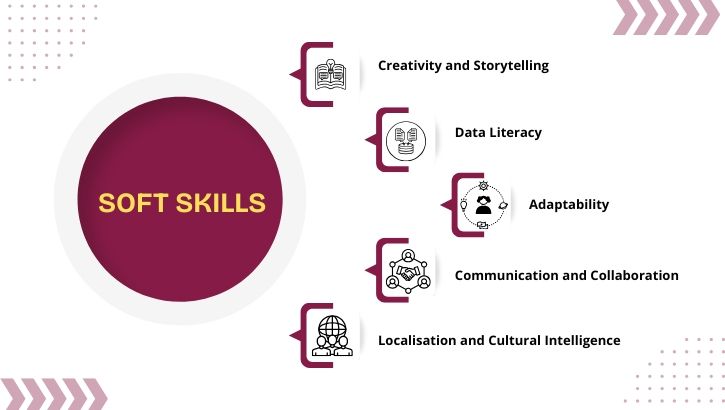
1. Creativity and Storytelling
In a world filled with automation, creativity remains the true differentiator. Storytelling transforms data and strategy into human emotion. Great marketers know how to craft narratives that inspire whether it’s a 6-second reel, a blog headline, or a long-form campaign story. Creativity ensures your brand doesn’t just appear in feeds: it connects.
2. Data Literacy
Marketers are expected to think like analysts. Being able to read a dashboard, understand conversion rates, identify anomalies, and draw actionable insights is crucial. Data literacy bridges the gap between creativity and commerce, empowering marketers to make informed decisions rather than assumptions.
3. Adaptability
The only constant in digital marketing is change. Algorithms shift, consumer preferences evolve, and new tools emerge weekly. Marketers who adapt quickly learning new platforms, experimenting with trends, and staying open-minded, will remain relevant. Adaptability isn’t just about learning tools; it’s about maintaining a growth mindset.
4. Communication and Collaboration
Modern marketing is a team sport. Whether coordinating with designers, content creators, ad specialists, or clients, clear communication ensures smooth execution. Strong interpersonal skills help marketers explain ideas persuasively, manage expectations, and maintain healthy professional relationships a vital trait for leadership roles.
5. Localisation and Cultural Intelligence
As global campaigns reach diverse audiences, marketers must embrace localization, customising content to match local languages, traditions, and consumer mindsets. In multilingual markets like India, understanding regional nuances can dramatically increase engagement. Cultural intelligence transforms a good campaign into a relatable one.
2025 marks a major shift toward automation, personalisation, and privacy-driven marketing. As third-party cookies phase out, first-party data, the data you collect directly from users, becomes the foundation of every marketing strategy. Marketers who can interpret this data to build customer journeys, predict intent, and design personalised offers will outperform competitors.
At the same time, AI-powered marketing is transforming content creation, audience segmentation, and predictive analytics. From generating ad copy to forecasting trends, AI empowers marketers to scale faster and smarter. However, the human element such as empathy, ethics, and storytelling remain irreplaceable.
In essence, the marketer of 2025 is both an analyst and an artist, mastering data tools while speaking the language of emotion. The future belongs to those who can blend AI with authenticity and automation with empathy.
Roles such as Social Media Executive, SEO Intern, Digital Marketing Trainee are abundant. These roles provide exposure to campaign setup, analytics, content creation, and help build a portfolio.
After 2-3 years of experience or upskilling in tools and analytics, professionals may move into roles like Performance Marketing Analyst, SEM Manager, Content Lead, or Regional Marketing Manager.
With 5-7 years of experience and strong results, opportunities open up for roles such as Digital Marketing Manager, Head of Growth, Agency Director, or Chief Digital Officer.
The demand for digital marketers is growing rapidly. With the right skills and certifications, students can position themselves ahead of peers. For instance, specialised training in AI-driven digital marketing, regional language marketing, and analytics can set students up for higher salary roles. These boost up the Scope of Digital Marketing in 2025 and in the future.
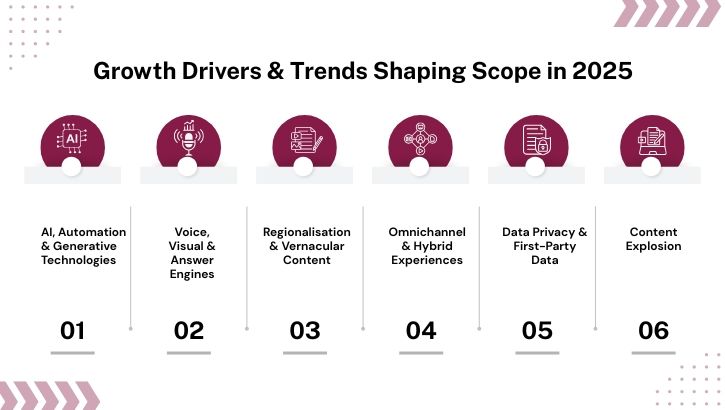
From content generation to ad targeting, AI is driving efficiency and scale in digital marketing.
Search is evolving: voice assistants, image search and AI chat interfaces are altering how users find information.
In India, regional language content is no longer niche but mainstream. Brands that localise content reach more users in lesser saturated segments.
Brands are integrating digital and physical experiences: online-to-offline, mobile-to-desktop, social commerce to store visits.
With cookies phasing out, marketers must rely more on first-party data, CRM insights, and build trust with audiences.
Content consumption continues to rise: short videos, live streams, podcasts, interactive content. This opens opportunities for content strategists and creators.
While the opportunity is strong, there are challenges:
The scope of digital marketing in 2025 is profound for businesses, marketers, and especially students. The combination of market growth, technology evolution, and consumer behaviour shift creates abundant opportunities. By building the right skills, staying adaptable, and focusing on measurable results, you can position yourself for a future-proof career in digital marketing.
Whether you aim to become a content strategist, performance marketer, SEO specialist or analytics professional, the time to act is now.
With the fast growth of the scope of digital marketing in 2025, now is the best time to start learning and building skills.