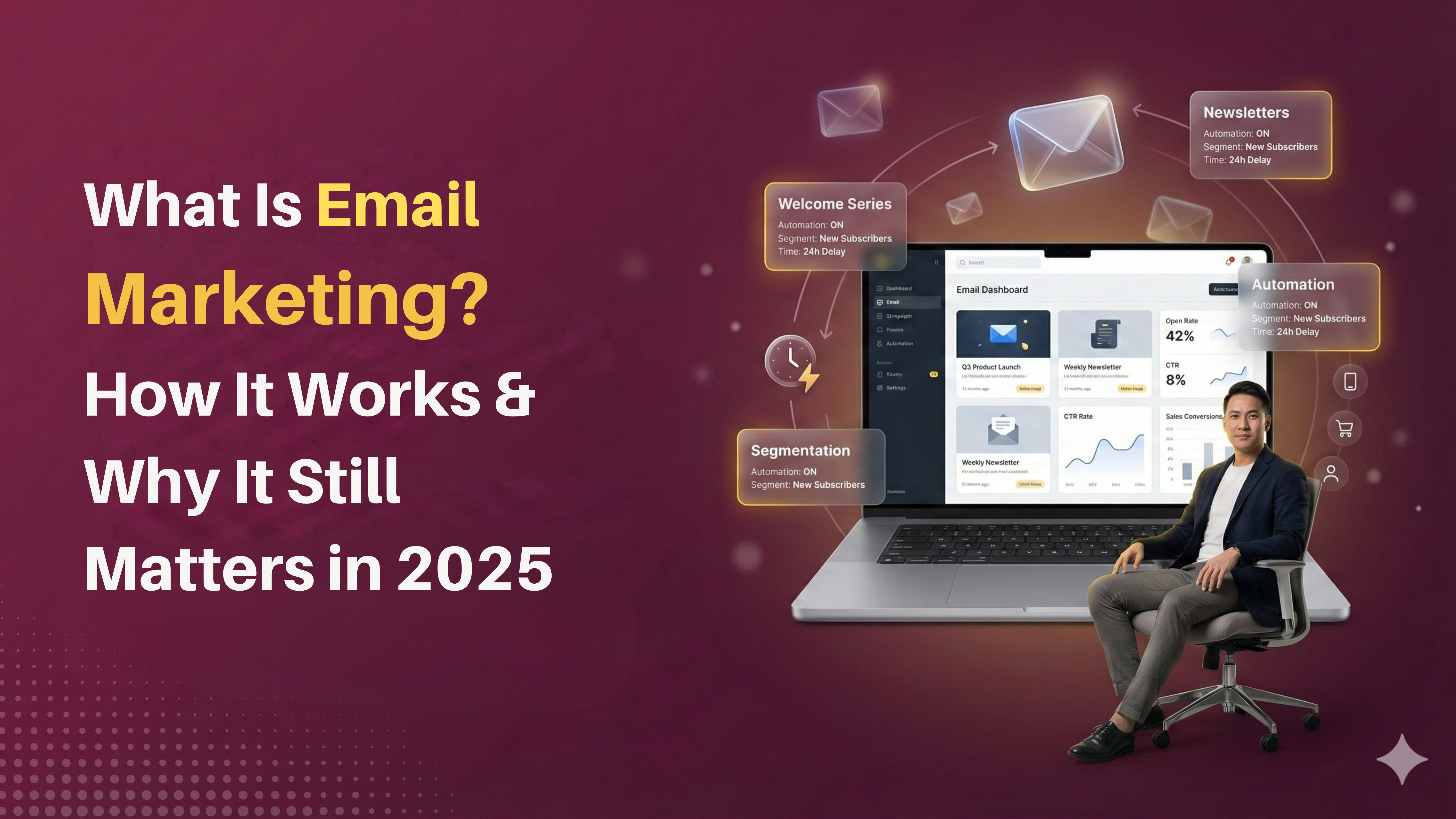
Email marketing in 2025 continues to outperform almost every digital channel, yet many businesses still struggle to turn their email lists into real results. With inbox competition rising and customer attention shrinking, brands often ask the same question: Does email marketing still work?
The answer is a clear yes. According to Litmus, email marketing delivers an average ROI of $36 for every $1 spent, making it one of the most profitable marketing channels today. HubSpot also reports that 77% of marketers saw increased engagement through email campaigns in the past year.
The real challenge in 2025 isn’t whether email works, it’s how to use it smarter. This blog breaks down what email marketing is, how it works, and why it remains essential for growth-focused businesses.
Email marketing is a digital strategy where businesses send targeted messages to people who choose to hear from them. It goes beyond simple newsletters; it’s a relationship-building tool that helps brands educate, nurture, and convert their audience. According to HubSpot, email marketing remains one of the most effective channels for direct communication because it gives businesses full control over how and when they engage their customers.
At its core, email marketing involves three things:
Example
Imagine someone downloads a free guide from your website. They receive:
This sequence helps the subscriber trust you, increases engagement, and moves them closer to becoming a customer.
Statistics prove its impact: Mailchimp reports that the average email open rate across industries is 34.17%, much higher than most social media platforms.
Email marketing works because it feels personal, direct, and valuable. When done right, it becomes one of the strongest drivers of conversions especially in 2025 when consumers expect meaningful, relevant communication.
Email marketing in 2025 begins with a clean, permission-based list. People must willingly subscribe to this improves engagement and reduces spam complaints. According to Mailchimp, permission-based lists see significantly higher open and click rates compared to purchased lists.
You can grow your list through:
Before sending anything, brands analyze subscriber behavior. HubSpot notes that segmented campaigns can generate 30% higher opens because emails match user intent.
Effective emails feel personal and helpful. Strong copy, simple design, and a clear CTA always win.
Examples of impactful email content:
Automation saves time and builds consistency. In 2025, brands use AI-driven workflows that respond to subscriber actions.
Example of an onboarding sequence:
Analytics help refine strategy. Key metrics include:
Campaign Monitor highlights that analyzing these metrics helps marketers make data-driven decisions, improving engagement.
In 2025, tracking performance is essential because user behavior shifts quickly and smarter data helps brands stay ahead.
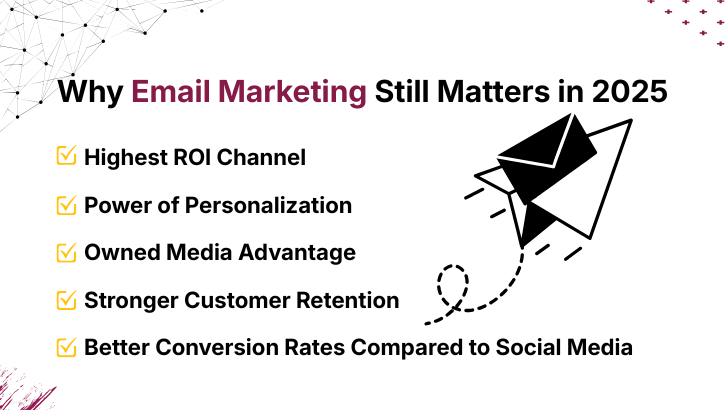
Highest ROI Channel
Email marketing remains unmatched when it comes to returns. According to Litmus, businesses earn an average ROI of $36 for every $1 spent, making email the most profitable digital channel.
This high ROI happens because email reaches users directly with no algorithms, no ad spend inflation.
Power of Personalization
Personalized emails drive stronger engagement. Campaign Monitor reports that personalized subject lines can boost open rates by 26%.
Example:
If a user browses “SEO courses,” a follow-up email recommending beginner-friendly SEO tips feels relevant and helpful.
Owned Media Advantage
Unlike social platforms where algorithms control reach, your email list is owned by the media. You decide when and how to communicate. HubSpot highlights that businesses value email because it offers stability and predictable engagement.
Stronger Customer Retention
Email is one of the best tools to keep customers engaged after purchase. Transactional and follow-up emails maintain trust and encourage repeat business. Research by Epsilon shows that automated retention emails can increase customer lifetime value significantly.
Better Conversion Rates Compared to Social Media
Email consistently outperforms social media for conversions. Barilliance found that email drives over 18% of eCommerce conversions, far higher than organic social channels.
In 2025, email marketing matters more than ever because it stays personal, measurable, and incredibly cost-effective.
Welcome Emails
Welcome emails introduce your brand and set expectations. They perform incredibly well, GetResponse reports that welcome emails see an average 86% open rate, making them the best place to start conversations.
Example: A user signs up for a fitness app and receives a welcome message with a quick-start guide and a personalized workout suggestion.
Newsletters
Newsletters keep your audience updated with helpful insights, product updates, or curated content. In 2025, businesses use short, scannable formats because users prefer quick value.
Lead Nurturing Emails
These emails educate and guide leads through the buying journey.
Example: A student downloads a “Career Roadmap Guide” and receives a sequence of emails sharing tips, course suggestions, and success stories.
Promotional Emails
Promotional emails highlight offers, discounts, or limited-time deals. They work best when personalized.
Example: An eCommerce brand sends a “20% off for your wishlist products” email driving faster conversions.
Transactional Emails
These include order confirmations, shipping updates, password resets, and receipts. While functional, they also offer engagement opportunities.
Example: A clothing store adds style recommendations inside the order confirmation email.
Re-Engagement Emails
These emails target inactive subscribers and remind them why they signed up.
Example: Netflix sends a “We Miss You Here’s What’s New” email showing trending shows based on the user’s old watch history.
Using a mix of these email types helps brands stay relevant, boost engagement, and create meaningful customer experiences in 2025.
Email marketing continues to be one of the most reliable and high-performing channels for businesses. Here are the top benefits you can’t ignore in 2025:
High ROI and Low Cost
Email marketing delivers one of the highest returns for minimal investment. Litmus reports an ROI of $36 for every $1 spent.
Example: A small coaching brand sends three weekly emails and drives consistent course sign-ups without spending on ads.
Personalized Customer Experiences
Personalization increases engagement and trust.
Example: An online bookstore recommends titles based on a user’s previous purchases boosting repeat sales.
Stronger Customer Retention
Emails help brands stay connected even after a purchase.
Example: A skincare company sends monthly skincare tips and product-care reminders, encouraging long-term loyalty.
Full Control Over Communication
Unlike social media, email is an owned channel. You decide how often to communicate.
Example: A SaaS company uses a weekly email digest to keep users updated on new features without relying on algorithms.
Easy Automation Saves Time
Automation makes customer journeys seamless and consistent.
Example: A student enrolls in a course and automatically receives onboarding emails, reminders, and bonus lessons.
Better Targeting Through Segmentation
Email tools in 2025 make segmentation simple and accurate.
Example: An eCommerce brand sends winter product recommendations only to users in colder regions increasing conversions.
Data-Driven Optimization
Email platforms provide clear insights.
Example: A marketer sees low open rates and tests new subject lines, improving engagement in one week.
In 2025, these benefits make email marketing a must-have for every business looking for sustainable growth.
Use AI Tools Wisely
AI helps marketers send smarter, more relevant emails. Tools like HubSpot and Mailchimp use AI to predict send times, segment audiences, and optimize content.
Example: A brand uses AI to recommend product suggestions based on previous purchases, boosting conversions.
Keep Designs Mobile-Responsive
More than 46% of all email opens come from mobile devices, according to Litmus.
Example: A simple, single-column layout with large buttons ensures users can read and click easily on their phones.
Segment Your Audience
Segmented campaigns drive 30% higher open rates and 50% more click-throughs, as reported by HubSpot.
Example: A career platform sends different emails to students, job seekers, and working professionals.
Test Subject Lines
A/B testing helps marketers understand what resonates best.
Example: Testing “Get Your Free Guide” vs. “Your Free Career Guide Is Here” reveals which earns higher clicks.
Personalization Without Over-Targeting
Personalization must feel natural, not intrusive.
Example: A travel brand suggests destinations based on browsing history without referencing overly personal data.
Follow Email Regulations (GDPR, CAN-SPAM)
Compliance protects your brand and builds trust. The GDPR guidelines and CAN-SPAM Act require clear consent, easy unsubscribes, and honest subject lines.
Example: A company includes a clear “Manage Preferences” link in every email.
Following these best practices ensures your email marketing in 2025 stays effective, compliant, and genuinely valuable for your audience.
Choosing the right tools can transform how you plan, automate, and analyze your email campaigns. In 2025, these trusted platforms stand out for reliability, features, and ease of use:
HubSpot
A complete marketing suite offering automation, segmentation, AI insights, and CRM integration. HubSpot reports that companies using automation see up to 451% more leads.
Example: A career platform uses HubSpot workflows to send tailored onboarding emails to new learners.
Mailchimp
Known for simplicity, powerful analytics, and AI-powered recommendations.
Example: A small business uses Mailchimp’s predictive demographics to send more relevant product suggestions.
Campaign Monitor
Great for customizable templates and in-depth performance reports.
Example: A nonprofit uses Campaign Monitor to design clean newsletters that drive recurring donations.
Active Campaign
Ideal for advanced automation and behavioral targeting.
Example: An eCommerce store sends personalized product recommendations based on browsing behavior.
GetResponse
Strong for webinars, landing pages, and automated customer journeys.
Example: A coach automates webinar reminders and follow-ups for higher attendance.
Sendinblue (Brevo)
A budget-friendly tool offering email, SMS, and automation.
Example: A startup uses Brevo to send timely order updates and promotional messages.
Using these tools helps marketers create data-driven workflows, optimize engagement, and scale email marketing efficiently in 2025.
Even in 2025, many marketers struggle with avoidable email mistakes that hurt engagement and conversions. Here are the most common pitfalls and how to fix them:
Sending Emails Without Segmentation
Sending the same email to everyone leads to lower engagement. HubSpot notes segmented campaigns generate 30% more opens.
Example: A job portal sends “freshers jobs” emails to senior professionals leading to mass unsubscribes.
Overloading Emails With Too Much Content
Long, cluttered emails overwhelm readers.
Example: A brand stuffing five promotions into one email sees fewer clicks than sending one focused message.
Ignoring Mobile Optimization
With nearly 46% of emails opened on mobile (Litmus), non-responsive designs lose readers instantly.
Example: Tiny text and small CTAs cause mobile users to abandon the email.
Not Testing Subject Lines
Weak subject lines kill open rates.
Example: “Check This Out” performs worse than “Your Free Career Guide Is Ready.”
Using No-Reply Email Addresses
No-reply addresses feel cold and reduce trust.
Example: Subscribers cannot respond with questions or feedback, lowering engagement.
Sending Too Many Sales Emails
People unsubscribe when every email feels like a sales push.
Example: A brand promoting discounts daily sees higher spam complaints.
Neglecting List Cleaning
Keeping inactive or bounced emails lowers deliverability.
Example: A list with many outdated emails leads to more spam filtering and poor inbox placement.
Skipping Analytics Review
Without analyzing metrics, improvements never happen.
Example: A marketer notices declining open rates only after checking reports and improves them with A/B testing.
Avoiding these mistakes helps brands maintain trust, boost engagement, and get more consistent results from email marketing in 2025.
Hyper-Personalization
In 2025, personalization goes far beyond using a subscriber’s name. Brands now tailor content based on browsing behavior, purchase history, and real-time actions. According to McKinsey, companies that excel at personalization generate 40% more revenue from these efforts.
Example: A travel app suggests trips based on your recent searches, preferred climate, and budget all inside a single email.
AI-Driven Automation
AI now powers smarter workflows that adapt automatically. Tools analyze user behavior, send emails at optimal times, and predict what content will convert best.
Example: An eCommerce brand uses AI to trigger cart reminders within minutes of abandonment, improving conversions.
Predictive Analytics
Predictive insights help marketers understand what subscribers will do next. According to Salesforce, 88% of marketers using predictive tools say it improves personalization and campaign performance.
Example: A course platform predicts which learners are likely to drop off and sends motivational emails or bonus resources.
Interactive Email Experiences (AMP)
Interactive emails make engagement easier by reducing the need to click out of the inbox. AMP technology lets users complete actions directly inside the email.
Example: A user can browse product catalogs, fill surveys, or track shipping updates without leaving their Gmail interface.
These trends show that email marketing in 2025 is becoming smarter, more intuitive, and more user-centered helping brands create richer, faster, and more meaningful digital experiences.
Email marketing isn’t just a powerful business tool it’s also a high-value skill that employers are actively looking for in 2025. With more companies shifting toward digital-first engagement, professionals who understand email strategy, automation, and analytics stand out in competitive job markets. If you’re exploring career growth opportunities, platforms like WHY TAP and offer excellent resources to help you upskill and stay job-ready.
Skills Employers Want in 2025
Companies now prioritize digital communication skills, customer understanding, and data literacy. According to LinkedIn’s Workplace Learning Report, marketing automation and analytics rank among the top skills employers seek.
Key skills email marketers use daily include:
Example: A job seeker who learns email segmentation and automation can easily apply for roles like Email Marketing Specialist, CRM Executive, or Content Strategist.
To explore career-building resources, check out the learning and development materials on WHY TAP.
Email marketing expands your career opportunities because it touches multiple domains content, analytics, automation, and customer experience. Businesses rely on skilled professionals who can create personalized campaigns and optimize customer journeys.
Example: A student who masters email automation can fast-track their digital marketing career and qualify for higher-paying, in-demand roles.
To find email marketing related job openings, explore ARC 360 Jobs, where you’ll find up-to-date opportunities aligned with your skill set.
Email marketing remains a high-value, future-proof career skill and leveraging it can open doors to exciting professional growth in 2025.
Email marketing in 2025 remains one of the most reliable, cost-effective, and high-impact channels for building meaningful customer relationships. Despite rapid changes in digital marketing, email continues to outperform with higher ROI, stronger personalization, and smarter automation. Whether you’re a business looking to boost conversions or a professional aiming to sharpen in-demand skills, mastering email marketing offers long-term value and future-ready opportunities.
As inboxes evolve and user expectations rise, the brands and individuals who adapt quickly through personalization, segmentation, and data-driven strategies will see the biggest wins. If you want to strengthen your marketing skills or explore career paths in this field, now is the perfect time to take the next step.
Email marketing is evolving fast don’t get left behind. Learn how to create high-impact campaigns and data-driven workflows with WHY TAP’s Digital Marketing. Enroll now and future-proof your marketing career.
FAQs