In digital marketing, every click, impression, and conversion tells a story. But the story that matters the most is simple:
Did the money you spent bring you profitable returns?
That’s where ROAS (Return on Ad Spend) becomes one of the most important marketing metrics in 2025. Many beginners first search “what is ROAS” when they want to understand Whether you run ads on Meta, Google, YouTube, or any other platform, ROAS shows exactly how much revenue you earned for every rupee you invested in advertising.
In a world where ad costs are rising and competition is increasing, understanding ROAS is not optional, it’s essential for smart marketing decisions.
This blog gives you a breakdown of ROAS, how to calculate it, what “good ROAS” means across industries, and how marketers actually improve ROAS using data, creative optimization, and audience targeting.
Let’s get started.
ROAS (Return on Ad Spend) is a marketing metric that tells you how much revenue your ads generated compared to the amount you spent.
The basic formula is:
ROAS = Revenue Generated / Advertising Spend
Example:
Your ROAS = 4 (also called 4x ROAS or 400% ROAS)
This means:
For every ₹1 you spent, you earned ₹4 back.
ROAS is one of the cleanest ways to understand if your campaign is profitable or not.
In 2025, ad platforms are more competitive than ever. Everyone from small businesses to giant brands is fighting for the same audience attention. Now that you know what is ROAS, it becomes easier to understand why brands depend on it to track campaign perfomance .
That’s why marketers rely heavily on ROAS to:
2.1. Know which campaigns are making money
Even if your ad gets many clicks, it may not be generating revenue. ROAS reveals the real performance.
2.2. Allocate budgets smartly
High-ROAS campaigns get more budget. Low-ROAS campaigns get paused, fixed, or removed.
2.3. Optimize creatives & audience targeting
Sometimes only one creative or audience segment drives profits. ROAS helps identify what’s actually working.
2.4. Communicate results to clients or management
ROAS is a universal metric in digital marketing that is easy to explain, easy to understand.
According to Google Ads Support, ROAS is so important that Google even provides an automated Smart Bidding strategy called Target ROAS, where Google optimizes bids to help advertisers hit their ROAS goals based on historical conversion value. Read more directly from Google here: Google Ads ROAS Guide.
This means Google itself believes ROAS is a core indicator of campaign profitability.
Many beginners confuse ROI and ROAS.
| Metric | Metric Measures | Includes Costs? | Best Used For |
|---|---|---|---|
| ROAS | Revenue from ads | Only ad spend | Marketing campaign performance |
| ROI | Net profit | All business costs | Business profitability |
ROAS → marketing metric
ROI → finance metric
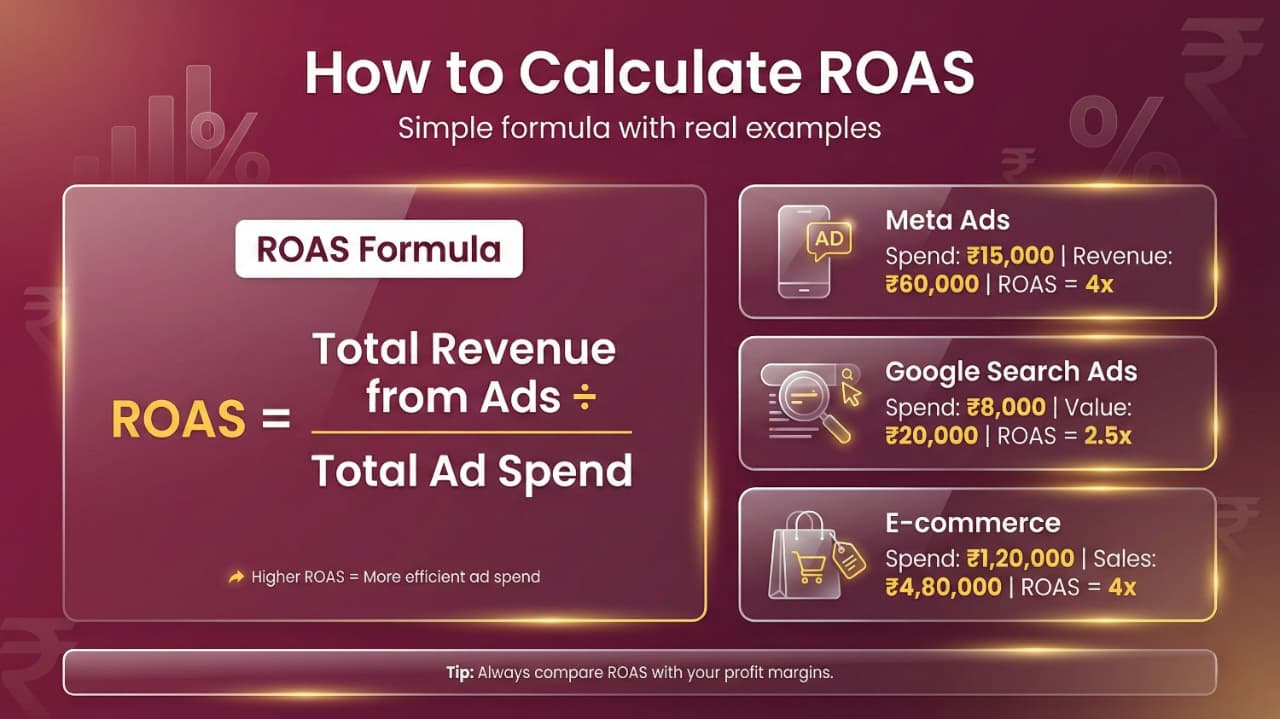
Many advertisers who ask what is ROAS usually learn the calculation first before analyzing campaign profitability.
Formula:
ROAS = Total Revenue from Ads / Total Ad Spend
Example 1: Meta Ads
ROAS = 4
Example 2: Google Search Ads
ROAS = 2.5
Example 3: E-commerce Store
ROAS = 4
According to Shopify’s ROAS benchmarks, most e-commerce brands consider 400% (4x ROAS) a healthy target meaning the business gets ₹4 back for every ₹1 spent on ads.You can explore Shopify’s breakdown here: Shopify ROAS Benchmarks
| Industry | Good ROAS |
|---|---|
| E-commerce | 4x–8x |
| Education | 3x–6x |
| SaaS | 5x–10x |
| Hospitality | 4x–7x |
| Local businesses | 3x–5x |
HubSpot highlights that ROAS helps marketers understand Ad spend efficiency across channels, especially when comparing Facebook, Google, and YouTube campaigns. You can read it here: HubSpot ROAS Guide.
HubSpot also emphasizes that ROAS reveals which ad platforms produce the highest value per rupee spent.
Factors That Affect ROAS
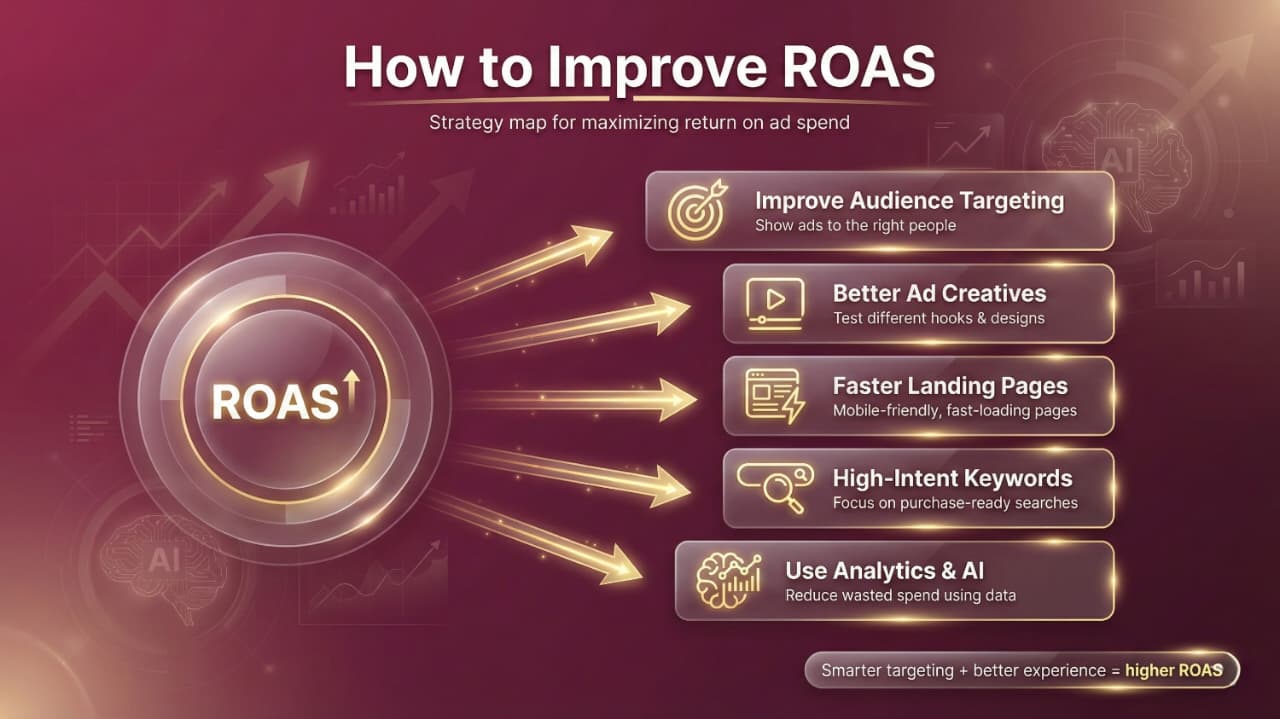
1. Improve Audience Targeting
Use Custom Audiences, Lookalikes, and retargeting.Wants to learn targeting, take a course at Whytap such as the Digital Marketing Course.
2. Improve Creatives
High-quality creatives reduce ad costs.
3. Optimize Landing Pages
Fast, simple, mobile-friendly pages → higher conversions → better ROAS.
4. Use High-Intent Keywords in Google Ads
Avoid broad keywords, focus on purchase-intent terms.
5. Use Data Analytics to Reduce Wasted Spend
Marketers who understand analytics get better ROAS.To build these skills, learners can explore the Data Analytics Course.
AI is transforming advertising by:
Platforms are becoming smarter, and marketers who understand AI-powered optimization get the best ROAS.
No. ROAS tells you revenue efficiency, but you also need to consider:
A brand with low ROAS but high LTV can still be extremely profitable.
ROAS is not just a number, it is the heart of decision-making in digital advertising. It helps marketers understand what’s working, what’s wasting money, and where to focus efforts next.
Anyone entering digital marketing should clearly understand what is ROAS because it helps measure whether campaigns generate meaningful results.
When combined with audience data, analytics, and AI optimization, ROAS becomes a powerful indicator of long-term marketing success.
To become a job-ready digital marketer, learning analytics, ROAS optimization, and advertising strategy is essential. Whytap offers advanced learning paths like Full Stack Development Course to help learners build strong technical and analytical skills for the future.