Technical SEO explained without jargon helps beginners understand how websites work in simple, everyday language. You’ve probably come across explanations filled with words like “crawl budget,” “schema markup,” or “canonicalisation.” Most people don’t speak that language and honestly, they don’t need to. Technical SEO isn’t supposed to confuse you; it’s supposed to help your website show up on Google with clarity and confidence.
In this blog, I’ll explain what Technical SEO really is, why it matters, and how it works using simple, everyday language.
Imagine your website is a house.
You may have beautiful furniture and stunning interiors, but if the foundation is weak and the wiring is faulty, the house won’t function well. In the same way, no matter how great your content is, your website needs a solid technical setup to perform well on search engines. So, Technical SEO explained without jargons simply means making your website easy for search engines to understand, trust, and show to people. That’s it. No rocket science.
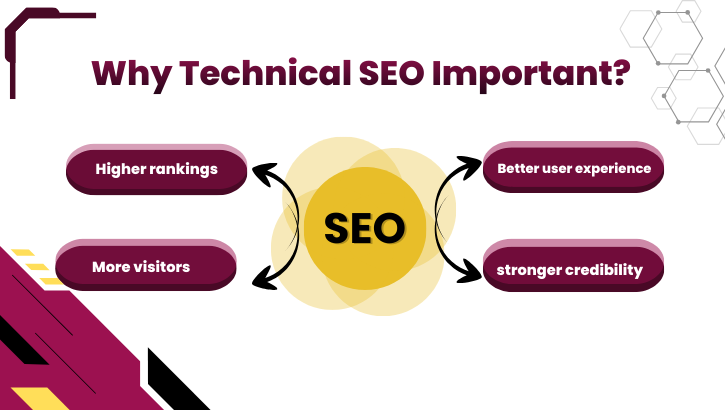
Think of Google as a super-busy librarian who has to sort and display billions of pages. If your website:
Google may not show it to users even if your content is fantastic. Technical SEO explained without jargons helps Google quickly understand your site and feel confident recommending it to others. When that happens, you get:
Without it, your site will feel like a hidden gem in the middle of nowhere beautiful but invisible.
In fact:
This shows how performance (a core part of technical SEO) directly impacts real business results.
To keep things simple, Technical SEO explained without jargons focuses on three main goals:
Goal 1: Make your website fast
People hate waiting, and so does Google. A slow site is like a slow-moving queue; nobody enjoys it. Indeed, studies show that slower pages lead to higher bounce rates and reduced engagement.
Goal 2: Make your website easy for search engines to explore
Search engines use “bots,” which are like digital visitors that scan your pages. Technical SEO explained without jargons ensures your site is easy for these bots to move around and understand.
Goal 3: Make your website easy for humans to use
Yes, humans matter. Technical SEO explained without jargons ensures your site is clean, safe, and easy to access on any device. If your site checks these three boxes, you’re already ahead of the competition.
Now, let’s explore the key parts of Technical SEO in a human-friendly language.
A. Speed: The Need for Speed
When someone clicks your website, they expect it to load instantly. Every extra second makes visitors leave and Google notices.
Slow websites usually suffer because of:
A technically strong website focuses on efficiency, not over-decoration. According to Cloudflare: “site speed is a key to SEO and user experience.”
B. Mobile-Friendliness: Your Website Should Work Everywhere
Most people now browse on their phones more than laptops. Google knows this, so it checks how well your site works on mobile.
A mobile-friendly website means:
Think of it like having clothes tailored to fit every size.
C. Easy Navigation: A Website Should Feel Like a Well-Organised Shop
Imagine entering a supermarket where:
You’d walk out, right?
Technical SEO explained without jargon makes sure your website is neat and logical. Every page should be reachable, connected, and purposeful. This helps both visitors and search engines find what they need quickly.
D. Fixing Broken Pages and Links
Have you ever clicked a link and seen a “Page Not Found (404)” message?
Broken pages irritate visitors and confuse search engines. Technical SEO ensures that:
Think of it like repairing broken stairs in your house so guests don’t trip.
E. Security: Keeping Visitors Safe
Ever noticed that some websites begin with https://and others with http://?
The extra “s” means the site is secure. People and Google love secure sites because they protect user information. Technical SEO helps implement this safely so visitors trust your website.
F. Structured Website Layout
A well-structured website is like a book with:
Search engines use this structure to understand what your content means. If your site is organised logically, Google will reward you with better visibility.
G. Duplicate Content
Imagine reading the same chapter twice in a book. Annoying, right?
Websites sometimes accidentally repeat pages, and search engines get confused about which version to show. Technical SEO explained without jargons ensures each page has its own unique identity, purpose, and value.
H. Clean URL Structure (Simple Addresses)
A clean, readable URL looks like this:www.example.com/blog/technical-seo
A messy, confusing URL looks like this:www.example.com/x?page_id=123&ref=abc
Guess which one Google prefers? The first one because it’s clean, clear, and easy to understand.
I. Image Optimization (Small Size, Big Impact)
Images are important, but large image files slow everything down. Technical SEO makes sure images are:
This keeps your site fast and visually appealing.
J. Keeping Your Site Updated and Error-Free
A technically sound website is like a well-maintained car. Regular servicing is essential. Technical SEO explained without jargons involves periodic checkups to ensure nothing breaks, slows down, or disrupts the user experience.
To avoid confusion, let’s clarify what doesn’t fall under Technical SEO:
Those all matter for digital visibility, but they belong to other branches like content marketing, on-page SEO, or social media marketing.
(Answer: Everyone)
Whether you’re:
You need Technical SEO.
It’s not a luxury, it’s the basic foundation that ensures your digital presence is healthy and competitive.Even educational platforms and career training institutes like WHY TAP emphasise Technical SEO in their digital marketing programs because it’s a must-have skill in today’s job market. A site that ignores technical foundations is like a building with cracks. Eventually, things fall apart.
When your website is technically strong, you get:
Faster Rankings
Search engines can understand your site more easily.
Higher Visibility
Google shows your pages to more people.
Better User Experience
Visitors enjoy browsing instead of struggling.
Lower Bounce Rates
People stay longer and explore deeper.
More Conversions
A smooth website encourages action, sign-ups, purchases, calls, etc.
Long-Term Stability
A technically optimised site grows steadily without frequent breakdowns.
And numerous studies confirm that:
You don’t need to be a techie to get started. Here’s a friendly checklist:
Step 1: Check your site’s mobile-friendliness.
Use any mobile preview tool online.
Step 2: Test your site speed.
Many free tools show where improvements are needed.
Step 3: Fix broken links and pages.
A simple scan can point them out.
Step 4: Compress large images.
There are free tools for this too.
Step 5: Ensure your site uses HTTPS.
Ask your hosting provider if unsure.
Step 6: Organise your website layout.
Group pages logically like chapters in a book.
Step 7: Keep updating your site.
Check for issues every month.
If you’re a student learning digital marketing or someone exploring SEO professionally, these steps form a strong starting point. Institutions like WHY TAP often teach hands-on SEO practices with real projects, which helps you understand these concepts even better.
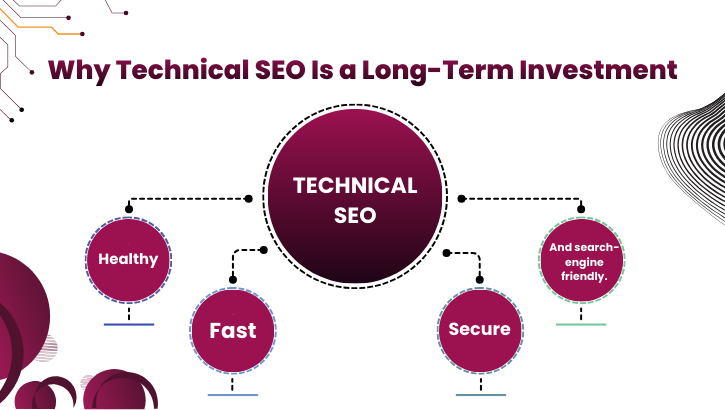
Technical SEO is not a one-time fix. It’s a long-term commitment that keeps your website:
Think of it like gym workouts. You don’t get fit with one session, you stay fit by being consistent. Websites work the same way.
Technical SEO Doesn’t Need Complex Language
Most explanations make Technical SEO sound like complicated wizardry. But at its heart, it’s simply:
Making your website clean, fast, secure, and easy for both humans and search engines to use.
That’s all.
If you implement these foundations correctly, every other part of digital marketing content, design, social media, and ads performs significantly better. And whether you’re learning through self-study or through structured programs such as WHY TAP’s modern, industry-aligned courses, understanding Technical SEO gives you a real competitive edge. A technically strong website is like a well-built house: it stands firm, welcomes visitors, and lasts for years.