


Table of Contents
- 1.
- 2.
- 2.1
- 2.2
- 3.
- 4.
- 4.1
- 4.2
- 4.3
- 5.
- 5.1
- 5.2
- 5.3
- 5.4
- 5.5
- 6.
- 6.1
- 7.
- 7.1
- 8.
- 8.1
- 8.2
- 8.3
- 9.
- 9.1
- 9.2
- 9.3
- 10.
- 10.1
- 11.
- 12.
Introduction
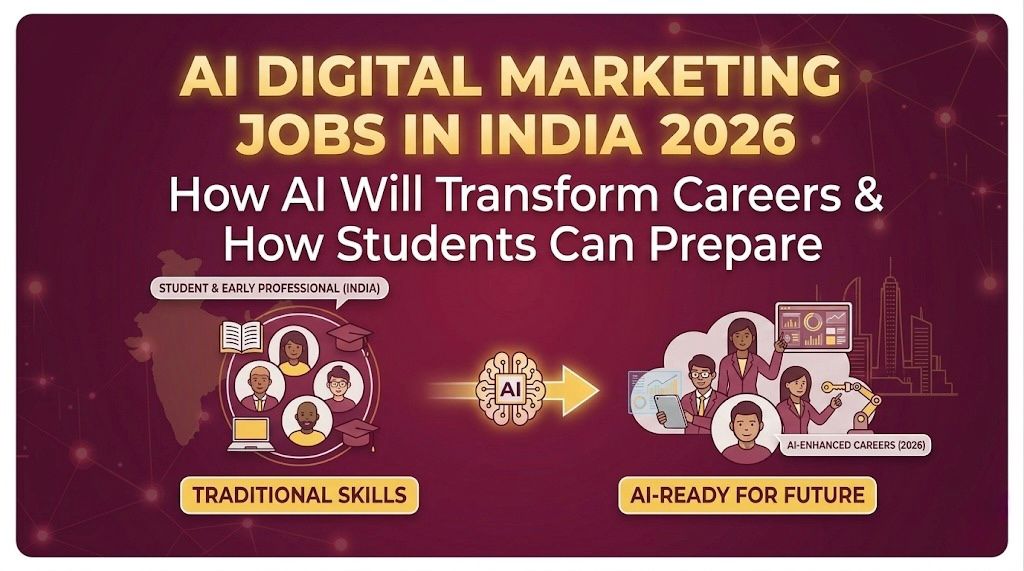
The digital marketing industry in India is entering a critical transformation phase. As Artificial Intelligence becomes deeply integrated into business operations, marketing roles are evolving faster than ever. By 2026, companies will no longer hire digital marketers based only on basic SEO, social media, or paid ads knowledge. Instead, they will demand professionals who understand AI-driven decision-making, automation, and data-backed strategies.
The rise of AI digital marketing jobs in India 2026 reflects a larger shift in how brands approach growth, customer engagement, and performance measurement. According to industry studies, organizations using AI-powered marketing tools already report higher campaign efficiency and improved customer personalization compared to traditional methods. This trend is expected to accelerate over the next few years.
For students and fresh graduates, this shift creates a clear opportunity but only for those who prepare early. Digital marketing careers are not disappearing; they are evolving. This blog explains how AI in digital marketing India is reshaping the job market, what future roles will look like, and how students can build the right skills to stay relevant in 2026 and beyond.
AI in Digital Marketing India: What Is Changing
AI is not replacing marketers; it is changing how marketing work is done. Instead of manual execution, AI enables faster analysis, smarter targeting, and better performance prediction.
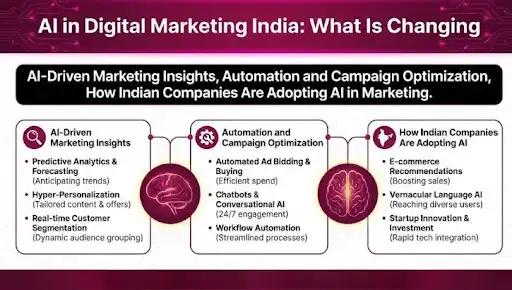
AI-Driven Marketing Insights
AI tools can analyze large datasets to identify:
- User behavior patterns
- Content performance trends
- High-converting audience segments
Automation and Campaign Optimization
AI-powered platforms now automate:
- Ad bidding and budget allocation
- Email personalization
- Customer journey mapping
This reduces repetitive tasks and allows marketers to focus on strategy and creativity.
How Indian Companies Are Adopting AI in Marketing
AI adoption in digital marketing is accelerating across Indian businesses, not just large enterprises but also startups and SMEs. Companies are increasingly using AI to reduce manual work, improve targeting accuracy, and make faster marketing decisions. This shift is driven by rising competition, increasing digital ad costs, and the need for measurable ROI.
In India, AI is commonly applied in areas such as customer segmentation, ad performance optimization, and predictive analytics. For example, e-commerce companies use AI to analyze browsing behavior and personalize product recommendations, while ed-tech and service-based businesses rely on AI-powered CRMs to automate lead nurturing and follow-ups.
Another major change is the way marketers evaluate campaign success. Instead of relying only on impressions and clicks, AI enables predictive insights helping marketers understand which users are likely to convert, when to retarget them, and how much budget to allocate. This data-first approach is shaping the future of AI digital marketing jobs in India 2026, where professionals are expected to interpret insights rather than manually execute tasks.
As AI tools become more accessible, companies now expect digital marketers to understand both marketing strategy and AI-driven execution. This trend clearly defines the future of AI in digital marketing India.
AI Digital Marketing Jobs in India 2026: Career Outlook
By 2026, the job market will favor professionals who can work alongside AI tools, not compete with them. Routine tasks will be automated, while strategic roles will expand.
Roles Likely to Decline
- Manual SEO-only roles
- Basic social media posting jobs
- Data-entry-based marketing tasks
Roles Likely to Grow
- AI-enabled marketing strategists
- Performance marketers using predictive analytics
- Automation and funnel specialists
This shift clearly defines the direction of digital marketing careers after AI.
Industry Demand Across Sectors in India
The demand for AI-enabled digital marketing professionals is not limited to one industry. By 2026, multiple sectors in India are expected to actively hire professionals with experience in AI-driven marketing strategies. E-commerce companies continue to lead this demand as they rely heavily on predictive analytics, personalized advertising, and automated customer journeys to increase conversions.
The IT services and SaaS sectors are also expanding their marketing teams to include AI-focused roles. These companies require marketers who can generate high-quality leads, analyze funnel performance, and optimize campaigns using data-backed insights. Similarly, the education, healthcare, and real estate sectors are increasingly investing in AI-powered digital marketing to improve targeting and reduce acquisition costs.
This multi-industry adoption strengthens the long-term stability of AI digital marketing jobs in India 2026. Unlike traditional roles that were often platform-dependent, AI-driven roles are transferable across industries. Professionals who understand AI-powered marketing workflows will find opportunities in diverse domains, making digital marketing one of the most adaptable career paths in the coming years.
Digital Marketing Job Roles 2026
New and upgraded job roles are already emerging across India’s marketing ecosystem.
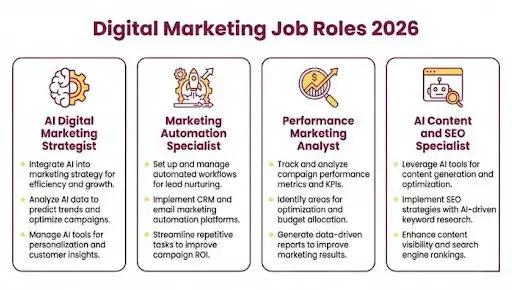
AI Digital Marketing Strategist
- Uses AI insights to plan campaigns
- Focuses on ROI and growth metrics
- Aligns marketing with business goals
Marketing Automation Specialist
- Designs automated customer journeys
- Manages CRM and AI-based lead scoring
Performance Marketing Analyst
- Uses AI dashboards to optimize ads
- Predicts conversion outcomes
AI Content and SEO Specialist
- Works with AI tools for search intent analysis
- Improves content performance using data
These roles represent the next phase of digital marketing job roles 2026.
Salary Trends and Hiring Demand for AI-Based Marketing Roles
Along with new job roles, salary structures in digital marketing are also changing. Professionals with AI and analytics expertise are already earning significantly more than those with only traditional digital marketing skills. Entry-level roles that combine marketing fundamentals with AI tool knowledge are expected to see faster growth in demand by 2026.
Hiring managers increasingly prioritize:
- Practical experience with AI tools
- Understanding of performance metrics
- Ability to optimize campaigns using data
Companies are no longer hiring multiple junior executives for manual tasks. Instead, they prefer fewer, highly skilled professionals who can manage AI-driven platforms and deliver measurable results. This trend strengthens the long-term scope of digital marketing careers after AI, especially for candidates who upskill early.
Additionally, AI-focused job roles offer better career progression. Professionals can move into leadership positions such as marketing strategists, growth managers, or analytics leads within a few years. This makes digital marketing job roles 2026 more stable and future-proof compared to traditional marketing roles that lack technical depth.
Digital Marketing Careers After AI: Reality Check
There is a common misconception that AI will eliminate marketing jobs. In reality, AI eliminates outdated skills, not careers.
What AI Cannot Replace
- Strategic thinking
- Creativity and storytelling
- Brand understanding
- Human decision-making
Professionals who adapt will find more opportunities, not fewer. This defines the real future of digital marketing jobs in India.
AI Tools for Digital Marketers
To remain competitive, professionals must become comfortable using AI-based tools across channels.
Key Tool Categories
- AI keyword research and SEO optimization tools
- Predictive advertising platforms
- AI-powered social media scheduling tools
- Marketing analytics and automation software
Mastering these AI tools for digital marketers is essential for career growth.
Digital Marketing Skills for Students in the AI Era
Students preparing for future roles must build a balanced skill set.
Technical Skills
- SEO and paid advertising with AI assistance
- Data interpretation and analytics
- Automation and campaign optimization
Professional Skills
- Critical thinking
- Business communication
- Adaptability and continuous learning
Employers increasingly value practical skills over theoretical knowledge, making digital marketing skills for students more important than ever.
Why Students Must Combine Marketing Knowledge with AI Literacy
Students entering the digital marketing field often focus only on tools, but long-term success requires a combination of marketing understanding and AI literacy. Knowing why a campaign works is just as important as knowing how to execute it using AI platforms.
AI can assist with keyword research, content generation, and ad optimization, but human judgment is still required to:
- Define brand voice
- Understand audience psychology
- Set campaign objectives
This is why digital marketing skills for students must include both strategic thinking and technical awareness. Students who understand customer journeys, conversion funnels, and analytics will be better equipped to work with AI rather than depend on it blindly.
By 2026, employers will expect freshers to understand AI-assisted workflows from day one. Students who practice with real campaigns and AI tools during training will have a clear advantage in securing AI digital marketing jobs in India 2026.
How to Prepare for Digital Marketing Jobs
Preparation for future roles requires a clear, structured approach.
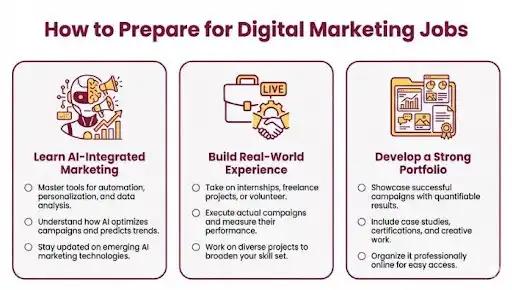
Learn AI-Integrated Marketing
Avoid outdated courses that teach only basics. Choose programs that include AI-driven workflows.
Build Real-World Experience
- Work on live projects
- Practice campaign optimization using AI tools
- Create performance reports
Develop a Strong Portfolio
Showcase:
- AI-assisted campaigns
- Automation strategies
- Measurable outcomes
This is the most effective way to prepare for AI digital marketing jobs in India 2026.
Why an AI-Powered Digital Marketing Course Matters
Traditional marketing education no longer matches industry expectations. An AI-powered digital marketing course helps students:
- Understand real business applications
- Work with modern tools
- Build job-ready confidence
Courses that integrate AI are becoming essential, not optional.
What Employers Look for in AI-Ready Digital Marketers
Employers hiring for digital marketing roles in the AI era are no longer impressed by certifications alone. They prioritize candidates who can demonstrate real-world application of AI tools and marketing concepts. Recruiters look for professionals who understand how AI improves efficiency, reduces costs, and enhances campaign performance.
Key attributes employers value include the ability to analyze campaign data, interpret AI-generated insights, and make informed decisions based on business objectives. Marketers are expected to understand how automation tools work across channels such as search engines, social media platforms, email marketing, and CRM systems.
Another critical factor is adaptability. AI tools and platforms evolve rapidly, so employers prefer candidates who show a willingness to learn continuously and upgrade their skills. This is why enrolling in an AI-powered digital marketing course that focuses on practical exposure and industry use cases becomes essential for students and early professionals.
Such training bridges the gap between academic learning and real-world job expectations, making candidates job-ready from day one.
How WHY Global Services Supports Future-Ready Careers
WHY Global Services focuses on preparing students for evolving industry needs by offering:
- AI-integrated digital marketing training
- Hands-on project experience
- Career-focused mentoring
- Placement-oriented learning
The goal is to bridge the gap between education and real-world digital marketing roles.
Challenges and Opportunities in AI-Driven Digital Marketing
AI-driven marketing brings enormous opportunities, but it also introduces challenges that professionals must understand. One major challenge is over-dependence on automation. Marketers who rely entirely on AI outputs without human validation risk poor decision-making and inconsistent brand messaging.
Another challenge is data quality. AI tools depend heavily on accurate and relevant data. If data inputs are weak, outputs will also be unreliable. This is why professionals must learn to audit data, interpret reports, and apply insights strategically.
Despite these challenges, the opportunities far outweigh the risks. AI enables marketers to scale campaigns faster, test ideas quickly, and personalize experiences at a level that was previously impossible. Professionals who understand both the strengths and limitations of AI will be in high demand.
For students and early professionals, this creates a clear path: learn AI as a support system, not a replacement. Those who adapt will thrive in the evolving landscape of AI digital marketing jobs in India 2026, while those who resist change may struggle to stay relevant.
Conclusion
The rise of AI digital marketing jobs in India 2026 signals a major shift in how marketing careers will evolve. AI is redefining roles, expectations, and required skills, but it is also creating new opportunities for those who prepare early.
Students who invest in AI-driven skills, practical experience, and continuous learning will be well-positioned for long-term success. The future of digital marketing jobs in India is not about replacing humans, it is about empowering smarter, more strategic professionals.