


Table of Contents
- 1.
- 2.
- 3.
- 4.
- 5.
- 6.
- 7.
- 8.
- 9.
- 10.
- 11.
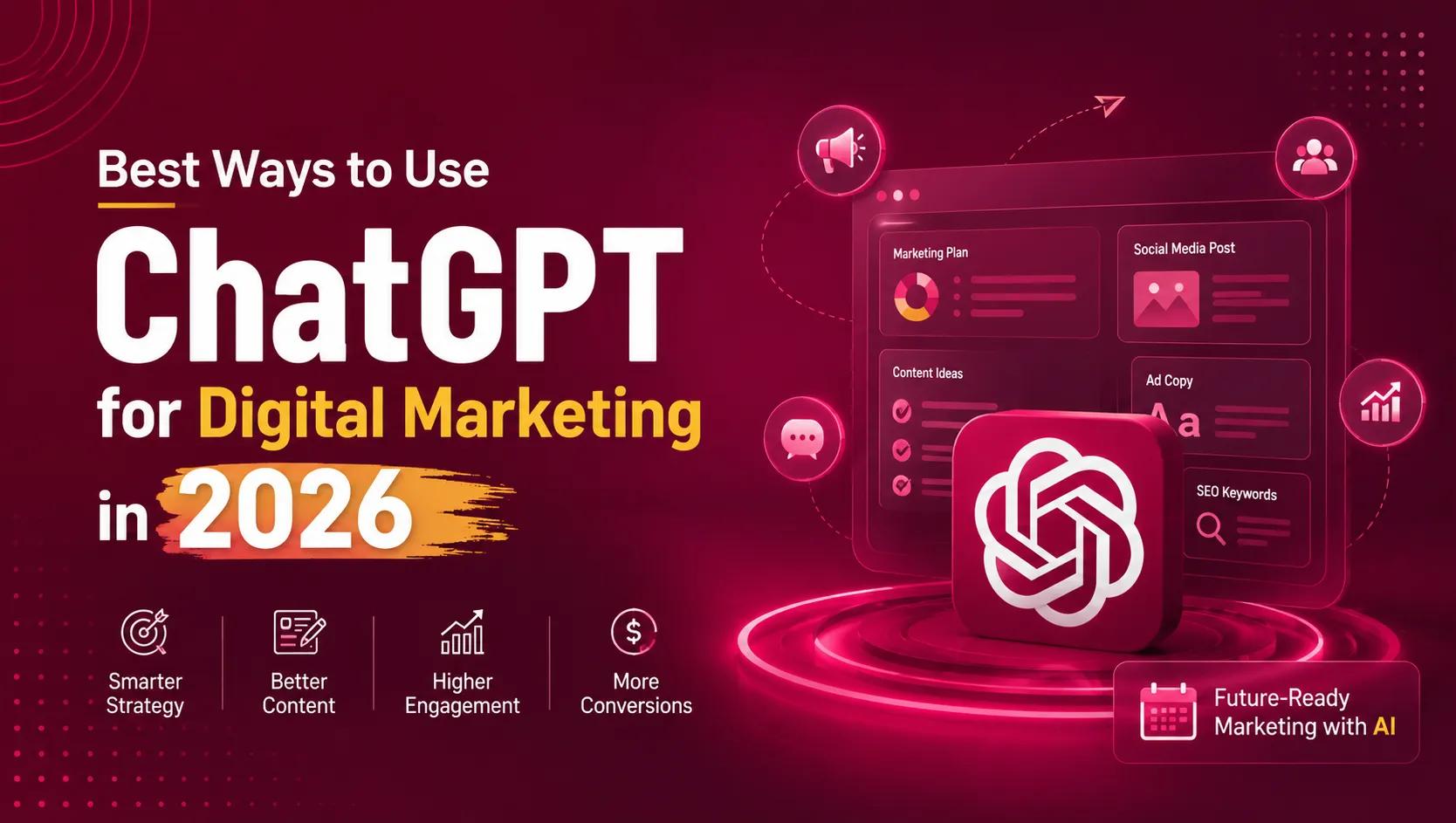
ChatGPT for digital marketing is becoming one of the most widely used AI solutions for businesses and marketers because it helps improve productivity, automate repetitive tasks, and create content more efficiently. In 2026, ChatGPT for digital marketing will play a major role in blog writing, SEO optimization, social media planning, email marketing, audience research, and campaign ideation.
Businesses are increasingly using ChatGPT marketing strategies to streamline digital workflows, save time, and improve campaign performance. Along with other AI tools for marketers, ChatGPT helps brands scale AI content creation and enhance communication strategies across multiple platforms.
Marketers now use ChatGPT for digital marketing to generate:
- Content ideas
- Social media captions
- SEO-friendly outlines
- Email drafts
- Marketing research insights
These capabilities help teams manage campaigns faster while improving workflow efficiency.
However, successful digital marketing still depends on creativity, audience understanding, and strategic thinking. AI tools can support workflows, but human input remains essential for creating authentic, audience-focused, and high-quality content. In the upcoming sections, we will discuss the best ways to use ChatGPT for digital marketing in 2026, how AI-assisted workflows improve productivity and content strategy, and which marketing tasks can be optimized through ChatGPT-powered automation and audience-focused digital marketing techniques.
Why ChatGPT Is Becoming Essential for Digital Marketing
ChatGPT is becoming an essential tool in digital marketing because it helps marketers handle multiple tasks faster and more efficiently. In 2026, businesses use AI-assisted workflows to improve productivity, reduce repetitive work, and support content-driven marketing strategies across different platforms.
One major advantage of ChatGPT is faster content ideation. Marketers use it to generate:
- Blog topic ideas
- Campaign concepts
- Social media content
- Ad copy suggestions
- Email marketing drafts
This helps teams save time during planning and brainstorming stages.
ChatGPT also improves workflow automation by supporting tasks such as:
- Content outlining
- SEO assistance
- Audience messaging
- Research summarization
- Marketing communication
These capabilities help marketers manage larger workloads more effectively.
Another reason businesses rely on ChatGPT is audience-focused communication. AI-assisted tools help marketers create:
- Personalized messaging
- Engaging captions
- Conversational content
- Structured content formats
- Faster response workflows
This improves both engagement and communication efficiency.
ChatGPT is also useful for campaign planning because marketers can use it to:
- Organize content calendars
- Generate strategy ideas
- Research audience interests
- Improve campaign structure
- Analyze marketing approaches
However, marketers still need human creativity and strategic thinking to ensure originality and brand consistency.
For businesses exploring modern ChatGPT for digital marketing strategies, understanding AI-assisted productivity and workflow optimization is becoming highly important in 2026.
ChatGPT Helps Marketers Create Content Faster
Content creation is one of the most time-consuming parts of ChatGPT for digital marketing, and businesses now rely on AI-powered workflows to speed up writing, planning, and campaign execution. In 2026, ChatGPT for digital marketing helps marketers improve productivity, maintain consistent publishing schedules, and streamline AI content creation across blogs, social media, landing pages, and email campaigns.
Many brands use ChatGPT for digital marketing to generate content ideas, optimize SEO strategies, create audience-focused messaging, and support digital marketing automation tasks. Combined with other AI tools for marketers, ChatGPT helps businesses scale content production while improving engagement and communication quality.
ChatGPT can support content creation tasks such as:
- Blog drafting
- Caption writing
- Email copy generation
- Content outlining
- Headline suggestions
These features help marketers reduce repetitive writing work and improve workflow efficiency.
Another major advantage is content repurposing. Marketers can use ChatGPT to transform:
- Blog articles into social posts
- Long-form content into short summaries
- Webinar points into captions
- Research notes into content ideas
- Videos into written content
This helps businesses scale content across multiple platforms more effectively.
ChatGPT Use Case vs Marketing Benefit
| ChatGPT Use Case | Marketing Benefit |
|---|---|
| Blog Content Drafting | Faster content creation |
| SEO Content Optimization | Improved search visibility |
| Social Media Captions | Better engagement consistency |
| Email Copywriting | Faster communication workflows |
ChatGPT also supports marketers by improving:
- Content structure
- Grammar consistency
- Idea generation
- SEO-friendly formatting
- Writing productivity
However, marketers should still review and refine AI-generated outputs to maintain originality, accuracy, and audience-focused communication.
For marketers exploring modern AI marketing strategies, understanding AI-assisted content workflows can significantly improve digital marketing efficiency in 2026.
ChatGPT Supports SEO and Search Intent Optimization
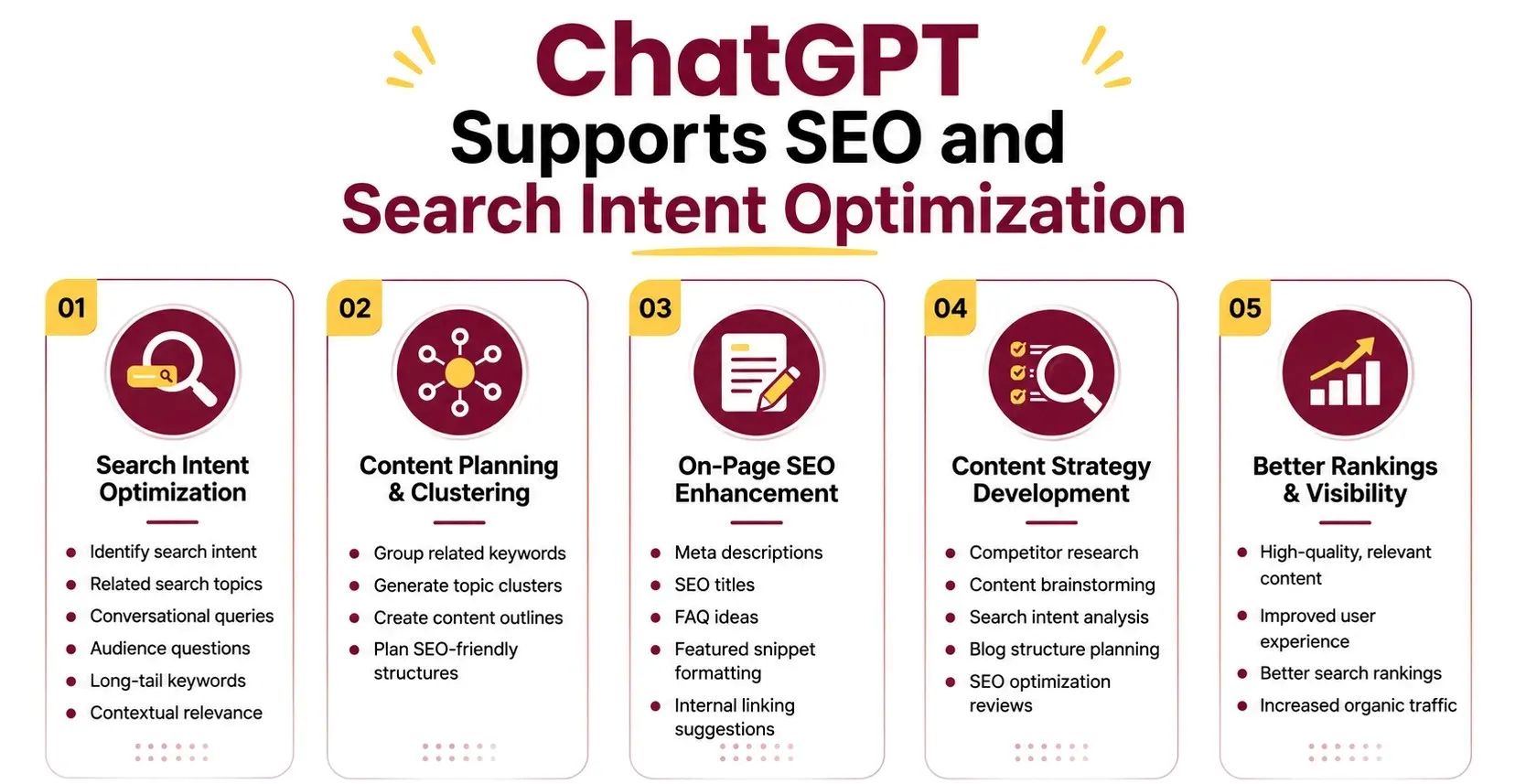
ChatGPT is becoming a useful tool for SEO and search intent optimization because it helps marketers organize content, understand audience queries, and improve content relevance. In 2026, businesses increasingly use AI-assisted workflows to support keyword planning, semantic SEO, and search-focused content strategies.
One major benefit is keyword and topic organization. Marketers use ChatGPT to:
- Group related keywords
- Generate topic clusters
- Create content outlines
- Identify search intent
- Plan SEO-friendly structures
This helps improve content planning and search relevance.
ChatGPT also supports semantic SEO by helping marketers create content around:
- Related search topics
- Conversational queries
- Audience questions
- Long-tail keywords
- Contextual relevance
Modern search engines prioritize useful and intent-focused content instead of only exact-match keywords.
Another important use is meta content generation. ChatGPT can assist with:
- Meta descriptions
- SEO titles
- FAQ ideas
- Featured snippet formatting
- Internal linking suggestions
These elements help improve search visibility and content organization.
AI-assisted SEO workflows also help marketers save time during:
- Competitor research
- Content brainstorming
- Search intent analysis
- Blog structure planning
- SEO optimization reviews
However, marketers should still validate SEO strategies using real analytics and audience insights instead of depending completely on automation.
For businesses comparing modern AI workflows, this ChatGPT vs Gemini guide can help improve understanding of AI-assisted marketing and SEO optimization strategies.
Social Media and Email Marketing Workflows Become More Efficient
ChatGPT for digital marketing is helping marketers improve social media management and email marketing workflows by reducing the time required for planning, writing, and organizing campaigns. In 2026, businesses increasingly use ChatGPT for digital marketing to maintain consistent communication across blogs, social media platforms, newsletters, and customer engagement channels.
Many companies rely on ChatGPT marketing strategies to create personalized messaging, generate campaign ideas, and support digital marketing automation processes. Combined with other AI tools for marketers, ChatGPT helps businesses improve productivity, streamline AI content creation, and maintain a stronger brand presence across multiple digital platforms.
For social media marketing, ChatGPT helps with:
- Caption generation
- Content calendar ideas
- Hashtag suggestions
- Campaign brainstorming
- Audience engagement messaging
These features support faster content planning and posting consistency.
Another major advantage is email marketing support. Marketers use ChatGPT to create:
- Email subject lines
- Promotional emails
- Welcome sequences
- Follow-up messages
- Newsletter drafts
This improves workflow efficiency and helps teams manage communication at scale.
ChatGPT also supports marketers by improving:
- Content personalization
- Tone consistency
- Campaign organization
- Engagement-focused messaging
- Workflow scalability
Businesses managing multiple campaigns can save significant time through AI-assisted automation.
Which AI Marketing Skills Will Be Important in 2026?
Students and marketers learning AI-powered digital marketing should focus on both technical and creative skills.
Important AI marketing skills include:
- Prompt writing
- SEO optimization
- Content strategy
- Audience analysis
- AI-assisted workflow management
- Marketing analytics interpretation
Professionals who combine AI productivity with creativity and strategic thinking are often better prepared for future marketing opportunities.
ChatGPT Improves Marketing Research and Productivity
Marketing research often requires significant time for analyzing competitors, understanding audiences, and organizing campaign ideas. In 2026, ChatGPT helps marketers speed up these processes by supporting faster information analysis and workflow organization.
Marketers use ChatGPT for research-related tasks such as:
- Competitor analysis summaries
- Audience research ideas
- Campaign brainstorming
- Content topic discovery
- Marketing trend analysis
These capabilities improve productivity during planning and strategy development.
Another major advantage is workflow efficiency. ChatGPT helps marketers organize:
- Content calendars
- Campaign structures
- Marketing checklists
- Communication workflows
- Research summaries
This reduces repetitive manual work and improves operational consistency.
Marketing Workflow vs AI Support
| Marketing Workflow | AI Support |
|---|---|
| Content Planning | Faster idea generation |
| SEO Optimization | Search intent assistance |
| Social Media Strategy | Caption and content support |
| Marketing Research | Faster information analysis |
ChatGPT also supports productivity by helping teams:
- Generate quick drafts
- Structure ideas clearly
- Simplify complex topics
- Repurpose marketing content
- Improve communication speed
However, marketers should still verify important data and apply strategic judgment because AI-generated insights may sometimes lack context or accuracy.
For marketers exploring modern AI marketing automation workflows, understanding AI-assisted productivity tools can significantly improve efficiency and campaign planning in digital marketing.
Common Mistakes Marketers Make While Using ChatGPT
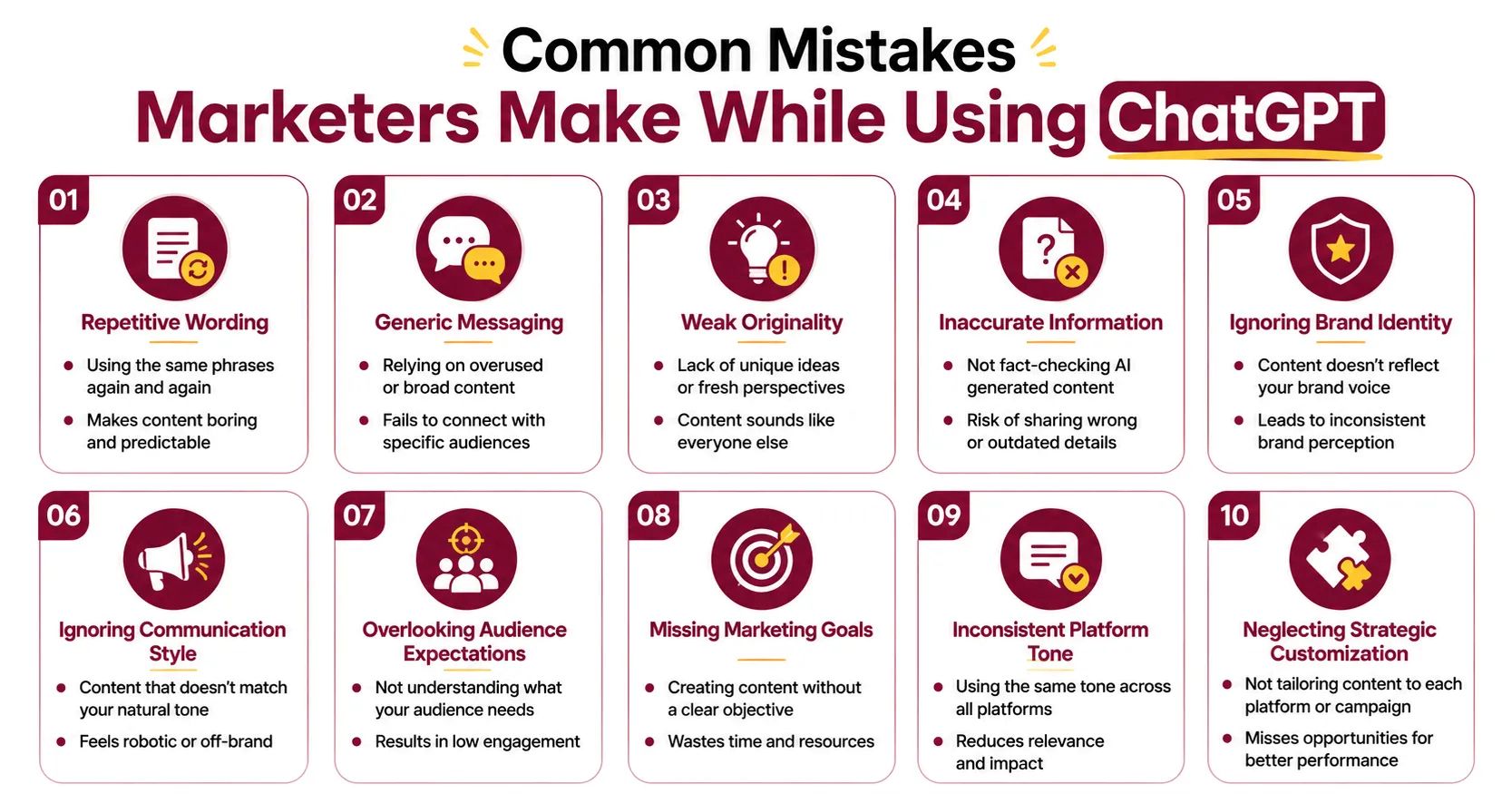
ChatGPT can improve marketing productivity but using it without proper strategy can reduce content quality and brand effectiveness. In 2026, many marketers make the mistake of depending too heavily on AI-generated outputs without adding human creativity, editing, and audience understanding.
One common mistake is publishing AI-generated content without proper review. This can lead to:
- Repetitive wording
- Generic messaging
- Weak originality
- Inaccurate information
- Poor audience connection
Search engines and audiences still prefer authentic and valuable content.
Another issue is ignoring brand voice. Some marketers generate content quickly without ensuring that it matches:
- Brand identity
- Communication style
- Audience expectations
- Marketing goals
- Platform tone
Consistent messaging remains important for strong branding.
Overdependence on automation is another growing concern. Some businesses use ChatGPT for:
- Full content generation
- Social media automation
- Email workflows
- SEO planning
- Customer communication
without applying strategic thinking or human review.
Marketers should also avoid:
- Using vague prompts
- Ignoring factchecking
- Publishing low-quality drafts
- Overusing AI-generated ideas
- Replacing creativity completely
AI tools work best when they support workflows instead of replacing marketing strategy and audience understanding.
For businesses exploring customer trust and brand credibility through google reviews, maintaining quality and authenticity remains highly important even when using AI-powered marketing tools.
How Students and Marketers Can Learn AI-Assisted Marketing
Learning AI-assisted marketing in 2026 requires understanding how AI tools support productivity, content strategy, SEO, and marketing workflows. Since businesses increasingly use AI-powered systems, students and marketers should learn how to combine automation with creativity and strategic thinking.
One of the best ways to start learning is by practicing how ChatGPT supports:
- Content creation
- SEO planning
- Social media workflows
- Email marketing
- Marketing research
Hands-on experimentation helps learners understand real-world AI marketing applications.
Students should also focus on improving prompt-writing skills because better prompts usually generate:
- More relevant outputs
- Clearer content structure
- Better audience-focused messaging
- Improved SEO support
- Higher workflow efficiency
Prompt engineering is becoming an important skill for AI-assisted marketing workflows.
Another important area is understanding human + AI collaboration. Successful marketers still need:
- Creative thinking
- Audience understanding
- Brand communication
- Analytics interpretation
- Strategic planning
AI tools improve efficiency, but human judgment remains essential for quality marketing.
Students should also stay updated with:
- AI-powered SEO tools
- Automation workflows
- Search engine changes
- Content marketing trends
- Audience behavior shifts
Professionals who combine AI-assisted productivity with strong marketing fundamentals are generally better prepared for future opportunities in digital marketing and content strategy.
Final Thoughts
ChatGPT is becoming an important part of digital marketing because it helps businesses improve productivity, automate repetitive tasks, and streamline content workflows. Marketers now use AI-assisted systems for content creation, SEO support, research, social media planning, and communication management across multiple platforms.
In 2026, AI-powered workflows will continue improving content scalability, search optimization, and marketing efficiency. However, successful digital marketing still depends heavily on creativity, audience understanding, strategic thinking, and authentic communication that AI alone cannot fully replace.
As AI tools continue evolving, students and marketers who understand both automation and human-centered marketing strategies will be better prepared for future opportunities in SEO, content marketing, and AI-assisted digital growth.
Build Future-Ready AI Digital Marketing Skills
AI-powered tools like ChatGPT are changing how businesses manage content creation, SEO, social media marketing, and workflow automation. Companies now look for professionals who can combine AI-assisted productivity with creativity, audience understanding, and strategic marketing execution.
Learning how to use ChatGPT effectively can help students and marketers improve content planning, search optimization, campaign management, and communication workflows. However, long-term success still depends on building strong marketing fundamentals alongside AI-powered skills.
To improve AI-assisted digital marketing skills in 2026, learners should focus on:
- Prompt writing
- SEO optimization
- Content strategy
- Social media workflows
- Marketing analytics
- AI-assisted productivity tools
If you want to build industry-ready expertise with practical learning exposure and future-focused marketing preparation, this AI marketing certification can help support your journey toward long-term success in AI-powered digital marketing.