

Table of Contents
- 1.
- 2.
- 2.1
- 2.2
- 2.3
- 3.
- 3.1
- 4.
- 4.1
- 5.
- 5.1
- 6.
- 7.
- 8.
- 8.1
- 9.
- 10.
- 10.1
Skill Stacking for Digital Marketing Careers
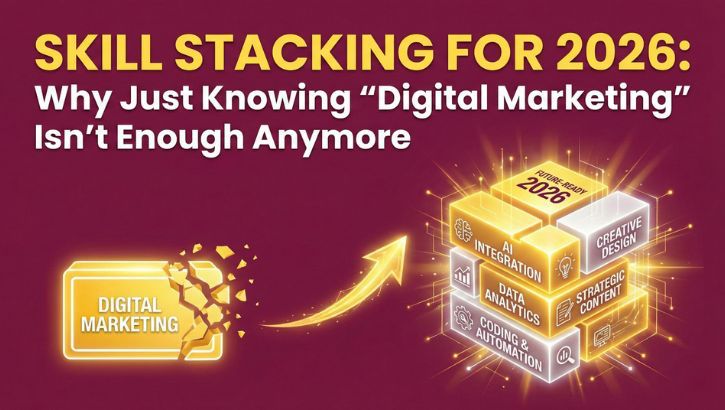
Not long ago, learning digital marketing alone was enough to land a good job. But in 2026, that’s no longer the case. Today, thousands of candidates share the same skill stacking for 2026 SEO basics, social media ads, and content marketing, making it harder to stand out in a crowded job market.
Industry reports consistently show that employers now prefer multi-skilled marketers who can combine marketing with data, AI tools, analytics, UX, or business strategy. In fact, hybrid roles are growing faster than single-skill positions because companies want professionals who can think, execute, and optimize across functions, not just follow instructions.
This is where skill stacking becomes a game-changer. By combining complementary skills instead of relying on one, marketers can unlock better roles, higher salaries, and stronger job security. In the sections below, we’ll break down what skill stacking really means, why it matters in 2026, and how students can start building the right skill combinations without feeling overwhelmed.
Why “Digital Marketing” Alone Is No Longer a Differentiator
Digital marketing was once a niche skill that helped professionals stand out. In 2026, however, it has become a basic requirement rather than a competitive advantage. With easy access to online courses, certifications, and free learning resources, most candidates now enter the job market with similar digital marketing knowledge.
Oversaturation of Digital Marketing Skills
The biggest challenge today is oversupply.
● Thousands of candidates learn SEO, social media marketing, paid ads, and content marketing every year
● Entry-level digital marketing skills are widely available through online platforms
● Recruiters receive a large number of resumes with identical skill sets and tools
As a result, knowing digital marketing alone no longer helps candidates stand out during shortlisting.
Employers Are Looking Beyond Basic Execution
Employers no longer hire marketers just to execute tasks.
● Basic skills like running ads or posting content are expected
● Companies want professionals who can analyze data, optimize performance, and understand business impact
● Marketers are expected to make decisions, not just follow instructions
This shift pushes demand toward professionals who can think strategically and adapt quickly.
One-Dimensional Profiles Struggle to Stand Out
Candidates with only one core skill face slower growth.
● One-dimensional roles are easier to replace
● Employers prefer marketers who can work across functions like analytics, AI tools, UX, or strategy
● Multi-skilled professionals add more value and are trusted with bigger responsibilities
As highlighted in Future-proof digital marketing skills for 2026, digital marketing has become the foundation. What truly differentiates professionals today is what they stack on top of it.
What Is Skill Stacking and Why It Matters in 2026
Skill stacking is becoming one of the most important career strategies for marketers in 2026. Instead of relying on a single skill, professionals combine complementary skills to increase their value, flexibility, and career growth. In a market where basic digital marketing is common, skill stacking is what helps candidates stand out.
Simple Meaning of Skill Stacking (Student Explained)
Skill stacking means building a mix of related skills that work well together, rather than trying to learn everything at once.
● It’s not about becoming an expert in 10 areas
● It’s about strengthening one core skill with 1-2 supporting skills
● For example:
○ Digital Marketing + Data Analytics
○ Digital Marketing + AI Tools
○ Digital Marketing + UX / CRO
This approach creates “T-shaped” or hybrid professionals - people who have depth in one area and working knowledge in others.
Why Employers Prefer Multi-Skilled Marketers
Companies today prefer marketers who can handle more than one responsibility.
● Teams are leaner, and roles are broader
● Employers want professionals who can:
○ Run campaigns
○ Analyze performance
○ Optimize results using tools and data
● Multi-skilled marketers reduce dependency on multiple hires
As explained in The marketer profile companies want today, businesses actively look for professionals who can think strategically and execute across functions.
In 2026, skill stacking isn’t optional - it’s the difference between being average and being in demand.
How Marketing Roles Are Evolving in 2026
Marketing roles in 2026 look very different from what they were a few years ago. Companies are no longer hiring marketers only to execute tasks - they want professionals who can think strategically, use data, and work with technology to drive measurable outcomes.
From Execution-Focused Roles to Strategy-Driven Roles
Earlier, many marketing roles were limited to execution posting content, running ads, or following instructions. That model is changing fast.
● Marketers are now expected to:
○ Understand business goals behind campaigns
○ Analyze performance and identify what’s working
○ Make optimization decisions based on data
● Roles are shifting from “task doers” to problem solvers
● Ownership and accountability are becoming key hiring criteria
This means marketers who can connect actions to results are valued more than those who only execute.
Rise of Hybrid and AI-Assisted Marketing Roles
Another major shift is the growth of hybrid roles that combine marketing with technology and data.
● New roles blend:
○ Marketing + analytics
○ Marketing + AI tools
○ Marketing + growth strategy
● AI-assisted tools are now part of daily workflows
● Marketers are expected to work alongside technology, not avoid it
As highlighted in The evolving landscape of marketing jobs (2026), modern marketing roles demand a broader skill set than ever before.
In 2026, the most in-demand marketers won’t be those who know one channel well - but those who can adapt, analyze, and add value across multiple areas.
Single-Skill Marketer vs Skill-Stacked Marketer
As the marketing industry evolves, the difference between a single-skill marketer and a skill-stacked marketer has become very clear. While both may start with digital marketing knowledge, their career paths, growth speed, and opportunities look very different over time.
Single-skill marketers usually focus on one area - such as SEO, social media, or paid ads. This works at an entry level, but growth often slows because these skills are easy to replicate and widely available. On the other hand, skill-stacked marketers combine digital marketing with complementary skills like data analytics, AI tools, UX, or business strategy. This makes them more versatile and valuable to employers.
Single-Skill vs Skill-Stacked Marketer: Career Comparison
| Factor | Single-Skill Marketer | Skill-Stacked Marketer |
|---|---|---|
| Skill Set | One core marketing skill | Multiple complementary skills |
| Job Opportunities | Limited to specific roles | Eligible for diverse role |
| Problem-Solving Ability | Task-focused | Strategy and data-driven |
| Career Growth | Slower and linear | Faster with multiple paths |
| Salary Potential | Average | Higher due to added value |
| Employer Value | Easily replaceable | High-impact and adaptable |
This comparison clearly shows why skill stacking is becoming essential. In 2026, employers don’t just look for someone who can execute tasks; they look for professionals who can connect skills, think holistically, and drive results.
Most Valuable Skill Stacks for Digital Marketers in 2026
In 2026, employers are not looking for marketers who know everything they’re looking for those who have the right combination of skills. The most successful professionals are those who stack digital marketing with complementary, high-impact capabilities that directly influence business outcomes.
Here are the most valuable skill stacks marketers should focus on:
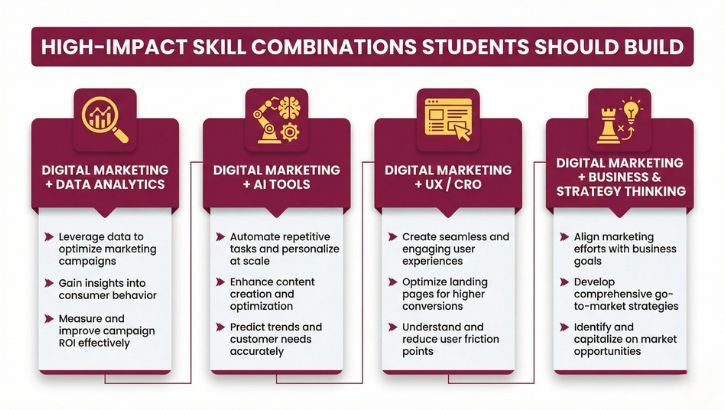
High-Impact Skill Combinations Students Should Build
Digital Marketing + Data Analytics
○ Understand campaign performance, user behavior, and ROI
○ Make decisions based on insights, not assumptions
○ Highly valued in performance and growth roles
● Digital Marketing + AI Tools
○ Use AI for content optimization, audience insights, and automation
○ Work faster and smarter without replacing creativity
○ Increasingly expected across modern marketing teams
● Digital Marketing + UX / CRO
○ Improve landing pages, funnels, and user journeys
○ Focus on conversion optimization, not just traffic
○ Strong advantage in e-commerce and product-led businesses
● Digital Marketing + Business & Strategy Thinking
○ Align marketing efforts with revenue and growth goals
○ Communicate impact clearly to stakeholders
○ Opens doors to leadership and managerial roles
To understand which skills employers already value most, refer to 10 skills every digital marketer must learn in 2025. These skills form the foundation on which effective skill stacks are built.
In 2026, it’s not about adding random skills it’s about stacking the right ones that multiply your career value.
Why Skill Stacking Improves Job Security and Salary
One of the biggest advantages of skill stacking is the impact it has on job stability and earning potential. In a fast-changing market, professionals with multiple, complementary skills are better protected against role changes, automation, and industry shifts.
Why Hybrid Marketers Are Harder to Replace
Skill-stacked marketers bring flexibility that single-skill roles cannot.
● They can contribute across multiple functions, not just one task
● If one channel or tool becomes less relevant, they can adapt quickly
● Employers depend more on professionals who understand the bigger picture
● Hybrid marketers reduce the risk of role redundancy
This makes skill-stacked professionals more valuable during restructuring or market slowdowns.
Skill Stacking and Salary Growth
Multi-skilled marketers often earn more because they deliver broader impact.
● They handle responsibilities that would otherwise require multiple hires
● Their work directly influences growth, performance, and decision-making
● Employers are willing to pay more for professionals who add strategic value
● Faster promotions and role expansion are common for skill-stacked candidates
Professionals who combine digital marketing with analytics, AI tools, or strategy are often considered for senior, growth, or lead roles earlier in their careers.
To see which skills currently drive higher demand and pay, explore Top digital marketing skills required in 2025. These skills highlight why stacking capabilities leads to better job security and stronger salary growth.
How Students Can Start Skill Stacking Without Overwhelm
One common fear students have about skill stacking is feeling overloaded—too many skills, too little time. The truth is, effective skill stacking is not about learning everything at once. It’s about building skills step by step, with a clear focus.
Step-by-Step Skill Stacking for Beginners
Here’s a simple and practical way students can start:
● Start with one strong core skill
○ Choose digital marketing as your base
○ Build clarity in fundamentals like SEO, ads, content, or social media
○ Don’t rush - strong foundations make stacking easier
● Add one complementary skill at a time
○ Pair marketing with analytics, AI tools, UX, or business thinking
○ Focus on how the new skill supports your core skill
○ Avoid learning unrelated tools just because they are trending
● Learn through projects, not theory
○ Apply skills to small real-world projects
○ Measure results, analyze outcomes, and improve
○ Projects help connect skills naturally instead of feeling forced
● Follow structured learning paths
○ Random tutorials can create confusion
○ Guided resources help you understand what to learn next and why
○ Platforms like WHY TAP Resources help students practice skills in a structured, career-focused way
● Review and refine your stack regularly
○ As industries evolve, some skills become more valuable
○ Adjust your stack based on job roles and interests
Skill stacking works best when it feels intentional, not stressful. By building one layer at a time, students can grow confidently without burnout - while staying aligned with future career demands.
Why Structured, Career-Focused Learning Matters for Skill Stacking
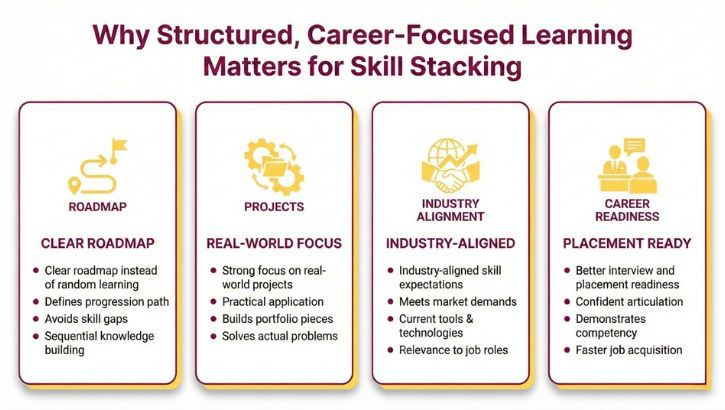
Skill stacking becomes powerful only when it’s done with clear direction and real-world context. Many students try to learn multiple skills through random courses or videos, but without structure, this often leads to confusion rather than career readiness. That’s where career-focused learning makes a real difference.
Here’s why structured learning is important for effective skill stacking:
● Prevents random and ineffective learning
○ Helps students understand what to learn first and what to add next
○ Ensures skills complement each other instead of overlapping or conflicting
○ Saves time and effort by focusing on industry-relevant skills
● Connects skills to real job roles
○ Skill stacking works best when aligned with actual job requirements
○ Structured programs map skills to roles like performance marketer, growth marketer, or digital strategist
○ Students gain clarity on how each skill adds career value
● Offers mentorship and guided practice
○ Mentors help students apply multiple skills in real scenarios
○ Feedback improves both technical and strategic thinking
○ Students learn how to combine skills confidently in projects and interviews
● Builds job-ready portfolios, not just certificates
○ Practical projects demonstrate how skills work together
○ Portfolios reflect problem-solving and impact, not just tool knowledge
In 2026, success won’t come from isolated skills - it will come from well structured skill stacks built with purpose and guidance.
Final Thoughts
In 2026, knowing digital marketing alone is no longer enough to stand out. As the industry evolves, employers are looking for professionals who can combine marketing with analytics, AI tools, strategy, and business thinking. This is exactly where skill stacking makes the difference. By building complementary skills instead of relying on a single capability, marketers can unlock better roles, faster career growth, stronger job security, and higher salaries.
Skill stacking is not about doing more it’s about doing the right combination of skills that multiply your value. For students and early professionals, starting this journey now means staying relevant, adaptable, and future-ready in an increasingly competitive market.
Build a Future-Ready Career with WHY TAP
At WHY TAP, we help students and professionals move beyond basic digital marketing by building career-focused skill stacks. Through expert mentorship, hands-on projects, and industry-aligned learning, you gain practical exposure to digital marketing, analytics, AI tools, and strategic thinking - all in one structured path.
Explore our PG Certification in AI-Powered Digital Marketing and start building the skills that employers will value in 2026 and beyond.