


Table of Contents
- 1.
- 2.
- 2.1
- 2.2
- 2.3
- 3.
- 3.1
- 3.2
- 3.3
- 3.4
- 3.5
- 3.6
- 4.
- 4.1
- 4.2
- 4.3
- 5.
- 5.1
- 5.2
- 5.3
- 5.4
- 5.5
- 6.
- 6.1
- 6.2
- 6.3
- 6.4
- 6.5
- 7.
- 7.1
- 7.2
- 7.3
- 7.4
- 8.
- 8.1
- 8.2
- 8.3
- 8.4
- 8.5
- 8.6
- 9.
Introduction
In India, the transition from campus to corporate remains one of the biggest career challenges for fresh graduates. Every year, millions earn degrees but employability tells a different story. As per the India Skill Report 2024 of Wheebox, the overall young employability in India was 51.25 percent in 2024, as compared to 40.44 percent in 2017. As per the latest estimates of Periodic Labour Force Survey (PLFS), conducted by the National Sample Survey Office, the unemployment rate on usual status for person of age 15-59 years in rural areas has decreased from 5.7 percent in 2017-18 to 2.8 percent in 2023-24.
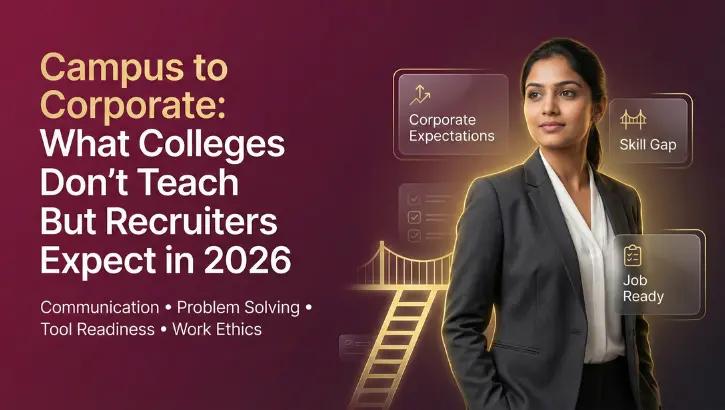
Recruiters today expect graduates to communicate clearly, solve real problems, work with tools, and adapt quicklyskills rarely taught in classrooms. This growing gap leaves many students confused, underprepared, and rejected despite good academic scores.
This blog on campus to corporate skills India breaks down what colleges don’t teach but recruiters expect in 2026. You’ll learn the exact skills companies look for, why they matter, and how to start building them before you enter the corporate world so you don’t struggle after graduation.
Why the Campus to Corporate Gap Still Exists in India
The campus to corporate gap in India hasn’t disappeared it has widened. Colleges produce graduates with degrees, but companies need professionals who can perform from day one. The mismatch starts with how students learn and how workplaces operate.
What colleges still focus on
Most Indian colleges still follow a theory-first approach.
- Heavy emphasis on exams and memorization
- Outdated syllabi that change slowly
- Limited exposure to real tools used in companies
- Marks-based evaluation instead of skill-based assessment
👉 Example: A student may score high in marketing theory but struggle to write a professional email or analyze campaign data.
What companies actually expect
Workplaces operate very differently.
- Problem-solving, not textbook answers
- Tool usage from day one (Excel, CRM, design tools, analytics)
- Clear communication across teams
- Ownership of tasks, not constant supervision
👉 Example: A fresher joining a sales team must analyze leads, coordinate with marketing, and report numbers not revise definitions.
Why the gap continues
Several structural issues keep this gap alive.
- Curriculum updates lag behind industry changes
- Faculty often lack current corporate exposure
- Limited industry-academia collaboration
- Students focus on degrees, not outcomes
The result
Graduates enter jobs feeling overwhelmed. Employers spend months retraining freshers or avoid hiring them altogether.
Until education aligns with industry needs, the campus to corporate skills gap in India will remain. The solution lies in students proactively building real-world skills before they step into corporate life.
Core Campus to Corporate Skills Recruiters Expect in 2026
In 2026, recruiters don’t expect freshers to know everything but they do expect them to be work-ready. According to a McKinsey Global Survey, companies report that skill gaps remain one of the biggest barriers to productivity, especially among entry-level hires. The issue isn’t intelligence it’s missing practical skills.
Here are the core campus to corporate skills recruiters actively look for today.
1. Communication Skills (Not Just English)
Recruiters value clarity over fluency.
- Writing professional emails
- Explaining ideas in meetings
- Asking the right questions
👉 Example: A fresher who clearly explains project delays earns more trust than one who stays silent.
2. Problem-Solving & Critical Thinking
Companies want thinkers, not instruction-followers.
- Breaking down problems
- Suggesting solutions
- Taking ownership
👉 Example: Instead of saying “the data is wrong,” a skilled fresher investigates why it looks wrong.
3. Tool & Digital Readiness
Most roles now require tools from day one.
- Excel / Google Sheets
- Power BI / Tableau / Figma / CRM
- Basic data literacy for all roles
4. Professional Behaviour & Work Ethics
Simple habits make a big difference.
- Time management
- Accepting feedback
- Meeting deadlines
Skill Expectations: Campus vs Corporate
| In College | In Corporate | ||
|---|---|---|---|
| Theory knowledge | Exams & grades | Individual work | Fixed syllabus |
| Practical execution | Outcomes & impact | Team collaboration | Continuous learning |
Why these skills matter
A Harvard Business Review study shows that companies prioritize employees who can adapt, communicate, and solve problems often more than those with high academic scores.
In 2026, degrees open the door but core campus to corporate skills decide how far you go inside.
Technical vs Non-Technical Skills — What Matters More?
Freshers often ask one question before entering the corporate world: Should I focus more on technical skills or non-technical skills? In 2026, recruiters look for both, but they value them at different stages of hiring and growth.
A Deloitte Global Human Capital Trends report highlights that employers increasingly prioritise human skills like communication, adaptability, and problem-solving alongside technical ability especially for early-career roles.
How recruiters actually evaluate skills
- Technical skills get you shortlisted
These prove you can handle the job basics.- Coding, analytics, design, marketing tools
- Role-specific software and platforms
- Non-technical skills decide long-term success
These determine how well you work with people.- Communication
- Teamwork
- Time management
- Feedback handling
👉 Example: Two candidates know the same tools. The one who explains ideas clearly and meets deadlines grows faster.
Real-world comparison recruiters see
| Skill Type | What It Shows | Hiring Impact | |
|---|---|---|---|
| Technical Skills | Non-Technical Skills | Tools & Software | Communication |
| Ability to execute tasks | Ability to work in teams | Job readiness | Clarity & confidence |
| Interview shortlisting | Performance & promotions | Faster onboarding | Leadership potential |
Why balance matters
According to a World Bank employment study, employers often struggle more with freshers’ workplace behaviour and communication than with technical gaps because tools can be taught faster than mindset.
The winning approach in 2026
- Build strong technical foundations for your role
- Practice communication and professionalism daily
- Learn to explain your work, not just do it
In today’s workplace, technical skills open doors but non-technical skills decide how long those doors stay open.
Real Campus vs Corporate Expectations (India-Focused)
The biggest shock for most freshers in India isn’t the workload it’s the difference between college life and corporate reality. What works on campus often fails at work because expectations change completely.
How campus life prepares students
Colleges train students to succeed in structured environments.
- Clear syllabus and fixed timelines
- One “correct” answer for exams
- Individual performance matters most
- Limited accountability beyond marks
👉 Example: Submitting an assignment late might cost a few marks but rarely real consequences.
What corporate life actually demands
Workplaces run on outcomes, not instructions.
- Ambiguous problems with no single solution
- Deadlines that affect teams and clients
- Constant collaboration across departments
- Ownership of tasks from start to finish
👉 Example: Missing a deadline can delay a product launch or upset a client not just reduce a score.
Key expectation shifts freshers face
- From marks to measurable impact
- From following instructions to taking initiative
- From solo work to team accountability
- From semester-based learning to continuous upskilling
Campus vs Corporate: A clear comparison
- Campus rewards effort and attendance
- Corporate rewards results and reliability
- Campus allows mistakes without pressure
- Corporate expects learning without repeating errors
Why this gap matters
Many freshers feel overwhelmed in their first six months because no one prepares them for this shift. Managers don’t expect perfection but they expect professional behaviour, clear communication, and accountability.
Understanding these differences early helps students adapt faster. When you adjust your mindset from student to professional, the campus to corporate transition becomes smootherand far less stressful.
How to Build Credibility as a Fresher
As a fresher, you may not have years of experience but you can still build strong professional credibility. Recruiters don’t expect perfection. They look for signs that you can learn fast, take responsibility, and deliver work.
1. Show proof, not promises
Avoid claiming skills without evidence.
- Share live projects, case studies, or demos
- Explain what problem you solved and how
- Highlight tools you actually used
👉 Example: Instead of saying “good at Excel,” show a dashboard you built and explain the insights.
2. Build experience before your first job
You don’t need a full-time role to gain credibility.
- Internships
- Freelance or part-time projects
- College clubs or NGO work
- Self-initiated practice projects
👉 Example: Managing social media for a college event counts if you show reach, engagement, and learnings.
3. Communicate professionally
Credibility often comes from behaviour.
- Write clear emails
- Ask questions when unsure
- Update seniors on progress
👉 Example: A fresher who shares regular status updates earns more trust than one who stays silent.
4. Be honest and reliable
Recruiters value integrity.
- Admit what you don’t know
- Meet deadlines consistently
- Accept feedback positively
5. Create a visible professional presence
Make your work easy to verify.
- Maintain a clean portfolio
- Keep LinkedIn and project links updated
- Share learnings publicly when possible
Credibility builds through consistent actions, not job titles. When recruiters see effort, clarity, and accountability, they trust you even as a fresher.
Campus to Corporate Skills Checklist for Indian Freshers (2026)
Before stepping into your first corporate role, ask yourself one simple question: Am I work-ready or just degree-ready? This checklist helps Indian freshers evaluate and build the campus to corporate skills recruiters expect in 2026.
Must-have skills every fresher should check
- Clear communication
You should write professional emails, explain your work in meetings, and ask questions confidently.
👉 Example: Summarising project updates instead of sending long, unclear messages. - Problem-solving mindset
Recruiters value freshers who think before escalating issues.
👉 Example: Identifying why data looks incorrect before reporting an error. - Tool readiness
Every role demands tools from day one.- Excel or Google Sheets
- Role-specific software (Power BI, Figma, CRM, GitHub, etc.)
- Time & task management
Meeting deadlines builds trust faster than talent alone. - Professional behaviour
Handling feedback, taking ownership, and working in teams matter daily.
Campus vs Corporate readiness check
| Skill Area | Campus Comfort Zone | Corporate Expectation | |
|---|---|---|---|
| Learning | Communication | Accountability | Feedback |
| Exam-focused | Informal | Individual | Occasional |
| Continuous upskilling | Clear & professional | Team-driven | Regular & direct |
Optional but high-impact skills
- Presentation skills
- Basic data literacy
- Documentation habits
- Adaptability to change
How to use this checklist
- Rate yourself honestly on each skill
- Pick 2–3 weak areas
- Improve them through projects, internships, or practice
In 2026, recruiters don’t expect freshers to know everything. They expect readiness, responsibility, and willingness to learn. This checklist helps you reach that level before your first job.
How Freshers Can Build Campus to Corporate Skills (Step-by-Step)
You don’t need to wait for your first job to become corporate-ready. Freshers who start early adapt faster and stand out during interviews. This step-by-step approach helps you build campus to corporate skills in a practical way.
Step 1: Understand your target role
Clarity saves time.
- Identify the role you want
- List the skills and tools it requires
- Study real job descriptions
👉 Example: A business analyst role demands Excel, data interpretation, and clear reporting not just theory.
Step 2: Learn through doing, not watching
Passive learning won’t help.
- Take short, skill-focused courses
- Practice with real datasets or case studies
- Apply concepts immediately
👉 Example: After learning Excel formulas, analyse a real sales dataset instead of moving to the next video.
Step 3: Build proof through projects
Projects turn learning into credibility.
- Self-initiated projects
- College assignments with real outcomes
- Internship or freelance tasks
Step 4: Improve communication daily
Strong communication multiplies your skills.
- Write emails professionally
- Present your work clearly
- Explain decisions and results
Step 5: Get feedback and iterate
Feedback accelerates growth.
- Ask mentors or seniors for review
- Fix mistakes quickly
- Track improvement
Skill-building roadmap
| Step | Action | Outcome | |
|---|---|---|---|
| Role clarity | Practice | Projects | Feedback |
| Study job needs | Hands-on work | Real proof | Continuous improvement |
| Focused learning | Skill confidence | Recruiter trust | Faster growth |
Freshers who follow this process don’t struggle in corporate roles they grow into them confidently.
- Data roles demand more than basics in 2026. If you want to strengthen your campus to corporate transition with real projects and AI tools, this WHY TAP Data Science program shows how to apply skills in real-world scenarios.
- Recruiters look for freshers who can analyse, interpret, and communicate data insights. This WHY TAP certification focuses exactly on those corporate-ready skills.
Conclusion: Turning Campus Knowledge into Corporate Readiness
The move from campus to corporate in India no longer depends on degrees alone it depends on skills, mindset, and readiness. Recruiters in 2026 expect freshers to communicate clearly, work with tools, solve real problems, and take ownership from day one. Colleges may provide the foundation, but students who actively build campus to corporate skills gain a clear advantage in interviews and on the job.
The good news is that these skills are learnable. Through hands-on projects, real-world practice, feedback, and continuous upskilling, freshers can bridge the gap long before their first job offer. Those who prepare early adapt faster, perform better, and grow with confidence in corporate environments.