


Table of Contents
- 1.
- 2.
- 2.1
- 2.2
- 3.
- 3.1
- 3.2
- 3.3
- 3.4
- 4.
- 4.1
- 4.2
- 4.3
- 4.4
- 5.
- 5.1
- 5.2
- 5.3
- 5.4
- 6.
- 6.1
- 6.2
- 6.3
- 6.4
- 6.5
- 7.
- 7.1
- 7.2
- 7.3
- 7.4
- 7.5
- 8.
- 8.1
- 8.2
- 8.3
- 8.4
- 9.
- 9.1
- 9.2
- 9.3
- 10.
- 10.1
- 10.2
- 10.3
- 10.4
- 11.
Introduction
An interview is a structured conversation where employers evaluate a candidate’s skills, experience, communication ability, and cultural fit. Success depends on preparation, research, structured answering methods like STAR, strong non-verbal communication, and strategic follow-up. Mastering these elements significantly improves hiring outcomes.
- An interview decide careers yet 93% of communication effectiveness is non-verbal, meaning body language and tone can make or break your impression (Source: UCLA research by Albert Mehrabian).
- Employers often form a first impression within 7 seconds of meeting a candidate (Forbes).
- A poor hire costs companies up to 30% of the employee’s first-year earnings (U.S. Department of Labor), which makes interview performance critical for both sides.
- Most candidates prepare resumes but not structured answers.
Understanding the Interview Process
An interview is a structured conversation where one person asks questions and another responds to share information, skills, or opinions. Most people think of job interviews first, but it happens in many areas of life.
At its core, an interview helps someone evaluate:
- Skills and qualifications
- Experience and achievements
- Communication style
- Problem-solving ability
- Personality and cultural fit
Where Does the Hiring Process Take Place?
You’ll see hiring process in different settings:
- Job interview → A recruiter asks about your experience before offering a role.
- College admission interview → Universities assess student motivation and readiness.
- Media interview → A journalist interviews a public figure for insights.
- Research interview → A researcher gathers data for a study.
- Podcast interview → A host invites experts to share knowledge.
Example
Imagine two candidates applying for a marketing role:
- Candidate A lists skills on a resume.
- Candidate B explains how they increased engagement by 40% using a campaign strategy.
The interview allows the employer to see real thinking, clarity, and confidence, not just claims on paper.
Why the Interview Process Matters
- They reveal how you think under pressure.
- They show how clearly you communicate.
- They help both sides decide if the opportunity fits.
Types of Hiring Rounds
Not all interviews look the same. Companies, universities, and media platforms use different formats depending on their goal. When you understand the type, you can prepare smarter.
Here are the most common types:
1. Recruitment rounds
Employers use these to evaluate candidates for roles.
- Screening Interview → A 15–30 minute call to check basic qualifications.
- Technical Interview → You solve job-related problems (e.g., a coder writes live code).
- HR Interview → You discuss culture fit, salary, and long-term goals.
- Panel Interview → Multiple interviewers ask questions at the same time.
- Group Interview → Several candidates participate together (common in sales or retail hiring).
Example: A software company may conduct a phone screening first, then a technical round, and finally an HR discussion.
2. Digital recruitment process
Companies now rely heavily on digital platforms.
- Live Video Interview (Zoom, Google Meet)
- Recorded Interview → You answer pre-set questions on camera.
- AI-Assessed Interview → Software analyzes your responses and behavior patterns.
3. Performance-focused discussions
Interviewers ask about past experiences.
- “Tell me about a time you handled conflict.”
- “Describe a challenging project.”
4. Professional guidance sessions
Professionals meet for networking and career guidance, not hiring.
Each type tests different skills. When you identify the format early, you tailor your preparation and gain a strong advantage.
How to Prepare for an Interview
Preparation separates average candidates from confident performers. According to Career Builder research shows that 47% of candidates fail interviews because they lack knowledge about the company. You can avoid that mistake with structured preparation.
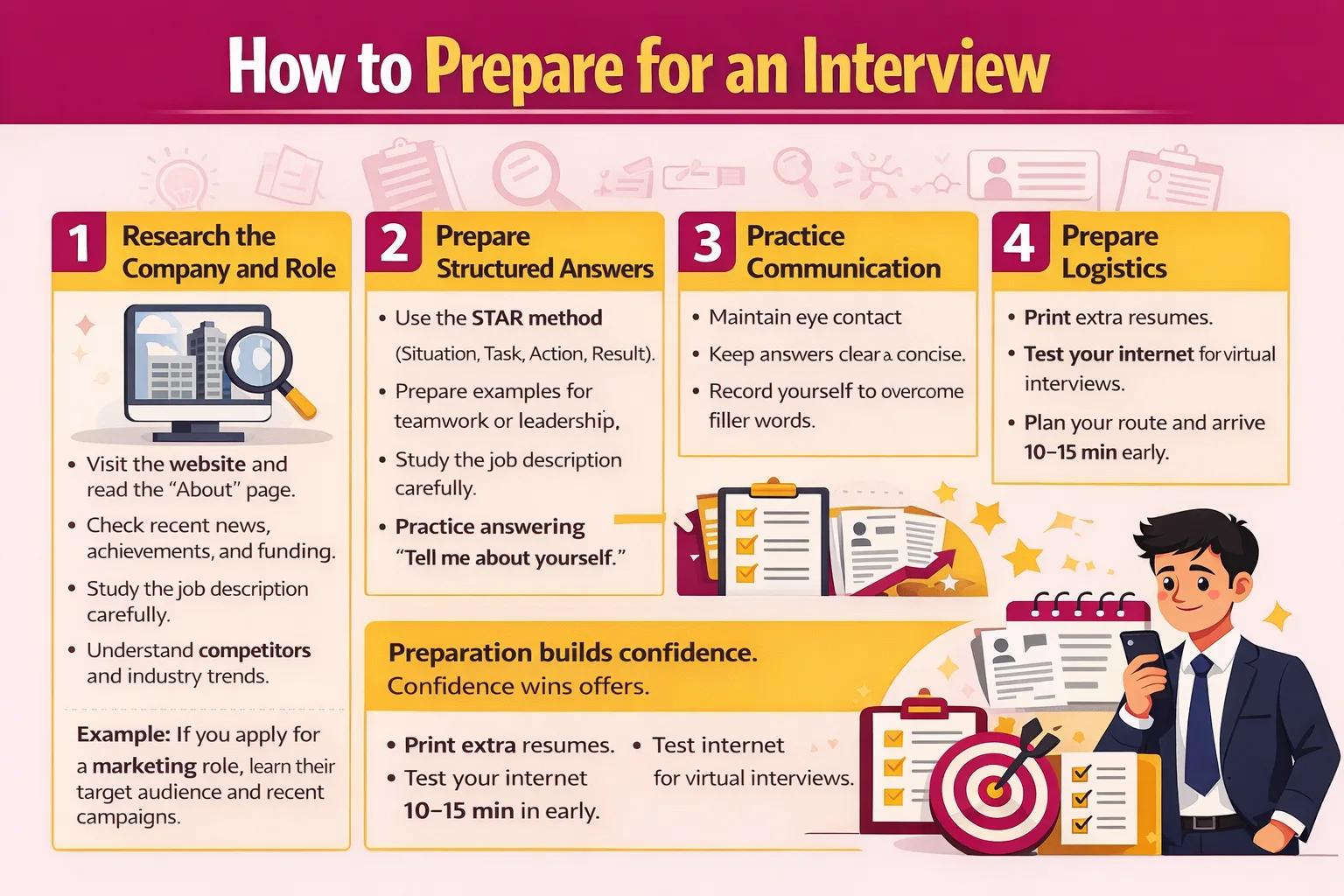
Start with these steps:
1. Research the Company and Role
Don’t walk in blind.
- Visit the company website and read the “About” page.
- Check recent news, achievements, or funding updates.
- Study the job description line by line.
- Understand competitors and industry trends.
Example: If you apply for a marketing role, learn their target audience and recent campaigns.
2. Prepare Structured Answers
Random answers create confusion. Structure creates clarity.
- Use the STAR method (Situation, Task, Action, Result).
- Prepare examples for teamwork, leadership, and problem-solving.
- Practice a strong answer to “Tell me about yourself.”
Example: Instead of saying “I improved sales,” say “I increased monthly sales by 25% in three months by launching targeted email campaigns.”
3. Practice Communication
Studies show that communication skills rank among the top qualities employers look for (LinkedIn Global Talent Trends).
- Maintain eye contact.
- Keep answers clear and concise.
- Record yourself to identify filler words.
4. Prepare Logistics
- Print extra resumes.
- Test your internet for virtual interviews.
- Plan your route and arrive 10–15 minutes early.
Preparation builds confidence. Confidence improves performance. Performance wins offers.
Struggling with interviews despite having the right skills?
Why Tap helps you prepare with structured mock interviews, real feedback, and practical frameworks that improve results.
Start preparing smarter at https://whytap.in/
Common Interview Questions and How to Answer Them
Recruiters don’t ask random questions. They look for patterns like confidence, clarity, and proof of results. If you prepare structured answers, you stay in control.
Here are common questions and how you should approach them:
1. Tell me about yourself.
Focus on professional highlights, not your life story.
- Start with your current role
- Mention 1–2 key achievements
- Connect your experience to the job
Example:
“I’m a digital marketer with 3 years of experience. I increased lead generation by 40% through performance campaigns, and now I want to apply data-driven strategies in a growth-focused company like yours.”
2. What are your strengths and weaknesses?
Stay honest but strategic.
- Strength → Back it with proof
- Weakness → Show improvement
Example strength: “I improved team productivity by creating SOPs.”
Example weakness: “I used to struggle with delegation, so I now use project tools to track tasks.”
3. Behavioral Questions (Use STAR Method)
| Interview Question | Structure Formula | Example |
|---|---|---|
| “Tell me about a challenge.” | “Describe a conflict.” | |
| Situation → Task → Action → Result | Explain issue → Your solution → Outcome | |
| Increased retention by 20% after resolving onboarding gaps | Mediated team dispute and met deadline |
4. Why should we hire you?
- Match your skills to job needs
- Mention measurable impact
- Show enthusiasm
Strong answers show results, not opinions. Numbers build trust. Structure builds clarity.
Interview Tips for Success
You don’t win interviews by luck. You win them with strategy, clarity, and control. Small improvements create a big difference.
Here’s how you increase your success rate:
1. Arrive Prepared and Early
Punctuality signals professionalism.
- Reach 10–15 minutes early.
- For virtual interviews, log in 5 minutes before time.
- Keep documents ready (resume, portfolio, notebook).
Example: If your interview starts at 10:00 AM, join the call at 9:55 AM and test your audio.
2. Control Your Body Language
Communication goes beyond words.
- Maintain steady eye contact.
- Sit upright.
- Avoid crossing arms.
- Keep natural hand movements.
Example: When answering a question, pause briefly instead of rushing. Calm delivery shows confidence.
3. Listen Before You Answer
Many candidates interrupt or guess the question.
- Let the interviewer finish.
- Clarify if needed.
- Structure your response.
Example: “If I understand correctly, you’re asking about how I handled tight deadlines. Let me share an example.”
4. Ask Smart Questions
Strong candidates ask thoughtful questions.
- “What does success look like in this role after 6 months?”
- “What challenges does the team currently face?”
5. Send a Follow-Up
Within 24 hours:
- Thank them for their time.
- Reaffirm interest.
- Mention one key discussion point.
Confidence + preparation + professionalism = interview success.
Interview Mistakes to Avoid
One small mistake can destroy an otherwise strong interview. Most candidates don’t fail because they lack skills, they fail because they ignore basics. Avoid these common errors.
1. Walking in Unprepared
Lack of research shows instantly.
- You don’t know the company’s services.
- You can’t explain why you want the role.
- You give generic answers.
Example: If the interviewer asks, “What do you know about us?” and you reply, “I saw your website briefly,” you lose credibility.
2. Speaking Negatively About Past Employers
Complaining raises red flags.
- Don’t criticize your boss.
- Don’t blame teammates.
- Don’t share workplace drama.
Example: Instead of saying, “My manager was terrible,” say, “I’m looking for a role with clearer growth opportunities.”
3. Talking Too Much or Too Little
Balance matters.
- Long, unfocused answers confuse interviewers.
- One-word answers show low engagement.
Use structured responses. Stay concise. Stay relevant.
4. Ignoring Body Language
Slouching, avoiding eye contact, or checking your phone sends the wrong message.
- Sit upright.
- Keep your phone silent.
- Maintain attentive posture.
5. Forgetting to Ask Questions
When you say, “No, I don’t have any questions,” you miss an opportunity to stand out.
Strong interviews require preparation, awareness, and discipline. Avoid these mistakes, and you instantly move ahead of average candidates.
How Employers Conduct Effective Interviews
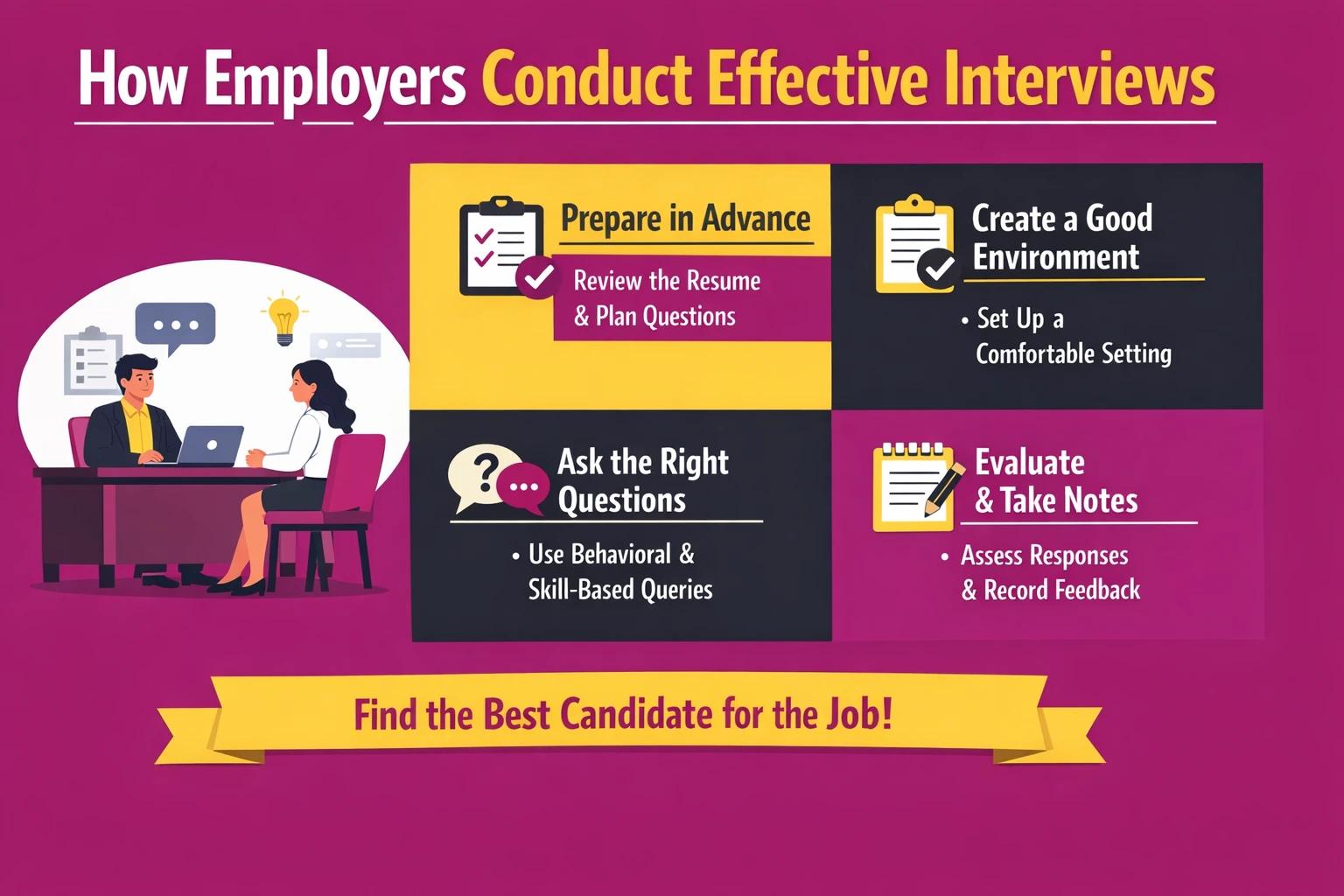
Smart employers don’t rely on gut feeling. They use structured methods to reduce hiring mistakes. A bad hire can cost up to 30% of the employee’s first-year salary (U.S. Department of Labor). That’s why companies design interviews carefully.
Here’s how effective employers run strong interviews:
1. Use Structured Questions
Structured interviews improve hiring accuracy.
- Prepare predefined questions for every candidate.
- Score answers using clear criteria.
- Compare candidates objectively.
Research from Harvard Business Review shows structured interviews predict job performance better than unstructured ones.
Example: Instead of casual chatting, an employer asks every candidate:
“Describe a time you handled a tight deadline. What was the result?”
2. Focus on Skills and Results
Strong interviewers look for evidence not opinions.
- Ask for measurable achievements.
- Request real examples.
- Test problem-solving ability.
Example: A sales candidate may complete a short mock pitch during the interview.
3. Reduce Bias
Effective employers protect fairness.
- Use diverse interview panels.
- Standardize evaluation forms.
- Avoid personal or irrelevant questions.
4. Assess Soft Skills
LinkedIn reports that 92% of talent professionals say soft skills matter as much as hard skills.
Interviewers evaluate:
- Communication clarity
- Emotional intelligence
- Team collaboration
Effective interviews feel structured, focused, and fair, not random conversations.
Online Interviews vs In-Person Interviews
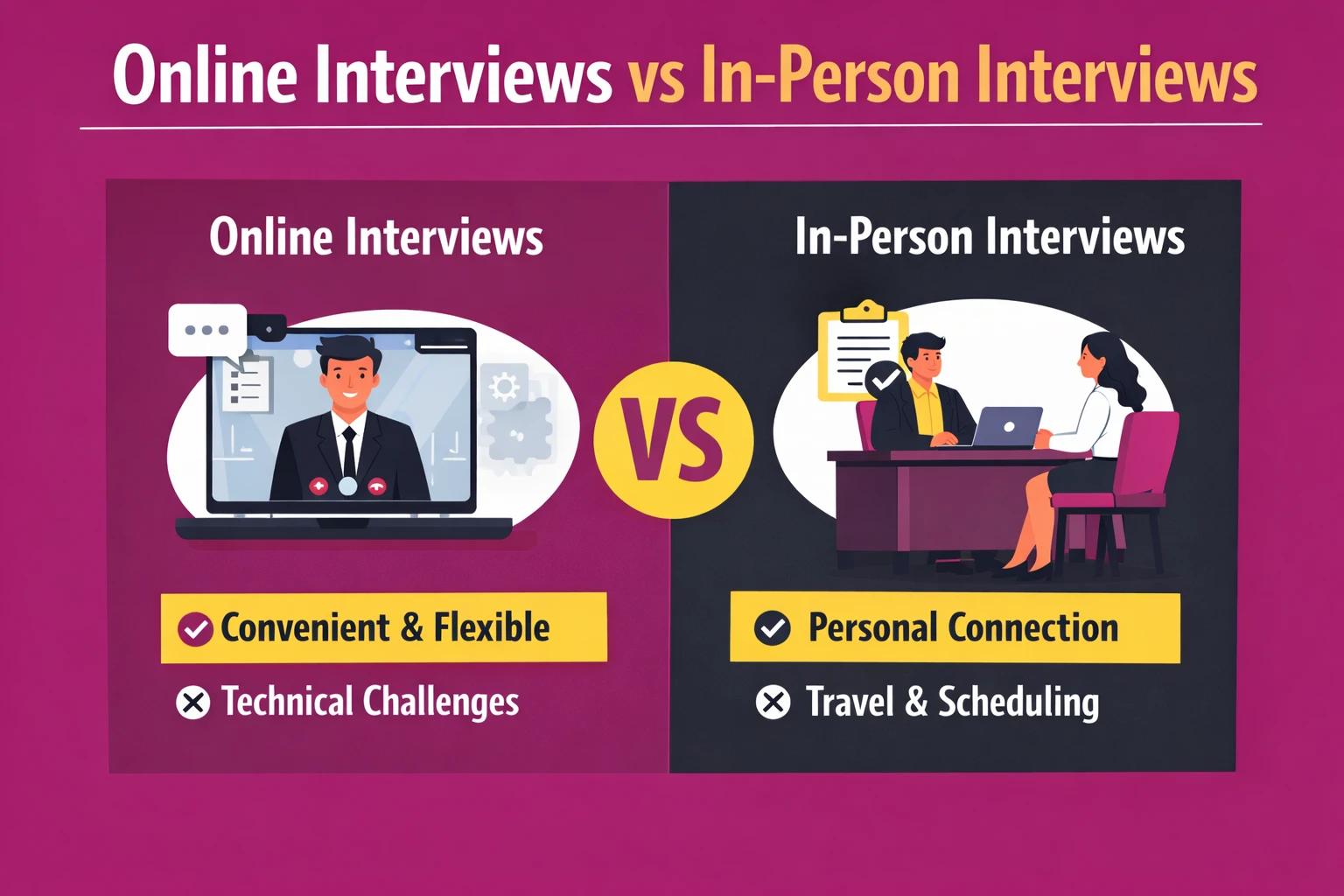
Hiring has changed rapidly. After 2020, companies increased virtual hiring significantly, and remote interviews became standard practice. According to a Gartner survey, 86% of organizations now use virtual interviews as part of their hiring process. You must prepare differently for each format.
Here’s how they compare:
Key Differences
| Factor | Online Interview | In-Person Interview | ||
|---|---|---|---|---|
| Setup | Body Language | Environment | Technical Risk | Personal Connection |
| Requires stable internet, camera, microphone | Limited visibility (mostly upper body) | You control background and lighting | Internet or audio issues can interrupt | Slightly harder to build rapport |
| Requires physical presence and punctual arrival | Full body language matters | Company controls environment | Travel delays may occur | Easier to create strong connection |
When You Attend an Online Interview
- Test your internet and camera before time.
- Use a clean, distraction-free background.
- Look directly into the camera to simulate eye contact.
- Keep notes nearby but don’t read from them.
Example: Place your laptop at eye level instead of looking down.
When You Attend an In-Person Interview
- Arrive 10–15 minutes early.
- Observe office culture.
- Offer a confident handshake (if appropriate).
- Maintain professional posture throughout.
Both formats test the same core skills like clarity, confidence, and preparation. Adapt your strategy based on the setting, and you gain a competitive edge.
Mastering Interviews for Career Growth
Interviews don’t just help you land a job, they shape your long-term career growth. Every strong interview builds confidence, clarity, and professional credibility. When you treat interviews as a skill, you create consistent opportunities.
Top performers approach interviews strategically. They don’t “hope” for success, they prepare for it.
Here’s how mastering interviews accelerates your career:
1. You Build Clear Communication Skills
Strong communication drives leadership growth.
- You learn to present ideas clearly.
- You structure answers logically.
- You explain results using data.
Example: Instead of saying, “I worked on a project,” say, “I led a 4-member team and increased efficiency by 30% in two months.”
2. You Strengthen Personal Branding
Every interview reinforces your professional identity.
- Define your expertise clearly.
- Align your skills with market demand.
- Highlight measurable achievements.
Example: If you position yourself as a “performance-driven marketer,” back it with numbers.
3. You Increase Confidence Under Pressure
Interviews test composure.
- You handle unexpected questions calmly.
- You think critically in real time.
- You communicate solutions confidently.
4. You Unlock Better Opportunities
Better interview performance leads to:
- Higher salary negotiations
- Faster promotions
- Access to competitive roles
Master interviews once benefit for years. Career growth follows clarity, preparation, and disciplined practice.
Your resume gets you shortlisted. Your interview performance gets you hired.
Why Tap gives you practical mock interviews, personalized feedback, and communication coaching so you walk in prepared not nervous.
Turn interviews into job offers.
Explore Why Tap at https://whytap.in/
Conclusion: Turn Interviews into Career Opportunities
Interviews decide more than job offers, they shape your professional trajectory. When you understand interview types, prepare structured answers, avoid common mistakes, and practice strategic communication, you shift from “hoping” to “performing.”
Most candidates rely on luck. Top candidates rely on preparation.
Remember:
- Research builds relevance.
- Structure builds clarity.
- Numbers build credibility.
- Practice builds confidence.
Interviews reward candidates who communicate value clearly and confidently. When you master this skill, you don’t just pass interviews, you control career growth, salary negotiations, and leadership opportunities.
If you want to stop guessing and start performing with confidence, structured mock practice and expert feedback can dramatically improve your results.