





Table of Contents
- 1.
- 2.
- 3.
- 3.1
- 3.2
- 3.3
- 3.4
- 3.5
- 3.6
- 3.7
- 4.
- 4.1
- 5.
- 5.1
- 5.2
- 5.3
- 5.4
- 5.5
- 6.
- 6.1
- 6.2
- 6.3
- 6.4
- 6.5
- 7.
- 7.1
- 7.2
- 7.3
- 8.
- 8.1
- 8.2
- 8.3
- 8.4
- 9.
- 9.1
- 9.2
- 10.
- 10.1
- 10.2
- 10.3
- 10.4
- 11.
- 12.
- 12.1
- 12.2
- 12.3
- 13.
- 14.
- 14.1
- 14.2
- 14.3
- 15.
- 15.1
- 15.2
- 16.
- 17.
- 18.
- 18.1
- 18.2
- 18.3
- 19.
Introduction
Breaking into data analytics in today’s competitive job market is no longer just about completing courses or earning certificates. Recruiters and hiring managers want to see proof of real-world analytical thinking, and that proof comes in the form of a strong portfolio. This data analytics portfolio guide is designed to help aspiring analysts, students, and career switchers build portfolios that demonstrate job readiness, not just technical knowledge.
Across industries, companies are shifting toward skill-based hiring. According to LinkedIn’s Global Talent Trends, practical skills and project experience now outweigh formal qualifications for many entry-level and junior analytics roles. This means your ability to work with data, extract insights, and communicate findings clearly matters more than ever.
A well-structured portfolio bridges the gap between learning and employment. It shows how you approach business problems, clean and analyze data, and translate numbers into decisions. In this guide, you will learn how to create impactful case studies, design professional dashboards, and structure a GitHub portfolio that recruiters in India and beyond respect.
Why a Data Analytics Portfolio Matters More Than Ever
Data analytics roles are expanding rapidly across sectors such as finance, e-commerce, healthcare, SaaS, and consulting. However, competition for entry-level roles has also increased. Employers now expect candidates to demonstrate practical capability, not just theoretical understanding.
A portfolio serves as evidence of:
- Your problem-solving approach
- Your ability to handle real-world, imperfect data
- Your communication and storytelling skills
Unlike resumes, portfolios allow recruiters to evaluate how you think. This is why a well-built portfolio often compensates for a lack of formal work experience.
What Makes a Job-Winning Data Analytics Portfolio
A successful portfolio is not defined by the number of tools used. It is defined by the quality of analytical decisions showcased.
Clear Problem Framing
Each project should begin with a clearly defined business problem. Recruiters want to know what question you are trying to answer and why it matters.
Structured Analytical Thinking
Your portfolio should reflect a logical flow:
- Understanding the problem
- Preparing and cleaning data
- Performing analysis
- Interpreting results
Business-Focused Insights
Insights should always connect back to business impact. Numbers alone are not enough; interpretation is critical.
How Recruiters Evaluate a Data Analytics Portfolio in the First 5 Minutes
Recruiters rarely study a portfolio line by line in the first round. Instead, they follow a quick mental checklist to decide whether a candidate is worth shortlisting. Understanding this evaluation process helps you design your portfolio more strategically.
Initial Scan: Clarity Over Complexity
In the first few minutes, recruiters look for:
- Clear project titles
- Easy navigation
- Short explanations of what each project solves
If a recruiter struggles to understand what a project is about, they often move on. This is why clarity matters more than advanced techniques in early screening.
Business Context Recognition
Recruiters quickly assess whether a project is framed around a business problem or just technical execution. Projects that start with a real-world question immediately stand out.
For example, a project titled “Sales Performance Analysis for a Retail Business” communicates intent far better than “Sales Dataset Analysis Using Python.”
Signal of Real-World Readiness
Recruiters also look for signals such as:
- Handling missing or messy data
- Explaining assumptions
- Drawing conclusions beyond charts
These signals indicate that the candidate understands how analytics works outside classrooms and tutorials.
How Many Projects Should You Include
Most recruiters prefer 3 to 5 high-quality projects rather than a large number of shallow ones. Each project should demonstrate a different type of analytical skill.
Recommended Project Mix
- Descriptive analysis (what happened)
- Diagnostic analysis (why it happened)
- Trend or performance analysis
- Dashboard-based storytelling
- Optional domain-specific analysis
This balance helps present a well-rounded skill set.
Choosing the Right Case Study Ideas
The datasets you choose are less important than how you frame the problem. Many candidates rely on overused datasets, which reduces differentiation.
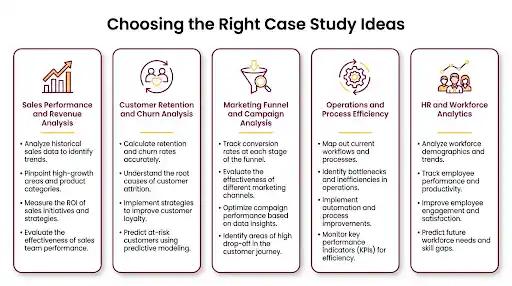
Sales Performance and Revenue Analysis
Focus on:
- Product-wise performance
- Regional trends
- Profitability and discount impact
This type of analysis mirrors real sales analytics use cases.
Customer Retention and Churn Analysis
Explore:
- Customer behavior patterns
- Segmentation logic
- Retention strategy recommendations
These projects are highly relevant across industries.
Marketing Funnel and Campaign Analysis
Analyze:
- Lead-to-conversion rates
- Channel effectiveness
- Cost versus return on investment
Marketing analytics remains a core business function.
Operations and Process Efficiency
Evaluate:
- Delivery timelines
- Inventory mismatches
- Process bottlenecks
Operational insights are valuable in logistics and manufacturing roles.
HR and Workforce Analytics
Assess:
- Attrition trends
- Tenure and performance relationships
- Hiring funnel efficiency
This reflects growing use of analytics in human resources.
How to Structure Each Case Study
A consistent structure improves readability and credibility.
Problem Statement
Explain the business challenge in simple terms and clarify the objective of the analysis.
Dataset Overview
Include:
- Data source
- Time period covered
- Key variables
Mention any limitations or data quality issues to demonstrate realism.
Data Cleaning and Preparation
Describe:
- Handling of missing values
- Treatment of outliers
- Data transformations
Explain the reasoning behind your decisions.
Analysis and Insights
Use charts, tables, and summaries, but always interpret what the findings mean for decision-making.
Recommendations
Conclude with practical suggestions based on your analysis. This step shows maturity and business understanding.
How to Show Experience Even If You Are a Fresher
One of the biggest misconceptions among beginners is that portfolios only matter after gaining experience. In reality, portfolios are how freshers simulate professional experience.
Use Business-Like Language
Instead of writing like a student, write like an analyst:
- Say “stakeholders” instead of “users”
- Say “recommendations” instead of “results”
- Say “business impact” instead of “output”
This subtle language shift signals maturity.
Document Decision-Making
Even small decisions matter. Mention:
- Why a certain KPI was chosen
- Why a particular chart type was used
- Why data was grouped or filtered
Decision explanations show experience, even if the project is academic.
Simulate Real Scenarios
You can add context like:
- “Assume this dashboard is presented to a regional sales manager”
- “Insights are intended for marketing leadership”
This positions your work within a professional environment.
Dashboard Projects for Students
Dashboards are often the first thing recruiters notice. Well-designed dashboards communicate insights quickly and effectively.
Focus on One Objective
Each dashboard should support a single decision or business question. Avoid overcrowding with unrelated visuals.
Prioritise Key Metrics
Place important KPIs at the top. Supporting details should come later.
Maintain Clean Design
Use consistent colors, readable labels, and logical layouts. Simplicity enhances clarity.
Add Contextual Explanations
Brief annotations or tooltips explaining trends add significant value and credibility.
GitHub Portfolio India: How to Structure It Professionally
Many candidates maintain GitHub profiles, but only a few use them strategically.
Recommended Repository Structure
Organise projects clearly with separate folders for each case study. Include datasets, analysis files, and documentation.
Importance of README Files
Each project README should cover:
- Business objective
- Dataset description
- Tools used
- Key insights
- Recommendations
Clear documentation improves trust and accessibility.
How to Present Your Data Analytics Portfolio on LinkedIn and Resumes
A well-built portfolio creates value only when recruiters can easily find and understand it. Beyond GitHub, how you present your work on LinkedIn and your resume plays a critical role in driving profile views, interview calls, and recruiter engagement.
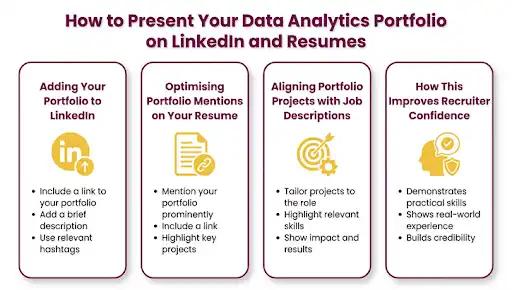
Adding Your Portfolio to LinkedIn
LinkedIn is often the first place recruiters look after receiving an application. Your portfolio should be clearly visible and contextualised.
Best practices include:
- Adding your GitHub link in the Featured section
- Linking individual projects in the Experience or Projects section
- Writing short descriptions that explain the business problem each project solves
Instead of listing tools, focus on outcomes. For example, describe how a project improved decision-making, identified trends, or revealed operational gaps.
Optimizing Portfolio Mentions on Your Resume
Your resume should not list every project. Instead, highlight 2–3 strongest case studies that align with the role you are applying for.
When mentioning projects:
- Use action-oriented language
- Highlight insights, not just analysis
- Quantify results wherever possible
For instance, mentioning that a project identified underperforming products or reduced analysis time carries more weight than simply stating the tools used.
Aligning Portfolio Projects with Job Descriptions
Before applying, review the job description carefully. Match your portfolio projects to the skills and responsibilities mentioned.
If a role emphasises dashboards, prioritise dashboard-heavy projects. If it focuses on SQL or business reporting, ensure those projects are easy to access and clearly explained.
How This Improves Recruiter Confidence
When your LinkedIn profile, resume, and GitHub portfolio tell the same story, recruiters perceive consistency and professionalism. This alignment reduces uncertainty and increases confidence in your readiness for the role.
A portfolio that is easy to find, easy to understand, and clearly connected to business outcomes significantly improves your chances of moving forward in the hiring process.
Common Portfolio Mistakes to Avoid
- Tool-focused projects without explanation
- Copy-pasted notebooks
- Overloaded dashboards
- Missing or broken GitHub links
- Lack of business interpretation
Avoiding these mistakes significantly improves credibility.
Aligning Your Portfolio with Job Roles
Data Analyst Roles
Emphasise SQL, Excel, dashboards, and insight communication.
Business Analyst Roles
Focus on problem framing, KPIs, and recommendations.
Students and Freshers
Show structured thinking, learning progression, and clarity.
Keeping Your Portfolio Updated
Treat your portfolio as a living asset. Update it when:
- You learn a new tool
- You improve analysis depth
- You explore a new domain
Continuous improvement signals professionalism.
Advanced Case Study Enhancements That Add Credibility
You do not need advanced machine learning to impress recruiters. Instead, focus on depth and reasoning.
Scenario-Based Insights
Add “what-if” thinking:
- What happens if prices increase by 5%?
- What if churn reduces by 2%?
Scenario-based insights show strategic thinking.
Limitations and Assumptions Section
Every strong analysis acknowledges its limits. Briefly mention:
- Data constraints
- Sample size limitations
- Assumptions made
This improves trust and analytical honesty.
Next Steps for the Business
Even if you cannot execute them, suggesting next analytical steps adds professionalism:
- Collect additional data
- Track new KPIs
- Run experiments
How to Use Your Portfolio During Interviews
Your portfolio is not just for applications - it is a live interview tool.
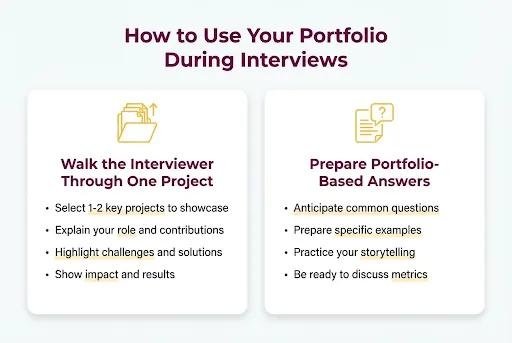
Walk the Interviewer Through One Project
Instead of listing all projects, choose one strong case study and explain:
- The problem
- Your approach
- The key insight
- The recommendation
This structured explanation leaves a strong impression.
Prepare Portfolio-Based Answers
Many interview questions can be answered using portfolio examples:
- “Tell me about a challenge you faced”
- “How do you handle messy data?”
- “How do you communicate insights?”
Answering with real portfolio examples builds credibility.
Common Portfolio Questions Recruiters Ask (And How Your Blog Prepares for Them)
Recruiters often ask:
- Why did you choose this metric?
- What would you do differently with more data?
- How would this insight impact business decisions?
Your portfolio should already answer these questions implicitly through explanations and recommendations.
How a Strong Portfolio Impacts Salary and Role Level
Candidates with strong portfolios often:
- Get shortlisted faster
- Skip basic screening rounds
- Qualify for higher entry-level pay bands
Recruiters associate clear portfolios with lower onboarding effort, which directly impacts compensation decisions.
Portfolio Maintenance: Long-Term Career Strategy
A portfolio should grow with your career.
Early Stage
Focus on clarity, fundamentals, and storytelling.
Mid-Level Transition
Add domain-specific projects and advanced analysis.
Role Switching
Use targeted case studies aligned with the new role.
This long-term approach turns your portfolio into a career asset, not a one-time requirement.
Conclusion
A strong portfolio is the most powerful asset for aspiring analysts. This data analytics portfolio guide highlights how to build portfolios that demonstrate real-world thinking, not just technical ability. By focusing on meaningful case studies, clear dashboards, and a well-structured GitHub presence, you position yourself as someone who can add value from day one.
In a competitive hiring environment, portfolios separate applicants from analysts. Build fewer projects, but build them better. When recruiters see your work and think “this person understands data and business”, your portfolio has done its job.