







Table of Contents
- 1.
- 2.
- 2.1
- 2.2
- 3.
- 3.1
- 3.2
- 3.3
- 4.
- 4.1
- 4.2
- 4.3
- 4.4
- 5.
- 5.1
- 5.2
- 5.3
- 5.4
- 6.
- 6.1
- 6.2
- 6.3
- 7.
- 7.1
- 7.2
- 7.3
- 7.4
- 8.
- 8.1
- 8.2
- 8.3
- 8.4
- 8.5
- 9.
- 9.1
- 9.2
- 10.
- 10.1
- 10.2
- 11.
- 11.1
- 12.
Introduction
In today’s data-driven economy, choosing between data engineering and data science can make or break your tech career-especially in a booming market like India. Demand for data science roles has soared, with over 84,000 jobs listed and a 60% growth in demand reported across Indian companies. Simultaneously, the data engineering landscape is expanding rapidly, with thousands of positions open due to critical needs in data infrastructure. While both fields work with data, their core functions differ: engineers build the pipelines and systems that fuel analytics, and scientists extract insights that inform business decisions.
With industry trends pointing toward massive growth through 2030, understanding the real differences between these roles-skills, salaries, and future job prospects-is no longer optional. This guide cuts through the confusion and helps you choose the right path for long-term success.
Understanding the Data Ecosystem - Where These Roles Fit
Before comparing data engineering vs data science, you need to understand how data actually moves inside a modern company. Most confusion happens because people see “data” as one job. In reality, it’s an ecosystem of roles, each solving a different problem.
Think of a company like an e-commerce app or a fintech platform. Every click, payment, search, and login generates raw data. That data is useless unless it’s collected, cleaned, stored, and analyzed in the right order.
How Data Flows Inside a Company
- Data is generated
- Mobile apps, websites, IoT devices, payment systems
- Data is processed and stored
- Cleaned, structured, and moved into databases or data lakes
- Data is analyzed
- Insights, predictions, dashboards, and business decisions
This is where data engineers and data scientists fit differently.
Role Placement in the Data Ecosystem
| Stage | Who Owns It | What Happens | ||
|---|---|---|---|---|
| Data collection | Data storage | Data preparation | Data analysis | Prediction & ML |
| Data Engineer | Data Engineer | Data Engineer | Data Scientist | Data Scientist |
| Builds pipelines from apps, logs, APIs | Designs warehouses, ensures reliability | Cleans, transforms, validates data | Finds patterns, trends, insights | Builds models for forecasting |
Simple Example
- A food delivery app tracks orders every second
- A data engineer ensures this data flows correctly into cloud systems
- A data scientist uses that data to predict peak hours or reduce delivery time
According to industry reports, over 80% of AI and analytics projects fail due to poor data infrastructure, not poor models. That’s why companies increasingly treat data engineering as the backbone and data science as the decision layer.
When you understand this ecosystem, choosing the right role becomes much clearer.
What Is Data Engineering? (Role, Responsibilities & Scope)
Data engineering focuses on building the backbone of data systems. If data science answers questions, data engineering makes sure the data is even usable in the first place. Every dashboard, AI model, or business insight depends on work done by data engineers.
In simple terms, data engineers design, build, and maintain systems that collect and move massive amounts of data reliably.
Core Responsibilities of a Data Engineer
A data engineer typically works on:
- Designing data pipelines that move data from apps to storage
- Cleaning and transforming raw, messy data into usable formats
- Managing data warehouses and data lakes
- Ensuring data accuracy, speed, and reliability
- Optimizing systems to handle growing data volumes
Industry reports consistently show that poor data quality and infrastructure cause most analytics failures, which is why companies invest heavily in data engineering teams.
Real-World Example
Imagine a fintech company processing millions of transactions daily:
- A data engineer builds pipelines that stream transaction data in real time
- They ensure zero data loss, even during traffic spikes
- Analysts and data scientists then trust this data for fraud detection and reporting
Scope & Career Outlook
With data volumes growing exponentially and AI adoption increasing, data engineering roles scale faster than data science roles. Companies need strong data foundations before they can extract insights.
If you enjoy backend systems, problem-solving, and building things that scale, data engineering offers strong job stability, high demand, and long-term growth-especially in data-heavy markets like India.
What Is Data Science? (Role, Responsibilities & Scope)
Data science focuses on turning data into insights, predictions, and decisions. While data engineers build the highways for data, data scientists drive on those highways to answer business questions. Companies rely on data science to improve revenue, reduce risk, and predict future outcomes.
In simple terms, data scientists analyze data, build models, and explain what the data means for the business.
Core Responsibilities of a Data Scientist
A data scientist typically works on:
- Exploring and analyzing structured and unstructured data
- Identifying patterns, trends, and anomalies
- Building machine learning and predictive models
- Communicating insights to business and leadership teams
- Testing and improving models using real-world data
According to industry reports, companies using data-driven decision-making improve productivity by over 5–6%, which explains the continued demand for skilled data scientists.
Tools & Technologies Used
| Category | Common Tools | |||
|---|---|---|---|---|
| Programming | Data Analysis | Machine Learning | Visualization | Statistics |
| Python, R, SQL | Pandas, NumPy | Scikit-learn, TensorFlow | Power BI, Tableau, Matplotlib | Probability, regression, hypothesis testing |
Real-World Example
Consider an e-commerce company:
- A data scientist analyzes customer browsing and purchase history
- They build a recommendation model to suggest products
- The business uses those insights to increase conversion rates and average order value
Scope & Career Outlook
Data science roles offer high impact and visibility, but they also demand strong fundamentals in statistics, problem-solving, and business thinking. The number of data science jobs continues to grow, yet competition remains high because many professionals enter this field without production-level skills.
If you enjoy analytics, experimentation, and storytelling with data, data science offers exciting opportunities-but success depends on depth, not just tools.
Data Engineering vs Data Science - Side-by-Side Comparison
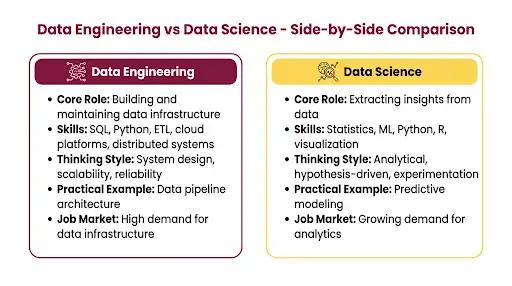
Choosing between data engineering vs data science becomes much easier when you compare what these roles actually do in the real world. Both work with data, but they solve very different problems and require different mindsets.
At a simple level: Data engineers build the data foundation. Data scientists build insights on top of it.
Core Role Differences
Data Engineering focuses on:
- Moving large volumes of data reliably
- Building pipelines from apps, APIs, and databases
- Cleaning, validating, and structuring raw data
- Ensuring systems scale as users and data grow
Data Science focuses on:
- Exploring data to find patterns and trends
- Applying statistics and machine learning
- Making predictions and recommendations
- Explaining insights to business teams
Skills & Thinking Style
Data Engineering suits people who:
- Enjoy coding and backend systems
- Like solving performance and reliability problems
- Prefer structured, engineering-driven work
Data Science suits people who:
- Enjoy math, logic, and experimentation
- Like asking “why” and “what happens next”
- Feel comfortable with open-ended problems
Practical Example
Take an e-commerce company:
- A data engineer ensures clickstream and order data flows into cloud systems without delay
- A data scientist uses that data to predict customer churn or recommend products
If the pipeline breaks, analysis stops. That’s why companies prioritize engineering first.
Job Market Reality
Hiring trends consistently show that data engineering roles grow faster than data science roles. Every AI, analytics, or BI initiative needs clean, reliable data before insights even become possible. Data science roles offer high impact but attract heavier competition.
In short:
- Choose data engineering for stability, scale, and long-term demand
- Choose data science for insight-driven influence-when strong data systems exist
Understanding this difference prevents costly career missteps.
Which Role Has More Jobs in India by 2030? (Market Reality)
If you look past the hype and focus on actual hiring patterns, the answer becomes clearer: data engineering will create more jobs in India by 2030 than data science. This doesn’t mean data science will disappear-but the volume and consistency of demand differ sharply.
What the Indian Job Market Shows
Indian companies now generate massive data volumes from apps, UPI payments, IoT devices, and AI systems. Before anyone can analyze that data, companies need strong foundations.
That’s why hiring trends show:
- More openings for data engineers than data scientists
- Faster growth in data engineering roles across IT services, GCCs, and startups
- Higher repeat hiring for engineers as systems scale
Industry estimates suggest 60–70% of data roles created in large organizations support data infrastructure, not analytics alone.
Why Data Engineering Is Growing Faster
Data engineering demand rises because:
- Every AI or ML project depends on clean, reliable data
- Cloud adoption creates constant pipeline and migration work
- Data volume grows faster than analytics teams
Companies don’t hire one data engineer once. They hire entire teams as platforms expand.
What About Data Science Jobs?
Data science roles remain valuable but limited in number:
- One data scientist often supports multiple teams
- Companies hire scientists only after data systems mature
- Competition stays high due to oversupply of entry-level candidates
Simple Example
In a fintech company:
- 10+ data engineers manage real-time transaction pipelines
- 2–3 data scientists build fraud and risk models
By 2030:
- Data engineering offers more jobs and stronger stability in India
- Data science offers fewer but high-impact roles
If your goal is job availability and long-term demand, data engineering clearly leads the market.
Career Path Comparison - Growth, Promotions & Future Roles
When choosing between data engineering vs data science, long-term career growth matters more than your first job title. Both roles offer strong futures, but the promotion paths and role evolution look very different in India’s tech ecosystem.
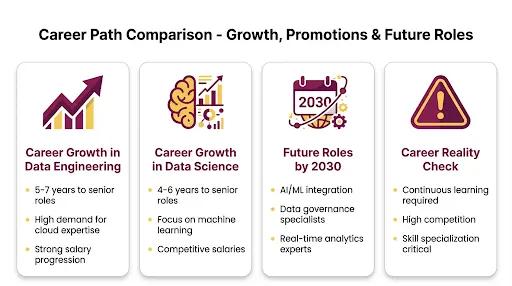
Career Growth in Data Engineering
Data engineering follows a clear, structured progression, similar to software engineering.
Typical growth path:
- Junior Data Engineer
- Data Engineer
- Senior Data Engineer
- Lead Data Engineer / Data Architect
- Platform Engineer / Head of Data Infrastructure
As companies scale, data platforms grow in complexity. That creates consistent promotion opportunities. Many Indian product companies and GCCs expand data engineering teams year after year because systems never stop evolving.
Career Growth in Data Science
Data science offers high-impact growth, but promotions depend heavily on business value.
Typical growth path:
- Data Analyst / Junior Data Scientist
- Data Scientist
- Senior Data Scientist
- Machine Learning Engineer
- AI Specialist / Applied Scientist
Progression often slows if models fail to move into production. That’s why many data scientists eventually shift toward ML engineering or hybrid roles.
Real-World Example
In a large e-commerce company:
- Data engineers grow into architects managing petabyte-scale systems
- Data scientists move into ML engineering to deploy models at scale
Future Roles by 2030
Data engineering will feed roles like:
- Data Platform Engineer
- Cloud Data Architect
- AI Infrastructure Engineer
Data science will evolve into:
- Applied ML Engineer
- Decision Scientist
- AI Product Specialist
Career Reality Check
By 2030, companies will promote professionals who build systems that scale or models that deliver revenue. If you want predictable growth, data engineering offers a smoother ladder. If you want influence and innovation, data science rewards depth and execution.
Which One Should You Choose? (Decision Framework)
Choosing between data engineering vs data science doesn’t depend on trends-it depends on how you think, what you enjoy, and what kind of work energizes you. A clear decision framework removes confusion and prevents costly career switches later.
Choose Data Engineering If YouX
You’ll likely succeed in data engineering if you:
- Enjoy coding, systems, and backend architecture
- Like solving performance, reliability, and scaling problems
- Prefer structured work with clear success metrics
- Want strong job availability and long-term stability
Example:If you enjoy building APIs, working with cloud platforms, or optimizing databases, data engineering aligns naturally. Many Indian companies hire data engineers in larger numbers because every analytics or AI project depends on data pipelines.
Choose Data Science If You
Data science fits you better if you:
- Enjoy statistics, patterns, and analytical thinking
- Like asking “why did this happen?” and “what happens next?”
- Want to influence business decisions through insights
- Feel comfortable with experimentation and ambiguity
Example:If you enjoy analyzing customer behavior or building prediction models, data science can feel rewarding-especially in domains like fintech, healthcare, or e-commerce.
Reality Check Before You Decide
Keep these market truths in mind:
- Companies hire more data engineers than data scientists
- Data science roles face higher competition at entry level
- Data engineering roles scale as data volume grows
Hybrid Option: Best of Both Worlds
Many professionals start as:
- Data engineers → ML engineers
- Analysts → data scientists
By 2030, hybrid skills will command the highest value.
Final Take
Choose data engineering for stability, scale, and predictable growth.Choose data science for insight-driven impact-if you commit to depth, not shortcuts.
Skills Roadmap for Indian Students (2026-2030 Ready)
If you’re an Indian student planning a data career, random courses won’t help. You need a job-aligned skills roadmap that matches how companies actually hire. According to IBM, over 90% of the world’s data is unstructured, which is why companies now hire both engineers to manage data and scientists to analyze it.
Data Engineering Skills Roadmap (Job-First Approach)
Focus on building systems before chasing fancy titles.
Core Skills to Learn
- Programming: Python, SQL (mandatory), basic Java/Scala
- Data Systems: Data Warehousing, ETL, Data Modeling
- Big Data: Apache Spark, Kafka
- Cloud: AWS / Azure (India hiring heavily favors cloud skills)
Example:A fintech startup in Bengaluru hires data engineers to build real-time payment pipelines using Spark + AWS S3.
Data Science Skills Roadmap (Insight-Driven Approach)
This path suits students who enjoy analysis and problem-solving.
Core Skills to Learn
- Math & Stats: Probability, hypothesis testing
- Programming: Python, SQL
- Analytics & ML: Pandas, Scikit-learn, basic ML models
- Visualization: Power BI / Tableau
Example:An e-commerce company uses data scientists to predict customer churn and personalize offers.
Quick Comparison: What to Learn First?
| Criteria | Data Engineering | Data Science | |
|---|---|---|---|
| Coding Depth | Math Level | Fresher Jobs (India) | Long-Term Stability |
| High | Low–Medium | More | Very High |
| Medium | High | Fewer | Medium |
Pro Tip for 2026-2030
Start with data engineering fundamentals, then layer analytics or ML later. India’s job market rewards builders before analysts-and that trend is only getting stronger.
Real-World Industry Use Cases in India (200-300 words)
In India, both data engineering and data science aren’t just buzzwords-they are powering real business transformations across sectors. From e-commerce giants to healthcare innovators, data teams are solving real problems and helping companies operate smarter and faster. (IABAC)
🔍 Where Data Engineering Makes an Impact
Data engineers lay the foundation for all data-driven insights by building pipelines, managing data systems, and enabling real-time processing. Typical use cases in India include: (fornaxhq.co)
| Industry | Real Use Case | ||
|---|---|---|---|
| E-commerce | Logistics | Finance | Marketing |
| Structuring customer clickstream & transaction data for analytics platforms | Real-time tracking and route optimization using massive sensor streams | Reliable ingestion of trading, compliance & risk data | Integrating campaign, CRM and social data for unified analytics |
💡 Example: Large Indian e-commerce firms rely on data engineering to process millions of daily transactions so analytics and ML teams can deliver recommendations and pricing insights. (fornaxhq.co)
📊 Where Data Science Drives Value
Data science uses the prepared data to extract insights, forecast trends, and automate decisions. Key examples include: (IABAC)
- Retail & E-commerce - Recommendation engines boost conversion rates by predicting products users are likely to buy.
- Finance - Algorithms detect fraudulent transactions or assess credit risk.
- Healthcare - Predictive models help personalize treatments and track disease patterns.
💡 Example: Indian banks use data science models to flag unusual transactions instantly, reducing fraud and improving customer trust. (Coursera)
Together, data engineering and data science form a powerful duo - engineering builds the data foundation, and science turns that data into actionable business intelligence. (herovired.com)
Common Myths About Data Engineering vs Data Science
The debate around data engineering vs data science is full of half-truths that confuse students and career switchers. Let’s bust the most common myths-clearly, practically, and without hype.
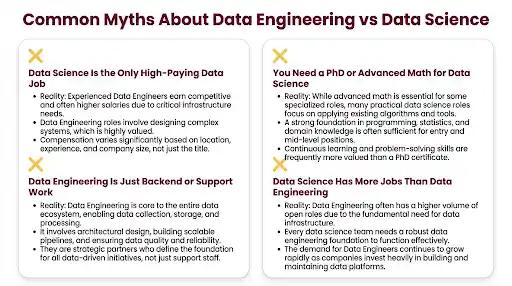
Myth 1: “Data Science Is the Only High-Paying Data Job”
Reality: Data engineers often earn equal or higher salaries, especially at mid-to-senior levels.
- In India, experienced data engineers frequently move into data architect or platform roles, which command premium pay.
- Many companies struggle more to hire strong data engineers than data scientists because infrastructure skills are harder to find.
Example:A data scientist cannot build models if pipelines break-but a data engineer ensures data flows 24/7.
Myth 2: “Data Engineering Is Just Backend or Support Work”
Reality: Data engineering is core to AI, ML, and analytics success.
- 80% of AI project time goes into data collection, cleaning, and pipeline management.
- Without scalable data systems, models never reach production.
Example:Netflix-style recommendations fail if ingestion pipelines lag or data quality drops.
Myth 3: “You Need a PhD or Advanced Math for Data Science”
Reality: Most industry data science roles focus on applied problem-solving, not academic research.
- Business understanding + Python + statistics often matter more than complex theory.
- Many successful data scientists come from engineering or analytics backgrounds.
Myth 4: “Data Science Has More Jobs Than Data Engineering”
Reality: Job postings often show higher volume for data engineering because every data team needs infrastructure before insights.
Bottom line:
- Data engineering = stability, scale, long-term demand
- Data science = insights, impact, competitive entry
Understanding these myths helps you choose a role based on reality, not buzzwords.
Conclusion
Choosing between data engineering vs data science is not about following hype it’s about understanding how companies actually use data and where long-term opportunities lie in India’s job market. Both roles are essential, but they solve very different problems and reward different strengths.
Data engineering focuses on building scalable, reliable data systems that power analytics, AI, and business reporting. As Indian companies continue to adopt cloud platforms, real-time analytics, and AI-driven products, the demand for strong data foundations will only grow. This is why data engineering is expected to create more jobs, greater stability, and consistent career growth in India by 2030.
Data science, on the other hand, delivers high-impact insights and predictive intelligence. It offers visibility and influence, but roles are fewer in number and more competitive especially at the entry level. Success in data science increasingly depends on depth in statistics, business understanding, and the ability to deploy models into production, not just build them.