






Table of Contents
- 1.
- 2.
- 3.
- 3.1
- 4.
- 5.
- 6.
- 7.
- 8.
- 9.
- 10.
- 10.1
- 11.
You're 22. Some of your friends already seem to have their careers figured out. Others are pursuing higher studies, switching fields, or landing their first jobs. Meanwhile, you might be sitting there wondering if you’re already behind or if you chose the wrong path. If this sounds familiar, you’re not alone-many people at 22 feel uncertain about where their career is heading.
The reality is that the job market has changed dramatically over the last decade. Traditional career paths are no longer the only option, and new opportunities are emerging in fields driven by technology and data. One of the fastest-growing areas today is the data career space, where professionals analyze information to help companies make smarter decisions.
The good news is that you don’t need to have everything figured out right now. What matters most is identifying fields that offer real growth opportunities and learning the skills needed to enter them. In this article, we’ll explore how a data career can provide a clear starting point for beginners and how you can begin building the skills that open doors to future opportunities.
Why So Many 22-Year-Olds Feel Lost About Their Career
Reaching the age of 22 often comes with a mix of excitement and uncertainty. Many people have just finished college or are about to enter the job market, and the pressure to make the “right” career choice can feel overwhelming. With so many options available today, it’s common for young professionals to feel unsure about which direction to take.
One of the main reasons for this confusion is the gap between education and real-world skills. Many academic programs focus on theoretical knowledge, but they may not always explain how those skills translate into actual career opportunities. As a result, graduates often find themselves asking questions like: What job should I pursue? What skills are actually in demand?
Another factor is the rapidly changing job market. New industries and roles are emerging faster than ever, especially in technology-driven fields. Careers related to data, artificial intelligence, and analytics are expanding quickly, but many students are not fully aware of these opportunities while they are studying.
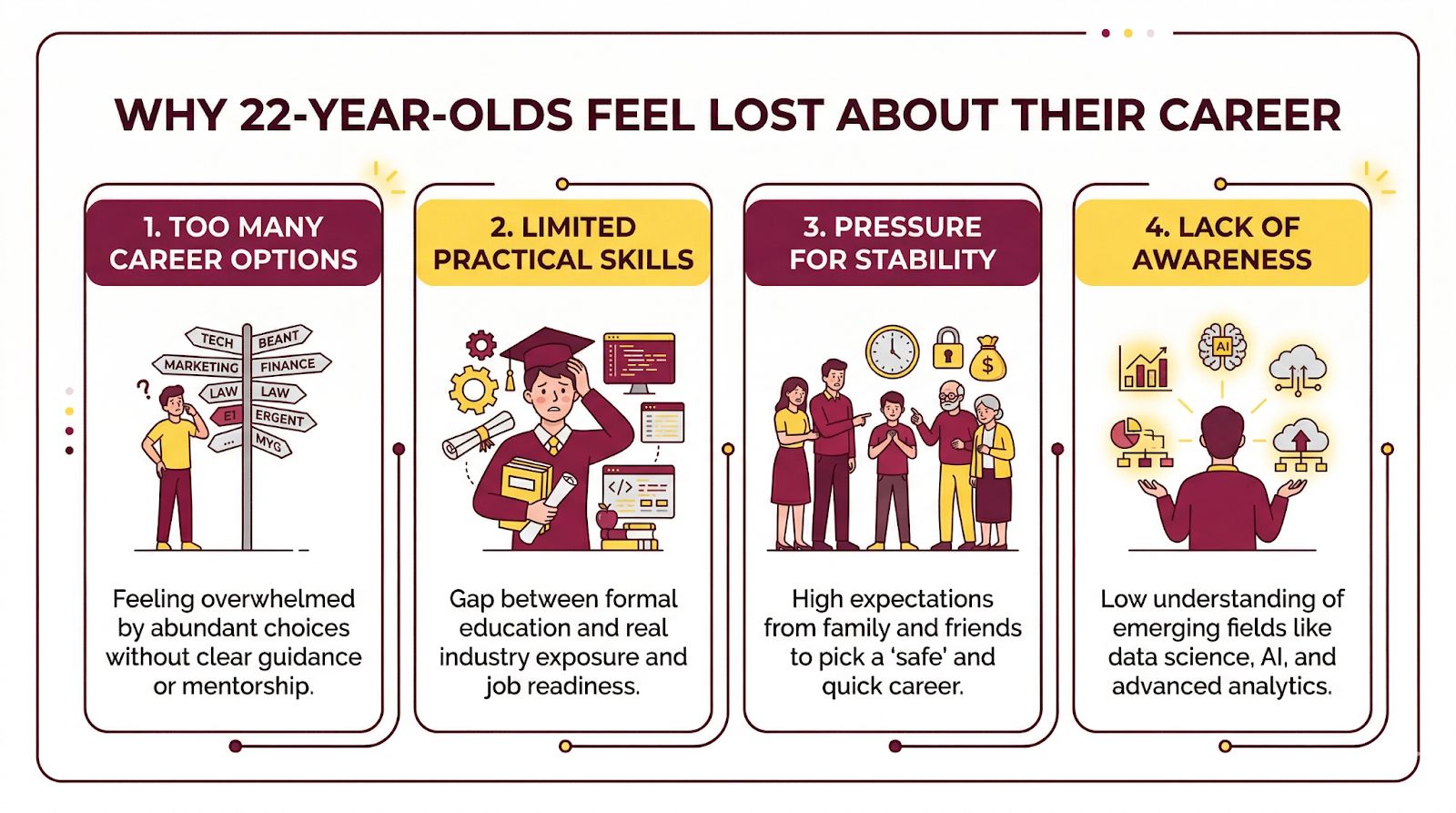
Some common reasons why people feel lost about their careers at 22 include:
- Too many career options without clear guidance
- Limited exposure to practical industry skills during education
- Pressure from peers and family to choose a stable career quickly
- Lack of awareness about emerging fields like data and analytics
The important thing to remember is that career uncertainty at this stage is completely normal. What matters most is exploring fields that offer strong growth potential and building skills that can open doors to future opportunities.
Why Data Careers Are Growing Faster Than Most Fields
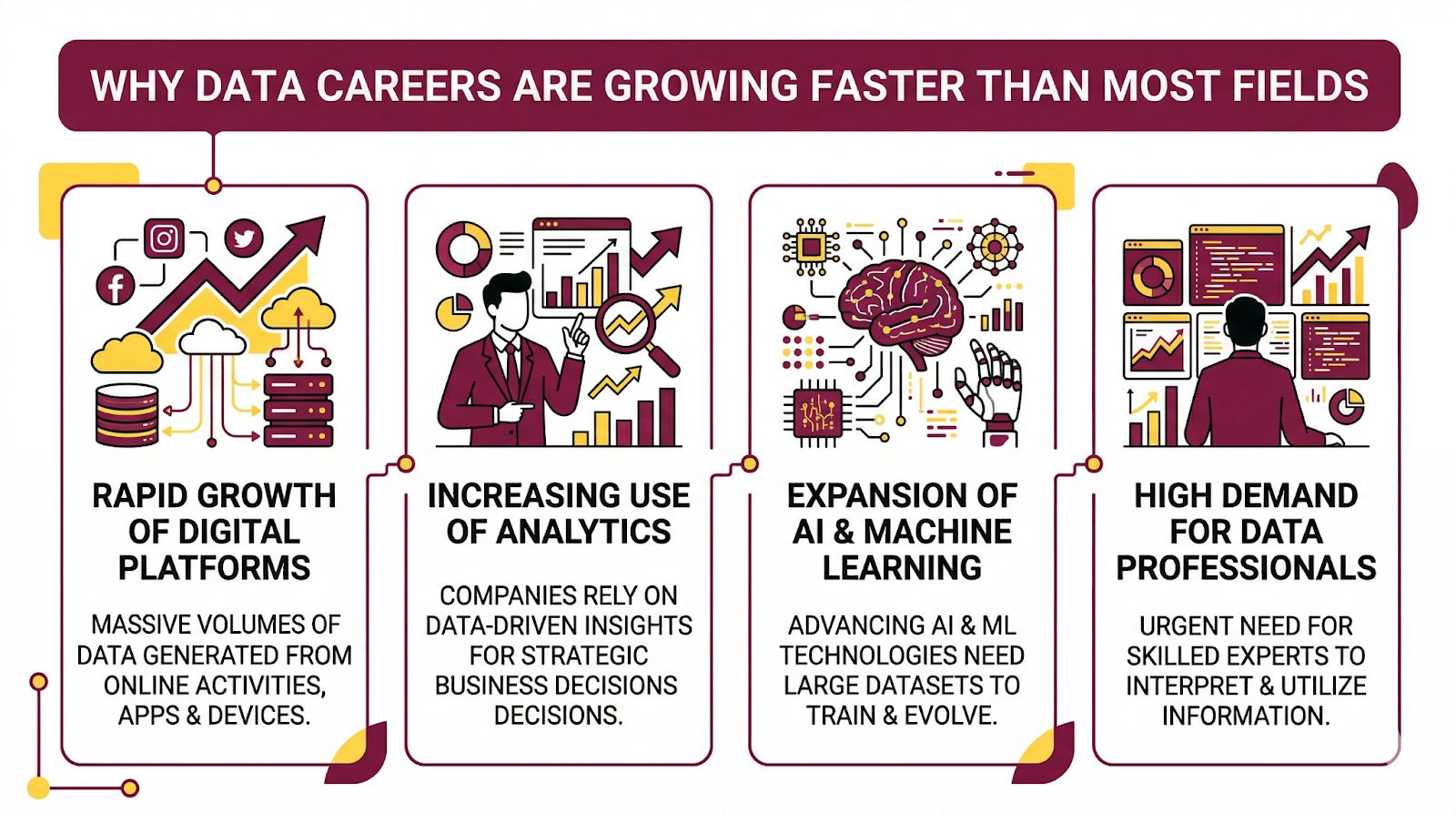
Over the past decade, the demand for professionals working with data has increased dramatically. Organizations across industries-from healthcare and finance to e-commerce and technology-are relying heavily on data to guide their decisions. Because of this shift, careers related to analytics, artificial intelligence, and machine learning have become some of the fastest-growing opportunities for young professionals.
A data career typically involves analyzing information, identifying patterns, and helping companies make smarter decisions. Businesses collect huge amounts of data every day-from customer behavior to sales performance-and they need skilled professionals who can turn that data into meaningful insights.
This growing demand has created several entry-level roles that are suitable for beginners. Many companies now hire data analysts, business intelligence analysts, and junior data scientists who can help interpret data and build simple analytical models.
Some key reasons why data careers are expanding quickly include:
- Rapid growth of digital platforms generating large volumes of data
- Increasing use of analytics in business decision-making
- Expansion of AI and machine learning technologies
- High demand for professionals who can interpret complex data
Because of these factors, many experts consider data science and analytics among the most promising career paths for the future. Learners who want to understand the long-term potential of this field can explore insights about a data science career to see how opportunities in the data industry continue to grow globally.
Understanding the Data Career Path
Once you start exploring the data field, one thing becomes clear: a data career is not limited to just one job title. Instead, it includes several roles that focus on different aspects of working with data. Understanding these roles can help beginners decide which direction aligns best with their interests and strengths.
One of the most common entry points into the field is the data analyst role. Data analysts work with datasets to identify patterns, generate reports, and support business decisions. Their work often involves cleaning data, analyzing trends, and presenting insights through dashboards or visualizations.
Another career path is data science, which involves building predictive models and using machine learning techniques to forecast outcomes. Data scientists typically work with larger datasets and develop algorithms that help organizations automate decision-making processes.
There are also roles such as business intelligence analysts, who focus on creating dashboards and reporting systems, and machine learning engineers, who build AI-driven systems that learn from data.
Entry-Level Roles in Data
For beginners, several roles provide a good starting point in the data field:
- Data Analyst – analyzing datasets and creating reports
- Business Intelligence Analyst – building dashboards and visualizations
- Junior Data Scientist – working with predictive models and datasets
- Data Operations Specialist – managing and organizing data systems
Beginners exploring these roles can also read expert career advice that explains how many professionals start their journey in the data industry and gradually grow into more advanced positions.
Skills You Need to Start a Data Career
Starting a data career might seem complicated at first, but the reality is that most beginners only need to focus on a few core skills in the beginning. Instead of trying to learn everything at once, successful learners usually build their skills step by step-starting with data analysis fundamentals and gradually moving toward more advanced tools and techniques.
One of the most important skills in the data field is data analysis. This involves understanding datasets, identifying trends, and extracting insights that can help businesses make better decisions. Learning how to clean and organize data is often the first step in this process.
Another important skill is basic programming, especially using Python. Python allows analysts to automate data analysis tasks and work efficiently with large datasets. Along with programming, understanding data visualization tools helps professionals present insights clearly through charts, dashboards, and reports.
some key skills beginners should focus on when starting their journey.
| Skill Area | What You Learn |
|---|---|
| Data Analysis | Understanding and interpreting datasets |
| Programming | Python basics for data tasks |
| Data Visualization | Creating dashboards and charts |
| Statistics | Identifying patterns and trend |
As the demand for data professionals continues to grow, developing these skills can open doors to many opportunities. Learners who want to explore the future of this field can read more about the data science career India and how data-related roles are expanding in the job market.
What a Beginner Data Career Roadmap Looks Like
Once you understand the basic skills required, the next step is to follow a clear learning path. Many beginners who want to build a data career feel overwhelmed because there are so many tools and concepts available online. The key is to focus on a structured roadmap that gradually builds your knowledge and practical skills.
Most successful learners start with data analysis fundamentals, such as understanding datasets, basic statistics, and simple data visualization. These skills help build a strong foundation before moving to more advanced topics. After that, learners typically begin working with programming tools like Python and SQL to analyze larger datasets and automate analysis tasks.
Another important step in the roadmap is project-based learning. Working on small analytics projects allows beginners to apply what they have learned and develop confidence. These projects can include analyzing sales data, creating dashboards, or identifying patterns in business datasets.
Beginners who want a deeper understanding of the field can explore this data science guide, which explains how data careers evolve and what skills professionals typically develop over time.
For learners ready to begin building practical skills, exploring programs such as an analytics certification course can provide structured training and hands-on experience with real analytics tools.
Simple Roadmap From Confused Graduate to Data Professional
Feeling uncertain about your career at 22 is normal, but following a structured plan can help you move from confusion to clarity. A data career often begins with learning the fundamentals and gradually progressing toward more specialized skills. Instead of trying to master everything at once, focusing on small, consistent steps can make the learning process much easier.
In the early stages, the goal is to understand how data works and how analysts interpret it. This includes learning basic statistics, exploring datasets, and practicing simple data visualization techniques. Once these foundational skills are in place, learners can start working with tools such as Python or SQL to perform deeper analysis.
As learners gain confidence, they can begin building projects that demonstrate their skills. Real-world projects help create a portfolio that showcases practical experience, which is valuable when applying for entry-level roles in analytics or data science.
A simple progression that many beginners follow when building their data career.
| Stage | Focus |
|---|---|
| Beginner | Learn analytics basics and tools |
| Intermediate | Work on data projects and datasets |
| Advanced | Explore machine learning and AI |
| Professional | Apply for entry-level data roles |
Following a structured roadmap helps transform uncertainty into a clear learning journey, making it easier for beginners to step into the growing world of data careers.
Final Thoughts
Feeling uncertain about your career at 22 is completely normal. Many successful professionals didn’t have a clear direction at the beginning of their journey. What matters most is choosing a field with strong growth potential and starting to build practical skills step by step. For many beginners today, a data career offers exactly that opportunity.
The demand for data professionals continues to grow as companies rely more on analytics and technology to make decisions. By learning foundational skills such as data analysis, visualization, and programming, beginners can gradually move toward more advanced roles in analytics or data science.
Key takeaways to remember:
- Career confusion at 22 is common and temporary
- Data-related careers are growing rapidly across industries
- Learning practical data skills can open new opportunities
- Following a structured learning path helps build confidence
Instead of worrying about finding the perfect career immediately, focus on building skills that are valuable in today’s job market. Taking the first step toward learning data skills can help you gain clarity and move closer to a rewarding professional path.
Start Building Your Data Career Today
If you’re ready to explore opportunities in the data field, the first step is gaining practical skills and industry exposure.
Explore available data courses that help beginners learn analytics tools, work on real projects, and start building a strong foundation for a future in data.