






Table of Contents
- 1.
- 2.
- 2.1
- 3.
- 3.1
- 3.2
- 3.3
- 4.
- 4.1
- 4.2
- 4.3
- 4.4
- 5.
- 5.1
- 5.2
- 6.
- 6.1
- 6.2
- 6.3
- 6.4
- 7.
- 7.1
- 7.2
- 7.3
- 8.
- 8.1
- 8.2
- 8.3
- 9.
- 9.1
- 9.2
- 9.3
- 10.
- 10.1
- 10.2
- 10.3
- 10.4
- 11.
Introduction
India’s rapidly digitising economy is producing data at an unprecedented scale but insights remain scarce. Businesses today are data-rich but insight-poor, and that gap has created massive demand for data professionals.
Over the past five years, data analytics jobs in India have grown by more than 52%, with the country contributing over 17% of global analytics job postings. At the same time, data science roles have surged by 60%+ since 2019, with more than 84,000 active openings across industries like fintech, healthcare, e-commerce, logistics, and AI-driven startups (The Times of India).
Yet, despite this explosive growth, students and freshers remain confused.
- Is data science better than data analytics?
- Which role pays more in reality?
- What skills do companies actually expect?
- Which path is safer for a fresher in 2026?
The confusion between data analytics (understanding past data) and data science (predicting future outcomes using ML and AI) often leads to poor career choices, mismatched jobs, and stalled growth.
This blog cuts through the noise by clearly comparing roles, skills, salaries, learning curves, and career stability so you can choose the right data science vs data analytics career path in India for 2026 and beyond.
Why the Data Career Confusion Is Worse Than Ever in 2026
In 2026, the confusion between Data Science and Data Analytics is no longer harmless it is actively impacting careers, hiring decisions, and training investments across India.
Despite both fields booming, many freshers struggle to clearly differentiate them. Even employers often blur the lines, making job searches frustrating and career planning risky.
What’s Fueling the Confusion?
🔹 Overlapping Skill Sets
Most job descriptions mention SQL, Python, Excel, and data visualization tools skills common to both roles. As a result, beginners often can’t tell whether they’re preparing for analysis-focused roles or model-driven data science positions.
🔹 Ambiguous Job Titles
Titles like “Data science vs data analytics”, “Analytics Engineer”, or “Data Specialist” are increasingly common. Many companies hire for analytics but expect machine learning, predictive modeling, or AI logic, which are core data science responsibilities.
🔹 Salary Ranges Add to the Fog
In India:
- Data Analysts typically earn between ₹2–14 LPA
- Data Scientists range from ₹4–28.9 LPA
However, these ranges often overlap due to company size, project complexity, and skill expectations making it harder for freshers to judge which role truly offers better growth.
🔹 Real-World Impact on Freshers
A common scenario:
A fresher joins as a Data Analyst expecting dashboards and reports but ends up building ML models without proper training. The result? Stress, burnout, and skill mismatch within the first year.
Understanding the Core Difference: Data Science vs Data Analytics
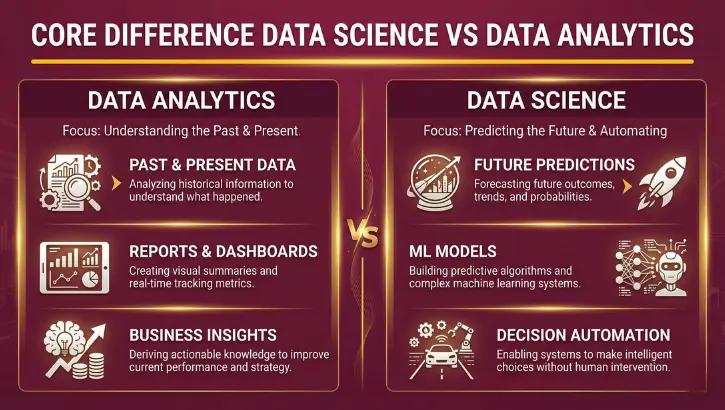
At the heart of the confusion lies a simple truth: data analytics looks at the past and present, while data science focuses on the future. Both work with data, but their goals, depth, and impact are very different.
Think of it this way:
- A Data Analyst asks: “What happened and why?”
A Data Scientist asks: “What will happen next and how can we influence it?”
In India, this distinction matters more than ever. According to industry hiring reports, over 65% of analytics roles are still descriptive and diagnostic, while data science roles increasingly demand predictive and prescriptive skills such as machine learning and AI-driven decisioning.
What Data Analytics Really Does
- Cleans and explores historical data
- Builds dashboards and reports
- Tracks KPIs for business teams
- Tools: Excel, SQL, Power BI, Tableau, basic Python
Example:
An e-commerce analyst identifies that sales dropped 18% last quarter and pinpoints pricing and delivery delays as the cause.
What Data Science Actually Does
- Builds predictive and ML models
- Works with unstructured & big data
- Automates decision-making systems
- Tools: Python, R, ML algorithms, cloud, deep learning
Example:
A data scientist predicts which customers are likely to churn next month and recommends personalized offers to retain them.
Side-by-Side Comparison
| Aspect | Data Analytics | Data Science | ||
|---|---|---|---|---|
| Focus | Core Output | Math Level | Business Role | Entry Barrier |
| Past & present insights | Reports, dashboards | Basic–intermediate | Decision support | Lower |
| Future predictions | Models, algorithms | Advanced (stats, ML) | Decision automation | Higher |
Data analytics helps businesses understand reality. Data science helps them change it. Choosing the right path depends on how deep you want to go into math, modeling, and AI-driven impact.
👉 Explore the program and decide with confidence.
Choosing the right data role matters more than chasing trends.
WHY TAP’s AI-Powered Data Analytics certification offers structured learning, live projects, and mentor support to help you grow with confidence.
👉 Visit site : WHY TAP
Data Science vs Data Analytics – Side-by-Side Comparison (2026)
In 2026, both Data Science vs Data Analytics are thriving career paths but they serve different business goals and require distinct skills. With India projected to generate over 11 million data jobs by 2026, understanding this distinction can help you make smarter career decisions [ Datamites ]
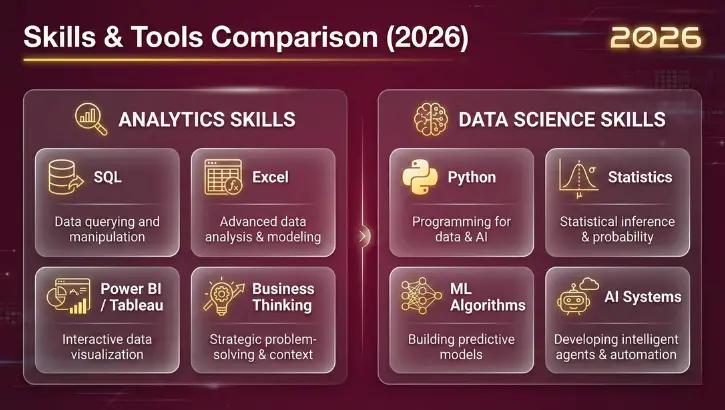
Here’s a clear side-by-side look at how they compare:
🔹 Focus & Purpose
- Data Analytics: Answers “What happened?” and “Why?” by analyzing historical data.
- Data Science: Predicts “What will happen next?” and “How can we act?” with models and machine learning.
🔹 Skills & Tools
- Analytics: SQL, Excel, Tableau/Power BI, trend reporting.
- Science: Python/R, ML, AI frameworks (TensorFlow, Spark), predictive modeling.
🔹 Typical Output
- Analytics: Dashboards, business reports, KPIs.
- Science: Predictive models, AI algorithms, automation frameworks.
📌 Salary & Career Trajectory (India)
- Data Analysts: Freshers ~₹4–7 LPA; mid-career ~₹9–12 LPA.
- Data Scientists: Freshers ~₹8–14 LPA; experienced roles ₹15–25 LPA+.
✔ Choose Analytics if you love business insights and visualization.
✔ Choose Data Science if you enjoy coding, statistics, and building future-focused models.
Both paths are in high demand but your interests and strengths should guide your choice.
Career Scope in India (2026 Job Market Reality)
In 2026, India’s data job market continues to expand rapidly, driven by digitization, AI adoption, and data-driven decision-making across industries. Experts project that the country will generate over 11 million opportunities in data science and analytics by year-end, highlighting persistent demand for both analysts and scientists.
Yet the job landscape is nuanced while volume hiring in STEM fields has become more selective, companies increasingly value industry-ready skills over just degrees.
Here’s what India’s 2026 employment reality looks like:
Key Growth Drivers
- ☑ Digital Transformation: Almost every sector from finance and e-commerce to healthcare and manufacturing uses data insights to drive strategy.
- ☑ AI & Analytics Adoption: With AI tools reshaping businesses, data roles now span AI engineering to automation and predictive analytics.
☑ Global Capability Centres (GCCs): Mid-market GCCs are adding tens of thousands of jobs, especially in tech and analytics hubs like Bengaluru and Hyderabad.
📊 2026 Career Snapshot (India)
| Role | Role Expected Entry Salary (₹/yr) | Mid-Career (₹/yr) | Growth Drivers |
|---|---|---|---|
| Data Analyst | Data Scientist | Machine Learning Engineer | Data Engineer |
| ₹4–8 LPA | ₹6–14 LPA | ₹8–18 LPA | ₹6–12 LPA |
| ₹10–15 LPA | ₹15–25 LPA+ | ₹18–30 LPA | ₹12–22 LPA |
| Dashboards, business insights | Predictive models, ML tech | AI systems and automation | Data pipelines & big data |
Real-World Example: Fresh graduates from top engineering colleges now receive placement offers in data science and analytics with packages soaring as high as ₹50–74 LPA, as companies hunt for skilled talent who can make immediate impact.
✔ India’s data career scope remains strong but success in 2026 depends on practical skills, hands-on projects, and the ability to work with advanced tools.
✔ Entry-level roles can lead to high-impact careers in AI, automation, and strategic decision systems within 3–5 years.
Salary Comparison in India (Freshers to 5 Years)
In India’s evolving data landscape, salaries in data science and data analytics reflect not just demand but how skills, role depth, and experience shape your earnings trajectory. In 2026, both fields pay well, but data science generally offers a steeper growth path due to technical depth and demand for predictive/ML skills.
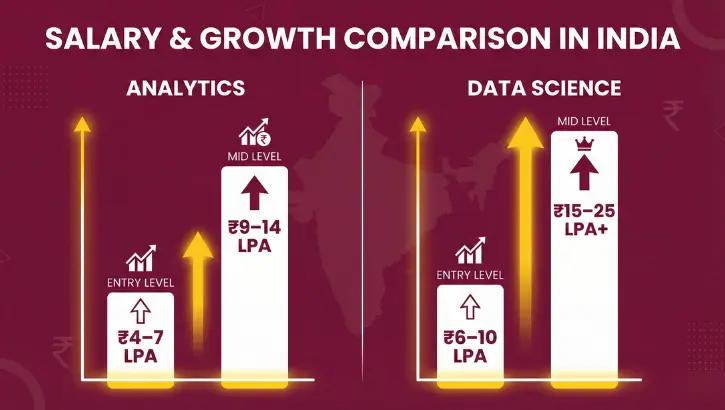
Here’s how the numbers stack up:
📊 Experience-Wise Salary Expectations (Annual ₹)
Freshers (0–1 Year)
- Data Analyst: ~₹4 L – ₹7 L 💼
- Data Scientist: ~₹6 L – ₹10 L 🚀
👉 Freshers with internships or specialised projects often get offers closer to the high end.
Early Career (1–3 Years)
- Data Analyst: ~₹7 L – ₹10 L
- Data Scientist: ~₹10 L – ₹16 L
👉 Here, hands-on experience with real datasets, SQL mastery, and automation skills make a visible impact.
Mid-Level (3–5 Years)
- Data Analyst: ~₹9 L – ₹14 L
- Data Scientist: ~₹15 L – ₹25 L+
👉 At this stage, leadership, ML deployment, and cloud analytics skills boost negotiating power.
Real-World Example:
A candidate with 3 years of Python + machine learning experience may see data scientist offers ~₹18–22 LPA, while a peer focusing on visualization and business reporting might see ₹10–12 LPA as a senior analyst.
Education Background – Who Should Choose What?
One of the biggest myths in India’s data job market is that only engineers can succeed in data roles. In reality, your education background influences which data path suits you best, not whether you belong in the field at all.
Let’s break it down simply.
🎓 Who Should Choose Data Analytics?
Data analytics is ideal if you enjoy business thinking, patterns, and storytelling with numbers.
Best-fit backgrounds:
- B.Com, BBA, MBA (Finance/Marketing/Operations)
- BA / BSc (Economics, Statistics, Maths)
- Non-engineering graduates transitioning into tech
- Professionals from sales, operations, finance, HR
Why it works:
- Lower math intensity
- Focus on insights, dashboards, and decisions
- Faster entry into the job market
Example:
An MBA graduate uses SQL and Power BI to explain why customer retention dropped in South India and suggests pricing changes.
🎓 Who Should Choose Data Science?
Data science suits those comfortable with coding, math, and complex problem-solving.
Best-fit backgrounds:
- B.Tech / BE (CSE, IT, ECE, EEE)
- BSc / MSc (Maths, Statistics, Computer Science)
- Engineers moving into AI/ML roles
Example:
A computer science graduate builds a churn prediction model using Python and deploys it for real-time decision-making.
📊 Side-by-Side Fit Guide
| Background | Better Fit | Reason | ||
|---|---|---|---|---|
| Commerce / MBA | Arts / Economics | Engineering | Statistics / Maths | Career switcher |
| Data Analytics | Data Analytics | Data Science | Data Science | Data Analytics |
| Business + insights focus | Interpretation & trends | Coding + math strength | Model-driven roles | Faster transition |
Learning Curve & Difficulty Level
When choosing between data analytics and data science, the learning curve is often the deciding factor. Both paths are achievable but the time, effort, and depth required are very different.
Let’s be honest and practical.
📈 Data Analytics: Moderate & Beginner-Friendly
Data analytics has a smoother learning curve, especially for freshers and career switchers.
What makes it easier:
- Starts with Excel, SQL, and basic statistics
- Focuses on understanding business questions
- Less math-heavy compared to data science
- Visible progress within 3–6 months of focused learning
Typical challenges:
- Writing efficient SQL queries
- Translating numbers into business insights
- Designing clean dashboards
Example:
A commerce graduate can learn Excel → SQL → Power BI and start analysing sales or marketing data without deep coding.
📉 Data Science: Steep & Technically Demanding
Data science has a much steeper learning curve because it combines multiple complex domains.
What makes it harder:
- Advanced statistics and probability
- Strong Python programming
- Machine learning algorithms & model evaluation
- Longer learning timeline (8–15 months realistically)
Common struggles:
- Understanding ML concepts (bias-variance, overfitting)
- Debugging models that don’t perform well
- Handling large, messy datasets
Example:
An engineering graduate may spend weeks tuning a churn prediction model before it performs reliably in production.
⚖️ Difficulty Comparison at a Glance
- Data Analytics
- Difficulty: ⭐⭐–⭐⭐⭐
- Best for: Beginners, non-tech backgrounds
- Focus: Insights, reporting, decision support
- Difficulty: ⭐⭐–⭐⭐⭐
- Data Science
- Difficulty: ⭐⭐⭐⭐–⭐⭐⭐⭐⭐
- Best for: Tech-inclined, math-comfortable learners
- Focus: Prediction, automation, AI systems
- Difficulty: ⭐⭐⭐⭐–⭐⭐⭐⭐⭐
Choose data analytics if you want faster results and business-facing work.
Choose data science if you enjoy deep problem-solving and don’t mind a longer, tougher learning journey.
The right choice isn’t about difficulty it’s about what kind of challenge excites you.
Data Science vs Data Analytics – Which Is Better for Freshers in India?
For freshers in India, the real question isn’t which field is better it’s which field is more realistic for you in 2026’s competitive job market. Both data science and data analytics offer strong careers, but they demand very different starting points.
Let’s break it down honestly.
✅ Why Data Analytics Is Often Better for Freshers
Data analytics is usually the safer and faster entry point for most fresh graduates.
Reasons:
- Lower technical barrier (Excel, SQL, Power BI first)
- Faster job readiness (3–6 months with practice)
- More entry-level openings in service firms, startups, and SMEs
- Strong alignment with business roles
Best suited if you:
- Come from commerce, arts, MBA, or non-tech backgrounds
- Enjoy dashboards, reports, and business insights
- Want a quicker first job
Example
A B.Com graduate learns SQL + Power BI and lands a junior data analyst role supporting sales and marketing teams.
🚀 When Data Science Makes Sense for Freshers
Data science can be rewarding but only if you’re technically prepared.
It works if you:
- Have a strong math/statistics foundation
- Are comfortable with Python and coding
- Can invest 8–12 months in serious learning
- Build strong ML-based projects
Risks:
- Fewer true entry-level roles
- Higher rejection rates without hands-on experience
Example:
A B.Tech (CSE) fresher builds ML projects, participates in Kaggle, and cracks a junior data scientist role at a product company.
⚖️ Quick Fresher Decision Guide
- ✔ Want faster placement → Data Analytics
- ✔ Strong in math & coding → Data Science
- ✔ Career switcher / non-tech → Data Analytics
- ✔ Long-term AI/ML ambition → Data Science
For most freshers in India, data analytics is the smarter starting point. You can always transition into data science later but starting too deep too early often leads to frustration, not success.
How Recruiters in India Actually Hire
In 2026, hiring for data roles in India is far more practical than aspirational. Recruiters are not impressed by long skill lists or fancy course certificates they focus on proof of work, role clarity, and business thinking.
Here’s what really happens behind the scenes.
🔍 What Recruiters Look at First
Before interviews even start, recruiters scan for:
- Clear role alignment (analyst or scientist not both)
- Relevant tools for the role (SQL + BI for analysts, Python + ML for scientists)
- Hands-on projects with real problems
- Internships, freelance work, or live datasets
A resume with “Excel, SQL, Python, ML, AI” but no context is often rejected.
📂 Projects Matter More Than Certificates
Recruiters ask:
- What problem did you solve?
- Why did you choose this approach?
- What business decision came from your analysis/model?
Example:
A fresher who explains how a Power BI dashboard reduced sales drop-offs is preferred over someone who only completed an online ML course.
Interview Reality (What They Test)
- Data Analytics Interviews
- SQL queries
- Case-based questions
- Insight explanation (why, not just what)
- SQL queries
- Data Science Interviews
- Python logic
- Statistics & ML concepts
- Model reasoning and trade-offs
- Python logic
🏢 Company Type Changes Expectations
- Service companies: Tool-based, reporting-focused
- Startups: Problem-solving + ownership
- Product companies: Depth, scalability, strong fundamentals
Example:
A startup may hire an analyst who can work independently over a candidate with higher theoretical knowledge but low execution skills.
Recruiters in India hire for job readiness, not job titles.
If you can show impact, explain decisions, and match the role you get hired.
Conclusion: Choosing the Right Data Career Path
The debate around data science vs data analytics isn’t about which role is “better” it’s about which role fits you in India’s 2026 job market. Data analytics offers a faster, more practical entry into data-driven careers, especially for freshers and non-tech backgrounds. Data science, on the other hand, rewards those willing to invest time in math, coding, and complex problem-solving with higher long-term impact and growth.
Throughout this blog, one truth stands out: titles don’t get you hired skills, clarity, and real-world application do. Recruiters look for professionals who can solve business problems, explain their thinking, and deliver measurable outcomes, whether through dashboards or predictive models.