

Table of Contents
- 1.
- 2.
- 2.1
- 2.2
- 2.3
- 3.
- 3.1
- 4.
- 4.1
- 4.2
- 4.3
- 4.4
- 5.
- 5.1
- 5.2
- 5.3
- 5.4
- 6.
- 6.1
- 7.
Introduction
Breaking into data science without a programming background sounds impossible to many learners, yet in 2026 it has become a realistic career path. Professionals from commerce, arts, science, and management increasingly search how to become data scientists without coding because the role itself has evolved. Data teams today spend less time writing algorithms and more time interpreting results and guiding decisions [KISSFLOW]. According to industry research, over 70% of new enterprise applications now rely on low-code or no-code platforms, reducing the need for deep programming skills. At the same time, global workforce studies show that organizations struggle more with data interpretation and business decision-making than with writing complex code.
This creates a clear problem for career switchers. You understand business and data concepts, but coding fear blocks progress. The solution is not avoiding data science. It is entering through tools, roles, and workflows that prioritize analysis, visualization, and insight generation.
Organizations Now Value Professionals Who Can
Organizations no longer hire data scientists only for technical execution. In 2026, they value professionals who can turn data into decisions, not just code into models. This shift explains why many learners explore how to become data scientists without coding.
Companies value professionals who can:
Understand business problems before touching data
They start with the “why,” not the dataset. This reduces wasted analysis and improves relevance.
Interpret dashboards and AI-generated insights
Tools generate charts automatically. Humans explain what changed, why it matters, and what to do next.
Communicate insights clearly to non-technical teams
Sales, marketing, and leadership teams need clarity, not jargon.
Example:
An AI tool highlights a drop in customer retention. One person reports the metric. Another explains the cause, identifies risky segments, and suggests experiments. The second professional delivers business value, even without heavy coding.
The Honest Truth Can You Become a Data Scientist Without Coding?
The honest truth is yes, you can become a data scientist without coding, but only if you aim for the right kind of role. In 2026, data science no longer revolves only around writing scripts. It revolves around understanding data, explaining insights, and guiding decisions. [ WORLD ECONOMIC FORUM ]
AI tools now handle much of the execution work. AutoML platforms build models. BI tools generate dashboards. According to global workforce reports, analytical thinking and problem-solving rank among the top skills employers value, while routine technical tasks continue to decline. This shift opens doors for non-coders.
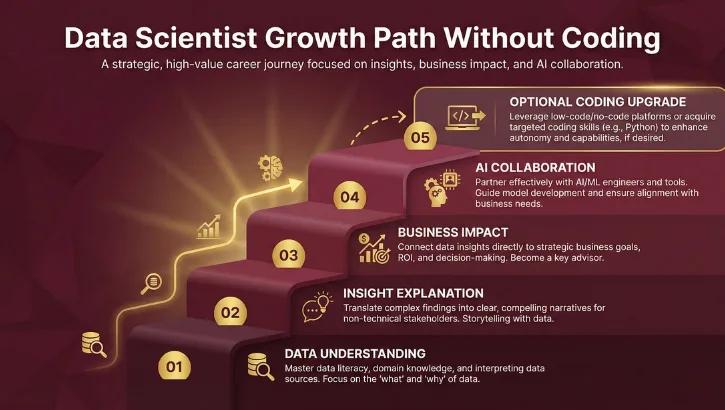
Here’s what that really means in practice.
- You do not need advanced Python or R for every data role
- You must understand statistics, logic, and data behavior
- You must question AI outputs instead of accepting them blindly
- You must explain insights in simple business language
Example:
An AI tool predicts a drop in sales. One person shares the chart. Another explains why sales fell, identifies the affected segment, and suggests what to test next. The second person adds value, even without heavy coding.
But there is a limit.
- You cannot skip data fundamentals
- You cannot avoid responsibility for decisions
- You cannot rely only on tools
So, can you become data scientist without coding?
Yes, if you focus on thinking, interpretation, and communication.
No, if you expect shortcuts without effort.
In 2026, data science rewards people who turn data into decisions, not just code into models.
Let’s be very clear using a simple comparison.
| Aspet | Coding-Heavy Data Scientist | Low-Code Data Scientist | |
|---|---|---|---|
| Corework | Tools | Focus | Value |
| Writing algorithms | Python, R, custom scripts | Model optimization | Technical depth |
| Interpreting insights | AutoML, BI tools, AI platforms | Business decisions | Insight and clarity |
The truth is simple.
You can enter data science without heavy coding, but you cannot enter without thinking, clarity, and real-world problem-solving.
What “Without Coding” Really Means
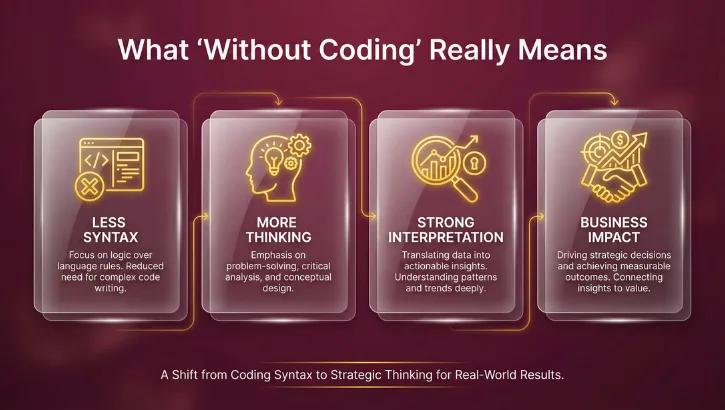
“Without coding” does not mean zero technical knowledge or avoiding data science fundamentals. It means shifting focus from writing complex algorithms to using tools, logic, and business thinking to solve data problems. In 2026, many data science roles rely on low-code and AI-assisted platforms where interpretation matters more than syntax.[ business analyst certification]
The difference becomes clear when you compare role expectations.
| Area | Coding-Heavy Data Scientist | Low-Code / Non-Coding Data Scientist | ||||
|---|---|---|---|---|---|---|
| Model Building | Coding | Data Preparation | Focus | Daily Work | Output | Key Strength |
| Manual algorithm design and tuning | Advanced Python or R scripting | Custom code pipelines | Algorithm performance | Writing and debugging code | Technical model accuracy | Technical depth |
| Tool-assisted models and AutoML | Minimal scripting or no-code tools | Drag-and-drop or AI-assisted workflows | Decisions and interpretation | Analyzing trends and insights | Business-ready recommendations | Business and data thinking |
In practice, companies use platforms that automate much of the technical work. These tools clean data, build models, and generate visual outputs. The real value comes from asking the right questions, interpreting results, and explaining what actions to take next.
Example:
An AI tool predicts customer churn. A low-code data scientist explains why churn increased, which segment is at risk, and what intervention to test. That insight drives decisions, even without writing complex code.
So, “without coding” means less time on syntax and more time on judgment, communication, and impact.
Skills You Can Keep Minimal (At First)
If you’re entering data science without a coding background, here’s the good news: you don’t need to master everything on Day 1. In 2026, many successful data professionals start to learn and expand skills as their role grows.
The key is knowing what can wait.
1. Advanced Programming
You don’t need to write complex algorithms or build models from scratch early on.
At the beginning, focus only on:
- Reading basic Python code
- Understanding what a script does
- Making small edits when needed
Example:
You don’t need to code a churn model but you should understand why it predicts churn and which features influence it.
2. Deep Machine Learning Theory
You can delay advanced topics like:
- Neural network architecture
- Hyperparameter tuning
- Optimization math
Instead, learn:
- When to use classification vs regression
- How to compare model performance
- What accuracy, precision, and recall mean
3. Big Data & Infrastructure Skills
You don’t need to start with:
- Hadoop, Spark internals
- Cloud architecture design
- Data pipelines
Those matter later once you specialize.
4. Complex Math (Initially)
You can keep these light at first:
- Linear algebra proofs
- Advanced calculus
But don’t skip understanding why a model works.
What You Should Prioritize Instead
- Business problems
- Data interpretation
- Clear communication
Example:
A fresher who explains a simple model clearly beats someone who builds a complex one but can’t explain it.
Start simple. Build confidence. Add complexity when your role demands it.
When You SHOULD Learn Coding Eventually
Starting in data science without coding is possible but staying there forever limits your growth. In 2026, the smartest professionals treat coding as a career accelerator, not a barrier.
The real question isn’t if you should learn coding. It’s when.
Signs It’s Time to Learn Coding
You should start learning coding when you notice these signals:
- You rely heavily on tools but can’t customize outcomes
- You struggle to debug model behavior
- You depend on others for simple data changes
- Your role starts demanding ownership, not just interpretation
What Coding You Actually Need
You don’t need to become a software engineer.
Start with:
- Python basics (data handling, simple logic)
- Reading and modifying scripts, not writing everything from scratch
- Using libraries, not building algorithms
Example:
Instead of building a model manually, you tweak Python code to test different features or validate assumptions.
How Coding Expands Your Career
Coding unlocks:
- Greater control over models
- Better collaboration with engineers
- Eligibility for senior data roles
- Higher salary ceilings
Without coding, your role may plateau at interpretation or decision support.
Want to become data scientist without coding the confusing way?
WHY TAP’s PG Certification in AI-Powered Data Science focuses on data thinking, AI tools, and real-world problem solving without unnecessary coding overload.
How AI Has Reduced Coding but Increased Responsibility
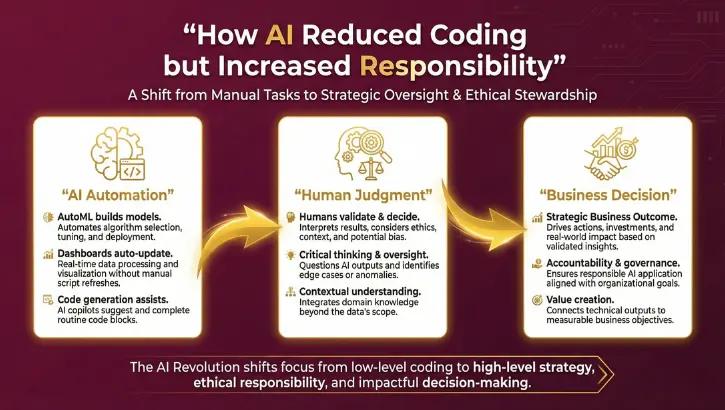
AI has changed how data science work happens in 2026. It has reduced the need for heavy coding, but it has increased responsibility on the human side. Tools now handle execution faster than ever. People handle judgment, accuracy, and outcomes.
Modern AI platforms automate tasks that once required weeks of coding.
- Data cleaning happens with one click
- Models get built using AutoML
- Dashboards update in real time
- Predictions generate automatically
This shift removes the coding barrier, but it does not remove accountability.
According to global workforce studies, companies now expect professionals to interpret AI outputs, not blindly trust them. When AI makes mistakes, humans answer for the impact. That responsibility sits with the data professional, not the tool.
Here’s what actually changes in practice.
- Less time spent writing code
- More time spent validating results
- More ownership of decisions driven by data
- Higher expectations from business leaders
Example:
An AI tool predicts customer churn and suggests increasing discounts. A responsible data professional questions the logic, checks margins, reviews customer segments, and recommends a controlled experiment instead of acting blindly. That judgment protects revenue.
AI also raises ethical responsibility
- Detect bias in data
- Avoid misleading insights
- Explain limitations clearly
- Take accountability for decisions
In earlier roles, mistakes hid inside code. In AI-driven roles, mistakes affect strategy, revenue, and people directly.
This is why AI reduces coding effort but raises the bar for thinking. Employers now look for professionals who can:
- Use AI efficiently
- Question outputs logically
- Explain decisions confidently
In 2026, tools execute.
Humans decide.
WHY TAP’s AI-powered data science program trains you on problem framing, model interpretation, and real business use cases, not just syntax.
👉 Build data science skills that go beyond coding. WHY TAP
Conclusion: Becoming a Data Scientist Without Coding Is About Sequence, Not Shortcuts
Becoming a data scientist without a coding background in 2026 is possible but only if you understand what “no coding” really means. It doesn’t mean avoiding logic, responsibility, or technical thinking. It means learning in the right order: data understanding first, decision-making next, and coding only when it adds value.
The key isn’t skipping skills. It’s building them strategically. Choose clarity over hype, execution over shortcuts, and learning paths that match how the industry actually works in 2026.