



Table of Contents
- 1.
- 2.
- 2.1
- 2.2
- 2.3
- 3.
- 3.1
- 3.2
- 3.3
- 3.4
- 4.
- 4.1
- 4.2
- 4.3
- 4.4
- 4.5
- 5.
- 5.1
- 5.2
- 5.3
- 6.
- 6.1
- 6.2
- 6.3
- 6.4
- 6.5
- 6.6
- 6.7
- 7.
Introduction
In 2026, having a degree alone is no longer enough to get shortlisted. Recruiters want proof of skills, not just claims on a resume. Despite India’s large number of college graduates, only about half (51.25%) are actually employable, per the Economic Survey 2023-24. The India Skills Report 2024 confirms this, showing just 52.3% of fresh graduates as job-ready. Unfortunately, for many, earning a degree does not translate into being employable. For example, ImaginXP’s research shows that 33% of India’s educated youth are unemployed due to lacking the practical, future-focused skills that jobs require
This is where student portfolios become a game changer.
A strong portfolio shows what you can actually do how you solve problems, use tools, and deliver outcomes. Whether you’re from tech, design, marketing, or a non-technical background, the right portfolio can instantly separate you from thousands of applicants. In this guide on student portfolio ideas 2026, you’ll learn what to build, how to structure it, and how to create a portfolio that recruiters notice and shortlist fast.
Why Portfolios Matter More Than Resumes in 2026
In 2026, resumes tell recruiters what you claim. Portfolios show what you can prove. That difference decides shortlisting.
Hiring teams now screen hundreds of applications for a single role. They spend 6–8 seconds on a resume, but they spend minutes on a strong portfolio because it answers one key question: Can this student actually do the work?
Multiple hiring surveys across India show that over 62% of employers struggle to assess real skills from resumes alone. Marks, degrees, and generic internships no longer predict job performance. Portfolios close that gap.
Here’s why portfolios win in 2026
- They show real skills, not keywords
Anyone can write “Python” or “Digital Marketing” on a resume. A portfolio shows dashboards you built, campaigns you ran, or code you shipped. - They reduce hiring risk for recruiters
When recruiters see outcomes, they feel confident shortlisting you. - They work across roles and industries
Tech, design, business, analytics even non-tech roles now expect proof of work.
Resume vs Portfolio: A simple example
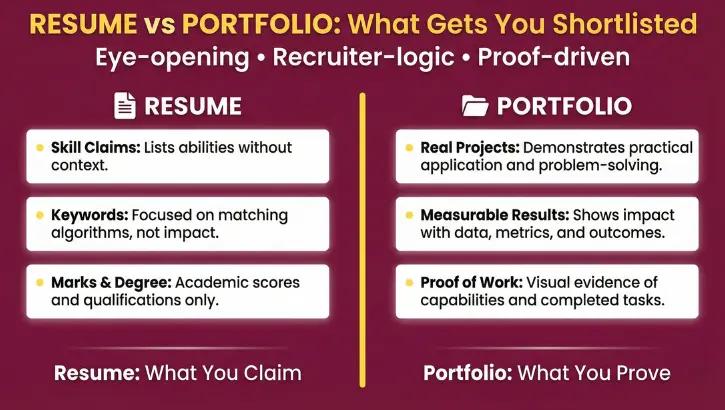
Resume line:
“Worked on social media marketing for a brand”
Portfolio proof:
- Audited 3 Instagram pages
- Improved engagement rate from 2.1% to 4.8% in 45 days
- Created content calendar + analytics dashboard
Which one gets shortlisted faster? The answer is obvious.
Portfolios also beat AI screening
Modern ATS and AI tools scan for:
- Project relevance
- Skill application
- Measurable results
Portfolios check all three boxes.
In 2026, resumes open doors. Portfolios get you inside the room.
What Recruiters Look for in a High-Impact Portfolio
Recruiters don’t read portfolios line by line. They scan for signals. In the first 30–60 seconds, they decide whether to shortlist you or move on. A high-impact portfolio makes that decision easy.
Top things recruiters actively look for
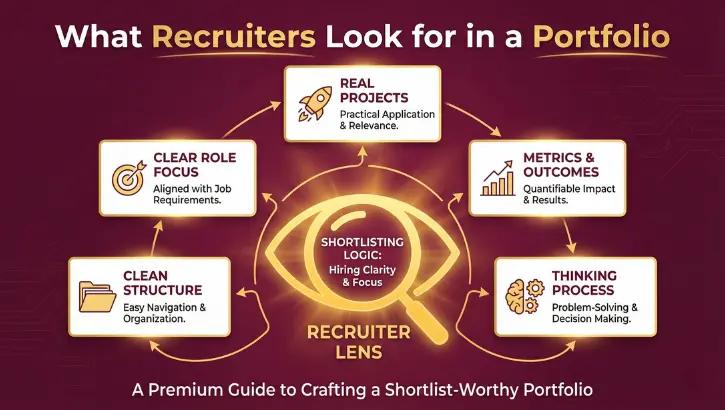
- Clear role focus
Your portfolio should answer one question fast: What role are you applying for?
A data analyst portfolio that also shows graphic design and content writing confuses recruiters. - Real, practical projects
Recruiters want proof, not theory. Academic projects work only when you explain how you applied skills, not just what the syllabus asked. - Measurable outcomes
Numbers build instant credibility.- “Built a website” sounds average
- “Improved page load speed by 38%” stands out
- Your thinking process
Recruiters care about how you solve problems, not just final results. - Clean structure & readability
If recruiters struggle to find your best work, they won’t try harder.
What weak vs strong portfolios look like
| Weak Portfolio | High-Impact Portfolio | |||
|---|---|---|---|---|
| Long personal bio | Tool list only | Generic college projects | No results | Cluttered layout |
| One-line value statement | Tools + where you used them | Problem-driven case studies | Clear metrics & outcomes | Simple, scannable sections |
Example recruiters love
Instead of writing:
“Created a sales dashboard”
Write this:
- Analyzed 50,000+ sales records
- Built a Power BI dashboard for trend analysis
- Identified 3 loss areas, helping improve monthly revenue visibility
Quick recruiter checklist
- Can I understand the candidate’s role in 10 seconds?
- Do the projects show real-world application?
- Are results clearly mentioned?
If your portfolio answers yes to all three, you’re already ahead of most students in 2026.
How to Build a High-Impact Portfolio That Gets You Shortlisted in 2026
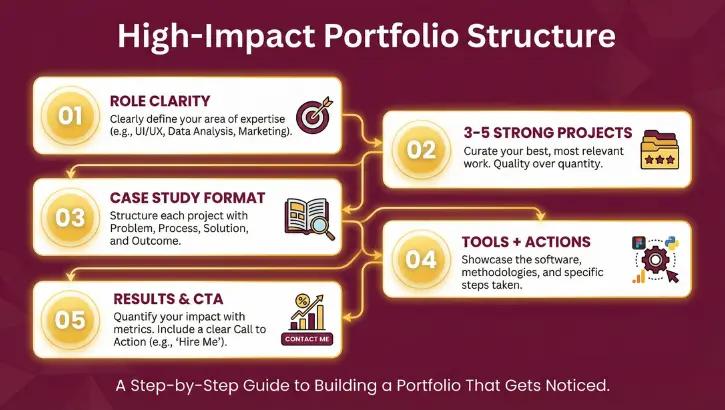
A high-impact portfolio doesn’t need 20 projects or fancy design. It needs clarity, proof, and relevance. Follow this simple, recruiter-tested approach.
Step 1: Pick one clear role
Decide what you want to get hired for now.
A scattered portfolio hurts shortlisting.
- Data Analyst
- UI/UX Designer
- Digital Marketer
- Software Developer
Example: If you target a data analyst role, remove unrelated design or content work.
Step 2: Choose 3–5 strong projects
Quality beats quantity every time.
Each project should show:
- A real problem
- Your approach
- Tools you used
- Results or learnings
Example:
Instead of “College Mini Project,” write:
- Analyzed customer churn using Python
- Built visual insights using Power BI
- Identified key churn drivers
Step 3: Use a simple case study format
Recruiters skim. Make it easy.
- Problem: What needed fixing?
- Action: What did you do?
- Tools: What tech or methods did you use?
- Result: What changed?
Step 4: Write for humans and AI
Use role-specific keywords naturally, but stay clear and honest.
- Replace buzzwords with actions
- Use numbers where possible
Step 5: End with a clear call-to-action
Don’t make recruiters guess.
- “View GitHub”
- “Download case study”
- “Contact for internship/full-time role”
In 2026, recruiters shortlist portfolios that feel focused, practical, and easy to trust. Build yours to answer one question clearly: Why should we hire you?
Tools and Platforms to Build a Professional Portfolio
You don’t need to be a developer to build a professional portfolio in 2026. The right tool depends on your role, your skill level, and how fast you want to go live. Recruiters care more about clarity and proof than fancy animations.
Best portfolio platforms students use in 2026
- Notion
Perfect for beginners and non-tech roles. You can publish fast, update easily, and structure case studies cleanly. - Webflow
Best for designers and marketers who want control over layout without coding. - GitHub
Essential for tech roles. Recruiters check repositories, commits, and documentation. - Behance
Ideal for UI/UX, graphic design, and motion design portfolios. - Carrd
Great for simple, single-page portfolios and quick launches.
Which platform should you choose?
| Career Goal | Best Platform | Why It Works | ||
|---|---|---|---|---|
| Data / Analytics | Software Developer | UI/UX Designer | Marketing / Business | Beginners |
| Notion + GitHub | GitHub + Webflow | Behance / Webflow | Webflow / Notion | Carrd / Notion |
| Case studies + code proof | Projects + clean presentation | Visual storytelling | Strategy + results | Easy, fast, no tech skills |
Example setup recruiters love
- Main portfolio on Notion or Webflow
- Project links to GitHub or Behance
- One clean link shared on resumes and emails
In 2026, the best tool is the one you actually use and update. Pick simple, publish fast, and improve as you grow.
Step-by-Step Checklist to Build Your Student Portfolio in 7 Days
You don’t need months to build a solid portfolio. You need focus and a clear plan. Follow this 7-day checklist and go live within a week.
Day 1: Define your goal
Decide what role you want to get shortlisted for.
- Data Analyst
- UI/UX Designer
- Digital Marketer
- Software Developer
Example: If you want a data analyst role, remove unrelated projects and tools.
Day 2: Select your best projects
Pick 3–5 strong projects that match your target role.
- College projects with real application
- Personal or self-initiated projects
- Internship or freelance work
Example: Replace “Mini Project” with “Customer Churn Analysis using Python.”
Day 3: Write project case studies
Use a simple, skimmable format:
- Problem: What needed solving?
- Action: What did you do?
- Tools: Python, Power BI, Figma, etc.
- Result: Numbers, insights, or outcomes
Day 4: Choose a platform & design
Pick one platform and keep it clean.
- Notion for speed
- Webflow for design control
- GitHub or Behance for role-specific proof
Avoid overdesign. Recruiters prefer clarity.
Day 5: Add keywords & polish content
Optimize for both recruiters and AI tools.
- Use role-specific keywords naturally
- Replace buzzwords with actions
- Keep sentences short and clear
Day 6: Get feedback & fix gaps
Ask for feedback from:
- Mentors
- Seniors
- Working professionals
Improve clarity, not length.
Day 7: Publish & share
- Add the portfolio link to your resume
- Share it in applications and emails
- Post one project summary online
In 7 days, you won’t have a perfect portfolio but you’ll have a live, shortlist-ready one, which already puts you ahead of most students in 2026.
Your skills deserve visibility. If your portfolio showcases UI/UX projects, make sure you can confidently explain them in interviews. This WHY TAP guide shows how interviewers assess design thinking, tools, and case studies.
Conclusion: Your Portfolio Is Your Real Resume in 2026
In 2026, recruiters don’t hire potential they hire proof. A well-built student portfolio shows what you can do, how you think, and the value you bring from day one. While resumes list skills, portfolios demonstrate them through real projects, clear outcomes, and practical thinking.
The right portfolio doesn’t need to be perfect or complicated. It needs focus, relevance, and honest work. When you choose the right projects, explain your approach clearly, and present your results with confidence, you make shortlisting easy for recruiters. You also stand out in a crowded job market where most students still rely only on degrees and certificates.
Whether you’re from tech, design, marketing, or a non-technical background, your portfolio can become your strongest career asset. Start small, build fast, and improve consistently. The students who get hired in 2026 won’t be the ones with the longest resumes they’ll be the ones with portfolios that prove they’re ready to work.