




Table of Contents
- 1.
- 2.
- 2.1
- 2.2
- 3.
- 3.1
- 3.2
- 4.
- 4.1
- 4.2
- 5.
- 5.1
- 6.
- 7.
- 7.1
- 7.2
- 7.3
- 7.4
- 8.
- 9.
- 9.1
- 9.2
- 9.3
- 10.
- 10.1
- 10.2
- 11.
- 11.1
- 11.2
- 12.
- 12.1
- 13.
- 13.1
- 13.2
- 14.
- 14.1
- 14.2
- 14.3
- 14.4
- 14.5
- 15.
- 16.
Introduction
In 2026, data continues to be one of the most valuable assets for businesses but Generative AI (GenAI) has become the force that turns raw data into strategic insights. India is emerging as a global leader in GenAI adoption, with over 90% of professionals actively using GenAI in Data Science tools at work, significantly ahead of global use patterns (ddnews).
At the same time, enterprises across India are rapidly shifting GenAI from pilot projects to impact-driven production use cases, integrating large language models (LLMs) like GPT-powered systems into analytics workflows. What Is GenAI and Why It Matters in Data Science
Generative AI refers to artificial intelligence systems that can create not just analyze content and insight. Unlike traditional analytics tools that only summarize or visualize data, GenAI models like LLMs (e.g., GPT, Bard, Claude) generate code, reports, predictions, and explanations based on natural language prompts.
In data science, GenAI functions as a career amplifier helping professionals:
- Generate SQL or Python code from plain English prompts
- Produce business insights from raw datasets
- Create narratives, summaries, and interactive reports
- Automate routine tasks such as data cleaning and exploratory analysis
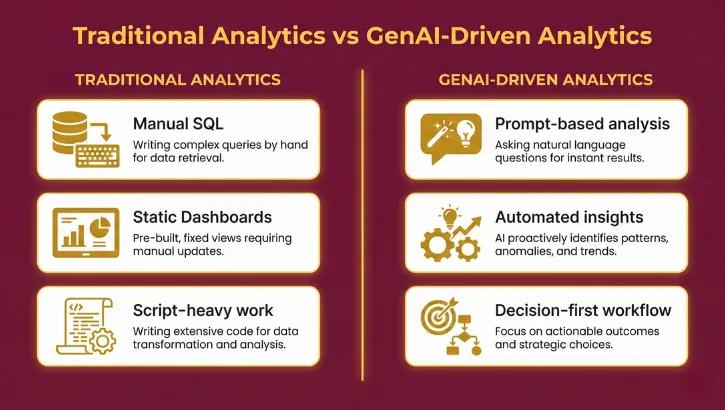
This capability fundamentally changes how analytics work gets done. Rather than spending hours writing manual scripts or debugging pipelines, professionals now co-pilot with GenAI to accelerate outcomes and focus on strategic thinking.
This blog explores how GenAI in Data Science, particularly LLMs, is radically reshaping data science and analytics careers in India. We’ll explore new roles, necessary skills, and why GenAI literacy is now essential for every data professional entering the workforce.
How GenAI Is Reshaping Analytics and Data Science Roles
GenAI is not just a new tool it’s changing expectations around job roles and skills in India’s data ecosystem.
1. New Job Titles and Career Horizons
Traditional roles like Data Analyst or Data Scientist are evolving into hybrid, GenAI-aware specializations. Some emerging roles include:
- GenAI Prompt Specialist
- AI Workflow Designer
- Agentic AI Developer
- LLM Operations Engineer
- AI Product Owner
Industry conversations increasingly highlight these new AI-related roles, which did not exist a few years ago underscoring how careers in analytics are broadening and deepening.
2. GenAI Across the Data Lifecycle
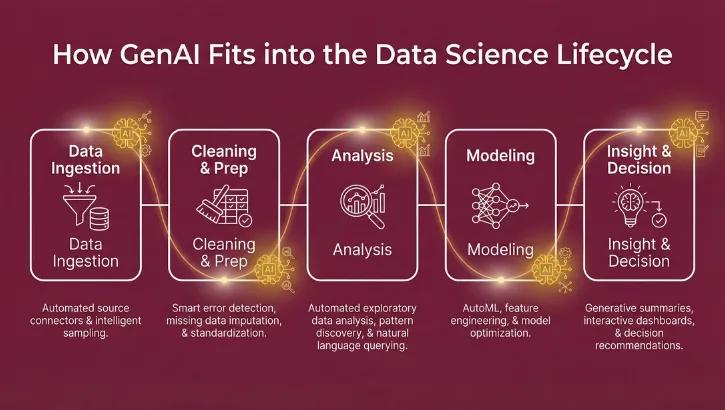
Rather than replacing data professionals, GenAI augments each stage of the analytics lifecycle:
Data Preparation & Cleaning
AI tools automatically detect anomalies and standardize datasets reducing time intensive manual effort.
Exploratory Analysis
GenAI can interpret trends in plain language and suggest next steps, enabling juniors to generate insights without expert-level coding.
Model Building & Evaluation
With prompt based development, baseline machine learning models and LLM-powered inference systems become accessible with minimal manual engineering.
Narrative & Reporting
Automated generation of executive ready insights, summaries, and recommendations translates technical output into business value.
This deep impact across functions means that teams expect professionals to think at a higher level not just execute scripts but design AI-driven solutions.
Why GenAI Skills Are Becoming Non-Negotiable in India
1. Rapid GenAI Adoption Across Indian Workplaces
India is not only using GenAI widely it’s leading adoption compared to many other countries. In surveys of GenAI engagement, Indian professionals and students show some of the highest utilisation rates globally.
With GenAI in Data Science becoming business critical, companies are demanding professionals who can harness these tools purposefully not just operate in legacy analytics environments.
2. Employers Prioritise Data + AI Skills
A sizable majority of Indian IT firms now prioritise skills in data science and AI as strategic differentiators. 72% of managers report they are currently upskilling, and 51% are reskilling. Compare that to 34% of non-managers who are upskilling and 27% who are reskilling [edx]
This trend directly impacts freshers: recruiters now look beyond basic SQL and Excel skills they want candidates with AI understanding, prompt engineering ability, and a mindset for machine cognition.
Skill Shifts: From Traditional Analytics to GenAI-Enhanced Data Science
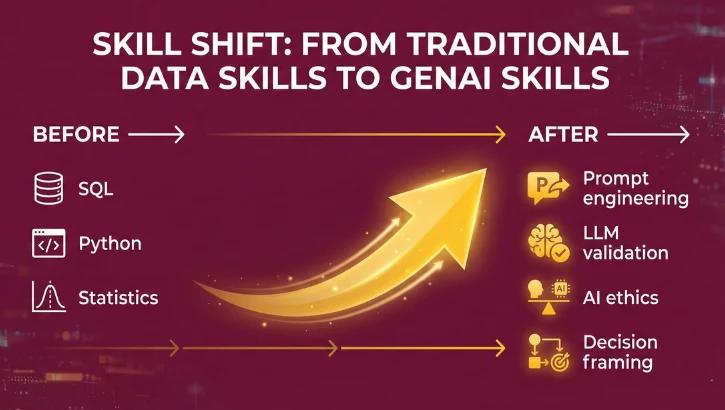
The rise of GenAI is reshaping skill expectations for entry-level and mid-level professionals:
Core Traditional Skills Still Matter
- Statistics & Probability
- SQL & Database Fundamentals
- Python or R for Data Work
But GenAI Sets New Expectations
- Prompt engineering for data tasks
- Understanding LLM workflows and tools
- Ability to curate and validate AI outputs
- AI ethics, fairness, and governance awareness
Where once the focus was purely technical, today’s landscape demands strategic interpretation and ethical AI thinking skills that GenAI amplifies rather than replaces.
The Future of Work: GenAI and Indian Employment Trends
By 2030, AI adoption could transform 38 million jobs, driving a 2.61% productivity boost to the Indian economy through gains in the organized sector and a potential for additional 2.82% with the adoption of Gen AI by the unorganized sector.[EY]
According to industry forecasts, AI adoption across sectors could reshape the workforce and add significant economic value.
This transformation offers a double opportunity for Indian professionals:
✔ Freshers who adopt GenAI early can outpace peers in employability.
✔ Seasoned professionals can pivot into strategic, high-impact AI-driven roles.
What does it mean for data science graduates? The future is multidisciplinary requiring both domain knowledge and fluency in AI-augmented tools.
What This Means for Freshers in India (Career Action Plan)
If you are starting your analytics or data science career in 2026:
Focus On:
📌 GenAI Tools & LLM Workflows – Learn prompt design, RAG techniques, and agent-based workflows.
📌 Business Problem Framing – Translate data questions into analytical action.
📌 Hands-on Projects With AI – Build portfolios that combine code with GenAI insights.
📌 AI Governance & Ethics – Understand responsible AI usage.
Avoid:
❌ Memorising tools without understanding business context
❌ Learning legacy analytics in isolation
❌ Assuming GenAI replaces human decision-making
The key advantage today belongs to professionals who can blend critical thinking with AI execution, especially in high-growth Indian tech hubs and GCCs.
How LLMs Are Changing Day-to-Day Work for Data Professionals in India
While GenAI in Data Science sounds futuristic, its real impact is visible in the daily workflows of Indian data teams. Large Language Models are not abstract research tools anymore they are actively embedded in analytics operations across startups, MNCs, GCCs, and SaaS companies.
From Manual Execution to AI-Assisted Thinking
Earlier, a data professional’s day was dominated by:
- Writing repetitive SQL queries
- Debugging Python scripts
- Manually creating dashboards
- Preparing reports for non-technical stakeholders
With LLMs, this has changed fundamentally.
Today, data professionals:
- Describe the problem in natural language
- Use LLMs to generate first-level code or analysis
- Validate, refine, and contextualise results
- Focus more on decision-making than execution
- This shift has reduced low-value work and increased the importance of critical thinking, business understanding, and validation skills.
GenAI in Indian Industries: Real Use Cases Driving Hiring
One reason GenAI skills are in high demand is that Indian industries are already deploying LLMs at scale.
1. BFSI & FinTech
- Automated credit risk analysis
- Fraud pattern explanation using conversational AI
- Customer behaviour summarisation for loan and insurance products
2. Healthcare & Pharma
- Clinical data summarisation
- Predictive diagnostics support
- AI-generated insights from patient and operational data
3. E-Commerce & Retail
- Demand forecasting with GenAI-assisted models
- Dynamic pricing analysis
- Customer sentiment analysis at scale
4. IT Services & GCCs
- Automated analytics reporting for global client
- AI-powered decision dashboards
- Faster PoCs and analytics delivery using LLM copilots
Because these use cases are already live, recruiters now expect candidates to understand how GenAI fits into real business problems, not just theory.
The Rise of “AI-Augmented” Roles in Analytics
One of the biggest career shifts in 2026 is that pure roles are disappearing.
Instead of:
- Data Analyst
- Data Scientist
- Business Analyst
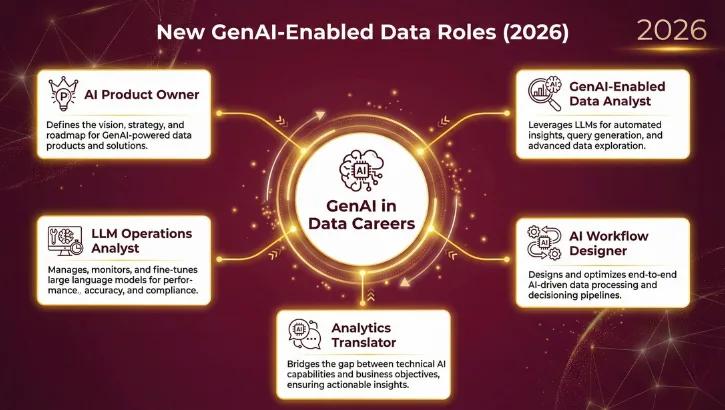
Companies now prefer AI-augmented hybrid roles, such as:
- GenAI-Enabled Data Analyst – Focuses on insights, storytelling, and business decisions using AI tools
- Applied Data Scientist – Builds ML models with GenAI-assisted feature engineering and evaluation
- Analytics Translator – Bridges business teams and AI systems
- AI Operations Analyst – Monitors, validates, and governs AI-generated insights
This means careers are no longer about job titles alone but about how effectively you can work with AI systems.
Why GenAI Makes Freshers More Employable (If Used Right)
Contrary to popular fear, GenAI does not reduce fresher opportunities it changes what makes a fresher valuable.
Earlier Fresher Value
- Tool knowledge
- Syntax memorisation
- Manual execution ability
Fresher Value in 2026
- Problem framing
- Asking the right questions
- Interpreting AI outputs
- Applying insights to business context
A fresher who understands:
- What to ask an LLM
- How to validate AI-generated results
- How to explain insights clearly
…often outperforms someone with years of tool-centric experience but limited AI fluency.
This is why GenAI has become a career accelerator, not a threat.
Your data career depends less on the tools you learn and more on how and when you learn them.
WHY TAP helps you follow the right learning sequence for long-term growth in data and analytics.
👉 Learn smarter with WHY TAP: https://whytap.in/
The New Skill Gap: Knowing Tools vs Knowing Outcomes
One of the biggest mistakes students make is focusing only on tools.
What Many Learners Do Wrong
- Learn Python syntax but not problem-solving
- Build dashboards without understanding business KPIs
- Use GenAI blindly without validation
- Copy outputs without interpretation
What Recruiters Actually Want
- Ability to define the problem
- Understanding of metrics and impact
- Judgement to trust or reject AI outputs
- Clear communication of insights
GenAI exposes this gap very clearly.
Those who rely on AI without thinking struggle.
Those who think with AI move ahead rapidly.
GenAI + Ethics: A New Responsibility for Data Professionals
As GenAI becomes embedded in analytics, ethical responsibility increases.
Indian organisations are increasingly cautious about:
- Data privacy
- Bias in AI-generated insights
- Hallucinations from LLMs
- Over-reliance on automated decisions
Modern data professionals must understand:
- When GenAI should be used
- When human judgment is mandatory
- How to validate AI-driven insights
- How to explain AI decisions transparently
This has created demand for professionals who understand Responsible AI, not just performance metrics.
How Companies Evaluate GenAI Readiness in Interviews
In 2026, interviews are changing.
Instead of asking only:
- SQL joins
- Python coding challenges
- Statistics formulas
Recruiters now ask:
- “How would you use GenAI to analyse this dataset?”
- “How do you validate AI-generated insights?”
- “Where would you not use GenAI?”
- “How do you explain AI-driven insights to business teams?”
Candidates who can answer these questions confidently stand out immediately.
Career Progression in a GenAI-Driven Analytics World
GenAI also changes how fast careers grow.
Traditional Career Path
Data Analyst → Senior Analyst → Manager → Architect (8–10 years)
GenAI-Enabled Career Path
Data Analyst → AI-Augmented Analyst → Lead / Consultant → Strategy / Product Roles (4–6 years)
Because GenAI increases productivity, professionals who adapt early often:
- Handle larger responsibilities
- Work closer to decision-makers
- Transition into leadership and strategy roles faster
How to Future-Proof Your Data Career in India
To stay relevant in 2026 and beyond, data professionals should focus on:
1. Learn GenAI as a Thinking Tool, Not a Shortcut
Use AI to explore, not to blindly execute.
2. Build AI-Integrated Projects
Show how you used GenAI to:
- Analyse
- Predict
- Communicate insights
3. Strengthen Business Understanding
Data without context has no value.
4. Practice Validation & Critical Thinking
Always question AI outputs.
5. Stay Updated With Industry Use Cases
Indian enterprises evolve fast skills must keep pace.
Still unsure how GenAI fits into your data science career?
WHY TAP’s PG Certification in AI-Powered Data Science is designed to help learners:
- Understand where analytics ends and AI begins
- Work on real-world, GenAI-driven projects
- Build job-ready skills aligned with Indian recruiters
- Develop both technical and decision-making capability
This is not just about learning tools it’s about becoming a future-ready data professional.
Conclusion
The rise of GenAI and LLMs is not an AI buzzword it’s a career inflection point for data science in India. Instead of automating jobs away, generative AI is creating deeper, more strategic, and higher-value analytics roles.
For freshers entering the field, GenAI literacy is no longer optional it’s a core foundation for future ready analytics careers.
Master GenAI not just as a tool, but as a strategic amplifier for data insights, decision support, and business value creation.
🚀 The future of data science in India is AI-augmented, human-led, and opportunity-rich.